Physical Address
304 North Cardinal St.
Dorchester Center, MA 02124
Physical Address
304 North Cardinal St.
Dorchester Center, MA 02124

Somewhere between the six-week and ten-week vaccination visit, most Indian parents have the same jolt of surprise: a private hospital bill of ₹6,000–₹9,000 for a single sitting, for vaccines they’d assumed were largely free. It’s not a scam and it’s not overcharging in the way it feels in the moment — it’s the result of India running two genuinely different, parallel vaccination systems side by side, and almost nobody explains clearly, before the first visit, how the two connect.
On one side is the Universal Immunisation Programme (UIP) — a government-run schedule that provides the full set of essential, life-saving vaccines completely free at government hospitals and public health centres. On the other is the private hospital and pediatric clinic track, where the same core protection is available, plus painless combination shots and several additional vaccines, all at a real cost that adds up meaningfully across the first year.
Neither track is “the right one” for every family — but almost every parent benefits from understanding exactly what’s free, what isn’t, why the private price varies so wildly between clinics, and how to build a vaccination budget (or a genuinely useful hybrid approach) instead of being surprised bill after bill. That’s what this guide covers.
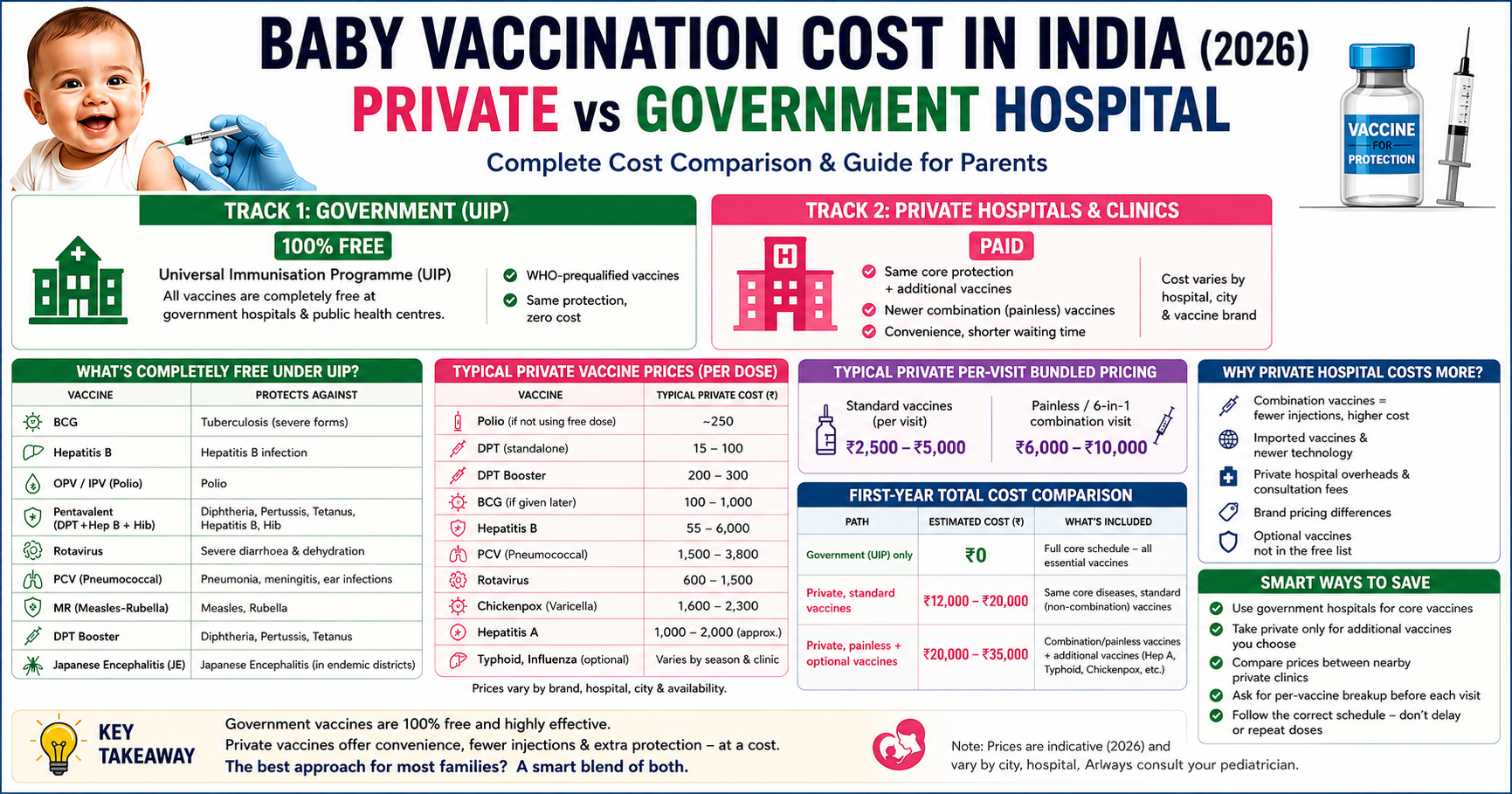
India’s baby vaccination cost structure in 2026 is best understood as a dual-track system:
Track 1 — Government (UIP): Provides the complete core immunisation schedule entirely free at government hospitals and primary health centres, covering the diseases responsible for the overwhelming majority of vaccine-preventable childhood illness and death.
Track 2 — Private hospitals and clinics: Offer the same core vaccines (often as newer combination formulations), plus a set of additional vaccines not currently part of the national free schedule, at a real, itemized cost — typically billed per visit, combining the vaccine price with a consultation or administration fee.
Most Indian families, in practice, use some blend of both — not because it’s confusing, but because it’s often the most practical choice: core protection through the free government schedule where convenient, and select additional vaccines through a private pediatrician for the ones the family decides are worth paying for.
Under the Universal Immunisation Programme, the Government of India provides a full set of vaccines at no cost, protecting against twelve vaccine-preventable diseases nationally, with a couple of additions depending on the state:
An important, often-missed point: these government vaccines are WHO-prequalified and protect against exactly the same diseases as their private-hospital equivalents. Paying more at a private clinic does not mean better core protection — it typically means a different delivery format (painless, combination, fewer injections per visit) or additional vaccines outside the free list, not stronger immunity against the diseases the free schedule already covers.
Private hospitals and pediatric clinics typically charge in one of two ways: itemized per-vaccine pricing, or a per-visit bundled price that combines the vaccine cost with a consultation/administration fee.
| Vaccine | Typical Private Cost |
|---|---|
| Polio (if not using free government dose) | Around ₹250 per dose |
| DPT (standalone) | ₹15 – ₹100 per dose |
| DPT Booster | ₹200 – ₹300 |
| BCG (if given later, outside birth window) | ₹100 – ₹1,000 |
| Hepatitis B | ₹55 – ₹6,000, depending on formulation and brand |
| PCV (Pneumococcal Conjugate Vaccine) | ₹1,500 – ₹3,800 per dose |
| Rotavirus | ₹600 – ₹1,500 per dose |
| Chickenpox (Varicella) | ₹1,600 – ₹2,300 |
| Hepatitis A | Priced separately, typically in a similar range to Hepatitis B combination formulations |
| Typhoid, Influenza (seasonal, optional) | Priced separately, seasonal and clinic-dependent |
Rather than itemizing every vaccine, many private clinics bundle the visit into a single fee:
This per-visit range is why parents sometimes report bills of ₹6,000–₹9,000 for a single sitting at 6 weeks — it’s not one expensive vaccine, it’s several combination vaccines and the visit fee bundled together.
Here’s how the numbers add up across the full first year of vaccinations:
| Path | Estimated First-Year Total | What’s Included |
|---|---|---|
| Government (UIP) only | ₹0 | Full core schedule — BCG, Hepatitis B, Polio, Pentavalent, Rotavirus, PCV (where available), MR, boosters |
| Private, standard vaccines | ₹12,000 – ₹20,000 | Same core diseases covered, standard (non-combination) formulations, standard number of injections per visit |
| Private, painless + optional vaccines | ₹20,000 – ₹35,000 | Combination/painless formulations (fewer injections per visit) plus additional vaccines like Hepatitis A, Chickenpox, and seasonal Influenza |
A crucial caveat: these totals will not exactly match a simple sum of the individual vaccine prices in the table above, because private clinics typically add a consultation or administration fee per visit, and often price visits as bundled packages rather than itemized line items. Treat the ranges above as realistic, real-world estimates — not an exact formula — and always ask your specific clinic for a written price list before your baby’s first visit.
Three factors explain almost all of the price variation you’ll see between private hospitals:
A standalone DPT shot is inexpensive; a 6-in-1 combination vaccine that covers DPT, Hepatitis B, Polio, and Hib in a single, gentler injection costs considerably more — but means fewer total injections and less discomfort per visit. This is a genuine convenience-and-comfort trade-off, not a difference in the strength of protection against the core diseases.
The same vaccine can be priced very differently depending on the brand used and whether the hospital is a large corporate chain, a mid-sized private hospital, or an independent pediatric clinic — corporate hospital chains in metro cities are typically at the higher end of every range above.
Vaccination costs in metro cities are consistently higher than in tier-2 or tier-3 cities, partly reflecting real cost-of-delivery differences and partly reflecting what the local market will pay. It’s genuinely worth asking two or three clinics in your area for a price list before committing to one for the full schedule.
While your pediatrician’s exact schedule may vary slightly, most Indian babies follow a broadly similar visit pattern in year one:
Knowing this pattern in advance is genuinely useful for budgeting: the 6-week, 10-week, and 14-week visits are typically the heaviest, since three to four vaccines commonly land in the same sitting — plan your private-hospital budget around these three visits specifically if that’s your chosen path.
This is the single most important myth to address directly: for the core vaccine-preventable diseases covered by the national programme, paying more at a private hospital does not buy stronger or more effective protection. Government (UIP) vaccines are WHO-prequalified and protect against the same diseases as their private equivalents.
What private, higher-cost options genuinely do offer:
These are real, legitimate reasons some families choose private vaccination — but they are convenience and access benefits, not superior core immunity. Framing the decision this way tends to relieve a lot of unnecessary guilt for families who use government centres, and unnecessary anxiety for families who can’t afford every optional private vaccine.
Rather than choosing one track exclusively, many Indian families build a deliberate hybrid approach:
This hybrid approach commonly brings a private-leaning family’s first-year vaccination cost down to roughly ₹8,000–₹15,000 — well below the full private-track estimate — while still adding the specific optional vaccines the family considers worthwhile.
A few ways families reduce their real out-of-pocket vaccination spend:
Yes — the complete core immunisation schedule (BCG, Hepatitis B, Polio, Pentavalent, Rotavirus, PCV, MR, and boosters) is provided completely free at government hospitals and public health centres under the Universal Immunisation Programme, regardless of family income.
Typically ₹12,000–₹20,000 for standard vaccines, or ₹20,000–₹35,000 if choosing painless combination shots plus optional vaccines like Chickenpox, Hepatitis A, and Influenza.
No — for the core diseases covered by the national programme, government vaccines are WHO-prequalified and provide the same protection as private equivalents. Private options mainly offer fewer injections per visit (combination formulations) and access to additional vaccines not yet in the free schedule, not stronger core immunity.
Yes, and many Indian families do exactly this — using the free government schedule for core vaccines and selectively paying for specific optional vaccines privately. Keep a single personal vaccination record to track both, since the two systems don’t automatically share data.
The 6-week, 10-week, and 14-week visits are typically the heaviest, since three to four vaccines commonly fall in the same sitting — worth budgeting for these three visits specifically if using a private clinic.
The real story behind India’s baby vaccination costs isn’t “government vaccines are worse” or “private vaccines are a rip-off” — it’s that two genuinely different, valid systems exist side by side, and most families benefit from understanding exactly what each one offers before their baby’s first visit. The core protection your baby needs is available completely free; everything above that is a real, legitimate set of convenience and access choices your family can make deliberately, rather than being surprised by, one bill at a time.
Planning your baby’s other first-year expenses too? Check out our Baby Budget Calculator to build a complete first-year cost picture, including vaccinations, alongside delivery, feeding, and gear costs.