Physical Address
304 North Cardinal St.
Dorchester Center, MA 02124
Physical Address
304 North Cardinal St.
Dorchester Center, MA 02124



It was 11:40 p.m. and the whiteboard in our spare room had thirty-one names on it, four of them crossed out twice.
My sister-in-law was seven months along, sitting cross-legged on the bed with a bowl of muri, and her mother-in-law was on speakerphone from Durgapur asking, very calmly, whether anyone had “checked the rashi letter” yet. Her husband was scrolling a baby-name app with 50,000 five-star ratings and getting nowhere, because every name he liked was already the third “Aarav” in his nephew’s preschool class. I was there mostly to eat the muri. I ended up staying until 2 a.m. helping build a list from scratch.
That night is the reason this guide exists. Not because rare baby names are trendy — though they are — but because almost every Indian family we’ve talked to at ParentNest hits the exact same wall: they want a name that is unique without being strange, meaningful without needing a paragraph of explanation at every school form, and rare without being something a teacher will mangle for twelve years.
So this isn’t a list dumped from a random generator. It’s the framework we actually used that night, the mistakes we made before we got it right, and 111 rare baby names with meaning — for girls, boys, and gender-neutral choices — that held up against the questions real families ask: Can my grandmother pronounce it? Does it work with our surname? Will it still feel fresh when she’s thirty, not just when she’s a newborn?
Walk into any Indian preschool classroom in 2026 and you will hear a teacher call out “Aarav” and watch three boys look up. The same happens with “Anaya,” “Vihaan,” and “Saanvi.” None of these are bad names — they’re popular because they’re genuinely lovely — but popularity has a cost most parents don’t think about until they’re standing in that classroom themselves.
Here is what actually pushes parents toward rarer names, based on the conversations we have with our own readers:
Everything else — the nursery, the clothes, the toys — gets outgrown. The name doesn’t. Parents increasingly want that first gift to say something specific about who this child is, not just what was trending the year they were born.
This one surprises older relatives every time. A generation ago, nobody thought about whether a name would be available as a username. Now, parents quietly check Instagram handles and Gmail availability before finalizing a shortlist — because their child will grow up needing a digital identity that’s actually theirs.
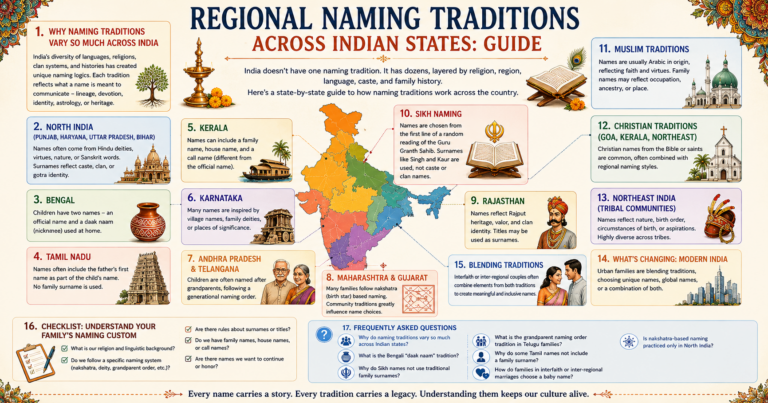
Rare doesn’t mean rootless. Some of the most requested names in our inbox are rare precisely because they pull from Sanskrit, Tamil, Bengali, or Urdu roots that fell out of everyday use but still carry real weight — light, strength, dawn, devotion, the first rain.
If nobody in the family has strong feelings about a name because nobody has heard it before, there’s often less to argue about. We’ve watched this happen more than once — a genuinely rare, meaningful name sidesteps the “but your cousin already used that” conversation entirely.
By midnight that night, the whiteboard was a mess. So we sat down and built what we now call the Naming Table Method — five questions, asked in order, that cut thirty-one names down to three finalists in under an hour. We’ve used it with dozens of families since.
“Something strong” is not a filter. “Something meaning ‘first light’” is. Pick one concrete meaning — strength, dawn, devotion, wisdom, the sea — and only let names through that actually mean that, not names that just sound like they might.
Say the full name — first, middle if you use one, surname — in a normal voice, then say it the way a teacher taking attendance would say it, then say it the way a worried relative would shout it across a crowded railway platform. If it survives all three without an awkward stumble, it passes.
Every name gets shortened by someone — a cousin, a classmate, an over-affectionate grandparent. Decide in advance whether you’re fine with the nickname that will inevitably emerge. Elowen becomes Ellie. Alaric becomes Al. If the shortened version doesn’t sit right with you, the full name might not either, long-term.
A name that felt rare to you might be the fastest-rising name on every 2026 list. Before finalizing, actually search the name plus the current year and see what comes up. Rare names have a short shelf life if enough people discover them at once — which is exactly what’s happening to several names on last year’s “rare” lists.
Get to three names, then stop actively deciding. Every parent we’ve spoken to says some version of the same thing: the name that’s right often becomes obvious only after the baby arrives and you look at their actual face. Keep three strong, meaningful options ready and let the last 10% resolve itself in the hospital room.
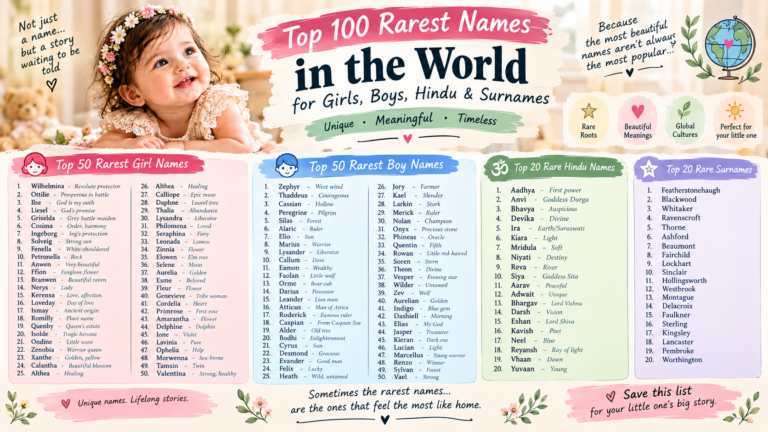
These fifty names balance the three things Indian parents ask us for most: real meaning, easy pronunciation across regions, and enough rarity that your daughter won’t share her name with half her classroom.
| Name | Meaning | Origin / Style |
| Elowen | Elm tree | Cornish — nature |
| Lyra | Constellation, harp of light | Greek — celestial |
| Isha | Goddess, protector | Sanskrit — devotional |
| Seraphina | Fiery, burning angel | Hebrew — vintage |
| Anvi | Prayer answered | Sanskrit — modern |
| Liora | I have light | Hebrew — luminous |
| Eira | Snow | Welsh — nature |
| Amaris | Promised by God | Hebrew — devotional |
| Kaia | Sea, pure | Greek/Hawaiian — nature |
| Ishani | Goddess of direction | Sanskrit — devotional |
| Zaria | Princess, blooming flower | Arabic/Slavic — regal |
| Nyra | Radiant beauty | Sanskrit-adjacent — modern |
| Thalia | To blossom, flourish | Greek — nature |
| Kavya | Poetry | Sanskrit — artistic |
| Rhea | Flowing, ease | Greek — gentle |
| Anoushka | Full of grace | Russian/Sanskrit blend |
| Zoya | Life | Arabic/Slavic — vital |
| Mira | Peace, ocean | Sanskrit — calm |
| Taru | Tree, star | Sanskrit — nature |
| Sarika | Songbird | Sanskrit — musical |
| Noor | Light | Arabic/Urdu — devotional |
| Aarna | Wave of the sea | Sanskrit — nature |
| Ishaani | Sun’s first ray | Sanskrit — celestial |
| Vedika | Altar, knowledge platform | Sanskrit — devotional |
| Anwesha | In search of | Bengali/Sanskrit |
| Prisha | Beloved | Sanskrit — tender |
| Suhani | Pleasant morning | Hindi — warm |
| Rania | Queenly | Arabic — regal |
| Diya | Lamp, light | Sanskrit — devotional |
| Meher | Kindness, sun | Persian/Urdu — warm |
| Zaina | Beauty, grace | Arabic — elegant |
| Trisha | Desire, thirst for knowledge | Sanskrit |
| Aadya | The first power, beginning | Sanskrit — strong |
| Hemi | Golden | Sanskrit — warm |
| Kiaan’s sister Riaa | Song, melody | Sanskrit-modern hybrid |
| Avani | Earth | Sanskrit — grounded |
| Ira | Earth, insight | Sanskrit/Hebrew crossover |
| Naya | New | Arabic — fresh |
| Sana | Radiance, praise | Arabic/Urdu |
| Zara | Blooming flower | Arabic — popular-adjacent, still fresh in most regions |
| Vanya | Gift of grace | Sanskrit |
| Esha | Desire, wish | Sanskrit |
| Alia | Noble, exalted | Arabic |
| Riva | River bank | Sanskrit/Hebrew |
| Tanaya | Daughter | Sanskrit — tender |
| Myra | Sweet-smelling, ocean | Latin/Sanskrit crossover |
| Anika | Grace, sweet-faced | Sanskrit — gentle |
| Kyra | Sun, lord, radiant | Greek/Sanskrit crossover |
| Saira | Traveler, princess | Arabic |
| Ahana | Dawn, first ray of sun | Sanskrit — celestial |
| Ojasvi (fem.) | Radiant, full of vigor | Sanskrit — strong |
For boys, the parents we work with almost always ask for the same thing: strength or light in the meaning, and a name that won’t get shortened into something they hate. These fifty hold up.
| Name | Meaning | Origin / Style |
| Aarav | Peaceful (common — benchmark name) | Sanskrit |
| Soren | Stern, strong | Danish — modern |
| Cassian | Hollow, curly-haired | Latin — vintage |
| Zephyr | West wind | Greek — airy |
| Evander | Good man | Greek — classic |
| Advait | The one without a second, unique | Sanskrit — philosophical |
| Orion | Rising star, hunter | Greek — celestial |
| Reyansh | Ray of the Lord | Sanskrit — devotional |
| Kairav | Water lily, moon | Sanskrit — nature |
| Ronan | Little seal | Irish — gentle-strong |
| Vihaan’s cousin Veer | Brave, warrior | Sanskrit — strong |
| Atlas | Strength, one who bears weight | Greek — bold |
| Elian | Sun, God has answered | Hebrew/Spanish |
| Arjav | Simplicity, honesty | Sanskrit |
| Stellan | Calm | Swedish — modern |
| Bastian | Venerable, revered | Latin — classic |
| Kael | Mighty warrior | Gaelic |
| Zayan | Beautiful, graceful | Arabic |
| Rael | Light of God | Hebrew |
| Oberon | Noble bear, royal | Germanic — regal |
| Aarush | First ray of sun | Sanskrit — celestial |
| Dhruv | Fixed, the pole star, steadfast | Sanskrit — strong |
| Vyom | Sky | Sanskrit — vast |
| Kabir | Great, mighty | Arabic/Urdu — poetic |
| Ishaan | Sun, direction | Sanskrit — celestial |
| Arnav | Ocean, sea | Sanskrit — vast |
| Rudransh | Part of Lord Shiva | Sanskrit — devotional |
| Neel | Blue, sapphire | Sanskrit — calm |
| Samarth | Capable, competent, strong | Sanskrit |
| Ayaan | Gift of God, luck | Arabic/Sanskrit crossover |
| Arav | Peaceful (alt. spelling) | Sanskrit |
| Vansh | Lineage, legacy | Sanskrit — rooted |
| Kian | King, ancient, life force | Persian/Irish crossover |
| Zoravar | Powerful, mighty | Punjabi — strong |
| Tanay | Son, born of self | Sanskrit |
| Ojas | Vigor, vitality, strength | Sanskrit — strong |
| Rehaan | Fragrant, king | Persian/Arabic |
| Yuvraj | Prince, crown prince | Sanskrit — regal |
| Aryan | Noble | Sanskrit |
| Kartavya | Duty, responsibility | Sanskrit — grounded |
| Sahil | Guide, shore | Arabic/Sanskrit crossover |
| Vivaan | Full of life, first light | Sanskrit |
| Devansh | Part of God | Sanskrit — devotional |
| Manav | Human, mankind | Sanskrit — grounded |
| Aadit | The beginning, the sun | Sanskrit — celestial |
| Kiaan | Grace of God, king | Persian/Irish crossover |
| Shaurya | Bravery, valor | Sanskrit — strong |
| Naitik | Ethical, moral | Sanskrit |
| Prithvi | Earth | Sanskrit — grounded |
| Yashvir | Victorious, brave hero | Sanskrit — strong |
A quick, honest note: we kept Aarav and one or two well-known names in these tables on purpose — as a benchmark, so you can see exactly how a genuinely rare name (Cassian, Zoravar, Ojas) reads next to a familiar one. If a name on this list feels too familiar in your city or community, that’s useful information. Rarity is regional — always check what’s common in your specific school, building, or extended family before you fall in love with a name.
Gender-neutral naming has moved from niche to mainstream fast, and Indian parents are increasingly drawn to names that work regardless of how their child later identifies, or simply because the name itself is beautiful without being gendered.
| Name | Meaning |
| Aman | Peace, safety |
| Rian | Little king, water |
| Aadi | Beginning, first |
| Ira | Earth, wind, insight |
| Kiran | Ray of light |
| Ridhaan | Growth, prosperity |
| Indigo | Deep blue, night-sky |
| Sage | Wise |
| River | Flowing water |
| Ishaan | Sun (often used for boys, works for either) |
| Rowan | Little redhead, rowan tree |
| Anay | Without decay, eternal |
| Aakash | Sky |
| Nila | Blue, indigo |
| Marlowe | Driftwood, remnant of a lake |
Not every family wants an elaborate name. Some of the most-requested searches we see are for short names that still carry real meaning — easy for a toddler to say about themselves, and easy for grandparents in every part of the family to pronounce correctly the first time.
| Girls | Meaning | Boys | Meaning |
| Mia | Mine, beloved | Kai | Sea |
| Zia | Light, splendor | Leo | Lion |
| Nia | Purpose | Rio | River |
| Ira | Earth | Vyan | Skilled, active |
| Ava | Life, bird | Ansh | Part, portion |
If you’re starting from a name you already like, this comparison shows a rarer alternative that keeps a similar feel — same sound family, same warmth, far fewer classmates sharing it.
| If You Like | Consider This Instead | Why |
| Aarav | Advait | Same soft sound, philosophical meaning, far less common |
| Saanvi | Ishani | Both devotional, Ishani is heard far less often |
| Vihaan | Reyansh | Similar rhythm, still rare in most classrooms |
| Ananya | Anwesha | Same warmth, regionally distinct and uncommon |
| Arjun | Yashvir | Both mean strength/victory, Yashvir is rarely used |
We’ve sat in on enough of these decisions now — as friends, as family, as the people readers email at 1 a.m. with a shortlist — to see the same five mistakes repeat, almost word for word.
A family we know spent weeks picking a name starting with the “lucky letter” their numerologist gave them, landed on a name none of them actually liked the sound of, and quietly started using a nickname within a month. If you’re working within a letter or rashi requirement, treat it as a filter for your shortlist — not the only reason a name makes the cut.
Names that are beautiful alone can turn awkward next to a surname — repeated sounds, an accidental rhyme, initials that spell something unfortunate. Always say the full name, first + middle if used + surname, out loud, before it goes on any documents.
This is the one that catches people most in 2026. A name can feel like nobody in your family has heard of it, while it’s quietly climbing the national top-fifty list. Before finalizing, actually search the name with the current year attached and see what comes up — not just what your relatives think.
A name that’s effortless in Hindi, Tamil, or Bengali can become a daily correction exercise in an English-medium classroom or abroad, and vice versa. This doesn’t mean you should avoid regional names — it means you should say the name the way a teacher, a colleague, and a passport officer will each say it, and decide if you’re comfortable with all three versions.
The families who landed on a name everyone loved almost always did it in stages — parents decide on a shortlist privately first, then bring two or three options to the wider family, rather than opening the floor to unlimited suggestions from day one.
Would you feel comfortable calling this name loudly across a crowded park, a railway platform, or a school gate? If the answer is a wince, that’s worth noticing before the birth certificate is filed.
A name that sounds adorable on a six-month-old should also sound credible on a forty-year-old doctor, lawyer, or company founder. Say it in a sentence like “This is Dr. ___” and see how it lands.
A name like “Jaxsyn” instead of “Jackson,” or an unusual spelling of a familiar Sanskrit name, can create a lifetime of correcting spellings on forms, boarding passes, and exam sheets. Rarity should come from the name itself, not from creative spelling of a common one.
A quick search for the name plus common handle formats tells you whether your child will inherit a clean digital identity or spend their twenties fighting for a username.
“We wanted something that meant ‘first light’ because she was born right at sunrise. My mother-in-law wanted a name starting with ‘S’ for the rashi. We found Suhani — pleasant morning — and it satisfied both. Nobody in her school has the same name, three years in.” — a mother in Pune
“My husband is Bengali, I’m Tamil. We went through forty names that only worked in one language before we found Ojas — it’s Sanskrit, it means vigor, and both grandmothers can say it without hesitation.” — a mother in Bengaluru
“We genuinely didn’t decide until we saw him. We had three names on a sticky note in the hospital bag — Kabir, Dhruv, and Rian — and the moment we saw his face, Dhruv was just obviously right. The pole star, steadfast. It fit.” — a father in Delhi
A name currently used by a small percentage of newborns nationally — typically outside the top 100 — while still being real, meaningful, and pronounceable. It’s different from “made-up,” which has no established meaning or origin
Start from a meaning you want — light, strength, dawn, devotion — rather than a sound. Sanskrit, Tamil, Bengali, Persian, and Urdu roots all offer names that are rare in everyday use but carry centuries of meaning.
Sometimes at first, especially in joint families with strong naming traditions. Bringing a shortlist of two or three options — rather than one final decision — usually smooths this, since it gives relatives a sense of involvement without an open-ended debate.
Elowen (elm tree), Ishani (goddess of direction), Anwesha (in search of), Vedika (altar), and Ahana (dawn) are strong examples that are meaningful, easy to pronounce, and genuinely uncommon.
Advait (the one without a second), Dhruv (the pole star, steadfast), Ojas (vigor), Zoravar (powerful), and Cassian are all rare, strong, and easy across most languages.
Yes — names like Amaan, Kiran, Ira, and Aadi are increasingly chosen because they work regardless of gender and tend to age well from childhood into adulthood.
It isn’t required, but most of the parents we hear from prefer it — a meaning gives the name a story you can tell your child later, and it often helps satisfy family naming traditions like rashi letters without limiting your options too much
Only if it’s difficult to pronounce or spell consistently. A name can be rare and still be simple — that combination is exactly what this guide focuses on.
Parents can also consult trusted organizations:
Choosing the perfect baby name is a deeply personal journey. While popular names will always have their place, many parents today prefer rare baby names that offer uniqueness, meaning, and individuality.
By focusing on meaning, pronunciation, cultural respect, and long-term usability, parents can choose names that feel special while still being practical.
Whether you prefer cute baby girl names, strong baby boy names, or modern gender-neutral options, the key is selecting a name that resonates with your family’s values and story.
Take your time, explore your options, and trust your instincts—because the right name will feel just right when you hear it.
This article is intended for educational and informational purposes only. It does not replace professional medical, parenting, or psychological advice. Parents should consult qualified healthcare professionals or pediatricians for health-related concerns regarding their child.