Physical Address
304 North Cardinal St.
Dorchester Center, MA 02124
Physical Address
304 North Cardinal St.
Dorchester Center, MA 02124

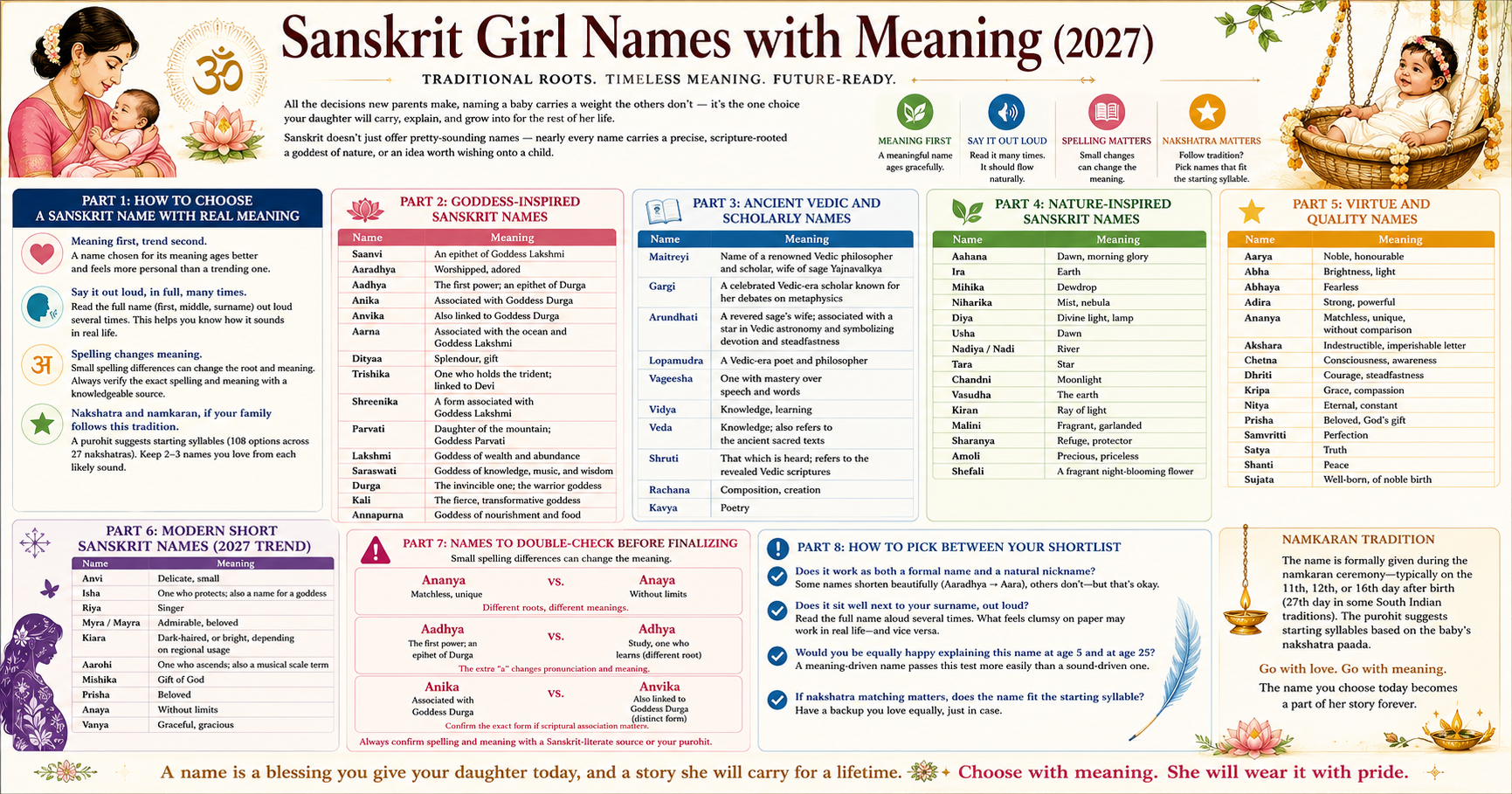
Of all the decisions new parents make, naming a baby carries a weight the others don’t — it’s the one choice your daughter will carry, explain, and grow into for the rest of her life. For many Indian families, Sanskrit is where that search naturally begins. As one of the world’s oldest languages, Sanskrit doesn’t just offer pretty-sounding names — nearly every name carries a precise, scripture-rooted meaning: a goddess, a virtue, a element of nature, or an idea worth wishing onto a child.
This guide is built specifically around meaning, not just trend. You’ll find Sanskrit girl names organized by the kind of meaning they carry — goddess-inspired, ancient and scholarly, nature-rooted, virtue-based, and modern short names — along with practical guidance on pronunciation, common spelling mistakes that quietly change a name’s meaning, and how naming ceremony (namkaran) traditions typically factor in. Whether you want something your daughter will proudly explain at twenty, or simply something beautiful rooted in real meaning, you’ll find it here.
Before the list, a few things worth thinking through:
Meaning first, trend second. A name that’s trending in 2027 will, by definition, be common among her peers. A name chosen specifically for its meaning tends to age better — both in how it sounds a decade from now, and in how proud she’ll feel explaining it.
Say it out loud, in full, many times. Read the full name — first, middle if applicable, and surname — out loud several times, including how teachers, colleagues, and her own children might eventually say it. Sanskrit names sound different when said quickly and casually versus read slowly off a page.
Spelling changes meaning. This is one of the most common — and easiest to avoid — mistakes parents make with Sanskrit names. Small spelling differences aren’t cosmetic; they represent genuinely different Sanskrit roots and meanings. Ananya (matchless, unique) and Anaya (without limits) look similar but come from different roots. Aadhya (the first power, an epithet of Durga) and Adhya are similarly easy to conflate. If a name has spiritual significance to you, it’s worth confirming the exact spelling and meaning with a knowledgeable source — a purohit, a Sanskrit teacher, or a reliable reference — rather than assuming two similar-looking names mean the same thing.
Nakshatra and namkaran, if your family follows this tradition. In many Hindu families, the formal name is finalized at the namkaran ceremony, typically on the 11th, 12th, or 16th day after birth (the 27th day in some South Indian traditions). A purohit identifies the baby’s nakshatra paada — one of 108 possible starting syllables across the 27 nakshatras — and suggests one or more starting sounds for the name. If this is part of your family’s practice, it’s worth having two or three names you love from each likely starting sound, so you’re not choosing under time pressure.
Names rooted in goddesses remain some of the most enduring choices in Sanskrit naming, carrying meanings of abundance, wisdom, strength, and grace.
| Name | Meaning |
|---|---|
| Saanvi | An epithet of Goddess Lakshmi |
| Aaradhya | Worshipped, adored |
| Aadhya | The first power; an epithet of Durga |
| Anika | Associated with Goddess Durga |
| Anvika | Also linked to Goddess Durga |
| Aarna | Associated with the ocean and Goddess Lakshmi |
| Dityaa | Splendour, gift |
| Trishika | One who holds the trident; linked to Devi |
| Shreenika | A form associated with Goddess Lakshmi |
| Parvati | Daughter of the mountain; Goddess Parvati |
| Lakshmi | Goddess of wealth and abundance |
| Saraswati | Goddess of knowledge, music, and wisdom |
| Durga | The invincible one; the warrior goddess |
| Kali | The fierce, transformative goddess |
| Annapurna | Goddess of nourishment and food |
For families wanting a name with real historical and intellectual weight, these names belong to actual figures from Vedic literature — sages, scholars, and philosophers whose stories are worth telling a daughter as she grows.
| Name | Meaning |
|---|---|
| Maitreyi | Name of a renowned Vedic philosopher and scholar, wife of sage Yajnavalkya |
| Gargi | Name of a celebrated Vedic-era scholar and philosopher known for her debates on metaphysics |
| Arundhati | Name of a revered sage’s wife, associated with a star in Vedic astronomy and symbolizing devotion and steadfastness |
| Lopamudra | Name of a Vedic-era poet and philosopher |
| Vageesha | One with mastery over speech and words |
| Vidya | Knowledge, learning |
| Veda | Knowledge; also refers to the ancient sacred texts |
| Shruti | That which is heard; refers to the revealed Vedic scriptures |
| Rachana | Composition, creation |
| Kavya | Poetry |
Sanskrit draws heavily on the natural world for names — dawn, rivers, stars, and delicate natural phenomena all appear as girls’ names with genuine poetic depth.
| Name | Meaning |
|---|---|
| Aahana | Dawn, morning glory |
| Ira | Earth |
| Mihika | Dewdrop |
| Niharika | Mist, nebula |
| Diya | Divine light, lamp |
| Usha | Dawn |
| Nadiya / Nadi | River |
| Tara | Star |
| Chandni | Moonlight |
| Vasudha | The earth |
| Kiran | Ray of light |
| Malini | Fragrant, garlanded |
| Sharanya | Refuge, protector |
| Amoli | Precious, priceless |
| Shefali | A fragrant night-blooming flower |
These names carry a specific hoped-for quality — strength, fearlessness, wisdom, or purity — rather than a person, deity, or object.
| Name | Meaning |
|---|---|
| Aarya | Noble, honourable |
| Abha | Brightness, light |
| Abhaya | Fearless |
| Adira | Strong, powerful |
| Ananya | Matchless, unique, without comparison |
| Akshara | Indestructible, imperishable letter |
| Chetna | Consciousness, awareness |
| Dhriti | Courage, steadfastness |
| Kripa | Grace, compassion |
| Nitya | Eternal, constant |
| Prisha | Beloved, God’s gift |
| Samvritti | Perfection |
| Satya | Truth |
| Shanti | Peace |
| Sujata | Well-born, of noble birth |
Parents in 2027 are strongly favouring short, two-to-three-syllable Sanskrit names that carry real meaning but sound crisp and travel well across languages and geographies.
| Name | Meaning |
|---|---|
| Anvi | Delicate, small |
| Isha | One who protects; also a name for a goddess |
| Riya | Singer |
| Myra / Mayra | Admirable, beloved |
| Kiara | Dark-haired, or bright, depending on regional usage |
| Aarohi | One who ascends; also a musical scale term |
| Mishika | Gift of God |
| Prisha | Beloved |
| Anaya | Without limits |
| Vanya | Graceful, gracious |
Because Sanskrit relies heavily on subtle vowel and consonant distinctions, a handful of name pairs are commonly confused. Before finalizing your daughter’s name, it’s worth confirming the exact spelling and meaning you intend, especially with these pairs:
If your family plans a formal namkaran ceremony, this is exactly the kind of detail worth confirming with your purohit in advance, rather than during the ceremony itself.
Once you’ve narrowed down to three or four names you love, a few final questions help settle the decision:
There’s no single “most meaningful” name — meaning is personal. Names like Maitreyi (a celebrated Vedic scholar) and Arundhati (devotion and steadfastness, linked to a star) carry historical and symbolic depth, while names like Saanvi (linked to Goddess Lakshmi) carry spiritual and cultural weight. The most meaningful choice is the one whose specific story or meaning genuinely resonates with your family.
Spelling changes meaning significantly in Sanskrit, so it’s worth confirming any name’s exact meaning with a knowledgeable source — a purohit, a Sanskrit teacher, or a reliable reference — rather than assuming two similarly-spelled names carry the same meaning.
Names like Lopamudra (a Vedic-era poet and philosopher), Vageesha (mastery over speech), and Sujata (well-born, of noble birth) are less commonly used today while still carrying substantial classical meaning.
It depends entirely on family tradition — many Hindu families follow this practice as part of the namkaran ceremony, while many others choose a name purely for its meaning without astrological matching. Both approaches are widely practiced; there’s no single “correct” tradition to follow.
Short, two-to-three-syllable names with soft vowel endings — such as Anvi, Ira, Isha, and Riya — are especially popular in 2027, valued for combining genuine Sanskrit meaning with easy, cross-language pronunciation.