Physical Address
304 North Cardinal St.
Dorchester Center, MA 02124
Physical Address
304 North Cardinal St.
Dorchester Center, MA 02124

Nobody told me about the night sweats.
Or the shaking. The full-body trembling that happened about an hour after I gave birth — a kind of physical aftershock that nobody had mentioned in any of the antenatal classes, books, or conversations I’d had in the preceding nine months.
Nobody told me about the afterpains — the cramping contractions that come in the days after birth while your uterus shrinks back down, and that get progressively more intense with each subsequent baby, reaching a level with my second that made me genuinely gasp.
Nobody told me that I would feel elated and absolutely hollowed out at the same time. That the first time I stood up after the birth, my legs would not entirely cooperate. That going to the bathroom for the first time after a vaginal delivery would require a level of psychological preparation I hadn’t anticipated.
Nobody told me that the six weeks after birth — the “fourth trimester,” as it’s now being called — would be a period of recovery so significant that in many cultures it is treated as a medical event in its own right.
In the UK, we tend not to do that. We send new mums home within hours of giving birth, we check in at six weeks, and in between we largely leave them to figure out postpartum recovery on their own, with Google and the occasional midwife visit.
This post is the information I wish I’d had. Real, honest, practical postpartum recovery tips for new mums — across the physical, emotional, and practical dimensions of healing after birth. What actually happens. What actually helps. What is normal and what deserves medical attention.
If you’re pregnant, read this now. If you’ve just given birth, read what’s relevant to where you are. If you’re someone who loves a new mum, read it and understand what she’s going through.
The term “postpartum” technically refers to the period following childbirth — most definitions cover the first six weeks, though increasingly, healthcare practitioners and researchers recognise that real recovery extends significantly beyond that.
The “fourth trimester” concept — coined by paediatrician Dr. Harvey Karp but now widely adopted in maternal health discourse — captures something important: the twelve weeks after birth are as significant a period of physical and emotional transition as any trimester of pregnancy. Possibly more so, because at least during pregnancy, the focus stays on the mother’s body. After birth, the focus shifts almost entirely to the baby.
What is actually happening in a postpartum body?
The uterus, which expanded to accommodate a full-term baby, is contracting back to its pre-pregnancy size — a process that takes approximately six weeks and involves genuine physical discomfort. The cervix is closing. If you had a vaginal delivery, the perineum — which may have torn or been cut — is healing. If you had a caesarean, you have a significant abdominal surgical wound healing through multiple layers of tissue. Your hormones drop precipitously in the 24-72 hours after birth — oestrogen and progesterone, which were at extraordinary levels during pregnancy, plummet. This hormonal cliff is one of the most dramatic hormonal shifts the human body ever experiences outside of menopause.
Your breasts are establishing milk production if you’re breastfeeding — a process that involves engorgement, sometimes pain, and a significant caloric demand on your body. Your joints, loosened by the hormone relaxin during pregnancy, are readjusting. Your pelvic floor — which has been under extraordinary pressure for nine months and, if you delivered vaginally, has been significantly stretched — is beginning a long process of recovery.
And you are doing all of this while not sleeping and learning to keep a new human alive.
Postpartum recovery is a big deal. It deserves to be treated as one.
The immediate postpartum period is one of the most intense experiences of a woman’s life — and also one of the least prepared-for. Here is what you need to know about the first few days.
The shaking I mentioned in the introduction is common and is thought to be caused by the physical exertion of labour combined with the hormonal and temperature fluctuations of the immediate postpartum period. It’s alarming if nobody told you it might happen. It passes.
You may experience significant sweating — both immediately after birth and in the nights that follow, as your body eliminates the excess fluid retained during pregnancy. Night sweats in the postpartum period can be dramatic. Changing your pyjamas at 3am because you’re soaked is not unusual. It is deeply unpleasant. It is temporary.
You will likely feel a kind of exhaustion that is unlike any tiredness you have previously experienced. This is appropriate. You have done something extraordinary. Rest is not laziness — it is medical necessity.
For mums who had a vaginal delivery, the first visit to the bathroom after birth is something that deserves its own frank conversation. It will likely be uncomfortable. Urinating over a perineum that is swollen and possibly sutured is stinging at minimum, and significantly painful for some women.
A peri bottle — a small squeezy bottle filled with warm water that you squirt over the perineum while urinating — dramatically reduces this discomfort by diluting the urine and reducing contact with the wound. Many hospitals provide these. If yours doesn’t, ask or bring your own.
The first bowel movement after birth is something many new mums dread, often postpone, and find is genuinely more manageable than anticipated. Stool softeners prescribed by your midwife or GP help. Staying well hydrated helps. A footstool to raise your feet into a more natural squatting position helps. Do not strain. Do not rush. It will happen when it happens.
Whether or not you had a tear or episiotomy, the perineum needs deliberate care in the days and weeks after a vaginal birth.
Ice packs: In the first 24-48 hours, ice packs or frozen maternity pads (put a maternity pad in the freezer for a couple of hours) reduce swelling significantly and provide genuine pain relief. Wrap in a cloth — never directly on skin.
Perineal sprays: Products like Spritz for Bits by My Expert Midwife or a witch hazel and lavender spray provide cooling, antiseptic, and anti-inflammatory relief. Use after every trip to the bathroom.
Salt baths: After the first 24 hours, warm shallow baths with a handful of table salt help keep the area clean and support healing. Avoid long soaks — these can actually impede healing by softening the wound edges. Ten minutes is plenty.
Pelvic floor exercises, gently: Starting gentle pelvic floor contractions — not the full exercises, just a gentle squeeze and release — within the first 24-48 hours post-delivery, if comfortable, helps with blood circulation and reduces swelling. Many midwives recommend beginning these even before it feels comfortable, because improved blood flow supports faster healing.
Air: When possible, letting air reach the perineum — lying down without underwear for short periods during the day — supports healing. This is not glamorous information. It is useful information.
If you had a caesarean section, your recovery looks different and involves managing a significant abdominal surgical wound.
Pain management is essential, not optional. Take your prescribed pain relief on schedule in the first few days — not when the pain becomes unbearable, but before it gets there. Staying ahead of the pain allows you to move, breathe deeply, and care for your baby in ways that are not possible when pain is poorly managed.
Moving matters — carefully. Getting up and moving gently, with support, within the first 12-24 hours after a caesarean is recommended because it reduces the risk of blood clots and supports recovery. This does not mean doing anything strenuous. It means sitting up, standing with help, taking a few steps. It will feel impossible. Do it anyway, with your support person and healthcare team.
Protect the wound: Support your incision when you cough, sneeze, laugh, or attempt to get up — hold a pillow firmly against your abdomen. This is called “splinting” and it genuinely reduces pain and protects the wound edges.
Watch for infection: Redness spreading beyond the wound, increased pain after the first few days, fever, or any discharge from the wound should be assessed by a healthcare professional promptly. Wound infections after caesarean are not uncommon and are much easier to treat when caught early.
This is the period that most postpartum recovery advice focuses on — and for good reason. The first six weeks are when the most significant physical healing happens, when feeding is established, and when the gap between expectation and reality tends to be most jarring.
This is the tip that gets the most resistance and matters the most.
In the first six weeks, rest is not something you do when you’ve finished your tasks. It is the task. The primary one. Everything else is secondary.
Your uterus is healing. Your hormones are recalibrating. Your body is producing milk. Your surgical wound — if you had a caesarean — is healing through multiple tissue layers. Your pelvic floor is recovering from the pressure and trauma of pregnancy and delivery. All of this healing happens during rest and sleep, not during activity.
The culture that celebrates new mums who “bounce back,” who are up and about quickly, who post gym selfies at eight weeks — this culture is not promoting health. It is promoting the suppression of a genuine recovery process, and the consequences of that suppression (prolapse, ongoing perineal pain, persistent abdominal weakness, burnout, postnatal depression) are real and sometimes long-lasting.
Rest. Actually rest. The laundry can wait.
Your body has just completed one of the most physically demanding things it will ever do. And if you’re breastfeeding, you’re now sustaining another human being on top of that. The caloric and nutritional demands of the postpartum period are extraordinary — comparable to the third trimester of pregnancy, and in some respects exceeding it.
This is not the time for any form of dietary restriction. This is the time to eat enough food — genuinely enough, across the full spectrum of nutrients — to support healing, milk production if applicable, hormone recalibration, mood regulation, and the raw physical energy demands of new parenthood.
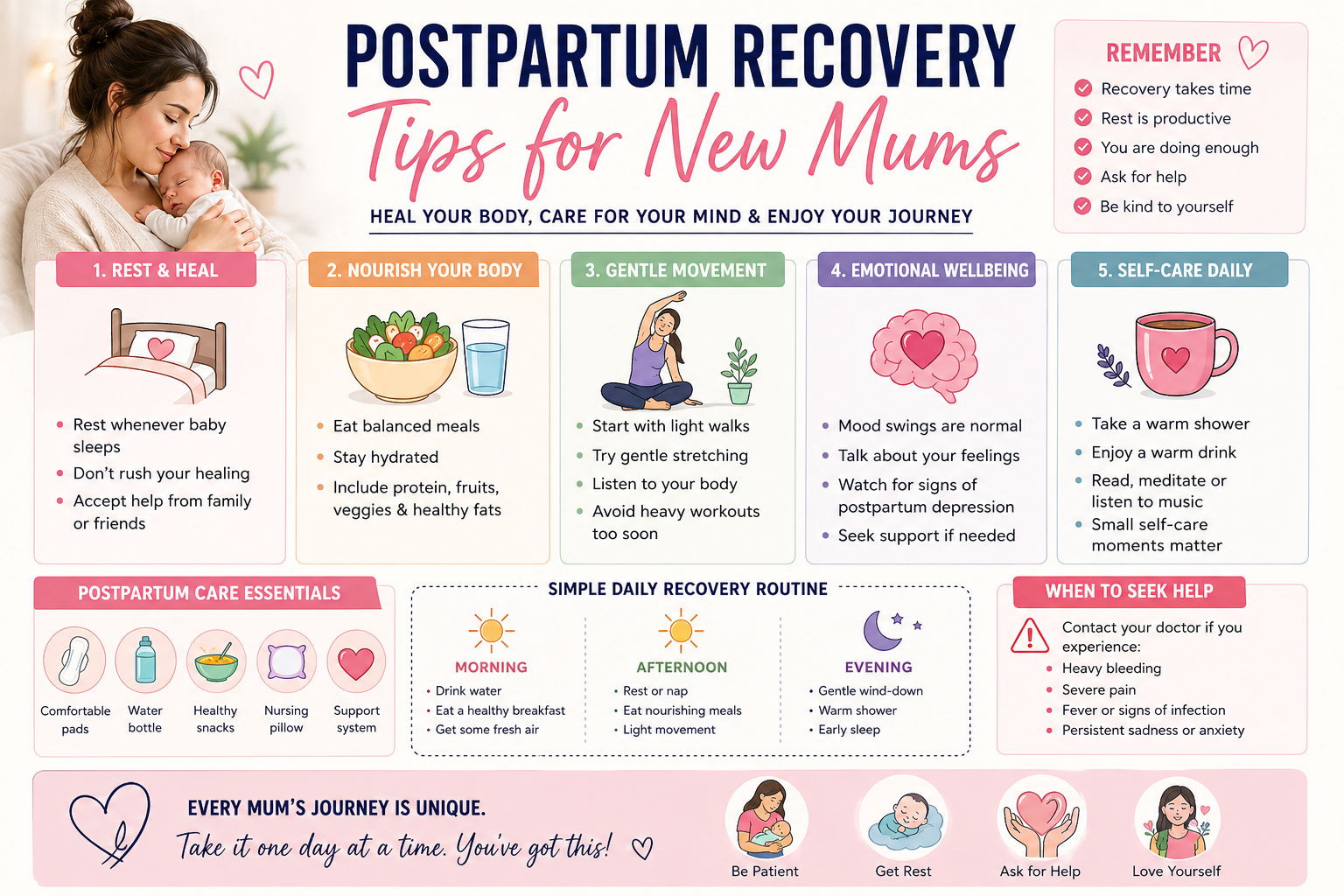
Key nutritional priorities in postpartum recovery:
Iron: Blood loss during birth depletes iron, which is essential for energy and immune function. If you had significant blood loss, your midwife may recommend an iron supplement. Iron-rich foods — red meat, lentils, dark leafy greens, fortified cereals — support recovery. Pair with vitamin C to enhance absorption.
Protein: Tissue repair requires protein. Every meal should have a protein source — eggs, meat, fish, pulses, dairy, or plant proteins. This is more important in postpartum recovery than it is at almost any other time in a woman’s life.
Omega-3 fatty acids: Particularly important for postnatal mental health and brain function. Oily fish (salmon, sardines, mackerel), walnuts, and flaxseed are good sources. If your diet is limited, an omega-3 supplement is worth considering.
Fibre and hydration: Supporting healthy bowel function in the postpartum period. Water, vegetables, fruits, whole grains. Simple and essential.
Warm, easy-to-eat foods: In the first couple of weeks especially, eat what is available and accessible. A bowl of porridge, a nourishing soup, a piece of toast with peanut butter at 3am — all of this counts. This is not the time to be precious about nutrition. Eat what you can, when you can.
If you’re breastfeeding, you need significantly more water than you think — approximately 2-3 litres per day as a baseline. Dehydration contributes to fatigue, headaches, reduced milk supply, constipation, and impaired healing.
Keep a large water bottle — at least one litre — within arm’s reach at all times, particularly when feeding. Set a reminder if you need one. Drink before you feel thirsty.
Coconut water, herbal teas, and diluted fruit juice all count toward hydration. Caffeinated drinks are fine in moderation but are not net-neutral for hydration — compensate with additional water.
Lochia is the postpartum vaginal discharge that occurs as the uterine lining sheds and the cervix closes. It typically lasts between four and six weeks and progresses through stages:
Days 1-4: Lochia rubra — bright red, similar to a heavy period, containing blood, mucus, and uterine tissue. Passing small clots (smaller than a 50p piece) is normal.
Days 4-10: Lochia serosa — the flow reduces and lightens to pink or brownish.
Days 10 onward: Lochia alba — yellow-white discharge that gradually reduces and stops.
Seek medical attention if: You pass clots larger than a 50p piece, have sudden heavy bleeding (soaking a pad in under an hour), experience a foul smell suggesting infection, or have fever alongside increased bleeding. These can indicate postpartum haemorrhage or infection, both of which require prompt attention.
Activity tends to increase lochia — this is a physical signal from your body that it needs you to slow down.
This is the postpartum recovery tip that has the most immediate and significant impact on both physical recovery and mental health — and the one that mums most consistently fail to act on.
The research on postpartum recovery is unambiguous: social support is one of the strongest protective factors against postnatal depression and burnout. Practical help — meals, cleaning, holding the baby while the mum sleeps — directly enables physical recovery by creating time and space for rest.
But “let me know if you need anything” is not useful. It puts the burden of identifying and requesting help on the person least capable of doing so. The mums who benefit most from postpartum support are the ones who are specific.
Practise these phrases:
Specific, time-bounded, practical requests. Say yes to help. Say yes every time. This is not weakness. This is participating in the way humans have always raised children — in community, with support — and you are entitled to it.
The six-week postnatal check with your GP is an important appointment — and one that is often misunderstood. Many mums treat it as a “clearance certificate” — as though the six-week mark means recovery is complete and full normal activity can resume. This is not what it means.
The six-week check assesses: your physical healing from birth, your emotional wellbeing, your blood pressure, your contraception needs, and the baby’s development. It is not a thorough postpartum assessment — it’s typically a ten-minute appointment with limited capacity to address everything that may be going on.
Come prepared with your actual questions. Pelvic floor concerns. Perineal pain that hasn’t resolved. Scar tenderness from a caesarean. Ongoing bleeding. Mood concerns. Intimacy concerns. Loss of bladder control. Do not leave without raising the things that matter.
And understand that “cleared at six weeks” does not mean your pelvic floor has recovered, your abdominal muscles have healed, your caesarean scar is fully resolved, or your body is ready for high-impact exercise. These processes take significantly longer — and require appropriate assessment, not just time passing.
Recovery doesn’t end at six weeks. For many mums, the weeks that follow are when they return to work, resume activities, and discover that their body is not yet where they expected it to be.
In France, all new mums receive a standard prescription for ten sessions of pelvic floor physiotherapy after birth. In the UK, this is not standard — which is a genuine gap in postpartum care.
The pelvic floor is a complex group of muscles, ligaments, and connective tissue that has been under significant strain throughout pregnancy and, if you had a vaginal birth, has been dramatically stretched during delivery. The consequences of an unsupported pelvic floor recovery include: urinary incontinence, pelvic organ prolapse, pelvic pain, painful sex, and long-term bladder and bowel problems.
Many of these consequences are preventable with appropriate early intervention. A women’s health physiotherapist can assess your pelvic floor internally, identify any dysfunction, and give you a tailored rehabilitation programme rather than the generic “do your Kegels” advice that doesn’t work for everyone and can actually be counterproductive if your pelvic floor is tight rather than weak.
Ask your GP for a referral. Many areas also allow self-referral to NHS physiotherapy. It is worth waiting for. It is worth pushing for. It is one of the most important things you can do for your long-term health as a woman who has had children.
Diastasis recti — the separation of the two bands of the rectus abdominis muscle along the midline of the abdomen — affects the majority of pregnant women to some degree. In most cases it resolves naturally, but in some it persists and requires specific rehabilitation.
Signs of diastasis recti include: a visible “coning” or doming along the midline of the abdomen when you sit up, a soft or hollow feeling at the midline when you press your fingers in, lower back pain, pelvic instability, or difficulty with core-related activities.
Why this matters: Returning to exercise — particularly exercises involving crunches, sit-ups, heavy lifting, or high-impact movement — without first addressing diastasis recti can worsen the separation and lead to ongoing abdominal and pelvic floor dysfunction. The “bounce back” culture that encourages mums to do HIIT classes at six weeks is, for many women, actively counterproductive.
A pelvic floor physiotherapist or women’s health physio can assess for diastasis recti and advise on appropriate exercise progression. Online programmes specifically designed for postpartum abdominal recovery — such as the Mutu System — are also evidence-informed options that can be done at home.
This is one of the areas where cultural pressure and physical reality are most at odds.
The evidence-based guidance from physiotherapy and obstetrics communities — including guidelines produced by the Royal College of Obstetricians and Gynaecologists — suggests the following general progression:
Weeks 0-6: Rest. Gentle walking when comfortable. Pelvic floor exercises as advised by your midwife. No gym, no running, no classes, no weight training.
Weeks 6-12: Gentle reintroduction of movement — walking progressing in duration, low-impact exercise. Continued pelvic floor rehabilitation. No running, no jumping, no heavy lifting without clearance from a pelvic floor physio.
After 12 weeks (with no symptoms): Gradual return to higher-impact exercise, guided by how your body responds. Return to running is typically advised no earlier than 12 weeks and only with no symptoms of pelvic floor dysfunction — no leaking, no pelvic heaviness, no pain.
These timelines feel slow. They exist for real reasons. The women who push through them often end up dealing with prolapse, incontinence, or pelvic pain that takes years to resolve. The women who respect them tend to return to full function more reliably and sustainably.
Physical recovery is only half of what postpartum recovery tips for new mums need to address. The emotional experience of the postpartum period is equally significant and considerably more likely to go unaddressed.
Between day two and day five after birth, the majority of new mums experience what’s commonly called the “baby blues.” Triggered by the precipitous drop in oestrogen and progesterone that occurs after delivery, the baby blues typically involve: weepiness with or without obvious cause, emotional volatility, anxiety, difficulty sleeping even when the baby sleeps, and feelings of being overwhelmed.
The baby blues are extremely common — affecting approximately 70-80% of new mums — and typically resolve within a week to ten days as hormones begin to stabilise.
What you need to know: The baby blues are not postnatal depression. They don’t require medical treatment. They do require kindness, patience from those around you, sleep where possible, food, warmth, and the reassurance that you are not broken — you are in a completely predictable hormonal adjustment.
If the weepiness, anxiety, and overwhelm persist beyond two weeks, or if they are severe rather than episodic, they may be indicating something more than baby blues and deserve medical assessment.
Postnatal depression (PND) affects approximately one in ten new mums in the UK, and a significant number go undiagnosed or under-treated because they don’t recognise what they’re experiencing, or because they’re afraid of judgment.
PND is not the same as being a bit low after birth. It is a clinical mood disorder that requires treatment — and the earlier it’s identified and treated, the better the outcomes for both mother and baby.
Signs of postnatal depression include:
PND can appear at any point in the first year, not just immediately after birth. Many mums experience onset at six to eight weeks, or when they return to work, or at other transition points.
Please contact your GP or midwife if any of this resonates. PND is treatable. With the right support — which may include talking therapy, medication, peer support, or a combination — the vast majority of mums with PND make a full recovery. The worst thing you can do is suffer in silence, believing it will pass on its own.
Postpartum anxiety is as common as postnatal depression and considerably less discussed. It involves persistent, intrusive worry that goes beyond the normal concern of a new parent — often centred on the baby’s health and safety, but sometimes more generalised.
Signs include: inability to switch off the worry even when the baby is safe and sleeping, physical symptoms of anxiety (heart pounding, shortness of breath, dizziness), constant checking of the baby, intrusive thoughts about something terrible happening, difficulty leaving the baby with anyone else, and a sense of perpetual impending disaster.
Postpartum anxiety responds well to the same treatments as PND — talking therapy, CBT in particular, and medication where appropriate. It can also co-occur with PND. Please raise it with your GP or health visitor if it sounds familiar.
This is the term — coined by anthropologist Dana Raphael and recently popularised by Dr. Alexandra Sacks — for the developmental transition of becoming a mother. Like adolescence, matrescence is a profound, biologically and psychologically driven shift in identity that can be disorienting, destabilising, and rarely acknowledged.
You may feel like you’ve lost yourself. You may grieve aspects of your pre-baby life even while loving your child fiercely. You may feel ambivalent, guilty, overwhelmed, and uncertain — all at once, all alongside joy and love.
This is not a sign that something has gone wrong. It is the process of a genuine and significant identity evolution. Naming it — knowing that matrescence is a recognised, studied experience rather than personal failing — helps many mums extend themselves more compassion during one of the most demanding transitions of their adult lives.
The postpartum period is one of the loneliest experiences many women have, paradoxically at the moment when they are surrounded by more people asking after them than perhaps at any other point in their life. But the visits are for the baby. The questions are about feeding and sleeping. Very few people ask the mum how she, specifically and genuinely, is doing.
Find at least one person you can be honest with. Not performatively okay. Genuinely, honestly, sometimes messily honest.
This might be your partner, your own mother, a friend who has been through it, a peer support group (both PANDAS and NCT run postpartum peer support options), or a therapist. The medium matters less than the honesty. Being truly heard by one person who isn’t judging is one of the most restorative things available in postpartum recovery.
Somewhere between three and six months after birth, many mums experience significant hair loss — handfuls in the shower, clumps on the pillow, a noticeably changed hairline. This is called telogen effluvium and is triggered by the hormonal shifts of the postpartum period.
During pregnancy, elevated oestrogen prolongs the growth phase of hair — meaning you lose less than usual and your pregnancy hair is often noticeably fuller. After birth, when oestrogen drops, all that hair that should have fallen over nine months falls at once.
It is alarming. It is not alopecia. It is temporary. Most mums find it resolves by nine to twelve months postpartum. Supporting it with good nutrition (particularly iron and protein), gentle hair care, and realistic expectations is about all that can be done. If loss is extreme or continues beyond twelve months, see your GP to rule out thyroid issues — postpartum thyroiditis is another hormonal condition that commonly presents with hair loss and is frequently missed.
Beyond the mood effects already discussed, the hormonal landscape of the postpartum period produces a range of physical symptoms that are rarely discussed in advance.
Vaginal dryness: The low oestrogen state of the postpartum period — particularly during breastfeeding, when oestrogen suppression is maintained by prolactin — can cause vaginal dryness and atrophy that makes resuming sexual activity genuinely painful. This is not psychological. It is a hormonal effect. A vaginal moisturiser (used regularly) and a lubricant (used during sex) are both appropriate and helpful. If symptoms are severe, a topical oestrogen cream prescribed by your GP can provide significant relief and is safe for breastfeeding mums.
Joint pain: The hormone relaxin, which loosened the joints during pregnancy to allow the pelvis to expand during birth, takes time to leave the system. Many mums experience ongoing joint laxity and associated discomfort for months after birth.
Skin changes: Hormonal fluctuations can produce postpartum acne, changes in skin texture, and the continuation or onset of the “mask of pregnancy” (melasma). These are hormonally driven and generally resolve as hormones stabilise, though may take longer while breastfeeding.
Because caesarean recovery is so different from vaginal birth recovery, it deserves its own dedicated section.
After a caesarean, you are advised not to lift anything heavier than your baby for the first six weeks. This is not conservative advice — it is genuinely important. The internal healing of the uterine incision and the abdominal wall takes at least this long, and lifting before this healing is complete risks wound separation and hernia.
This creates a practical challenge if you have older children, because you physically cannot lift a toddler out of a cot or a car seat in the immediate postpartum period. Plan for this before the birth. Have conversations with your support network. Accept that your partner or another adult needs to handle these lifts for the first few weeks.
Once your caesarean scar has fully closed — typically around six to eight weeks — scar massage can significantly improve both the appearance and the functional quality of the scar tissue. Scar tissue, if left unmassaged, can adhere to the layers of tissue beneath it, causing tightness, pulling, pain, and — in some cases — bladder or bowel dysfunction.
Starting scar massage with a neutral oil (coconut, vitamin E, or a specific scar oil) once the wound is fully closed and with guidance from your midwife or physiotherapist reduces these complications and is widely recommended.
Many mums also find that caesarean scar tissue causes emotional responses when touched — tenderness, numbness, or even grief or trauma associations. This is entirely normal and can be addressed through physiotherapy and, if needed, psychological support.
Redness, warmth, or swelling beyond the immediate wound area; fever; increasing rather than decreasing pain after the first few days; any opening or separation of the wound edges; foul-smelling discharge — any of these warrant a same-day call to your midwife or GP. Wound complications after caesarean are not rare and are very treatable when caught early. Do not wait and hope they resolve.
The best time to plan for postpartum recovery is before you give birth — when you have the cognitive capacity, the time, and the ability to have conversations and make arrangements.
Here is what’s worth doing in advance:
Stock the freezer. Batch-cook and freeze meals in the weeks before your due date. Soups, curries, bolognese, casseroles — anything that can be reheated one-handed is gold. You will be grateful for this at 6pm on day four when the last thing you have capacity for is cooking.
Get postpartum supplies in advance. Good maternity pads, a peri bottle, perineal spray, nipple cream, a large water bottle, magnesium supplements, stool softeners, easy-to-eat snacks. Have these in the house before you go to hospital. Coming home to a postpartum-ready environment rather than having to order things while in pain is a significant quality-of-life difference.
Have the help conversation. Tell your partner, family, and friends specifically what you’ll need. Meals on specific days. Company without expectation. Practical help rather than visits that require you to host. Make the asks before the birth so they’re in people’s diaries.
Research your local postpartum support. Find your local NCT branch, PANDAS group, breastfeeding support (the Association of Breastfeeding Mothers and La Leche League both have local groups), and any relevant community resources. Having these bookmarked rather than having to search for them when you’re in the thick of it reduces friction significantly.
Look into pelvic floor physio in your area. Find a local women’s health physiotherapist before you give birth so that booking an appointment at six to eight weeks postpartum is a simple admin task rather than a research project when you’re exhausted.
Postpartum recovery is not a six-week process despite the common cultural assumption. The six-week postnatal check marks one milestone, but genuine recovery — of the pelvic floor, abdominal muscles, hormonal systems, and emotional wellbeing — typically takes three to twelve months, and in some areas longer. Caesarean scar tissue continues remodelling for up to two years. Pelvic floor recovery with appropriate physiotherapy can take three to six months of rehabilitation. Hormonal stabilisation, particularly while breastfeeding, may not fully occur until after weaning. The fourth trimester concept — which treats the first twelve weeks as a distinct and significant recovery period — reflects a more accurate timeline than the traditional six-week model.
The most important postpartum recovery tips are: rest as your primary job in the first six weeks, eat enough food to support healing and breastfeeding, stay well hydrated, accept practical help without guilt, attend your six-week check with prepared questions, see a pelvic floor physiotherapist (not just do generic exercises), respect the return-to-exercise guidelines rather than rushing back, monitor your emotional health and seek support early if you’re struggling, and be honest with your partner about what you need. The tendency to push through recovery too fast is one of the most common mistakes new mums make, with consequences that can last years.
Baby blues are extremely common — affecting up to 80% of new mums — and typically begin two to five days after birth, lasting around one to two weeks. They are caused by the rapid hormonal shift after delivery and involve weepiness, emotional volatility, anxiety, and feeling overwhelmed. They resolve as hormones stabilise and do not require medical treatment. Postnatal depression (PND) is a clinical mood disorder affecting approximately one in ten new mums. It involves persistent low mood, loss of interest, difficulty bonding, feelings of hopelessness, and sometimes intrusive thoughts. PND does not resolve on its own without treatment and can begin at any point in the first year. If your mood hasn’t improved by two weeks postpartum, or if symptoms are severe, please see your GP.
The evidence-based guidance from physiotherapy and obstetric bodies suggests: no high-impact exercise, running, jumping, or heavy lifting until at least 12 weeks postpartum, and only then if you have no symptoms of pelvic floor dysfunction. In the first six weeks, rest, gentle walking, and pelvic floor exercises (guided by your midwife) are appropriate. Between six and twelve weeks, low-impact movement can be reintroduced gradually. Returning to running is specifically advised no earlier than twelve weeks, and ideally following assessment by a pelvic floor physiotherapist. The cultural pressure to “bounce back” at six weeks is not supported by any evidence and causes real harm for many women.
Postpartum nutrition should prioritise: iron-rich foods to replace blood loss (red meat, lentils, dark leafy greens), protein at every meal for tissue repair (eggs, meat, fish, pulses, dairy), omega-3 fatty acids for mental health and brain function (oily fish, walnuts, flaxseed), fibre for digestive health, and plenty of water — particularly if breastfeeding, when hydration needs are significantly elevated. This is categorically not the time for calorie restriction or dieting. If breastfeeding, you need approximately 300-500 additional calories per day above your pre-pregnancy needs. Warm, easy-to-eat, nutritious food eaten frequently is the goal. Ask friends and family to bring meals rather than gifts.
Yes — ideally all new mums should have access to pelvic floor physiotherapy after birth, regardless of delivery method. Vaginal births cause direct stretching and sometimes trauma to pelvic floor structures. Caesarean births still involve nine months of pregnancy pressure on the pelvic floor and abdominal wall. Generic advice to “do your Kegels” is not sufficient — pelvic floor muscles can be either too weak or too tight, and the same exercises won’t help both. A women’s health physiotherapist can internally assess your specific pelvic floor and provide tailored rehabilitation. Ask your GP for a referral or check whether your area allows self-referral to NHS physiotherapy. It is one of the most important things you can do for your long-term health.
Postnatal depression (PND) may be present if you experience persistent low mood lasting more than two weeks, inability to feel pleasure in things you usually enjoy, overwhelming guilt or feelings of worthlessness, difficulty bonding with your baby, intrusive thoughts about harm to yourself or your baby, withdrawal from people you love, or anxiety and physical symptoms without clear cause. PND can develop at any point in the first year, not just immediately after birth. The Edinburgh Postnatal Depression Scale (EPDS) is a validated screening questionnaire available online that can help assess your experience. If you recognise yourself in these symptoms, please contact your GP or midwife. PND is very treatable — earlier intervention leads to faster recovery.
Signs of postpartum infection requiring medical attention include: fever (temperature above 38°C), foul-smelling lochia or vaginal discharge, increased rather than decreasing abdominal pain, redness, swelling or discharge from a caesarean wound, red streaks or warmth spreading from a wound or episiotomy, and painful, swollen, hot areas in the breasts (which may indicate mastitis). Postpartum infection can develop rapidly — if you have any concern, contact your midwife or GP the same day. In the UK, you can also call 111. Blood clots — signalled by sudden severe leg pain, swelling, or difficulty breathing — require emergency care (call 999).
The fourth trimester refers to the three months (approximately twelve weeks) following birth — a period increasingly recognised as a distinct and significant phase of physical and emotional recovery for the mother, and of neurological and developmental adjustment for the baby. The term highlights that the immediate postpartum period is not the “after” of pregnancy and birth but an integral part of the process, deserving the same level of care, support, and medical attention as the trimesters that preceded it. Understanding the fourth trimester reframes the expectation of rapid recovery, validates the profound adjustment of new motherhood, and makes the case for structured postpartum support — including rest, nutrition, community, and healthcare access — rather than the current model of relative abandonment after the six-week check.
Nobody told me about the shaking after birth. Nobody told me about the afterpains, the night sweats, or the first bathroom visit. Nobody told me that six weeks was an arbitrary milestone and not a recovery finish line. Nobody told me that what I was feeling at week eight wasn’t weakness — it was my body and mind doing something genuinely enormous with very little structural support.
I’m telling you.
Postpartum recovery is a big deal. Your body has done something extraordinary. Your hormones are doing something seismic. Your identity is shifting in ways that don’t have language yet. All of this is happening simultaneously while you’re learning to keep a new human alive on no sleep.
You deserve to know what’s coming. You deserve to know what helps. You deserve to know what’s normal and what needs attention. You deserve to take your recovery seriously — not as an afterthought once the baby’s needs are met, but as a parallel, essential, non-negotiable priority.
Rest when you can. Eat when you can. Ask for help before you’re desperate for it. See the physio. Go to the GP if the mood doesn’t lift. Be honest with the people who love you about how hard this is.
And please — be kind to yourself. The way you’d be kind to any person recovering from something significant, which is exactly what you are.