Physical Address
304 North Cardinal St.
Dorchester Center, MA 02124
Physical Address
304 North Cardinal St.
Dorchester Center, MA 02124

I remember the exact moment I realised something was wrong.
Not tired wrong. Not bad week wrong. Something deeper than that.
My daughter asked me to play with her — she was three, she’d brought me her favourite stuffed rabbit and her little face was full of hope — and I felt nothing. Not even a flicker of wanting to say yes. I said the words, I sat on the floor, I moved the toys around. But I wasn’t there. I was hollow.
That evening I sat in the car for twenty minutes after my husband came home. Not because I had anywhere to go. Just because I couldn’t make myself go back inside.
That was burnout. And it had been building for months.
If you’re reading this, something brought you here. Maybe you recognise yourself in what I just described. Maybe you’ve been feeling off for a while — more irritable, more detached, more exhausted than sleep seems to fix. Maybe someone who loves you said “you don’t seem like yourself” and you didn’t know how to answer.
This post is about how to manage mum burnout — what it actually is, how to know if you have it, and what genuinely helps. Not the Instagram version. The real version, for real mums.
The term “burnout” gets used a lot. It gets diluted, packaged into self-help content, turned into an aesthetic. But mum burnout is a specific, serious condition — and it’s different from ordinary tiredness in ways that really matter.
Burnout was originally identified in workplace contexts by psychologist Herbert Freudenberger in the 1970s, and later expanded by researchers Christina Maslach and Susan Jackson. It has three defining features: exhaustion, depersonalisation, and a reduced sense of personal accomplishment.
In 2018, Belgian researchers Isabelle Roskam and Moïra Mikolajczak published the first major scientific framework for parental burnout specifically, finding that it mirrors workplace burnout but is driven by the demands of parenting rather than professional life. Their research — now replicated across multiple countries — shows that parental burnout is a clinically distinct condition with real consequences for both mothers and their children.
The key difference between burnout and tiredness is this:
Tiredness is resolved by rest. Burnout is not.
You can sleep eight hours and wake up just as depleted. You can have a free day and feel no better by the end of it. That’s the hallmark of burnout — the tank stays empty regardless of what you put in, because the problem isn’t the fuel. It’s the system.
Mum burnout is particularly prevalent because of something researchers call the “double shift” — the reality that most mothers carry both the visible labour of childcare and home management and the invisible labour of emotional and cognitive planning (also called the “mental load”). This combination of relentless physical demand, chronic emotional labour, and socially imposed guilt about needing rest creates a perfect environment for burnout.
You are not weak. You are not failing. You are depleted — and that’s a different thing entirely.
Burnout doesn’t usually arrive all at once. It creeps in. It wears the costume of a bad week, then a bad month, then just how things are now. By the time many mums recognise it, it’s been present for a long time.
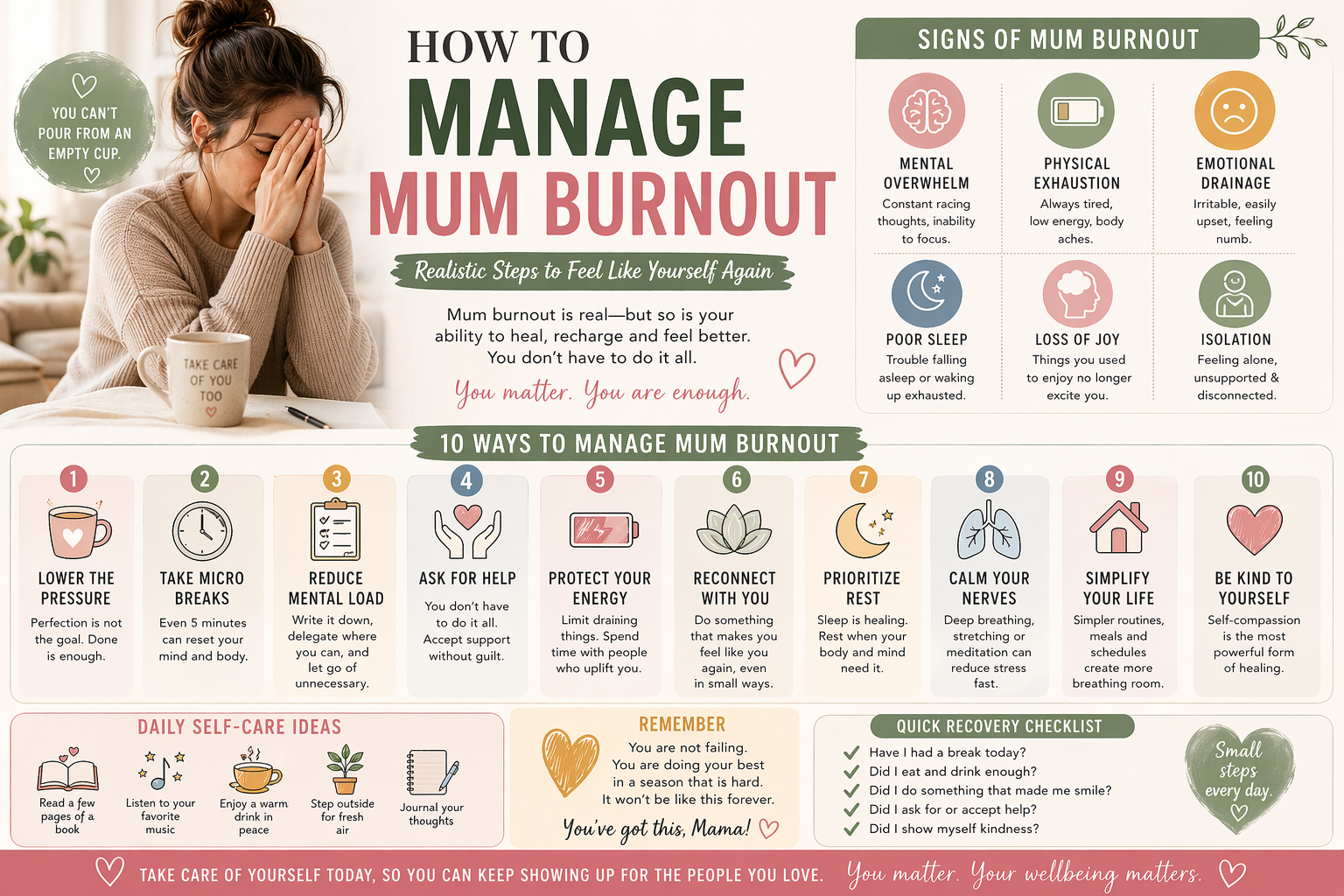
Here are the signs. Read them carefully. Be honest.
Emotional exhaustion beyond normal tiredness — You feel emotionally wiped out in a way that goes beyond sleepiness. Even pleasant things feel effortful. The emotional bandwidth isn’t there.
Emotional detachment from your children — This is the most frightening one for mums to admit, so let me be clear: it is a symptom, not a character flaw. Feeling like you’re going through the motions with your children, not being able to access warmth or joy when you’re with them, feeling like you’re watching yourself from the outside — this is depersonalisation, and it’s a direct consequence of burnout.
Chronic irritability and low frustration tolerance — Small things that wouldn’t normally bother you trigger disproportionate reactions. You snap. You feel the anger rising before you can catch it. Then you feel guilty, which feeds the exhaustion further.
Crying without knowing why — Or the opposite: being unable to cry even when you want to. Emotional numbness or volatility with no clear cause.
Resentment — Toward your partner, your children, your life, other mums who seem to be managing better. Resentment is almost always a sign that your needs are being consistently unmet. It’s information, not a personality defect.
Feeling like motherhood has swallowed you whole — A loss of identity beyond being “Mum.” The sense that the person you were before children has become inaccessible.
Persistent fatigue that sleep doesn’t fix — The defining physical feature of burnout. You rest and you’re still tired. Your body feels heavy. Getting up is a conscious effort.
Getting ill frequently — Chronic stress suppresses immune function. If you’re catching everything the kids bring home, if you’re getting colds that linger for weeks, if your body keeps failing you — that’s a physical sign of being chronically depleted.
Physical symptoms without medical cause — Headaches, digestive issues, muscle tension, chest tightness, heart palpitations. The body holds stress in physical form when the emotional load becomes too great.
Changes in sleep quality — Not just quantity, but quality. Waking at 3am with your mind racing. Difficulty falling asleep despite being exhausted. Non-restorative sleep where you wake more tired than when you went down.
Neglecting your own basic needs — Not eating properly, not drinking enough water, not going to the GP about the thing that’s been bothering you for six months. When self-maintenance feels impossible, that’s a serious sign.
Withdrawing from everything — Cancelling on friends you actually like. Not replying to messages. Finding socialising intolerable even when you once found it energising.
Increasing reliance on numbing behaviours — More alcohol than usual, more scrolling, more food used for comfort, more television not because you enjoy it but because it turns your brain off.
Loss of things that used to bring pleasure — Hobbies, activities, interests that once restored you now feel flat or pointless. This is called anhedonia and it’s a significant clinical symptom.
Difficulty with basic decisions — Decision fatigue taken to an extreme. Even simple choices — what to make for dinner, what to wear — feel overwhelming because your executive function is operating under such high load.
Here is something important, and it matters: mum burnout is underdiagnosed because so much of what it looks like gets normalised.
“All mums are tired.” True — but not that tired.
“It’s just the toddler phase.” Maybe — but burnout doesn’t care which phase you’re in.
“You’ll feel better when you get a full night’s sleep.” Often false, if the issue is burnout rather than sleep deprivation.
There is also a cultural problem. We celebrate maternal sacrifice. We reward self-depletion in mothers with the label of “devoted.” We make it very difficult for mums to say I am not okay without the fear of being perceived as ungrateful, incapable, or somehow failing their children.
This cultural silence has real consequences. Research by Roskam and colleagues found that burnout is associated with escape ideation (persistent thoughts of running away or disappearing) and in severe cases, child maltreatment — not because burned-out mums are bad parents, but because humans who are profoundly depleted cannot reliably access their best selves.
This is why talking about mum burnout matters. Not to add guilt — but to remove it. To say: this is a real thing, it has real consequences, and you deserve real help.
You cannot manage mum burnout without understanding what’s causing it. And the causes are usually not one dramatic thing — they’re the accumulation of a hundred small, invisible things that never get named.
The mental load is the cognitive labour of running a family: remembering the school uniform order, booking the dentist, knowing who needs new shoes, planning meals, tracking developmental milestones, holding the emotional temperature of everyone in the household.
Research consistently shows this load falls disproportionately on mothers — including in households where both parents work. It is exhausting not because any one task is hard, but because it is constant and invisible and rarely acknowledged.
There is often a significant gap between the parenthood we were sold and the parenthood we’re living. The idea of motherhood — warm, instinctive, fulfilling, natural — does not always match the reality of it: repetitive, isolating, undervalued, and structurally unsupported.
When reality consistently falls short of expectation, it erodes the sense of meaning that makes hard work sustainable. That erosion is central to burnout.
Humans were not designed to raise children alone, or in nuclear family units without community support. The village is real — and for most modern mums, it doesn’t exist. No grandparents nearby. Friends with their own full lives. Partners who are present but not fully sharing the load.
Chronic isolation combined with chronic demand is a direct path to burnout.
The internal voice that says you should be doing more, being more, giving more — that voice is fuel for burnout. Perfectionism in parenting doesn’t produce better outcomes. It produces exhausted parents.
The standard you’re holding yourself to may simply be impossible. That’s worth looking at directly.
Before children, you had a career, friendships, interests, ambitions, and an identity that was wholly yours. Motherhood can overlay all of that so completely that you stop being able to remember who you are outside of it.
Loss of identity is both a symptom and a cause of burnout. When you can no longer access the parts of yourself that brought you meaning and joy, the work of parenting loses its broader context.
Now we get to the part that actually matters. Not a five-step plan that wraps everything up neatly. Real strategies, in order of what needs to happen first.
This sounds too simple. It is not.
Naming burnout — saying the words, even just to yourself — does something important. It moves the experience from vague, formless suffering to a specific, identifiable thing that has causes and solutions. It takes it out of the realm of “I’m just not coping” and puts it where it belongs: “I am experiencing burnout. That’s a real condition. It’s not my fault. And it can get better.”
If you can say it to someone else — your partner, a friend, your GP — even better. The act of naming it aloud reduces its power significantly.
I mean this seriously, not as a disclaimer. Burnout can be indistinguishable from clinical depression, anxiety, or a hormonal imbalance (particularly in postpartum or perimenopausal mums). A GP can help rule out or identify contributing medical factors and can refer you to appropriate support.
There is nothing dramatic about making this appointment. It is the sensible first move, especially if your symptoms have been present for more than a few weeks.
If you’re experiencing thoughts of escaping, harming yourself, or profound hopelessness, please contact your GP today or call the Samaritans on 116 123 (free, 24/7 in the UK). Burnout at this level requires professional support, not blog posts.
The only way out of burnout is to reduce what’s causing it. Everything else — the self-care, the mindfulness, the supplements — is supportive. But if the conditions that created the burnout don’t change, burnout will return.
This means having difficult conversations.
With your partner: What specifically are you carrying that they’re not? Name it. Not in a moment of crisis, but calmly and clearly. You may need to use a framework like the “Fair Play” system (Eve Rodsky’s book on equitable division of the mental and physical load) to make the invisible visible.
With your family: Can your mum take the kids one afternoon a week? Can your sister come over and just be present? Don’t wait for people to offer — ask.
With yourself: What can actually stop? What are you doing out of obligation, guilt, or habit rather than genuine necessity? The school bake sale, the perfect birthday parties, the immaculate house — some of this can go.
The belief that you have to earn rest is central to burnout. It’s also completely wrong.
Rest is not a luxury to be unlocked once everything is done. It is a physiological need, as non-negotiable as food and water. Your nervous system requires rest to function. Denying it is not noble — it’s unsustainable.
This means resting before you’re desperate. It means napping when the children nap without first cleaning the kitchen. It means sitting down in the afternoon, in the middle of the day, without a productive reason. It means sleeping before midnight.
If guilt arrives when you rest — and it will, for a while — try acknowledging it without obeying it: “I can hear that voice telling me I should be doing something useful. I’m choosing to rest anyway.”
One of the most underestimated aspects of burnout recovery is rebuilding the sense of self that exists beyond parenting.
This does not mean abandoning your children or rejecting motherhood. It means remembering that you were a full person before you became a mum, and that person still exists and still has legitimate needs.
Ask yourself: Who was I before this? What did I love that has nothing to do with children? What made me feel capable and interesting and alive?
Then find one small way to reconnect with that. A weekly book club. A creative project. A podcast that engages your brain. A career conversation you’ve been putting off. A friendship you’ve been neglecting.
Identity isn’t rebuilt in a single afternoon. It’s rebuilt in small, consistent acts of remembering yourself.
When you’re in burnout, your nervous system is stuck in a state of chronic activation — your body is running as though there’s always an emergency, even when there isn’t. Small, consistent habits that engage the parasympathetic nervous system (the “rest and digest” mode) gradually shift this baseline.
These are not cures. They are tools. Used consistently, they make a measurable difference:
Breathwork — Box breathing, 4-7-8 breathing, or simply long slow exhales (the exhale specifically activates the vagus nerve). Do this for two minutes whenever you feel the anxiety rising. Over time, it recalibrates your stress response.
Physical movement — Not as punishment or weight loss, but as nervous system regulation. A 20-minute walk, gentle yoga, swimming — movement metabolises the stress hormones that burnout keeps flooding your system with.
Sleep protection — Before anything else, before any habit, before any other self-care: protect your sleep. Go to bed before midnight. Remove screens from the bedroom. Keep a consistent sleep and wake time. Prioritise it above almost everything else in the short term.
Nature exposure — Even briefly. Even just sitting by an open window or standing in the garden for ten minutes. Natural environments reliably downregulate the stress response in ways that are out of proportion to how simple they seem.
Cold water on your face — This sounds strange, but splashing cold water on your face activates the dive reflex, which slows heart rate and reduces acute anxiety within 30 seconds. Useful in moments of overwhelm.
Isolation feeds burnout. Connection interrupts it.
But here’s the thing: when you’re burned out, socialising often feels like another demand. The idea of making plans, showing up, being present — it can feel impossible. The temptation is to withdraw further.
The withdrawal makes it worse.
You don’t need to perform. You don’t need to be entertaining or positive or have it together. You need to be in the presence of people who know you and accept you as you are.
One honest conversation with a friend who knows you well — where you actually say “I’m not okay, I’m burned out” — can be more restorative than a week of solo self-care. We are fundamentally social animals. We heal in connection, not in isolation.
If your current social circle doesn’t have space for honesty, therapy is not a second-best option. It’s a first-rate one.
Recovery from burnout doesn’t happen in one grand gesture. It happens in a hundred small, consistent daily choices. Here is a realistic framework for the early stages of recovery.
Wake before the children if at all possible. Not to be productive — to be quiet. Drink something warm. Sit without your phone for a few minutes. Set one intention for the day: not a task, but a way of being. Something like “Today I will ask for help once” or “Today I will take a rest without guilt.”
This window — even just fifteen quiet minutes — creates a small buffer between sleep and the demands of the day. Over time, that buffer becomes important.
Don’t wait for big windows of self-care that may never arrive. Look for micro-moments:
These feel trivial. Consistently done, they are not trivial.
The evening is where burnout either gets worse or starts to soften, depending on what you do with it.
Resist the urge to spend the post-bedtime hours catching up on tasks. Do some tasks — but protect at least 45 minutes of genuine downtime before your own sleep: not scrolling, not news, not productivity. A bath. A book. A conversation with your partner that isn’t about logistics. Something that signals to your nervous system that the day is genuinely ending.
Once a week, build in something that is solely yours. Not a chore done alone, not a task accomplished without children — something that genuinely restores you. A long walk. An afternoon at a coffee shop alone. A creative project. A nap with the phone in another room.
This requires coordination. It requires asking your partner or family for the time. It requires protecting it when other things try to take it. It is worth all of that.
Because this matters too.
The instinct when burned out is often to try harder. To organise better, plan better, be more efficient, squeeze more productivity out of the same depleted system. This does not work. It makes burnout worse. The nervous system doesn’t respond to willpower when it’s in a state of chronic depletion.
Social comparison is always unhelpful. During burnout, it is actively harmful. The mum who looks like she’s managing — the school gate mum, the Instagram mum — is carrying something you can’t see. And even if she genuinely is thriving, her situation is different from yours in ways that make comparison meaningless.
Burnout that gets mislabelled as tiredness tends to get treated with rest, which helps briefly but doesn’t address the underlying depletion. Proper recognition leads to proper recovery. Give it the weight it deserves.
The withdrawal impulse is strong. Resist it. Even one honest conversation a week with someone who loves you matters. Isolation makes every symptom of burnout worse.
Burnout does not typically resolve without intervention. The conditions that created it continue; the symptoms continue; the depletion deepens. Active recovery — changing conditions, seeking support, building habits — is what moves the needle.
It’s important to say clearly: burnout and depression share significant overlap, and it is not always easy to tell them apart.
Burnout tends to be contextual — better on holiday, worse during intense periods of demand. Depression is more pervasive — present regardless of context, not improved by rest.
But both are real. Both deserve attention. And both require professional support at certain levels of severity.
Please contact your GP if:
Useful UK resources:
Recovery is not a straight line. This is important to know.
There will be good days that feel like the corner has been turned, followed by a hard day that makes you feel like you’re back at square one. You haven’t gone backwards — this is what recovery looks like. It’s non-linear. It moves in waves.
What changes, gradually, is the depth and frequency of the hard days. The good days start to outnumber the difficult ones. The emotional reactivity softens. The joy starts to come back — not all at once, not reliably, but in moments. A laugh that surprises you. A moment with your child that actually lands.
Recovery requires:
That last one matters most. The inner critic that tells a burned-out mum she should be doing better, coping more gracefully, needing less — that voice is part of the problem. Learning to quiet it is part of the solution.
If you’re a partner reading this because someone sent it to you — pay attention.
Mum burnout is not a personal failing. It is the predictable result of too much demand and too little support. If your partner is burned out, the question to ask is not “What’s wrong with her?” but “What has she been carrying that I haven’t seen?”
The most useful thing you can do is ask, and then listen. Not to fix — to listen. Ask what she’s carrying that you’re not. Ask what she needs. Ask what she’s given up. And then take action to share the load differently.
This is not about blame. It’s about a sustainable system that works for both of you. A burned-out mum is not good for anyone in the household — not for herself, not for the children, and not for the relationship. Supporting her recovery is an investment in your whole family.
Mum burnout is a state of chronic physical, emotional, and mental exhaustion caused by the relentless demands of motherhood without adequate support or recovery. It is distinct from ordinary tiredness in that rest alone does not resolve it. Mum burnout is characterised by three core features: deep exhaustion, emotional detachment from your children (depersonalisation), and a lost sense of fulfilment in parenting. It is a recognised condition studied by academic researchers, including Isabelle Roskam and Moïra Mikolajczak, whose work on parental burnout has been published internationally.
The main signs of mum burnout include: persistent exhaustion that sleep doesn’t fix, emotional detachment or numbness toward your children, chronic irritability and low patience, frequent crying or emotional flatness, physical symptoms like headaches and illness, withdrawal from friends and activities, loss of personal identity, resentment toward your family or situation, and a sense of going through the motions of parenting without any emotional connection. If several of these have been present for weeks rather than days, it’s worth taking seriously.
Recovery from mum burnout typically takes several months rather than weeks. The timeline varies depending on severity, the level of support available, whether the underlying causes are addressed, and whether professional help is involved. Recovery is rarely linear — there will be better days and harder days — but with consistent effort, changed conditions, and support, most mums do experience meaningful improvement. If symptoms don’t improve after a few weeks of active effort, please see your GP.
Mum burnout and postnatal depression overlap in symptoms but are different conditions. Postnatal depression (PND) is a clinical mood disorder that occurs after childbirth and involves persistent low mood, loss of interest, and sometimes thoughts of self-harm. Mum burnout can occur at any stage of motherhood — not just in the postnatal period — and is primarily driven by excessive demand and insufficient recovery rather than hormonal or neurological factors. However, the two can coexist, and both require professional attention. If you’re unsure which you’re experiencing, please see your GP.
Yes. Mum burnout is arguably more common in stay-at-home mums precisely because there is no separation between “work” and “home” — the demands are continuous, there is no clear end to the working day, and the social isolation of full-time childcare at home removes many of the natural buffers against burnout. Stay-at-home mums are also sometimes less likely to have their exhaustion taken seriously, because their labour is culturally undervalued. Burnout does not discriminate based on employment status.
The first thing to do is name it — say the words to yourself or someone else. Then see your GP, particularly if symptoms have been present for more than two to three weeks. Next, try to identify what specifically is contributing to your burnout (the mental load, isolation, identity loss, perfectionism) and address at least one of those causes. Begin small, consistent daily habits that support nervous system recovery — sleep, movement, breathwork, rest. Seek connection rather than further isolation. And please, be patient with yourself. Recovery is possible.
Choose a calm moment rather than a moment of crisis. Be specific rather than general — rather than “I’m exhausted,” try naming particular things: “I’m carrying all the mental load of the family and I’m depleted. I need us to share this differently.” Use resources like Eve Rodsky’s Fair Play system to make the invisible load visible. Be clear about what you need — not a vague “more support” but specific asks. And be prepared for the conversation to take more than one sitting. Your partner may not immediately understand what burnout means, but they can learn.
Yes — but it’s important to understand why. Anger in burnout is almost always a symptom of unmet needs rather than a character problem. Chronic irritability and low frustration tolerance are classic features of burnout because the nervous system is chronically overloaded and has no buffer left. This doesn’t make the anger appropriate or consequence-free, but it does make it explainable. Addressing the underlying depletion — through rest, reduced load, and support — typically reduces the anger significantly over time.
Yes. Therapy, particularly Cognitive Behavioural Therapy (CBT) or compassion-focused therapy, can be very effective for mum burnout. A therapist can help you identify the thought patterns (perfectionism, guilt, the inner critic) that contribute to burnout, develop coping strategies, process the grief and loss that often accompanies burnout, and work through the identity questions that motherhood raises. Many therapists now offer online sessions, which makes access easier for mums at home. NHS Talking Therapies offers free, self-refer sessions in the UK.
Preventing relapse requires addressing the conditions that created the burnout in the first place: ongoing equitable sharing of the mental and domestic load, regular time for personal restoration, a social network that provides genuine support, maintained medical care for yourself, and the consistent practice of saying no to non-essential demands. It also requires ongoing self-compassion — the willingness to treat your own depletion as seriously as you’d treat your child’s fever rather than something to push through. Burnout prevention is not a one-time fix. It’s a consistent, ongoing commitment to treating yourself as someone who matters.
Mum burnout is real. It’s not a sign that you’re doing motherhood wrong — it’s a sign that you’ve been doing too much for too long without enough support. And that is a structural, cultural, relational problem, not a personal failing.
The path through it is not one heroic gesture. It’s the slow, consistent work of naming what’s happening, getting support, reducing the load, resting without guilt, and rebuilding the parts of yourself that got buried under the weight of it all.
You were a whole person before you became a mum. You still are. And you deserve to feel that way again.
If today all you do is admit to yourself that you’re burned out — that’s enough. That’s where it starts.