Physical Address
304 North Cardinal St.
Dorchester Center, MA 02124
Physical Address
304 North Cardinal St.
Dorchester Center, MA 02124

Nobody warned me that breastfeeding would be the hardest thing I did in those first weeks.
Not the birth. Not the sleep deprivation — though that was a close second. Breastfeeding.
I had assumed it would be instinctive. Natural. The word is right there in the discourse around it: natural. As though it would simply happen, smoothly and intuitively, because mammals feed their young this way and I am a mammal. As though my body and my baby would immediately find each other in the dark and work it out together.
What actually happened was: three days in, my nipples were cracked and bleeding. My milk hadn’t come in yet and my colostrum-fed baby was screaming what I understood, in my sleepless state, to be an accusation. A lactation consultant watched me attempt a latch and said, very gently, “Let’s try that again from the beginning” — and I burst into tears in a way I hadn’t managed during the birth itself.
The thing is: it did get better. By week three it was comfortable. By week six it was easy. By month three I was doing it in the supermarket with one hand while checking my shopping list.
But those early weeks were genuinely hard. And nobody had told me they would be. Nobody had given me the specific, practical, unglamorous information that would have made them less hard.
This post is that information.
These are the breastfeeding tips for new mums I wish someone had handed me in the hospital: the honest ones, the specific ones, the ones that address the gap between what breastfeeding is supposed to be like and what it is actually like for a significant number of new mums in the first days and weeks.
This is the single most useful reframe I can offer you, and it should come before any specific tip.
Breastfeeding is a skill. It is learned — by you and by your baby, simultaneously, while you are both exhausted and new to each other and operating under conditions of significant hormonal flux.
Like every skill, it takes time to learn. Like every skill, it involves doing it badly before you do it well. Like every skill, it is far easier with a good teacher than without one.
The cultural narrative that breastfeeding should come naturally creates enormous suffering when it doesn’t — because the mum who is struggling assumes the problem is her. Her body. Her commitment. Her adequacy as a mother. When the actual problem is that she is learning something genuinely difficult without adequate support, and she needs help, not self-blame.
When it’s hard — and for many mums it will be hard — the answer is not to try harder alone. It is to ask for help. From a midwife. From a lactation consultant. From one of the several excellent breastfeeding helplines available free of charge in the UK. Help is the answer. Not perseverance through pain without information.
Before any breastfeeding tip: the wellbeing of your baby depends on them being fed. If breastfeeding is not working — if there is a genuine supply problem, a medical issue, a mental health crisis, a physical barrier — feeding your baby in whatever way achieves that is the priority. Always.
This post is written in support of mums who want to breastfeed and want practical help to do so. It is not written to pressure any mum into breastfeeding when it is not working for her. Formula exists and it is a completely valid choice. Both can be true: breastfeeding has genuine benefits worth supporting, and formula feeding is not failure.
With that said — let’s get into the tips.
The first days of breastfeeding happen in an environment of intense hormonal shift, physical recovery from birth, and steep learning curve for both you and your baby. Here is what you need to know to navigate them.
Skin-to-skin contact immediately after birth — your baby placed directly onto your bare chest — helps trigger the instinctive feeding behaviours babies are born with. In this state, given time and no interruptions, many newborns will “breast crawl” toward the nipple and attempt to latch without any help.
This first feed, ideally within the first hour after birth (sometimes called the “golden hour”), sets the scene for early milk production by triggering the hormonal cascade — specifically the release of oxytocin and prolactin — that initiates breastfeeding.
However: if you had a complicated birth, a caesarean, or if your baby needs medical attention, this immediate skin-to-skin may not be possible. That is okay. It does not mean breastfeeding is now impossible. Many mums who couldn’t feed in the first hour go on to breastfeed successfully. Ask your midwife about when and how to begin.
In the first two to four days after birth, your breasts produce colostrum — a thick, yellowish, concentrated early milk that is sometimes called “liquid gold.” It is produced in very small quantities (often just millilitres per feed) and this alarms many new mums who expect to see significant volumes.
Colostrum is not inadequate. It is perfectly calibrated to a newborn’s tiny stomach (the size of a marble at birth) and provides exactly what your baby needs in the first days: concentrated protein, antibodies, growth factors, and a natural laxative that helps clear meconium. Your baby does not need large volumes of colostrum. They need frequent access to small amounts.
Your milk will “come in” — transition from colostrum to mature milk — typically between day two and day five postpartum. This process involves breast engorgement (your breasts becoming noticeably fuller, firmer, and sometimes uncomfortably so) and often a shift in your baby’s feeding behaviour.
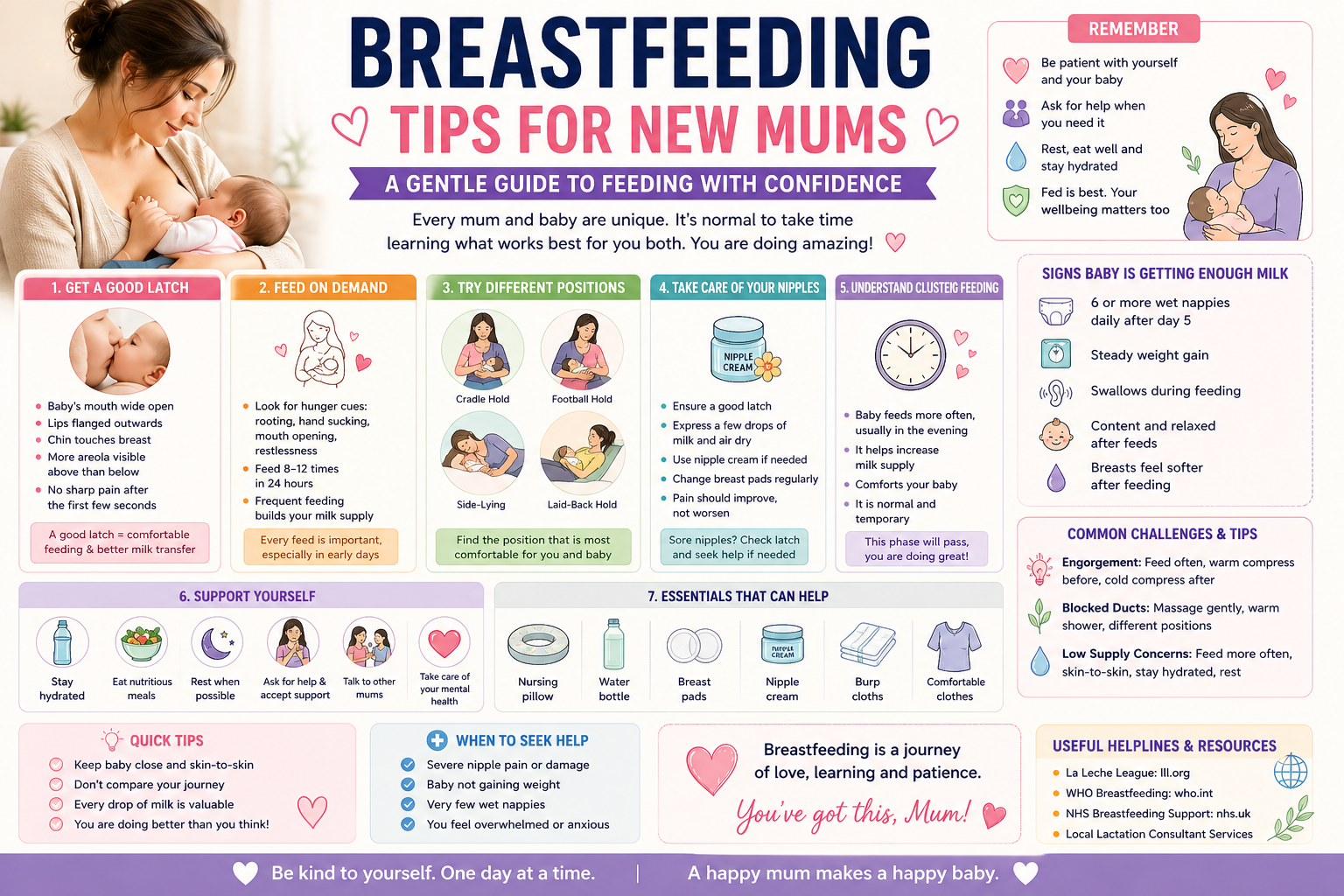
Trust the colostrum. Feed frequently in these early days (8-12 times per 24 hours is normal and necessary). The frequency of feeding drives the milk supply that follows.
In the early weeks, breastfeeding works best when it is demand-led. Feed when your baby shows hunger cues — rooting (turning the head and opening the mouth), sucking on hands, making mouthing movements — rather than at set intervals.
Feeding on demand in the early weeks does two critical things: it prevents your baby from becoming too hungry and too upset to latch effectively, and it establishes your milk supply by creating frequent demand signals to your body.
The frequency of newborn feeding is genuinely relentless and often surprises new mums. Eight to twelve times per 24 hours is the norm in the first weeks. Some babies feed more often. Cluster feeding — where a baby feeds very frequently for several hours, often in the evening — is completely normal and is not evidence that you don’t have enough milk (more on this below).
Watch your baby, not the clock.
Rather than watching the clock during feeds, learn to read the signs that your baby is feeding well:
Signs of a good feed in progress:
Signs your baby has had enough:
Signs the feed may not be effective:
If there is one breastfeeding tip for new mums that matters more than all the others combined, it is this: the latch is everything.
A good latch is the foundation of comfortable, effective breastfeeding. A poor latch is the cause of most of the problems that lead mums to stop breastfeeding earlier than they wanted to: nipple pain, nipple damage, low milk transfer to the baby, and low milk supply caused by inadequate emptying of the breast.
The good news: latch problems are almost always fixable. The frustrating news: fixing a latch requires hands-on support and practice, not just reading a description. Use this section to understand what you’re aiming for, and please get in-person help from a midwife, health visitor, or lactation consultant if the latch isn’t comfortable.
A good latch has all of these features:
The baby’s mouth is wide open — like a yawn, not a small pout. You are aiming to get as much of the areola (the darker skin around the nipple) as possible into the baby’s mouth, not just the nipple itself.
The baby’s chin is touching the breast — the chin makes first contact before anything else. This position means the baby’s tongue is placed well to draw milk effectively.
The baby’s lips are flanged outward — like a fish’s lips, turned out rather than tucked in. You may need to gently ease the lower lip out after latching if it’s tucked under.
More areola visible above the top lip than below the bottom lip — this asymmetric latch is normal and correct. The baby takes more from the bottom of the areola than the top.
Your nipple is comfortable — there may be brief discomfort at the start of latching as the nipple positions itself correctly in the baby’s mouth, but this should fade within the first ten to thirty seconds. If pain persists throughout the feed, the latch needs adjusting.
1. Position yourself comfortably first. You will spend many hours in this position. Your back should be supported, your arm comfortable, and the baby at breast height — either with a nursing pillow or strategically placed sofa cushions. The baby comes to the breast; you don’t lean toward the baby.
2. Hold your baby tummy to tummy. Your baby’s whole body should be turned toward you — not lying on their back with their head turned sideways. Ear, shoulder, and hip should be in a straight line.
3. Aim nipple to nose, not mouth. Position your nipple so it points toward your baby’s nose or upper lip, not directly at the mouth. This positioning encourages the baby to tilt their head back and open wide to reach up for the nipple, which produces a deeper latch than aiming straight in.
4. Wait for a wide-open mouth. You can encourage this by gently touching your nipple to your baby’s upper lip, which often triggers the rooting reflex and a wide open mouth. Wait for the wide open moment before bringing the baby to the breast.
5. Bring the baby to the breast quickly and decisively when the mouth opens wide. Don’t push the breast to the baby — move the baby to the breast with the back of their head (not pushing the head, just guiding gently). This quick movement is what achieves a deep latch.
6. Check immediately. Can you hear swallowing? Is the latch comfortable? If pain persists beyond thirty seconds, break the suction gently (slip your clean finger into the corner of the baby’s mouth to break the seal) and try again.
Never simply pull the baby off the breast — the suction created during breastfeeding is significant and pulling against it causes nipple trauma. Always break the seal first by inserting a clean finger into the corner of the baby’s mouth and then removing the baby from the breast.
Different positions work better for different mums, different babies, and different situations. Here are the main ones worth knowing.
The most common and recognisable position. Baby lies horizontally across your body, tummy to tummy, with their head in the crook of your arm on the same side as the feeding breast. This position works well once feeding is established but can be more difficult in the early days when you’re learning the latch, because it gives you less control over the baby’s head position.
Baby lies horizontally across your body as in the cradle hold, but your opposite hand supports the baby’s head. If feeding from the right breast, your left hand cups and supports the baby’s head, giving you more control over positioning and latch. Many lactation consultants recommend this for new mums specifically because the greater control makes it easier to achieve a good latch while you’re still learning.
Baby is tucked under your arm on the same side as the feeding breast, like a rugby ball. This position is particularly useful after a caesarean because there is no pressure on the abdominal wound. It’s also useful for mums with larger breasts, for twins (one under each arm), and for babies who have difficulty latching in the cradle hold.
Both you and your baby lie on your sides, facing each other, tummy to tummy. This position is excellent for night feeds because neither of you has to fully sit up, and it allows the mum’s body to rest during long feeding sessions.
Important safety note: if you think you might fall asleep while feeding in this position, ensure you follow safe co-sleeping guidelines (firm mattress, no duvets near the baby, no alcohol or sedating medication, no bed-sharing if either parent smokes). The Lullaby Trust has current safe sleep guidance. It is safer to know and plan for the possibility of feeding while drowsy than to be unprepared for it.
You lean back at approximately a 45-degree angle (supported by pillows) and your baby lies tummy-down on your chest, with their head at the breast. This position uses gravity to help stabilise the baby against your body, can help with fast letdown (milk that comes too quickly for the baby to manage), and many mums find it activates the baby’s natural feeding instincts more reliably than other positions.
This is the section most new mums need most urgently and find hardest to access quickly. Here are the most common breastfeeding challenges and what actually helps.
Some nipple tenderness in the first few days of breastfeeding is normal — the skin is adapting to a new and intense function. What is not normal, and should not be accepted as unavoidable, is ongoing sharp pain during feeding, nipples that emerge from feeds looking flattened or lipstick-shaped, or nipples that are cracked, bleeding, or developing scabs.
If your nipples are very sore: first, assess the latch. Most nipple pain is caused by a shallow latch. Get hands-on help from a midwife or lactation consultant. In the meantime:
Lansinoh HPA Lanolin: Apply after every feed. This is the most consistently recommended nipple cream by lactation consultants worldwide. It relieves pain, creates a moist healing environment, and is safe for the baby (no need to wipe off before feeds). Apply a small pea-sized amount generously.
Breast milk: A few drops of your own breast milk on the nipple after a feed, allowed to air-dry, has antimicrobial properties and supports healing. This is a free and effective intervention.
Air: Let your nipples air between feeds when possible. Moisture trapped in a bra creates an environment for bacteria and yeast. Air them.
Nipple shields: These silicone covers worn over the nipple during feeding can provide temporary relief from severe nipple pain and allow healing. They should be used with guidance — they can affect milk transfer if used incorrectly — but in the short term with support, they can be the difference between continuing to breastfeed and stopping. Ask your midwife or lactation consultant before using them.
When your milk comes in — typically day two to five — your breasts can become swollen, hard, and uncomfortably full. Engorgement also happens if feeds are missed or spaced too widely.
What helps:
Worry about milk supply is one of the most common reasons mums stop breastfeeding earlier than they wanted to. It’s important to distinguish between genuinely low milk supply (which is less common than perceived) and normal newborn breastfeeding behaviour that is misread as insufficient supply.
Signs your baby is getting enough milk:
Things that are not evidence of low supply:
Genuinely boosting supply: The most effective strategy for increasing milk supply is increasing demand — feeding more frequently, ensuring complete breast emptying at each feed, and adding pumping sessions after feeds. The breast operates on a supply-and-demand principle: the more milk removed, the more milk produced.
Galactagogues — foods and supplements traditionally associated with milk production (oats, fenugreek, brewer’s yeast, blessed thistle) — have mixed evidence but are harmless and used widely. More important than any supplement is frequent, effective feeding.
If you have genuine concerns about supply — particularly if your baby is not gaining weight appropriately — please see your midwife or GP rather than trying to manage it alone. A lactation consultant can assess milk transfer directly and give you accurate information about what is happening.
Mastitis is an inflammation of the breast tissue, which may or may not involve infection. It typically presents as a red, hot, painful patch on one breast, accompanied by flu-like symptoms — fever, chills, body aches, extreme fatigue.
Mastitis requires prompt attention. If you develop these symptoms:
Keep feeding from the affected breast. This is counterintuitive when the breast is painful, but continuing to feed (or express) is the most important thing you can do. Milk stasis (milk that isn’t being removed) is what allows mastitis to develop and worsen. Stopping feeding from the affected breast dramatically increases the risk of a breast abscess.
Feed or express frequently — starting with the affected side where possible.
Apply warmth before feeding to help milk flow and cold after feeding to reduce inflammation.
Rest. Mastitis thrives on exhaustion. This is a medical reason to stop everything and rest.
See your GP within 24 hours if symptoms don’t improve or if they began with a fever above 38.5°C. Antibiotics are commonly prescribed and are safe during breastfeeding. Take the full course even if you feel better — undertreated mastitis can develop into a breast abscess, which is significantly more serious and may require surgical drainage.
If you have burning, stinging nipple pain during and between feeds — a deep, shooting pain rather than the surface tenderness of latch issues — and if you’ve had antibiotics recently or your baby has white patches in their mouth, nipple thrush may be involved.
Nipple thrush is caused by the candida fungus and requires antifungal treatment for both mum and baby simultaneously, because it passes back and forth between nursing pairs. Treating only one of you will result in reinfection.
See your GP. Daktarin oral gel for the baby’s mouth and an antifungal cream for your nipples are the standard treatment. Continue breastfeeding through treatment.
A tongue tie (ankyloglossia) is a condition where the frenulum — the small band of tissue connecting the underside of the tongue to the floor of the mouth — is too short or tight, restricting the tongue’s range of movement. It affects approximately 4-10% of babies and can significantly impact breastfeeding by preventing the baby from achieving a deep latch.
Signs that may indicate tongue tie:
Tongue tie is diagnosed by assessment — ask your midwife, health visitor, or GP for referral to a tongue tie practitioner. Division (snipping) of the tongue tie is a simple, quick procedure that often immediately improves latch and feeding. In the UK it is available through some NHS trusts and privately.
Cluster feeding is one of the most commonly misunderstood aspects of early breastfeeding — and one that causes a significant number of new mums to supplement with formula or stop breastfeeding, because they interpret it as evidence that they don’t have enough milk.
Cluster feeding is when a baby feeds very frequently — sometimes every twenty to thirty minutes — for a period of several hours, usually in the evening. It is completely normal. It is not evidence of insufficient supply.
Cluster feeding serves multiple purposes: it triggers increased milk production (the baby is effectively placing an order for more milk in the coming days), it satisfies increased nutritional and comfort needs during a growth spurt or developmental period, and it loads the baby up with milk before a longer sleep stretch.
Growth spurts — and therefore cluster feeding episodes — typically occur around day three to five, around week three, around six weeks, around three months, and at various points beyond. They last approximately two to three days each time.
How to survive cluster feeding:
Accept that the evening cluster feed session is your job for this period. Set yourself up somewhere comfortable — a good chair or sofa corner with back support, a nursing pillow, everything you need within arm’s reach, and something you enjoy watching or listening to. This is not wasted time. You are building your supply and meeting your baby’s needs in the most direct way possible.
Tell everyone in your household what is happening and why — “this is cluster feeding, it’s temporary and normal, I’m going to need food and drinks brought to me for the next few days.” Remove the expectation that you’ll be moving from this spot.
And perhaps most importantly: do not supplement with formula during a cluster feeding phase unless there is a medical reason to do so. Supplementing with formula during cluster feeding reduces the demand signal to your breasts at exactly the moment your body is being asked to increase production. This is one of the most common ways in which genuine supply issues develop.
Every place you regularly breastfeed should have within arm’s reach:
A large water bottle. Breastfeeding makes you intensely thirsty — particularly at the moment of letdown. You will not remember to get up and get water mid-feed, so it needs to be there already. Aim for 2.5-3 litres of water per day while breastfeeding.
One-handed snacks. Breastfeeding burns approximately 300-500 extra calories per day. You are hungry for good reason. Nuts, oat bars, fruit, crackers and cheese, anything you can eat without two hands and without needing to cook or prepare.
Nipple cream. Applied after every feed, especially in the early weeks.
Breast pads. Disposable or reusable — to manage leakage between feeds, which is very common in the first weeks and can be significant.
Your phone and headphones. You are going to be stationary for a lot of hours. Having something to listen to or watch makes this time feel less like being trapped and more like a carved-out pocket of something that’s yours.
A good pillow for your back and one for positioning the baby. A nursing pillow (My Brest Friend, Boppy, or a large V-pillow) makes a real difference to your physical comfort during feeds, particularly for longer sessions.
A well-fitting, supportive nursing bra — one with easy access clips for feeding — matters more than it sounds. Underwire bras can press on milk ducts and contribute to blocked ducts and mastitis. Bras that are too tight restrict circulation. A correctly fitted soft-cup nursing bra provides support without compression.
Get measured for a nursing bra after your milk comes in rather than before — your size will change significantly. Bravado, Hotmilk, and Carriwell are consistently well-reviewed brands. Many department stores and specialist maternity shops offer nursing bra fitting services.
At night, a sleep nursing bra or soft crop-style nursing bra provides enough support to hold breast pads in place without being restrictive.
Expressing — using a pump or hand expression to remove milk outside of direct feeds — gives you options: a partner can feed the baby, you have a supply for when you’re away, and in some cases pumping is used to boost supply.
When to start expressing: Most breastfeeding advisors recommend waiting until breastfeeding is well established — typically around four to six weeks — before regularly expressing, so that your supply calibrates to your baby’s demand rather than to a combination of baby demand and pump. There are exceptions: if your baby is premature or unwell and unable to feed directly, or if you’re producing significantly more milk than your baby needs, earlier expressing may be recommended.
Hand expression is worth learning — it’s free, always available, and useful particularly in the early days for softening an engorged areola or collecting colostrum. Ask your midwife to show you before you leave hospital.
Electric pumps: Hospital-grade double electric pumps are the most effective option. Many can be hired through NCT or the Association of Breastfeeding Mothers. Consumer-grade double electric pumps (Medela, Elvie, Spectra) are effective and convenient. Hands-free wearable pumps (Elvie, Momcozy) give you back the use of your hands and are worth the investment if you’ll be pumping regularly.
Storing breast milk: Freshly expressed breast milk can be stored at room temperature for up to four hours, in the fridge for up to four days (at the back, not the door), or in the freezer for up to six months. Use sterile containers or breast milk storage bags. Label with the date and time expressed.
You have an absolute legal right to breastfeed in public in England, Scotland, and Wales — in any place you are legally permitted to be. No one can ask you to leave or cover up. This is protected under the Equality Act 2010.
The most practical tip for feeding in public is practice: the more you do it, the less conspicuous it feels and the less conspicuous you actually are. A loose top and a nursing bra make feeding in public very discreet if that’s your preference. A muslin over your shoulder, a specific nursing cover, or simply the natural coverage provided by your baby’s body — all are options. So is feeding openly and without any cover, which is equally legal and equally valid.
Confidence grows with repetition. Give yourself permission to feed wherever you and your baby need to, because you are absolutely entitled to do so.
This is possibly the most important part of the entire post.
Breastfeeding support is not something you should need to earn by suffering first. If something is wrong — if feeding is painful, if you’re worried about your baby’s intake, if you’ve been told things aren’t right and you’re not sure what to do — please contact support today. Not after another few days. Not when you see the midwife next week. Today.
Your first port of call for breastfeeding concerns while your community midwife is still visiting (typically until day ten to fourteen postpartum). Request additional visits if feeding is not going well — you are entitled to them.
Your health visitor takes over from the midwife at day ten to fourteen and is available for breastfeeding questions, weight checks, and referrals beyond this point.
Many NHS trusts have a dedicated infant feeding team with specialist breastfeeding support. Ask your midwife or health visitor for a referral or contact your local maternity unit directly. In many areas this service is available as a drop-in.
These are genuinely excellent services staffed by trained breastfeeding counsellors who can help you work through problems by phone or video call:
National Breastfeeding Helpline: 0300 100 0212 (9:30am – 9:30pm daily) Association of Breastfeeding Mothers (ABM): 0300 330 5453 (9:30am – 10:30pm daily) La Leche League GB: 0345 120 2918 (24 hours) NCT Breastfeeding Helpline: 0300 330 0700 (8am – midnight daily)
If it is 3am and feeding is painful and you are sitting in a chair crying — which is where a significant number of new mums find themselves in the first two weeks — La Leche League’s 24-hour line is there. Use it.
If you need more intensive, hands-on support than the helplines can provide, an IBCLC is the gold standard in breastfeeding support. These are health professionals with extensive specialist training in lactation management. Private IBCLCs typically offer home visits and can assess latch, tongue tie, supply, and milk transfer directly.
Find a registered IBCLC in your area through the LCGB (Lactation Consultants of Great Britain) website.
Breastfeeding support groups — run by the NCT, La Leche League, peer support volunteers, or the NHS — offer in-person support, community, and the reassurance of being in a room with other breastfeeding mums. Many are free. Finding your local group and attending even once in the first few weeks is one of the most consistently valuable things a breastfeeding mum can do.
Some mums experience a sudden, brief wave of intense negative emotion — sadness, anxiety, dread, homesickness, or inexplicable emotional distress — at the moment their milk lets down during a feed. This typically lasts thirty to ninety seconds and resolves as the letdown passes.
This is called Dysphoric Milk Ejection Reflex (D-MER) and it is a physiological phenomenon — not a psychological one. It is thought to be caused by a sudden drop in dopamine that occurs as prolactin rises at letdown. It is not postpartum depression. It is not a sign that something is wrong with your bond with your baby. It is a genuine hormonal response that many mums experience without ever having a name for it.
Knowing it has a name and a cause is itself helpful. D-MER tends to improve over time as hormones stabilise. If it is severe or persistent, there are management strategies worth discussing with a healthcare provider. The D-MER Association (dmer.org) has the most comprehensive resource available.
If breastfeeding doesn’t work despite genuine effort — due to a medical issue, a mental health crisis, insufficient supply, an unsupported tongue tie, or simply circumstances that make it unsustainable — the grief that follows is real.
Many mums experience genuine loss when breastfeeding ends earlier than they wanted. This grief deserves to be acknowledged, not dismissed with “but the baby is fed and healthy.” Both things can be true: the baby is well, and you are sad about something you wanted that didn’t happen. The sadness doesn’t make you a failure. It makes you someone who cared.
If you are carrying this grief, please talk to someone — your health visitor, your GP, a peer support group, or a therapist. It is worth addressing rather than suppressing.
The most critical breastfeeding tips for new mums are: understand that breastfeeding is a skill that takes time to learn and that struggling is normal and fixable; prioritise getting the latch right above everything else — most breastfeeding problems stem from a shallow latch; feed on demand in the early weeks rather than on a schedule; don’t interpret cluster feeding as evidence of low supply; stay well hydrated and well nourished because breastfeeding has significant caloric and fluid demands; use nipple cream after every feed; ask for help early rather than persevering through pain without support; and know the contact details for breastfeeding helplines before you need them.
Some breast tenderness in the first few days is normal. Ongoing, significant, sharp pain during feeds is not normal and indicates a problem — most commonly a shallow latch — that can and should be fixed. If your nipple emerges from a feed flattened, white, or lipstick-shaped, the latch needs adjustment. Apply Lansinoh HPA Lanolin after every feed, allow nipples to air between feeds, and seek hands-on help from a midwife, health visitor, or lactation consultant. Do not accept persistent nipple pain as simply part of breastfeeding — it is a signal that something needs to change, and the change is almost always achievable with the right support.
The most reliable indicators that your breastfed baby is getting enough milk are: at least six wet nappies per 24 hours after day four, regular bowel movements (frequent and yellow in a newborn), your baby regaining their birthweight by two weeks (most by ten days), alertness between feeds, and a settled baby after most feeds (though not all — cluster feeding is normal). Things that are NOT reliable indicators of insufficient supply include: your breasts feeling softer after the first couple of weeks, your baby feeding frequently or for long periods, being unable to express much milk, or your baby wanting to cluster feed in the evening.
Cluster feeding is when a baby feeds very frequently — sometimes every twenty to thirty minutes — for a period of several hours, usually in the evening. It is completely normal and is not evidence of low milk supply. Cluster feeding serves to increase milk supply (the baby is placing an order for more), to meet heightened comfort and nutritional needs during growth spurts, and to load up before a longer sleep stretch. Growth spurts and associated cluster feeding typically occur around day three to five, around three weeks, six weeks, and three months. Supplementing with formula during cluster feeding disrupts the supply-building process and is one of the most common reasons genuine supply problems develop.
To achieve a good latch: position yourself comfortably first with the baby at breast height. Hold the baby tummy to tummy with their ear, shoulder, and hip in a straight line. Aim your nipple at the baby’s nose (not mouth) to encourage them to tilt their head back and open wide. Wait for a wide-open yawn-like mouth before bringing the baby to the breast quickly and decisively. A good latch shows your baby’s chin touching the breast, lips flanged outward, more areola visible above the top lip than below, and comfortable, rhythmic feeding with audible swallowing. If pain persists beyond thirty seconds, break the suction gently with a clean finger and try again.
If you develop a red, hot, painful area on your breast accompanied by flu-like symptoms (fever, chills, body aches), you likely have mastitis. Keep feeding from the affected breast — milk stasis worsens mastitis and stopping feeding dramatically increases the risk of a breast abscess. Feed or express frequently from the affected side. Apply warmth before feeds to help milk flow and cold after feeds to reduce inflammation. Rest as much as possible — this is a medical reason to stop all non-essential activity. See your GP within 24 hours, or sooner if you have a high fever. Antibiotics are commonly prescribed and are safe during breastfeeding. Take the full course even if you feel better.
The World Health Organisation recommends exclusive breastfeeding for six months, with continued breastfeeding alongside solid foods for two years or beyond. The NHS recommends exclusive breastfeeding for the first six months as the ideal. However, any amount of breastfeeding — one week, one month, six months — provides benefit. The right duration of breastfeeding is the one that works for both you and your baby. The decision to stop breastfeeding — whenever it happens and for whatever reason — is a personal one that doesn’t require justification or defence.
The most effective strategy for increasing milk supply is increasing demand — feed more frequently, ensure complete breast emptying at each feed, and add pumping sessions after feeds if needed. The breast operates on supply-and-demand principles: more milk removed equals more milk produced. Ensure your latch is effective, as an inefficient latch reduces milk removal and therefore supply. Stay well hydrated (2.5-3 litres per day). Eat enough food — significantly restricting calories reduces supply. Avoid nipple shields unless under lactation consultant guidance, as they can reduce milk transfer. Traditional galactagogues (oats, fenugreek, brewer’s yeast) have mixed evidence but are generally harmless. If you have genuine supply concerns, see a lactation consultant who can assess actual milk transfer.
Tongue tie (ankyloglossia) is a condition where the frenulum — the tissue connecting the underside of the tongue to the floor of the mouth — is too short or tight, restricting tongue movement. It affects approximately 4-10% of babies and can prevent a baby from achieving a deep latch, leading to nipple pain, ineffective milk transfer, and supply problems. Signs include persistent nipple pain despite working on latch, nipples emerging from feeds flattened or lipstick-shaped, a clicking sound during feeding, and visible difficulty lifting or extending the tongue. Diagnosis requires assessment by a trained practitioner. Division of the tongue tie is a quick, simple procedure that often immediately improves feeding. Ask your midwife or GP for referral.
Contact a lactation consultant (IBCLC) if: breastfeeding is consistently painful despite working on latch; your baby is not gaining weight appropriately; you suspect tongue tie; your supply seems genuinely low rather than a normal variation; you’re experiencing recurring mastitis or blocked ducts; your baby is having difficulty latching; you’re exclusively pumping and need support; or you simply want professional, hands-on, specialist support to establish feeding well. IBCLCs can be found through the LCGB (Lactation Consultants of Great Britain). In the meantime, the free breastfeeding helplines (National Breastfeeding Helpline: 0300 100 0212; La Leche League: 0345 120 2918, 24 hours) provide immediate, trained support by phone.
Three days postpartum, sitting in a hospital chair with a lactation consultant watching me and a baby who was screaming because we couldn’t figure each other out — I genuinely didn’t believe it was going to get better.
It got better.
Not all at once. Not in a single ah-ha moment where everything clicked. Gradually, incrementally, feed by feed and day by day, my body and my baby found a rhythm. The latch became automatic. The pain went away. The cluster feeding became a cosy evening ritual rather than a desperate endurance test.
By three months, I couldn’t remember what the hard part felt like from the inside.
If you’re in the hard part right now — if feeding is painful and you’re exhausted and you’re not sure you can keep going — please ask for help today. Not tomorrow. Today. The breastfeeding helplines are free and available. Lactation consultants exist specifically for this. Your midwife and health visitor can help, or help you find someone who can.
The information in this post is a starting point — the specific, practical breastfeeding tips for new mums that I wish someone had put in my hands before I left the hospital. But the post cannot replace hands-on support from someone who can see your latch, assess your baby’s feeding, and give you information specific to your situation.
Use this as a starting point. Then go find your people.
You’re doing something genuinely hard and genuinely worthwhile. Both of those things are true at the same time.