Physical Address
304 North Cardinal St.
Dorchester Center, MA 02124
Physical Address
304 North Cardinal St.
Dorchester Center, MA 02124

Meera watched her four-year-old, Aryan, stand frozen in front of the shoe rack for the third morning in a row, one shoe on, one shoe somehow already lost under the sofa, while she stood at the door with her office bag already on her shoulder, watch ticking toward a meeting she couldn’t be late for. It wasn’t defiance. It wasn’t even distraction, exactly. He just seemed to genuinely lose track of what he was doing between “find the shoe” and “put it on,” the same way he lost track mid-sentence sometimes, or forgot the second half of a two-step instruction the moment he started the first half.
Her mother, visiting for the week, watched the whole scene from the kitchen doorway and said, not unkindly, “Yeh sab discipline ki kami hai. Thoda strict ho jao.” A little more discipline, she meant. Meera wasn’t so sure. She’d recently read a phrase in a pediatrician’s waiting room pamphlet that had stuck with her — “executive function skills” — and something about it felt closer to what she was actually watching than a simple discipline problem. That evening, once Aryan was finally, chaotically, out the door and dropped off, she sat in her car outside work and looked it up properly for the first time.
If you’ve had your own version of that shoe-rack morning — a child who isn’t being naughty so much as genuinely, visibly struggling to hold a plan in their head and follow it through — this article is the deep dive Meera went looking for. Let’s actually unpack what executive function is, why the “just discipline them more” instinct usually misses the point, and what genuinely helps build these skills from early childhood onward.
It’s worth naming upfront why this particular gap in understanding is so common, and so easy to fall into even for attentive, loving parents. Executive function doesn’t have the visible markers that other developmental milestones do — you can see a child learn to crawl, watch them take their first steps, hear their vocabulary grow week by week. The skills discussed here are largely invisible, happening entirely inside a developing brain, which makes it far easier to misread their gaps as behavior problems rather than developmental ones, simply because there’s no equivalent of “watching a toddler wobble while learning to walk” to make the struggle visually obvious and instantly sympathetic.
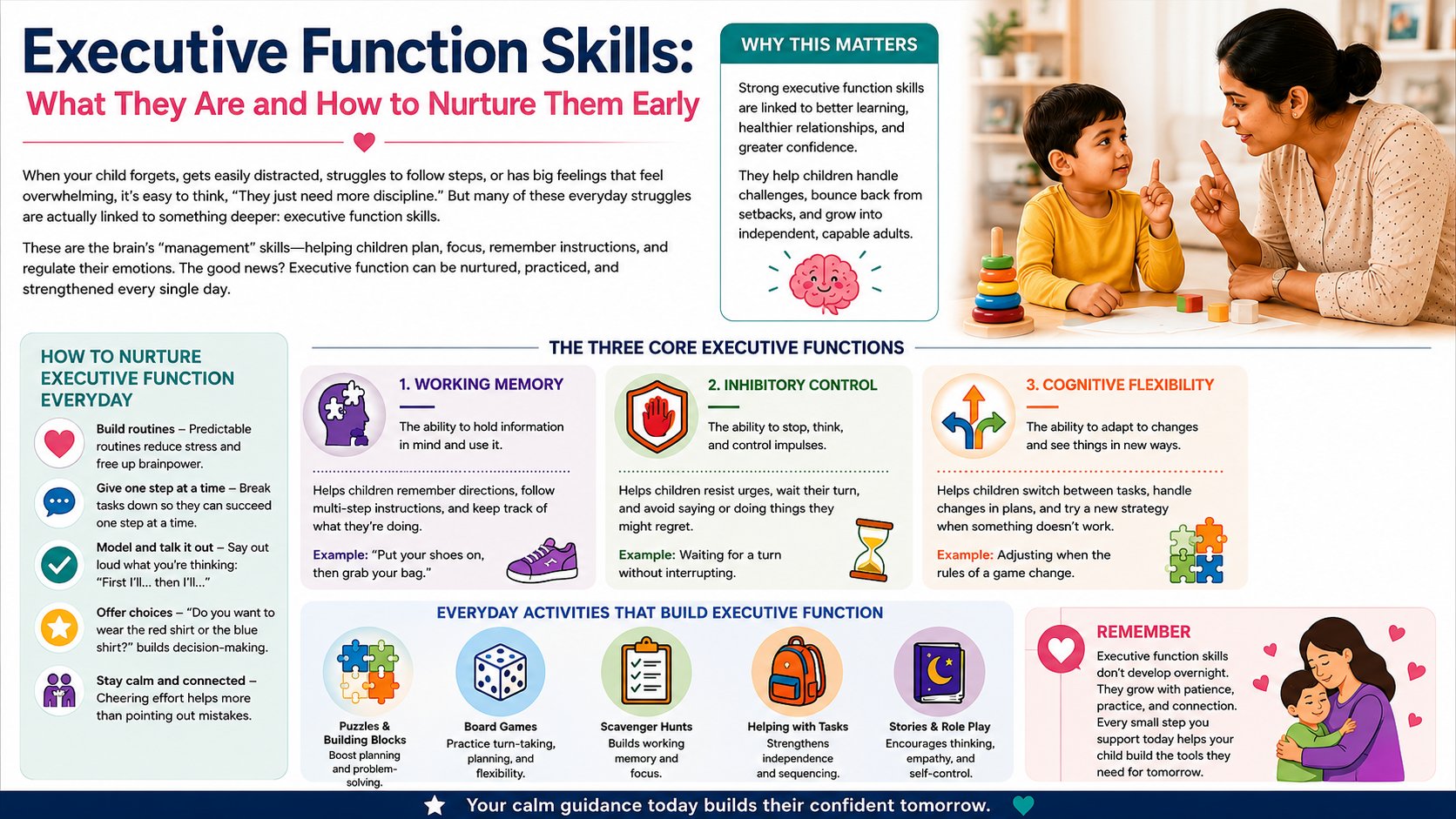
Executive function is the umbrella term for the set of mental skills that let us manage our own thoughts, actions, and emotions in service of a goal — everything from remembering a two-step instruction, to resisting the urge to grab a toy from a sibling, to shifting smoothly when plans change unexpectedly. Researchers sometimes describe it as the brain’s “air traffic control system,” because it’s the set of processes coordinating and directing everything else going on, rather than being any single skill on its own.
This isn’t a fringe or trendy concept dreamed up by parenting content — it’s a well-established area of developmental neuroscience, centered largely in the prefrontal cortex, the part of the brain responsible for complex planning and self-regulation. What makes it especially relevant to early childhood is that this part of the brain develops unusually slowly and unusually late compared to the rest of the brain, which is exactly why a four-year-old genuinely, biologically struggles with tasks an adult would find trivial — it’s not a character flaw or a discipline gap, it’s an under-construction part of the brain doing its best with limited scaffolding so far.
While you’ll see executive function broken down into anywhere from three to over a dozen specific skills depending on which framework you’re reading, researchers in developmental psychology and neuroscience generally agree on three foundational, core executive functions that the more detailed lists build on top of:
Working memory is the ability to hold information in mind and actively use it, rather than just briefly noticing it and losing it a moment later. This is what lets a child remember “put your shoes on, then grab your bag” as a connected sequence rather than two disconnected instructions that immediately fall out of their head after the first one.
Inhibitory control is the ability to resist an impulsive response, override an automatic reaction, and pause before acting. This is what lets a child not grab a toy the instant they want it, wait their turn in a game, or stop themselves from blurting out an answer before they’ve actually thought it through.
Cognitive flexibility is the ability to shift between different tasks, rules, or ways of thinking about something, rather than getting rigidly stuck on one approach. This is what lets a child adjust when a game’s rules change mid-play, switch from one activity to another without a meltdown, or consider a different solution when their first approach to a problem doesn’t work.
Nearly every other executive function skill you’ll encounter in more detailed lists is either a direct application of one of these three core abilities, or a more complex skill built by combining them — which is why understanding these three deeply tends to matter more for a parent than memorizing a longer list.
It’s worth sitting with just how much of daily life for a young child actually runs through these three functions, since it’s easy to underestimate once you know the terms. Getting dressed in the right order draws on working memory (remembering the sequence) and inhibitory control (not getting distracted by every toy in the room along the way). Sharing a toy draws almost entirely on inhibitory control. Adjusting to an unexpected change in weekend plans draws on cognitive flexibility. A huge share of what looks like “good behavior” or “difficult behavior” in a young child is, underneath, one of these three systems either coping well or genuinely struggling with the demand placed on it in that moment.
If you’ve searched around this topic already, you’ve probably noticed different sources cite different numbers — 3 core functions, 7 skills, 12 skills, 13 functions — and it’s worth explaining why that’s not actually a contradiction, just different levels of granularity applied to the same underlying territory.
The three core executive functions (working memory, inhibitory control, cognitive flexibility) are the foundational building blocks agreed upon across most of the academic research in this area.
From there, more applied, practical frameworks — often used by occupational therapists, educators, and clinicians working directly with children — expand these three into more specific, actionable skills. A commonly cited seven-skill framework typically includes: impulse control, emotional control, flexible thinking, working memory, self-monitoring, planning and prioritizing, and task initiation.
More detailed clinical and occupational therapy frameworks extend this further into twelve or thirteen distinct executive function skills, which typically include all seven of the above plus additions like organization, time management, metacognition (thinking about your own thinking), goal-directed persistence, response inhibition specifically as distinct from broader impulse control, and sometimes foresight or hindsight as their own separate categories.
The honest takeaway here: there isn’t one single “correct” number, because these are different ways of slicing up the same underlying set of related cognitive abilities, at different levels of specificity, for different professional purposes. For a parent trying to understand and support a young child, the three-core-function framework is usually the most useful starting point, since nearly everything in the longer lists traces back to one of those three.
It’s a bit like asking how many muscles are involved in “walking” — you could reasonably answer with a small number of major muscle groups, or a much longer, more technical list depending on how granular you want to get, and neither answer is wrong, they’re just serving different purposes. A physiotherapist working on a specific gait issue needs the detailed list; someone just trying to understand why walking matters for daily life is well served by the simpler version. Executive function terminology works the same way — clinicians and researchers building detailed intervention plans benefit from the 12-13 skill breakdown, while a parent trying to understand their child’s shoe-rack morning is usually better served starting with the three-function version and only reaching for more detail once a specific challenge calls for it.
Kindergarten and primary school classrooms place enormous, often underappreciated demands on exactly these three core functions, which is part of why executive function has become such a significant focus in early education research. Sitting through a lesson requires inhibitory control. Following a teacher’s multi-step instruction requires working memory. Transitioning between subjects, seating arrangements, or activities throughout the school day requires cognitive flexibility, repeated dozens of times before lunch.
Research in early childhood education has increasingly found that executive function skills at school entry predict academic success as strongly as, and in some studies more strongly than, early literacy or numeracy skills measured in isolation. This makes intuitive sense once you consider it: a child with strong early reading skills but weak working memory will still struggle to follow a teacher’s layered instructions, and a child who can count well but can’t yet manage the inhibitory control needed to wait for a turn or stay seated during instruction time will struggle to access the learning happening around them, regardless of their raw academic potential. This is exactly why many preschool and kindergarten programs have started weaving executive function practice directly into their daily structure, rather than treating it as separate from “real” academic preparation.
This surprises most parents, so it’s worth stating plainly: executive function is not fully developed until well into early adulthood, typically somewhere in the mid-20s, with some research suggesting continued refinement up to around age 30. This isn’t a sign that something is unusually slow about any particular child — the prefrontal cortex, where most executive function is centered, is among the last brain regions to fully mature, continuing its development throughout childhood, all of adolescence, and into early adulthood.
What this means practically is that executive function develops in a long, gradual arc rather than reaching some fixed, complete state in early childhood. The preschool years (roughly ages 3 to 6) are a period of particularly rapid executive function growth — often described as a genuine golden window for this kind of development, driven by intense brain growth and connection-building happening during this stage specifically. But rapid early growth is not the same as full maturity, and expecting an adult level of planning, impulse control, or emotional regulation from a young child, or even a teenager, sets everyone up for frustration that has nothing to do with how well that child is actually developing.
It helps to ground all of this in what executive function struggles and strengths actually look like in a young child’s ordinary day, rather than staying purely abstract.
A toddler or young preschooler with developing working memory might need instructions broken into single steps rather than a sequence — “put the block in the box” rather than “clean up your toys and then come wash your hands and then get your bag,” which asks far more of an under-construction working memory than it can reasonably hold.
A child with developing inhibitory control might grab a toy from another child not out of unkindness, but because the impulse to grab arrives faster than the ability to pause and consider an alternative — the pause-before-acting machinery simply isn’t fully online yet, the same way a toddler’s legs aren’t yet capable of a smooth run before they’ve mastered walking.
A child with developing cognitive flexibility might have a genuinely difficult time when a planned outing gets cancelled, or when the rules of a game change mid-play, reacting with distress that looks disproportionate to an adult but reflects a real, biological difficulty shifting mental gears rather than simple stubbornness.
None of this means a young child has no executive function at all — quite the opposite, these skills are visibly present and developing from a very early age, often observable even in a one-year-old’s early attempts to wait, redirect attention, or adjust to a changed routine. What’s happening in early childhood is the beginning of a long developmental arc, not the absence of the skill entirely.
Even within a single family, this arc rarely progresses at exactly the same pace for every child, which is worth knowing if you’re comparing an older and younger sibling and noticing real differences in how each handles waiting, following instructions, or adapting to change. Individual variation in executive function development is completely normal, shaped by temperament, sleep, environment, and simple developmental timing differences between children, and it’s rarely a useful comparison to make between siblings any more than comparing when each child took their first step.
This is worth addressing directly, because it’s such a common, well-meaning response from relatives, teachers, and sometimes parents themselves — the instinct Meera’s mother had at the shoe rack. Executive function challenges in a young child often look, on the surface, like the same behaviors that discipline is meant to address: not listening, not following through, seeming distracted or oppositional.
The difference matters enormously for how you respond. A child who understands an instruction and is choosing not to comply is a genuinely different situation from a child whose working memory simply can’t hold a multi-step instruction long enough to execute it, or whose inhibitory control genuinely can’t yet override an impulse in the moment it arrives. Treating the second situation as a discipline problem — more consequences, more strictness, more repetition of “listen to me” — doesn’t build the underlying skill; it just adds frustration and shame on top of a genuine developmental gap, for both the child and the increasingly exasperated adult.
This isn’t a case for permissiveness or dropping expectations. It’s a case for matching your response to what’s actually happening — scaffolding a genuinely developing skill (breaking instructions into smaller steps, building in practice for pausing and waiting, modeling flexible thinking out loud) rather than punishing a child for a brain structure that, quite literally, isn’t finished being built yet.
It’s worth adding a word of reassurance here specifically for parents who feel a wave of guilt reading this, thinking back to moments they responded to an executive function gap as if it were defiance. Nearly every parent does this at some point, simply because the distinction isn’t obvious in the moment, and there was no widely available framework like this one to reach for during your own toddlerhood or theirs. The point of understanding this isn’t to retroactively judge every past reaction — it’s to have a better tool available for the next shoe-rack morning, which is a far more useful use of the information than guilt over the mornings that already happened.
It’s worth pausing here, because a lot of parents reading an article like this about their child start quietly wondering the same thing about themselves — the chronic procrastination, the lost keys, the half-finished projects, the sense of “why can’t I just get it together” that so often gets privately labeled as laziness.
The honest answer: genuine executive dysfunction and ordinary low motivation can look similar from the outside but come from different places, and the distinction matters. Laziness, as a concept, generally implies a person could do the task with reasonable effort but chooses not to. Executive dysfunction describes a person who often genuinely wants to do the task, may even feel real distress about not doing it, but struggles with the underlying mechanics of starting, sequencing, remembering, or following through — task initiation, working memory, and self-monitoring specifically are common trouble spots. A telling sign is the emotional experience underneath: genuine executive dysfunction is frequently accompanied by real frustration, shame, and a felt sense of “I don’t understand why I can’t just do this,” rather than straightforward indifference to the outcome.
This isn’t a self-diagnosis tool, and if this pattern feels like it’s significantly affecting your work, relationships, or daily functioning, it’s worth raising with a doctor or psychologist rather than settling for either label on your own — executive dysfunction can show up on its own or alongside conditions like ADHD, and a proper evaluation can clarify what’s actually going on far better than a label picked up from an article. But it is worth naming plainly, if only to interrupt the reflex so many adults have of assuming every struggle with follow-through is simply a character failing rather than a legitimate cognitive difference worth understanding.
Here’s the genuinely good news underneath all of this: executive function is highly responsive to environment and practice, especially during the rapid-growth preschool years. This isn’t about drilling flashcards or buying a specific branded toy — the research consistently points toward ordinary, playful, repeated practice as the most effective path.
Unstructured pretend play — running a pretend shop, playing house, acting out a story with toys — asks a young child to hold a role in mind, follow self-imposed rules, and adjust when a playmate changes the scenario, which is genuine, real-time executive function practice disguised entirely as fun. Some developmental research specifically links rich, sustained pretend and role-play to measurable executive function gains, precisely because of how much mental juggling this kind of play actually demands, even though it looks effortless from the outside.
Freeze Dance (dancing to music, freezing instantly when it stops) directly practices inhibitory control and attention — the pause between impulse and action is the entire mechanic of the game. Simon Says builds listening, working memory, and impulse control simultaneously, since children must hold the rule in mind and override the urge to simply copy every instruction. Red Light, Green Light offers similar inhibitory control practice through a physical, whole-body format many young children find easier to engage with than a purely verbal instruction.
Rather than a long multi-part instruction, offer one step, let your child complete it, then offer the next. This isn’t lowering your standards — it’s matching the instruction to the working memory capacity your child actually has right now, the same way you wouldn’t hand a toddler learning to walk a task requiring them to run.
Consistent daily routines — a similar sequence for mornings, mealtimes, and bedtime — reduce the executive function load a child needs to spend figuring out “what happens next,” freeing up mental resources for the parts of the routine that are still genuinely challenging. Over time, a well-established routine becomes partly automatic, which is itself a form of executive function scaffolding, not a workaround that avoids building the skill.
Children learn an enormous amount by watching adults model the exact skills they’re developing. Saying out loud, “Hmm, I planned to make dal today but we’re out of toor dal — let me think of what else I can make instead” gives your child a live demonstration of cognitive flexibility and problem-solving in action, far more effectively than any explanation of the concept would.
Sorting laundry by color, setting the table with a specific number of items per person, helping plan the order of errands — these ordinary household tasks are genuine planning, sequencing, and organization practice, especially when you involve your child in the “what comes first” thinking rather than simply directing each step yourself.
Asking a young child to wait — for a turn, for a snack, for a sibling to finish something — builds inhibitory control, but the waiting period needs to be genuinely appropriate to their current capacity. A few seconds of waiting for a three-year-old is meaningful practice; a ten-minute wait is simply setting up a predictable meltdown that teaches frustration rather than patience.
“What do you think we should do first?” or “What happened when you tried it that way?” builds metacognition — the ability to think about one’s own thinking — which becomes an increasingly important executive function skill as children move into school-age tasks like planning a project or reviewing their own work.
This is easy to overlook, but a tired, overscheduled child has measurably less capacity for self-regulation and impulse control than a well-rested one — executive function, like most cognitive functioning, is significantly affected by fatigue, which is worth remembering the next time a meltdown seems to come out of nowhere at the end of a long, over-packed day.
Passive, fast-paced screen content doesn’t ask much of a child’s developing executive function — there’s little working memory demand, little need to inhibit an impulse, and little requirement to flexibly adjust, since the content simply flows at the child regardless of their engagement. This doesn’t mean all screen time is harmful, but it’s worth balancing with the kinds of activities described above that actively demand planning, waiting, and flexible thinking, rather than letting passive viewing crowd out the more effortful play that’s doing the real developmental work. Interactive, slower-paced content that asks a child to make choices or solve simple problems places more genuine executive function demand on a child than passive viewing does, if screen time is part of your routine regardless.
Toddlers and young preschoolers (roughly 2-4 years): simple one-step instructions, basic sorting games (colors, shapes), peekaboo and hiding games that build early working memory, short waiting games with immediate, visible rewards, and simple call-and-response songs that require listening and response.
Preschoolers and kindergarteners (roughly 4-6 years): Freeze Dance, Simon Says, Red Light Green Light, simple board games with turn-taking, two-step instructions, sorting and categorizing tasks with more complex rules, pretend play with assigned roles, and basic planning conversations (“what should we pack for the park?”).
Early school-age children (roughly 7-12 years): more complex board and strategy games (chess, card games with changing rules), independent multi-step chores like packing their own school bag against a checklist, journaling or planning tools for homework and projects, cooking a simple recipe together that requires following a sequence, and organizational systems like a visual weekly planner they help maintain themselves.
Meera didn’t overhaul her mornings overnight, but she made two specific changes after that evening of reading. First, she broke the morning routine into a simple, illustrated checklist taped near the shoe rack — shoes, bag, water bottle, each with a small picture — so Aryan had an external anchor for the sequence rather than needing to hold the whole thing in his head. Second, she stopped narrating the full morning plan out loud all at once and instead gave him one instruction at a time, waiting for each to land before adding the next.
It wasn’t instant. The shoe rack still occasionally claims a sock or a shoe some mornings. But the frozen, lost-mid-task moments happen less often now, and when they do, Meera finds herself saying “let’s look at the picture, what comes next?” rather than “why can’t you just listen,” which has changed the tone of their mornings considerably, even on the days the system doesn’t run perfectly.
Her mother, for her part, watched the illustrated checklist in action for a few days and eventually admitted, somewhat grudgingly, “Achha hai yeh, usko yaad rakhne mein help karta hai.” Not quite an endorsement of executive function science by name, but close enough for Meera to feel like a small, meaningful shift had happened at that shoe rack.
A few weeks later, Meera noticed something else worth mentioning — she’d started applying the same “break it into one step” instinct to her own overwhelming to-do lists at work, an accidental side benefit she hadn’t anticipated when she first looked up the term in her car that evening. “I used to write myself these massive lists and then feel paralyzed looking at them,” she said. “Turns out breaking my own tasks into one visible next step works for the same reason it worked for Aryan’s shoes. I guess the brain doesn’t fully finish developing this stuff until your mid-20s for a reason — some days it still feels like mine could use the same checklist.”
A commonly used seven-skill framework includes impulse control, emotional control, flexible thinking, working memory, self-monitoring, planning and prioritizing, and task initiation. This sits between the three core academic functions and the more detailed 12-13 skill clinical frameworks.
In early childhood, executive function shows up as a young child’s developing ability to hold simple instructions in mind, pause before acting on an impulse, and adjust to changes in routine or plans — all still very much under construction and expected to develop gradually rather than fully arrive at once.
A commonly cited twelve-skill clinical framework typically includes response inhibition, working memory, emotional control, flexible thinking, task initiation, planning and prioritizing, organization, time management, goal-directed persistence, metacognition, sustained attention, and self-monitoring.
A thirteen-function list generally includes the twelve above plus one additional distinct category, most often foresight or hindsight as its own separate skill from general planning — different frameworks vary slightly in exactly which additional skill earns the thirteenth spot.
Executive function isn’t considered fully mature until the mid-20s, with some research pointing to continued refinement up to around age 30, since the prefrontal cortex is among the last brain regions to complete development.
Working memory, inhibitory control, and cognitive flexibility are the three foundational executive functions most consistently agreed upon across developmental psychology and neuroscience research, with more detailed frameworks building further, more specific skills on top of these three.
The two can look similar but come from different places — laziness generally implies choosing not to do something manageable, while executive dysfunction involves genuinely struggling with starting, sequencing, or following through despite real intention and often real distress about the gap. This distinction is worth exploring with a doctor or psychologist rather than settling on a label alone, especially if it’s meaningfully affecting daily life.
Older children benefit from more complex strategy games (chess, card games with layered rules), independent multi-step responsibilities like packing their own school bag against a checklist, cooking a recipe that requires following a sequence, and organizational tools like a visual weekly planner they help maintain themselves. At this age, involving the child in creating their own systems tends to build the skill more effectively than a parent simply imposing one.
While there’s a genetic and temperamental component to executive function, like most cognitive abilities, research consistently shows these skills are highly responsive to environment, practice, and support, especially during the rapid-growth preschool years. This is genuinely good news for parents — deliberate, playful practice through the strategies above makes a measurable difference, rather than executive function being a fixed trait a child either has or doesn’t.
If you’ve been standing at your own version of the shoe rack, watching a young child seem to lose the plot mid-task and wondering what you’re doing wrong, the honest answer is probably: nothing. You’re watching a brain still very much under construction, doing its early, imperfect best with a set of skills that won’t be finished developing for another two decades. The discipline instinct is understandable, but the more useful one is scaffolding — breaking things down, practicing the pause, modeling the flexibility — the same patient, repeated work you’d expect if you were watching a toddler learn to walk, just happening in a part of development that’s much less visible than legs and balance.