Physical Address
304 North Cardinal St.
Dorchester Center, MA 02124
Physical Address
304 North Cardinal St.
Dorchester Center, MA 02124

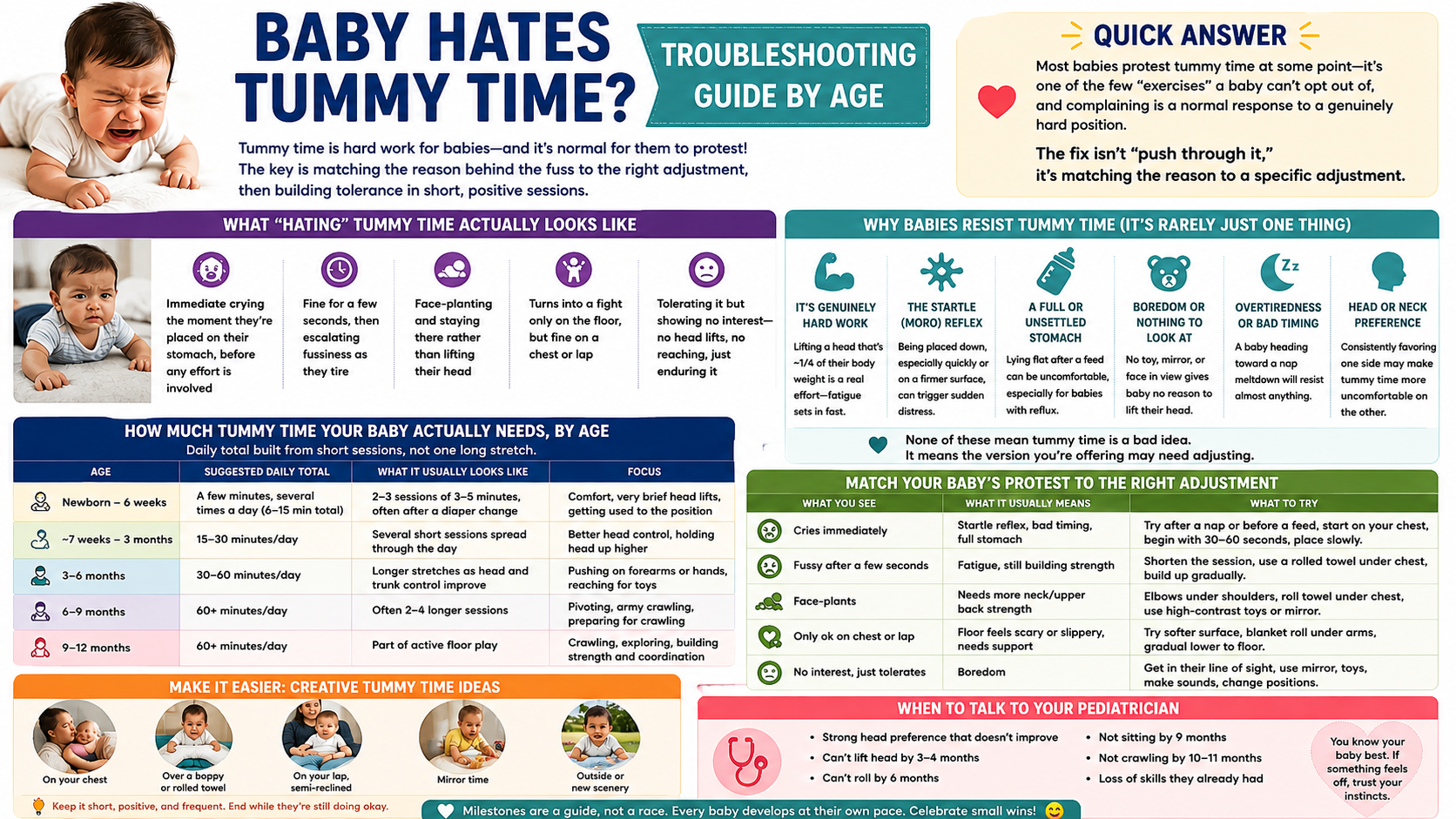
Quick answer: Most babies protest tummy time at some point — it’s one of the few “exercises” a baby can’t opt out of, and complaining is a normal response to a genuinely hard position. The fix isn’t usually “push through it,” it’s matching the reason your baby resists (a startle reflex, a full stomach, boredom, tiredness, a head preference) to a specific adjustment, then rebuilding tolerance in very short sessions. What counts as “enough” also changes a lot by age, which is where a lot of the worry comes from.
You put your baby down on the mat, get the toy ready, maybe even get your phone out to catch the moment they finally lift their head — and within ten seconds they’re red-faced and furious, like you’ve committed some kind of betrayal. You pick them up, they calm down instantly, and you’re left wondering if you just did something wrong, or if this is just how it’s going to be. It usually isn’t a sign you’re doing it wrong. It’s more often a sign of which wrong is happening — and once you know which one, the fix tends to be small.
This guide walks through why babies resist tummy time, how much is genuinely needed at each age, how to match your baby’s specific protest to a specific adjustment, and the short list of things that are actually worth mentioning to your pediatrician.
“Hates it” covers a wide range of behavior, and it’s worth being specific about which one you’re seeing, because the fixes differ:
The first two usually point to timing or a reflex response. The third can be a strength or positioning issue. The fourth is often about surface and support rather than the position itself. The fifth is often about boredom rather than distress — a different problem with a different fix.
A few overlapping reasons show up again and again:
It’s genuinely hard work. For a newborn, lifting a head that’s roughly a quarter of their body weight is a real physical effort — closer to a plank hold than a nap. Fatigue sets in fast, and fatigue in a baby usually announces itself as crying.
The startle (Moro) reflex. Being placed down, especially quickly or onto a firmer surface, can trigger a startle response that looks like sudden distress. It’s reflexive, not a judgment on the activity.
A full or unsettled stomach. Lying flat on the stomach right after a feed can be uncomfortable, and babies with reflux in particular often protest more on a full stomach in this position.
Boredom or nothing to look at. Tummy time on a blank floor with no toy, mirror, or face in view gives a baby no reason to lift their head and look around.
Overtiredness or bad timing. A baby who’s already heading toward a nap meltdown will resist almost anything, tummy time included.
A head or neck preference. Some babies who consistently favor turning their head to one side may find the position more uncomfortable on one side than the other — this is worth mentioning to a pediatrician if it’s consistent (more in the safety section below).
None of these mean tummy time is a bad idea for your baby specifically. They mean the version of tummy time you’re offering may need adjusting.
There’s a real number here, and it’s smaller than a lot of parents expect. The American Academy of Pediatrics (AAP) and other pediatric sources describe it as a daily total built from short sessions, not one long stretch a baby has to survive.
| Age | Suggested daily total | What it usually looks like |
|---|---|---|
| Newborn – 6 weeks | A few minutes, several times a day (roughly 6–15 minutes total) | 2–3 sessions of 3–5 minutes, often right after a diaper change |
| 7 weeks – 3 months | Building toward 15–30 minutes/day | Several short sessions spread through the day as tolerance grows |
| 3–6 months | Building toward 30–60 minutes/day | Longer stretches as head and trunk control improve |
| 6–9 months | Ongoing floor time, often blended into play | Less “formal,” since rolling, sitting, and reaching naturally add prone time |
| 9+ months | No fixed target — floor play with variety matters more than a tummy-specific total | Crawling and cruising largely take over the strengthening job |
A newborn managing three minutes at a time, three times a day, is meeting the guidance — not falling behind it. The daily total matters more than any single session length, and a baby who protests does better with more frequent, shorter attempts rather than one longer session pushed through.
Rather than one generic list of tips, it helps to work from what you’re actually seeing.
| What you’re noticing | Likely cause | What to try |
|---|---|---|
| Crying the instant they’re put down | Startle reflex / newness | Lower them down slowly, keep a hand resting on their back for a few seconds before letting go |
| Fine at first, then melts down | Fatigue | Cut the session shorter than you think you need to — 60–90 seconds counts |
| Fussier soon after a feed | Reflux / full stomach | Try tummy time about 20–30 minutes after feeding, or before a feed instead |
| Tolerates it but disengaged | Boredom | Get on the floor at their eye level, use a small mirror, high-contrast card, or crinkly toy just in front of them |
| Only okay on a person, not the floor | Surface / support | Start on your chest or lap, then transition to the floor once they’re calmer there generally |
| Consistently turns head to one side only | Possible neck tightness | Offer tummy time propped on alternating sides; flag it to your pediatrician if it doesn’t vary |
Go slow on the way down. A sudden drop onto a mat can trigger the exact reaction you’re trying to avoid. Placing a hand on their back for a moment after they’re down, and talking to them the whole time, helps more than most parents expect.
Timing is often the whole fix here. Try shifting sessions to before a feed, or a good half hour after one, rather than right after. If reflux has already been mentioned by your pediatrician, this is worth raising with them specifically — they may have position-specific advice.
Babies engage with tummy time when there’s a reason to lift their head. A face at their level, a small unbreakable mirror, or a single high-contrast toy just out of reach does more than an empty mat ever will.
Right after a nap or after a diaper change — when a baby is alert but not yet hungry or tired — tends to work better than squeezing it in whenever there’s a spare minute.
If your baby consistently prefers turning their head one direction regardless of which side you offer a toy on, or seems to resist tummy time more on one side specifically, it’s worth mentioning at the next well-child visit. This can sometimes relate to torticollis (tightness in a neck muscle), which a pediatrician or physical therapist can assess and address — not something to try to diagnose or fix on your own.
This is the age group most likely to protest, and also the one where the least is actually required. Start the day you’re home from the hospital if you feel up to it — a few minutes, a few times a day, is genuinely enough. Chest-to-chest tummy time (baby lying on your chest while you recline) counts, and it’s often the easiest starting point because your heartbeat and voice are right there.
By this age, some head and forearm control is expected, so tummy time can feel like more of a workout, which sometimes means more protest, not less. If a newborn tolerated it and a 4-month-old suddenly doesn’t, it’s often a strength or interest issue rather than regression — try propping a small rolled towel under the chest to make pushing up easier, and add something worth looking at.
Many babies this age are rolling or close to it, which can make lying still on the stomach feel pointless to them — they’d rather be moving. Shorter, more playful sessions blended into regular floor time (reaching for a toy, rolling into and out of the position) tend to work better than a dedicated “tummy time” block.
At this stage, many babies are sitting, crawling, or pulling up, and formal tummy time on a flat mat has largely done its job. A baby who’s crawling is already getting the strengthening benefit tummy time was building toward. If yours still resists a flat prone position specifically but is otherwise moving, reaching, and building strength through crawling or cruising, this is usually not something to worry about — the goal was always the movement, not the specific position.
No — sitting and tummy time build different things. Tummy time strengthens the neck, shoulders, upper back, and core through the prone (stomach-down) position and prepares a baby for rolling and crawling. Sitting relies more on trunk and hip stability in an upright position. A baby who can sit well hasn’t automatically “made up for” skipped tummy time, though by the time sitting is solid, a baby is usually close to rolling and crawling anyway, which does most of the same strengthening work tummy time was aiming for. If your baby dislikes flat tummy time but is otherwise meeting movement milestones through rolling, reaching, and eventually crawling, that’s a reasonable substitute path — it just isn’t the same skill on paper.
You might find yourself doing tummy time three separate times before 9 a.m. because each attempt only lasted ninety seconds — that’s not failure, that’s the daily total adding up the way it’s supposed to.
Or you’ve noticed your baby is completely fine on your chest while you’re reclined on the couch, but the second they touch the play mat it’s a different baby entirely — in that case, the floor itself, not the position, may be what needs easing into.
Or your 9-month-old, who is crawling all over the living room, still refuses to lie flat on their stomach and stay there for even ten seconds — and at that stage, that’s genuinely fine, because the crawling is doing the job tummy time was building toward.
Most tummy time resistance is ordinary and resolves with small adjustments and time. It’s worth raising with your pediatrician — not as an emergency, just at a regular visit or a call — if you notice:
None of these are cause for panic on their own, and this list isn’t a diagnostic checklist — it’s simply the kind of thing a pediatrician is well placed to look at directly, since only an in-person assessment can tell the difference between a normal preference and something that would benefit from early support.
Yes, this is common in the first few weeks. Very short, frequent sessions tend to work better than trying to extend a session your baby is already unhappy in.
There’s no fixed session length — what matters is the daily total, which grows from a few minutes at newborn stage toward 15–30 minutes by around 7 weeks and up from there as your baby’s tolerance builds.
No. They build different muscle groups and skills, though a baby who’s rolling and moving well is generally getting similar strengthening benefits through other means.
That’s a normal starting point. Chest-to-chest or lap-based tummy time still counts, and can be a bridge toward floor tolerance rather than something to skip past.
Supervised, awake tummy time isn’t harmful in itself. The safety guidance that matters most is the opposite direction — always place baby on their back to sleep, and only do tummy time while awake and watched.
Usually not, especially if they’re otherwise crawling, sitting, or pulling up. By this age, other movement is generally doing the same strengthening work.
It can help reduce the risk, alongside varying your baby’s head position during sleep and awake time generally. It’s one part of a broader approach, not a guarantee on its own.
Many parents find success right after a diaper change or after waking from a nap — a baby who is alert but not hungry or overtired tends to tolerate it best.
This is common around growth spurts, teething, or new milestones like rolling, where a previously tolerated position suddenly feels different or less interesting. It’s rarely a regression to worry about.
Talk to your pediatrician if this is a significant, ongoing concern for your specific baby. In general, babies build the same underlying strength through varied floor play, being carried in different positions, and eventually crawling — tummy time is one route to that strength, not the only one.
A baby who fights tummy time isn’t telling you it’s the wrong thing to do — they’re telling you something about how it’s being offered right now: too long, too soon after a feed, too boring, too sudden, or just too much for today. Shrinking the sessions, changing the timing, and giving them something worth looking at solves most of it. The rest tends to resolve on its own as your baby’s strength catches up to the demands of the position — which, for almost every baby, happens faster than the daily protests make it feel.