Physical Address
304 North Cardinal St.
Dorchester Center, MA 02124
Physical Address
304 North Cardinal St.
Dorchester Center, MA 02124

Meera still remembers the exact evening it happened. Her son Aarav was eleven months old, and she was chopping bhindi in the kitchen while he sat propped against the sofa in the next room, the way he always did. She heard a thud, then silence, then a delighted squeal — and when she ran in, Aarav was standing, one hand gripping the sofa leg, grinning at her like he’d just won a cricket match. She dropped everything, picked up her phone, and called her mother in Nagpur before she’d even picked him up.
“Ammaji, woh khada ho gaya!” she said, half-laughing, half-crying.
Her mother’s response was calm, the way grandmothers’ responses usually are. “Theek hai, ab dauda karega jaldi hi.” Now he’ll be running around soon enough.
If you’re a parent anywhere in India right now — in a one-bedroom flat in Pune, a joint family home in Lucknow, or a rented apartment in Bengaluru with no family nearby to call — you’ve probably had a version of this exact moment. A milestone hits, your phone fills up with videos, and somewhere underneath the excitement sits a quieter question: is this the right time for this to be happening? Is he behind? Is she ahead? What am I even supposed to be watching for?
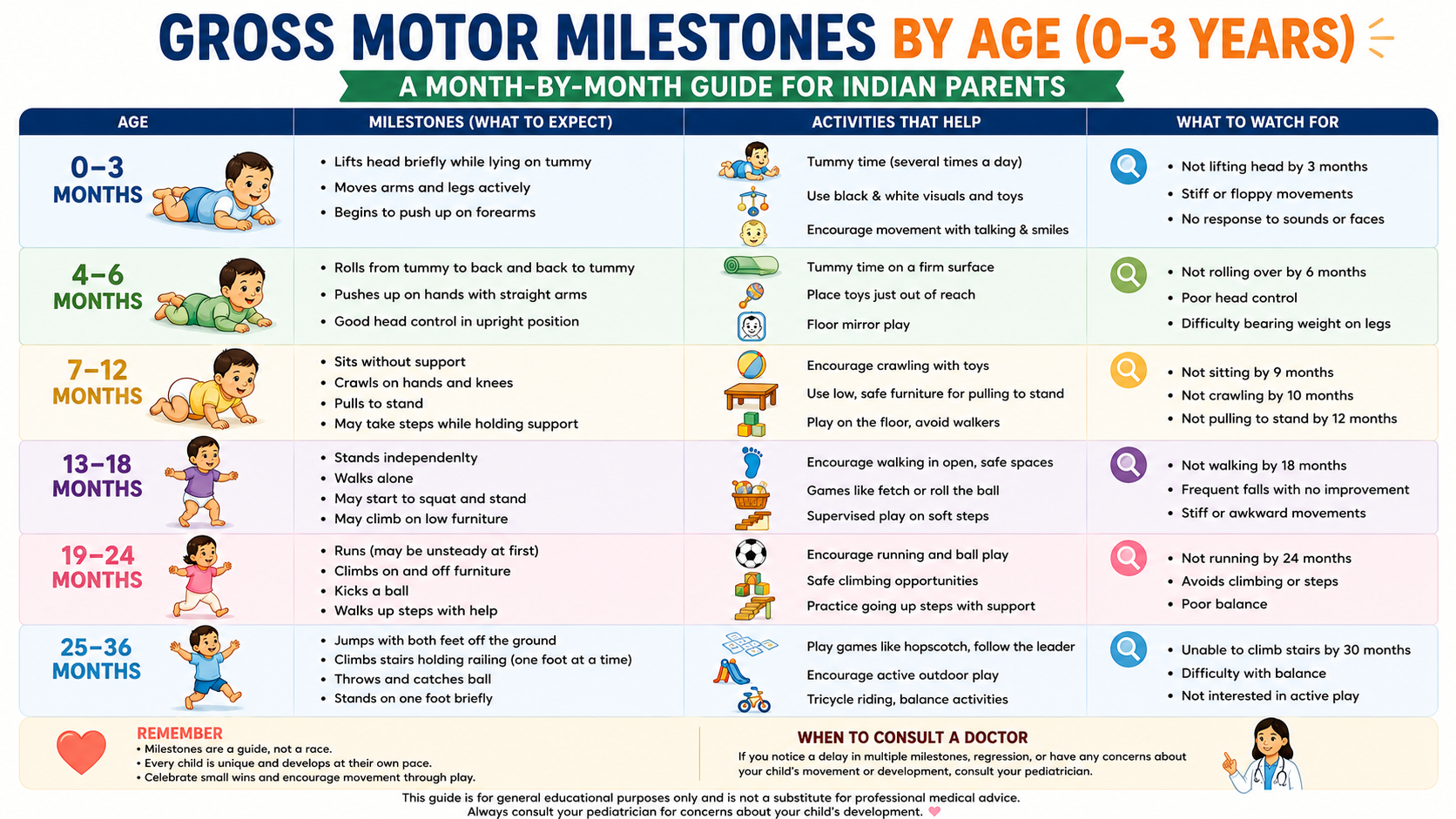
This guide exists to answer exactly that question, month by month, from the day your baby is born until the day they turn three. We’re going to talk about gross motor skills — the big, whole-body movements like rolling, crawling, walking, running, and jumping — and we’ll walk through what’s typical at each stage, what activities actually help, and when it’s worth a conversation with your pediatrician instead of a WhatsApp forward from a family group.
Before we get into the age-by-age breakdown, let’s clear up a mix-up that trips up almost every new parent at some point: the difference between gross motor skills and fine motor skills.
Gross motor skills involve the large muscles of the body — the arms, legs, torso, and neck — and they’re responsible for movements like holding up the head, rolling over, sitting, crawling, standing, walking, running, climbing, and jumping. Basically, anything that moves the whole body through space or holds it upright falls under gross motor development.
Fine motor skills, on the other hand, are the small, precise movements made with the hands, fingers, and wrists — picking up a raisin between thumb and finger, holding a spoon, stacking blocks, turning the pages of a book, or later, gripping a crayon to scribble on the wall (every parent’s favourite milestone, said no one ever).
Here’s the part that surprises a lot of parents: these two systems aren’t separate tracks running in parallel. They’re deeply connected. A baby who spends time on their tummy building shoulder and core strength — a gross motor skill — is quietly laying the groundwork for the hand stability they’ll need later to hold a pencil. Occupational therapists will often tell you that weak “proximal” strength (the big muscles closer to the body’s center) shows up years later as messy handwriting or clumsy scissor skills. So when your mother-in-law insists on more tummy time, she’s not entirely wrong — she’s just describing it differently than a pediatric OT would.
There’s a fine line we want to walk carefully in this article, so let’s say it upfront: every child develops at their own pace, and a difference of a few weeks or even a couple of months from an “average” timeline is completely normal. Motor development isn’t a race, and it isn’t a report card.
That said, gross motor milestones matter because they’re one of the easiest, most visible windows into a child’s overall neurological and physical development. Doctors track them for a reason — not to create a checklist parents should panic over, but because these milestones tend to unlock the next stage of learning. A baby who can sit independently frees up both hands to explore toys. A toddler who can walk confidently can now approach the world instead of waiting for the world to be brought to them. Movement, in the first three years, is quite literally how a child starts to understand cause and effect, spatial awareness, and independence.
For Indian families specifically, gross motor development also intersects with some very real, practical realities — joint family living spaces where floor time might be limited, urban homes with less open space than a village courtyard, and grandparents who often have strong (and sometimes outdated) opinions about walkers, jhulas, and when a baby “should” be sitting up. We’ll touch on some of these cultural specifics as we go, because context matters.
A quick, necessary disclaimer: this article is written for general educational purposes and is not a substitute for professional medical advice. Every baby’s growth chart looks a little different, and premature babies, in particular, are usually assessed against their adjusted age rather than their birth age. If you have any concern about your child’s development at any point, please speak with your pediatrician rather than relying solely on an article, a YouTube video, or a WhatsApp forward — however well-meaning it is.
With that out of the way, let’s get into it.
The first three months are less about “movement” in the way we usually picture it and more about a baby slowly discovering they even have control over their own limbs. Newborns arrive with reflexes, not skills — the startle reflex, the rooting reflex, the tight little fists. Over these twelve weeks, those reflexes gradually give way to intentional movement.
What you’ll typically see:
Activities that actually help:
Tummy time is the single most important gross motor activity in this window, and Indian parents sometimes underuse it because a crying baby on their belly feels unnecessarily unkind. Start with just 2-3 minutes, a few times a day, right after a nappy change when the baby is alert but not overtired. Get down on the floor at eye level with them — babies work harder to lift their heads when there’s a face to look at, and yours is the most interesting thing in the room to them anyway.
A rolled-up thin towel under the chest can help in the early weeks if the baby tires quickly. Bright, high-contrast toys or even a black-and-white printed pattern held slightly above eye level can encourage them to lift and turn their head further than they would otherwise bother to.
Gentle “bicycle” leg movements while changing a diaper, soft massage with coconut or almond oil (a near-universal practice in Indian households, and genuinely useful for encouraging limb awareness), and simply giving the baby supervised time on a flat surface instead of constantly in a bouncer or car seat all support this stage.
This is usually the stretch where things start feeling more dramatic to parents, because babies begin to look less like newborns and more like tiny, opinionated people who want to move.
What you’ll typically see:
Activities that actually help:
Floor gyms with hanging toys just out of reach encourage reaching and rolling in a way that a baby permanently parked in a walker or bouncer simply doesn’t get. If your home has a joint family setup, this is a great age to let different family members take turns doing floor time — babies often push harder to reach for a favourite chachi or dadi than they will for a plastic toy.
Supported sitting practice, a few minutes at a time, helps build the core and back strength needed for independent sitting later. You don’t need fancy equipment — a firm cushion arrangement on a bed (always supervised, never near the edge) works perfectly well.
“Reach and roll” games, where you place a colourful dupatta, a set of bangles, or a favourite toy slightly out of reach to one side, encourage the rolling motion in a playful, motivating way rather than as a forced exercise.
Somewhere in this window, most babies figure out that the floor is not a place to be tolerated but a place to conquer. This is often the age parents start baby-proofing in a panic, having previously assumed they had more time.
What you’ll typically see:
Activities that actually help:
Create a “crawling corridor” with cushions on either side in a hallway or between two rooms, and place an interesting object at the end — a set of keys (safe, supervised ones), a favourite toy, or even a parent lying down and calling out playfully. This gives crawling a purpose beyond the abstract.
Low, stable furniture that a baby can pull up on safely — and that won’t tip if they yank on it — becomes valuable at this stage. A steel trunk, a low wooden stool, or the base of a sturdy sofa all work. Just do a wobble-test on anything before letting a baby loose near it.
This is also the age where many Indian households bring out the “walker” debate, and it’s worth being direct about it here: pediatric associations, including the American Academy of Pediatrics, have long recommended against baby walkers on wheels, citing both safety risks (stairs, tip-overs) and evidence that they don’t speed up walking and may even interfere with natural muscle development for independent standing and walking. A stationary activity centre or a push-walker toy without wheels rolling freely is a safer alternative if you want something similar.
The first birthday tends to loom large in Indian families — the mundan might already be done, the first birthday party planning may already be underway, and everyone has an opinion on whether the baby “should” be walking by now. Let’s set the record straight on timing before we go further.
What you’ll typically see:
Activities that actually help:
Push-along toys — a wooden cart, a sturdy box, even an upturned plastic stool pushed carefully across the floor — give babies something to hold onto while practicing the balance needed for independent walking, without the safety concerns of a wheeled walker.
“Cruise and reach” games along a sofa or low wall, where you place small toys at slightly increasing distances, encourage sideways stepping and reaching, which builds the balance needed for that first unsupported step.
Bare feet on varied, safe surfaces — a cotton dhurrie, a grassy patch in the park, sand at the beach if you’re near one — give babies better sensory feedback for balance than socks or shoes do at this stage. Indian pediatricians and physiotherapists generally agree that shoes aren’t necessary until a baby is walking outdoors regularly; barefoot indoors is genuinely better for foot development.
If the first year was about getting upright, the second year is about getting confident. This is the age where toddlers go from tentative, wide-legged, arms-up “Frankenstein walking” to genuinely purposeful movement, and parents often describe this year as the one where they finally understand what “toddler-proofing” really means.
What you’ll typically see (roughly 12-18 months):
What you’ll typically see (roughly 18-24 months):
Activities that actually help:
An obstacle course made from household items works brilliantly here and costs nothing — cushions to step over, a chair to crawl under, a low stool to climb onto and off, a line of dupattas laid out to walk along like a balance beam. Rotate the layout every few days to keep it interesting.
Ball games are genuinely one of the best investments of your time at this age. Rolling a ball back and forth, then progressing to gentle kicking and throwing, builds balance, coordination, and the ability to shift weight — all core gross motor skills. A soft foam ball or even a rolled-up pair of socks works indoors.
Music-and-movement time, using songs your own family already knows — nursery rhymes, garba-style clapping and stepping, or simply dancing to whatever’s playing on the radio — encourages rhythm, balance, and full-body coordination in a way that feels like play rather than “development work,” which, frankly, is the whole point.
Staircase practice, closely supervised, with your hand available for balance rather than doing the climbing for them, builds leg strength and confidence. If your home doesn’t have stairs, a park with a small slide and two or three steps up to it works just as well.
By the time a child turns two, they’re not a baby anymore in any meaningful physical sense — they’re a small, extremely determined person who wants to do everything themselves, immediately, and preferably the hard way. Gross motor development in this year is largely about refinement: taking skills that already exist and making them smoother, faster, and more controlled.
What you’ll typically see:
Activities that actually help:
Outdoor free play remains, by a wide margin, the single most valuable gross motor activity at this age — and it’s worth saying plainly that a nearby park, a housing society compound, or even a terrace is doing more for your child’s physical development than any structured toy or app ever will. If open outdoor space is genuinely limited where you live, even 20-30 minutes of active free movement indoors, cushions cleared away, makes a real difference.
Simple “Simon Says” style games that incorporate jumping, hopping, standing on one leg, and running in place build both motor skill and the ability to follow instructions — a nice two-for-one at this age.
A tricycle or balance bike, introduced around this age, is one of the better toy investments for gross motor development, building leg strength, coordination, and an early sense of steering and balance that will matter later for cycling.
Dance and freeze games — play music, dance, pause the music, freeze in place — are excellent for balance and body control, and this is a genuinely universal favourite across Indian households, whether the soundtrack is Bollywood, a regional folk song, or nursery rhymes in English.
Parents often search for very specific examples depending on where their child is heading next — home, preschool, or kindergarten — so here’s a quick breakdown by context.
Gross motor skills examples for toddlers (roughly 1-3 years): Walking, running, climbing stairs, kicking a ball, throwing overhand, jumping with both feet, pushing and pulling toys, squatting to pick up objects, and riding a tricycle.
Gross motor skills examples for kindergarten (roughly 3-5 years, useful to know what’s coming next): Hopping on one foot, skipping, catching a ball with both hands, climbing playground structures independently, riding a bicycle with training wheels, balancing on a beam, and participating in simple team games like passing a ball in a circle.
Everyday gross motor skills examples for adults, for context: Walking, climbing stairs, bending to pick something up, standing from a seated position, and maintaining posture while carrying groceries — the same fundamental skill categories your toddler is building right now stay with them, refined, for life.
| Aspect | Gross Motor Skills | Fine Motor Skills |
|---|---|---|
| Muscles used | Large muscles — legs, arms, torso, neck | Small muscles — hands, fingers, wrists |
| Examples | Walking, running, jumping, climbing | Grasping, stacking blocks, holding a spoon, scribbling |
| Typically develops | Earlier, in a head-to-toe (cephalocaudal) pattern | Slightly later, building on gross motor stability |
| Why it matters | Enables mobility and independence in space | Enables precise tasks, self-care, and later, writing |
| Common activities | Floor time, obstacle courses, ball games, outdoor play | Threading beads, playing with clay, drawing, buttoning |
Since fine and gross motor development are so closely linked, and because it’s one of the most commonly searched follow-up questions, here’s a short checklist of what fine motor skills typically look like by the preschool years (roughly age 3):
If several of these feel far off for your three-year-old, it’s worth a conversation with your pediatrician — but keep in mind that this is exactly the kind of area where individual variation is enormous, and a checklist is a guide, never a verdict.
One of the most common concerns Indian parents raise — especially those in smaller apartments without a garden or a nearby park — is that they don’t have the “right” equipment or space for gross motor activities. The truth is, almost everything effective can be done with things already lying around the house.
We want to be careful here, because this section exists to inform, not to alarm. Every child’s timeline varies, and a baby who’s “a little late” on one milestone is, more often than not, completely fine. That said, pediatricians generally suggest a conversation — not panic, just a conversation — if you notice any of the following:
Again, this list is meant as general information, not a diagnostic tool, and it should never replace an actual pediatric evaluation. Indian pediatric associations and the WHO both emphasize that these are broad windows reflecting natural variation across healthy children studied across multiple countries — including India — not rigid deadlines.
If your baby was born early, the milestone windows in this article won’t apply in quite the same way, and it’s worth understanding why before you start comparing your child’s progress to anyone else’s. Pediatricians generally recommend tracking a premature baby’s development against their “adjusted age” — meaning the age they would be if they’d been born on their original due date, not their actual birth date — usually until around age two, sometimes a little longer depending on how early they arrived.
So if your baby was born eight weeks early and is now six months old by the calendar, their adjusted age is closer to four months, and that’s the window you should be comparing their gross motor progress against, not the six-month one. This single piece of context resolves a huge amount of unnecessary worry for parents of preemies, and it’s genuinely surprising how often it doesn’t get explained clearly at hospital discharge. If you’re unsure how to calculate your own child’s adjusted age, your pediatrician or the hospital’s NICU follow-up team can walk you through it in a couple of minutes.
One thing this article would be incomplete without mentioning: in most Indian households, a baby’s gross motor development doesn’t happen in isolation — it happens under the watchful, opinionated eye of at least two generations of relatives, all of whom have strong views on the “right” way to do things. Someone will insist on daily oil massage as the secret to strong legs. Someone else will be convinced that a baby who isn’t sitting by six months needs immediate intervention. A third person will swear that walkers never did any harm to anyone in the family, thank you very much.
Most of this advice comes from love, not malice, and a fair amount of it — like oil massage, floor time, and simply letting a baby move freely without being carried constantly — genuinely lines up with what pediatric research recommends anyway. Where it’s worth gently pushing back is on anything involving rigid deadlines (“he must sit by five months or something is wrong”) or outdated equipment recommendations like wheeled walkers or overly restrictive swaddling that limits leg movement. You don’t need to win every argument at the dinner table. You just need enough clarity yourself to know which advice to nod along to and which to quietly set aside.
Gross motor skills use the large muscles of the body for movements like walking, running, and climbing, while fine motor skills use the small muscles of the hands and fingers for precise tasks like grasping, drawing, and buttoning. Gross motor skills generally develop first and provide the physical stability that fine motor skills later build upon.
Most babies begin crawling somewhere between 7 and 10 months, though the normal range is wider than most parents expect. It’s also completely normal for a baby to skip crawling entirely and move straight to cruising and walking — this happens in a meaningful minority of healthy babies and isn’t, on its own, a cause for concern.
The typical range for a baby’s first independent, unsupported steps spans roughly 9 to 18 months, with most babies walking somewhere between 12 and 15 months. Earlier or later within that broad window is usually within normal variation.
Most pediatric guidance, including from the American Academy of Pediatrics, recommends avoiding wheeled baby walkers, both for safety reasons (falls and stair accidents) and because they don’t help — and may even delay — the natural development of independent standing and walking. Stationary activity centres are a safer alternative.
Everyday household items work just as well as specialized equipment. Cushion obstacle courses, dupatta balance beams, ball games with rolled-up socks, staircase practice, and simple dance-and-freeze games all build the same core skills as store-bought toys, at no extra cost.
Yes, this is genuinely common and not a cause for concern on its own. Some children are naturally drawn to big, physical movement — running, climbing, jumping — while others gravitate toward quieter, hands-focused play like drawing or building. Both patterns are within the range of normal development.
Most pediatric guidance suggests starting with just a few minutes, several times a day, from the first couple of weeks, gradually building up to around an hour total spread across the day by 3 months. It’s the accumulated time across the day that matters, not one long, difficult session.
Not usually, no. The ages given in most guides, including this one, represent typical ranges based on large studies of healthy children, not fixed deadlines. A gap of a few weeks to a couple of months from the “average” is common and usually not meaningful on its own. Persistent delays across multiple milestones, or any regression in a skill your child previously had, are the situations most worth discussing with a pediatrician.
Somewhere between Meera’s phone call to her mother and the day Aarav eventually ran — properly ran, arms flailing, giggling, straight into a wall because toddlers have approximately zero sense of momentum — there was no single dramatic turning point. Just weeks of ordinary floor time, ordinary cushion forts, ordinary evenings of him falling down and getting back up without anyone making a fuss about it.
That’s really the heart of gross motor development in these first three years: it rewards patience far more than it rewards intervention. You don’t need imported equipment, a structured “curriculum,” or a milestone tracked to the day. You need floor space, a bit of your time, and the willingness to let your child fall down safely and get back up on their own, over and over, until one evening you’re the one calling your own mother with the news.
This article is intended for general informational purposes only and does not constitute medical advice. Please consult a qualified pediatrician for any specific concerns about your child’s development.