Physical Address
304 North Cardinal St.
Dorchester Center, MA 02124
Physical Address
304 North Cardinal St.
Dorchester Center, MA 02124

Priyanka was scrolling Instagram one evening, seven-month-old Ishaan finally down for the night, when she stopped on a reel of a baby joyfully squishing coloured rice through his fingers in what looked like a professionally styled sensory bin. Soft lighting, matching wooden trays, a caption about “supporting neural pathway development.” She felt the familiar mix of inspiration and exhaustion that comes with most parenting content at 9 pm — this looks lovely, and also, who has the time, the trays, or the follow-through for this.
The next morning, half out of curiosity and half out of guilt, she pulled a steel katori, a fistful of dry rajma, and an old dupatta out of the kitchen drawer and set them in front of Ishaan on his play mat. He spent the next twenty-five minutes utterly absorbed — banging the katori, dragging the dupatta across his face and yanking it off in delighted surprise, picking up single rajma beans with a fist that hadn’t quite figured out fingers yet. No trays. No styling. Twenty-five minutes of a baby completely, gloriously occupied, and a mother finally able to drink a full cup of chai while it was still hot.
That’s really what this article is about. Sensory play for babies between 6 and 12 months doesn’t need to look like the Instagram version to actually work — it just needs a baby, a handful of safe household objects, and a little bit of your attention. Let’s go through what actually helps at this age, organized the way your baby’s own development unfolds, plus the safety details that matter more than the aesthetics ever will.
It’s worth naming upfront why this particular gap — between what sensory play “should” look like online and what it actually takes to work — causes so much quiet guilt for parents. Social media algorithms favor visually striking content, which means the sensory play that gets shown to you disproportionately features elaborate setups, not because elaborate setups work better, but because they photograph better. A baby genuinely engrossed in a steel katori doesn’t make for a scroll-stopping reel, even though developmentally it’s doing exactly the same job as the styled version. Once you see this gap for what it is — a difference in photogenic quality, not developmental value — a lot of the pressure to “keep up” tends to fall away on its own.
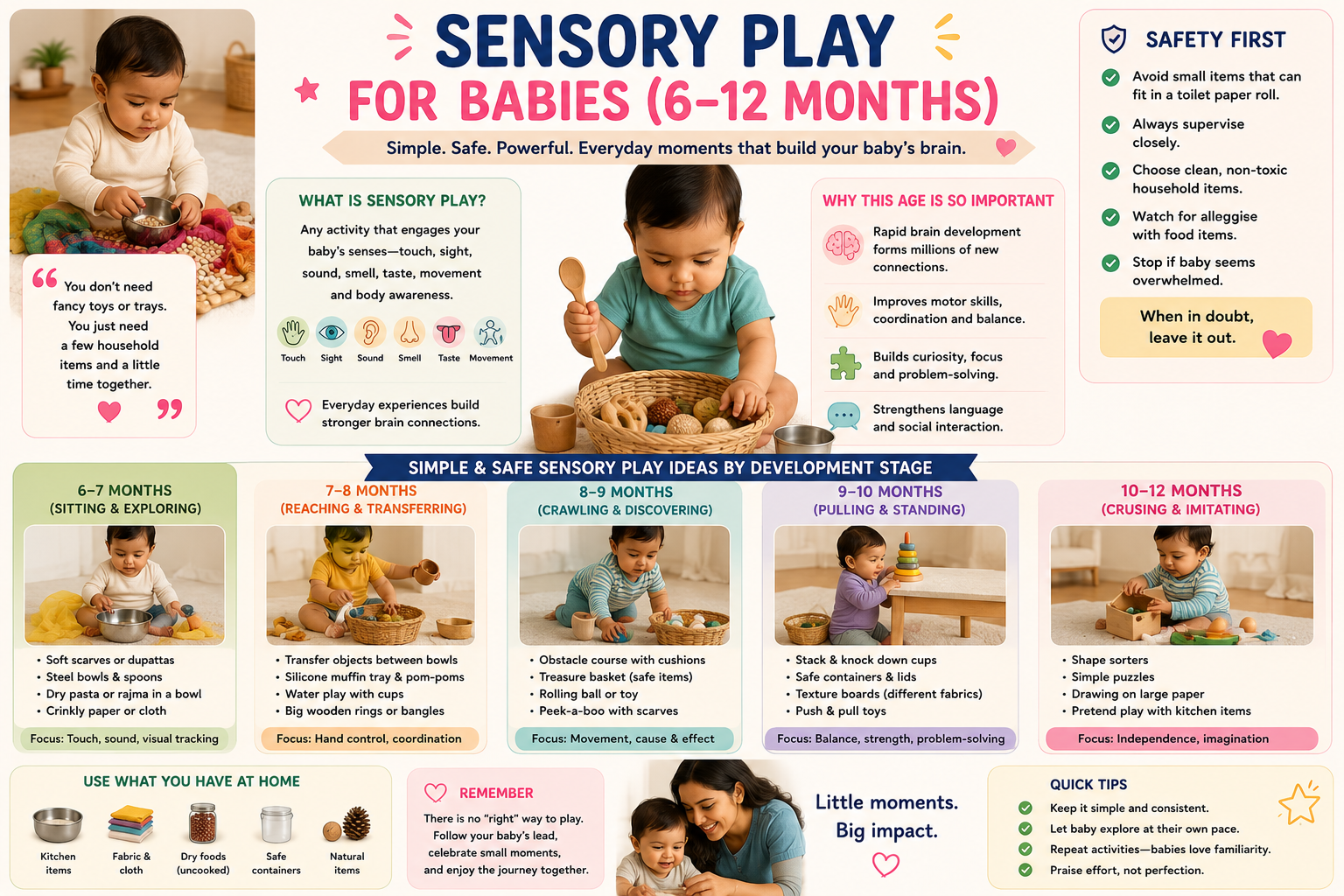
Sensory play, at its simplest, is any activity that engages one or more of your baby’s senses — touch, sight, sound, taste, smell, and also the body-awareness senses of movement and balance that don’t get talked about as often but matter just as much. A baby banging two spoons together, feeling the difference between a soft cloth and a cold steel bowl, or watching a ball roll across the floor is doing sensory play, whether or not it was ever styled for a photo.
The 6-to-12-month window is a particularly rich stretch for this kind of exploration because of how much is changing in your baby’s body during these months. Around six months, most babies can sit with some support and are beginning to reach and grasp with more intention. By eight or nine months, many are crawling, pulling to stand, and starting to use their thumb and forefinger together in what’s called a pincer grasp — which is exactly why small, safe objects to pick up become so much more interesting to them around this age than they were a few months earlier. By ten to twelve months, plenty of babies are cruising along furniture, saying a word or two, and engaging with cause-and-effect toys with real intention rather than pure reflex.
A developing baby’s brain forms an enormous number of new neural connections during this period, and each new sensory experience — a new texture, a new sound, a new way to move their body — gives that developing brain something concrete to build those connections around. This isn’t about turning your living room into a Montessori showroom or feeling pressure to “maximize” every waking moment. It’s simply that ordinary household objects, offered with a little intention and supervision, do genuine, meaningful work during this age window — often more than an expensive toy would.
It’s also worth noting that every baby moves through these months at their own pace, and the age ranges throughout this guide are meant as general guidance rather than a checklist to measure your baby against. A baby who’s still working on independent sitting at seven months, or one who’s already cruising confidently at nine, are both well within the very wide range of normal development. The activities below are organized by what your baby is currently doing rather than by their exact age in weeks, precisely so you can pick what actually fits your baby right now rather than what a calendar says they should be doing.
Before diving into specific activities, a few safety basics matter more here than in almost any other kind of baby play, because sensory activities often involve small objects, food items, or things a baby will inevitably put in their mouth.
Choking hazards are the single biggest risk to plan around. Anything smaller than a toilet paper roll’s diameter is a potential choking hazard for a baby this age, and mouthing objects is completely normal exploratory behavior at 6-12 months, not something to try to train out of them. This means small items like beans, rice, buttons, or bells need either constant, close, hands-on supervision, or should be swapped for taste-safe alternatives if your baby is a particularly enthusiastic mouth-explorer.
A simple household test many parents find useful: if an object can pass entirely through a toilet paper roll, treat it as a choking risk for this age group and either remove it from unsupervised reach or restrict it to moments of your full, undivided attention rather than a “keep half an eye on it” level of supervision.
Plastic bags and cling film need special care. Sensory bags — a zip-top bag filled with colored gel, paint, or rice, sealed and taped shut — are a popular, mess-free option, but they should always be secured well away from a baby’s face and never left within reach unsupervised, given the suffocation risk any thin plastic sheeting poses.
“Taste-safe” doesn’t mean “fine to eat in bulk.” Many sensory play recipes use edible bases specifically so that a baby mouthing the material isn’t dangerous — think cooked, cooled rice, mashed fruit, or yogurt-based mixtures — but taste-safe still means small amounts explored under supervision, not a meal substitute or something to let a baby consume freely.
Temperature and reaction checks matter for anything novel. If you’re introducing a new food-based texture (a fruit puree, a spice-infused water), do a small skin patch test first if you have any concern about allergies, and always check temperature yourself before letting your baby touch or taste something new.
Supervision is constant, not occasional, for this entire age range. None of the activities in this guide are “set it up and step away” activities. Sensory play at 6-12 months is inherently a together activity — you’re not just providing supervision for safety, you’re also the person narrating, naming, and making the experience richer through your own engagement with your baby during it.
Check for allergies before introducing new food-based materials. If your baby has any known or suspected food allergies, or if you’re introducing an edible sensory base made from a food they haven’t eaten before, treat it the same way you would a new food at mealtime — a small first exposure, watched closely, rather than a full sensory bin session with an entirely untested ingredient. This is especially relevant for common allergens like peanut-based flours, dairy-based yogurt mixtures, or egg-based materials sometimes used in edible play recipes.
Keep small-parts toys and sensory materials separate if you have older children at home. A common, easily overlooked risk in households with both a baby and an older sibling is small toy pieces from the older child’s play migrating into the baby’s reach. If older siblings are nearby during sensory play, a quick sweep of the area beforehand for stray small items is worth the extra minute.
Rather than organizing this strictly by month, it helps to think about what stage your baby is currently in, since babies within the 6-12 month window vary quite a bit in when they hit each milestone.
At this stage, your baby’s hands are becoming more purposeful, but their balance is still developing, so activities that can be done sitting supported — in your lap, propped with cushions, or in a supportive seat — work best.
Texture treasure basket. Gather a handful of safe household items with genuinely different textures — a soft cotton washcloth, a cool steel katori, a wooden spoon, a slightly bumpy loofah (new and unused), a soft dupatta or muslin cloth, a plastic measuring cup. Place them within reach and let your baby explore each one at their own pace, narrating the differences out loud: “this one is soft, na? And this one is thanda, cold.” This kind of open-ended treasure basket is one of the simplest, lowest-effort sensory activities to set up, and it works precisely because it doesn’t try to do too much — it just offers genuine variety for small hands to investigate.
Scented sock exploration. Fill a few old, clean socks with different dry, safe-smelling fillings — dried mint leaves, a cinnamon stick, dried orange peel — and tie the open end securely so nothing can spill out. Let your baby squeeze and hold each sock while you name the scent. This introduces smell as a distinct sensory category in a safe, contained way, since the filling stays sealed inside the fabric rather than being directly accessible.
Water bottle discovery bottles. Take a few small, clean plastic bottles with childproof lids taped shut for extra security, and fill each with a different visually interesting mix — water and glitter, water and a few floating buttons, dry rice and a bell. Babies at this stage can’t yet manipulate these with much intention, but shaking, watching, and listening to the different sounds and movements inside each bottle is genuinely captivating and completely mess-free.
Temperature exploration. Fill one small bottle with slightly warm (not hot) water and another with cool water and a few ice cubes. Sitting with your baby, let them feel each bottle one at a time, then both together, narrating “garam” and “thanda” as you go. This is a simple, low-prep way to introduce temperature as a distinct sensory concept, and many babies find the contrast genuinely fascinating rather than uncomfortable, since neither bottle is ever at an extreme temperature. Always test both bottles against your own wrist first, the same way you’d check bathwater, before handing either to your baby.
Tummy time sensory hoop. For babies still building neck and arm strength during tummy time, laying a hula hoop or a large circular scarf on the floor and placing a few colourful, interesting objects around its edge — just out of immediate reach — gives your baby a reason to lift, reach, and eventually shift their weight toward each item. This turns a task many babies resist (tummy time itself) into something with its own built-in reward. If your baby genuinely dislikes tummy time regardless of what’s on offer, short, frequent sessions of just a minute or two, repeated several times a day, tend to work better than forcing a single longer stretch they’re actively fighting.
Once mobility kicks in, sensory play can expand to include activities that reward movement, since your baby is now motivated to get to things rather than waiting for objects to be brought to them.
Edible sensory bins. A shallow bin or tray filled with a taste-safe base — cooked and cooled plain rice, mashed banana, a thick yogurt mixed with a food-safe color, or a simple “moon sand” made from crushed graham crackers and a bit of oil — gives your baby a rich, safe material to dig through, squish, and inevitably taste. Add a few safe scoops, a katori, or a large spoon to extend the play, and expect this to be genuinely messy — an old sheet under the high chair or play area saves considerable cleanup stress.
For families who’d rather avoid food waste concerns with an edible base, a similarly rich but non-edible alternative is cooked, cooled, dyed pasta (using food coloring) in a shallow bin, which offers comparable texture and visual interest while being easy to store and reuse across a few sessions if kept refrigerated between uses.
Ball pit or rolling ball play. A shallow container with a few soft balls of different textures and sizes — a smooth rubber ball, a textured sensory ball, a soft cloth ball — encourages reaching, grasping, and eventually purposeful throwing or rolling. This also naturally supports crawling practice, since babies at this stage will often crawl after a ball that’s rolled just out of reach. A shallow laundry basket or the bottom half of a large storage bin works well as an improvised ball pit if you don’t already own one specifically for this purpose.
Pots, pans, and kitchen orchestra. This is one of the lowest-cost, highest-payoff activities on this entire list: a few steel plates, a wooden spoon, an upside-down steel dabba, and a katori or two, laid out for your baby to bang, drag, and experiment with sound. Babies at this stage are genuinely fascinated by cause and effect — the direct connection between “I hit this” and “it makes a sound” — and kitchen items provide an enormous range of different pitches and tones for free.
Bubble wrap crawl. Tape a large sheet of bubble wrap securely to the floor (fully taped down at all edges so it can’t be picked up or bunched into a choking or suffocation hazard) and let your baby crawl across it. The popping sound and texture under their hands and knees is a genuinely novel sensory experience, and the activity naturally encourages more crawling practice as they explore the full sheet. Choose bubble wrap with larger bubbles for a more satisfying pop and a lower risk of any small torn pieces coming loose, and inspect the sheet for tears before each use.
Sensory bags for gentle squishing. A durable zip-top bag filled with hair gel or a thick paint mixture, sealed and further secured with strong tape around the opening, gives your baby a completely mess-free way to squish, poke, and watch colors move and blend. Always tape this flat to a table or highchair tray, well within your direct line of sight, since the plastic itself needs to stay fully secured and never loose near your baby’s face.
Around this stage, the pincer grasp is typically well established, many babies are cruising or taking early steps, and attention spans for more complex activities start to stretch slightly longer.
Fine motor picking activities. A muffin tin or ice cube tray with a few larger, safe pom-poms, large buttons, or soft pasta shapes in each compartment gives your baby focused practice picking up small items with their fingers — genuinely valuable fine motor work disguised as play. Always supervise closely given the small-object choking risk, and choose items on the larger end for babies who are still enthusiastic mouthers.
This activity also happens to be one of the easiest to scale in difficulty as your baby’s grasp improves — starting with larger, easier-to-grab items and gradually introducing smaller ones over the following weeks and months gives you a natural way to keep the same basic setup interesting well past the first birthday, without needing to invent an entirely new activity each time.
Sticker peeling and sticking. Large, soft foam stickers or simple paper stickers on a piece of cardboard give babies at this stage a satisfying peel-and-stick activity that works their pincer grasp directly. This tends to hold attention longer than you’d expect, precisely because peeling a sticker off and successfully sticking it somewhere else is a genuinely difficult, satisfying fine motor achievement at this age.
Ice and water play. A shallow tray of ice cubes, some with small toys frozen inside, gives babies at this stage a fascinating combination of temperature, texture, and problem-solving as they try to free the toy from the ice. Keep sessions short given how cold the ice will be, and always supervise directly.
“Lift the flap” texture board. A simple homemade board with different textured fabric squares glued under cardboard flaps — fabric scraps, sandpaper, cotton wool, foil — rewards babies at this stage for the specific fine motor action of lifting each flap to discover what’s underneath, combining curiosity, cause-and-effect, and texture exploration in one activity.
Simple obstacle crawling course. A few cushions, a low step made from a folded blanket, and a soft tunnel (even a large, sturdy cardboard box with both ends open) turns your living room into a full-body sensory and movement experience, engaging your baby’s sense of balance and body position alongside the tactile experience of crawling over different surfaces. Rotate the arrangement every week or two rather than leaving it static, since babies at this stage tend to master a fixed obstacle course fairly quickly and benefit from small variations to keep the challenge fresh.
If you’d rather think in terms of which sense you want to focus on today rather than your baby’s exact stage, here’s a faster reference:
Touch: texture treasure baskets, edible sensory bins, sensory bags, water play, ice play, different fabric scraps Sight: black-and-white contrast cards for younger babies in this range, colour sensory bags, bubbles, a simple mirror for supervised mirror play Sound: kitchen pots and spoons, shaker bottles, bells sewn securely onto a soft anklet for supervised movement play, simple rhymes and songs sung during any activity Smell: scented socks, cooking together nearby so your baby experiences kitchen smells, herb and spice exploration under close supervision Taste: food-based sensory bins using items your baby is already cleared to eat, offering a variety of textures and flavors during regular mealtimes as its own form of sensory learning Movement and balance: tummy time hoops, obstacle crawling courses, supported standing and cruising near furniture, gentle bouncing on your lap to music
One of the most freeing realizations for a lot of parents is that almost none of this requires buying anything. Steel katoris, wooden spoons, old dupattas, empty spice boxes with lids, dry lentils and rice already in your kitchen, an old hula hoop from a cupboard, muffin tins, ice cube trays — the vast majority of genuinely engaging sensory play for this age comes from ordinary household items rather than curated sensory kits.
This matters for reasons beyond cost. Household objects also tend to hold a baby’s interest longer than dedicated baby toys precisely because they’re not designed to be toys — they have real textures, real weights, real sounds that a manufactured plastic toy often can’t replicate. A steel katori dropped on the floor sounds and feels different from a plastic one in a way babies notice immediately, even if they can’t articulate why.
There’s a practical planning benefit here too, beyond the developmental one. Because household-item sensory play doesn’t require ordering anything or waiting for a delivery, it’s available exactly when you need it — a rainy afternoon, a day when your baby is fussy and needs redirection, the last hour before dinner when everyone’s patience is thin. Keeping a small, rotating mental list of two or three go-to combinations (the katori-and-cloth basket, the pots-and-spoons setup, a quick edible rice bin) means you’re never stuck wondering what to do with an unoccupied baby, because the entire kit already exists in your kitchen drawers.
It’s also worth saying plainly: you don’t need to set up a “sensory activity” every single day, or even most days, for your baby to get real developmental benefit from this kind of play. A single well-chosen activity two or three times a week, done with your genuine attention and narration alongside it, does more for your baby’s development than a rushed, daily activity you’re mentally checked out of. The engagement you bring to the fifteen minutes matters as much as the activity itself.
One of the easiest ways to keep sensory play feeling natural rather than like a separate chore on your to-do list is to fold it into things your family is already doing, especially around festivals and everyday rituals.
Diwali season offers genuinely rich sensory material even with a baby too young for actual diyas or firecrackers — cotton wicks to feel, small brass or steel diyas (unlit, cleaned, and supervised) to explore for weight and shine, the sound of bells during aarti, and the smell of fresh flowers or incense from a safe distance all become sensory experiences woven into a celebration your baby is already present for.
Holi, while too early for a baby this age to join in traditional color play, can still be adapted safely — a small bowl of natural, food-grade colored water (well diluted, kept away from eyes and mouth, and only ever under direct supervision) or simply letting your baby watch and feel the texture of flower petals used for a gentler, baby-safe version of the festival captures some of the sensory spirit without the risk that commercial colors or larger amounts of water can pose.
Everyday kitchen time is arguably the richest, lowest-effort sensory environment already built into most Indian homes. Sitting your baby nearby (safely out of reach of the stove) while you cook exposes them to the smell of spices tempering, the sound of a pressure cooker whistle, the sight of steam rising, and the rhythm of chopping — all genuine sensory input that requires zero additional setup on your part.
This isn’t about manufacturing a “sensory experience” out of every single family moment — it’s simply noticing that a lot of what your household is already doing offers exactly the kind of textural, auditory, and olfactory richness this age group benefits from, without needing a separate activity block carved out of your day.
A few weeks after that first accidental rajma-and-dupatta discovery, Priyanka has a loose rotation going — nothing scheduled, nothing styled for a photo, just a small mental list of household items she reaches for depending on Ishaan’s mood and how much cleanup energy she has that day. Steel katoris and spoons on high-energy mornings. The texture basket on quieter afternoons. An occasional messy edible rice bin on days she’s decided cleanup is worth it, usually right before a bath was happening anyway.
“I used to think I needed to be doing the Pinterest version of this,” she told me, watching Ishaan methodically bang a steel lid against the floor with the kind of total concentration only a baby can manage. “Turns out he doesn’t know the difference between a styled wooden tray and my kitchen drawer. He just wants to bang things and feel things and have me sitting there with him while he does it.”
The rotation has evolved a little as Ishaan has grown, too. What started as pure texture exploration around six months has, by ten months, turned into him deliberately stacking two katoris, dropping a rajma bean into an empty one and looking up at Priyanka with visible pride each time, and dragging the dupatta across the room to specifically bring it to her rather than just playing with it alone. “I didn’t plan for any of that to happen,” she said. “It just sort of built on itself, the same objects doing something a little more complicated every few weeks.”
That’s really the whole secret this guide is trying to hand over: the developmental value was never in the styling. It was always in the baby’s hands, the ordinary object, and someone paying attention nearby.
At six months, simple texture treasure baskets with safe household items — a soft cloth, a steel katori, a wooden spoon — tend to work best, since babies at this age are still developing sitting balance and grasp, and open-ended exploration suits that stage better than more complex activities.
Mouthing is a completely normal way babies explore objects at this age, which is exactly why choosing taste-safe materials (like cooked rice or mashed fruit) for anything small enough to fit fully in the mouth matters, along with constant supervision for any non-edible items in a sensory activity.
There’s no fixed requirement — two or three genuinely engaged sessions a week tend to offer more developmental value than a rushed daily activity, since your attentive presence during the activity matters as much as the activity itself.
Steel katoris and plates, wooden spoons, old dupattas or muslin cloths, dry rice or lentils (for supervised play), empty spice containers with secure lids, and muffin tins or ice cube trays are all effective, low-cost options already found in most Indian kitchens. Many of these can be reused across dozens of different activities simply by combining them differently or pairing them with a new texture, so there’s rarely a need to buy anything specifically labeled as a “sensory toy.”
Simple, taste-safe sensory bins can generally be introduced once a baby is sitting independently and reaching with intention, typically somewhere around 7 to 9 months, though supervision requirements remain high throughout the entire 6-12 month window regardless of the specific activity.
Genuine engagement with varied textures, sounds, and movement experiences does support the rapid neural development happening during this age window, though this doesn’t require elaborate or expensive setups — ordinary household objects, explored with your attention alongside your baby, provide real developmental value.
Not necessarily — many sensory activities work well shared between two babies of similar age, especially larger-scale ones like a shared texture basket, a bubble wrap crawl area, or a kitchen pots-and-pans setup with enough items for both. What matters more is ensuring each baby has enough of their own space and objects to avoid frustration over sharing at an age when that skill hasn’t developed yet, and giving both babies individual attention and narration during the activity rather than splitting your focus entirely.
Yes, and many activities translate naturally outdoors given appropriate weather and shade — texture exploration with leaves, grass, or sand under close supervision, water play in a shallow basin, or simply sitting your baby on a mat outside to experience different sounds and temperatures than they get indoors. Outdoor sensory play carries its own additional considerations, like checking for insects, ensuring shade during hot parts of the day, and being more vigilant about small objects like pebbles that pose a choking risk.
Completely normal at this age, and often more a reflection of a baby’s naturally short attention span than the activity’s quality. Rotating through two or three different textures or objects within the same session, rather than expecting sustained focus on one item, tends to work better than persisting with a single activity your baby has already moved past.
If you’ve been feeling behind because your sensory play doesn’t look like the styled version on your feed, let this be the permission slip to put it down. Your baby doesn’t know or care about matching wooden trays and soft studio lighting. They care about the katori in front of them, the dupatta over their face, and you sitting close enough to laugh when they figure out how to pull it off themselves. That’s the whole activity. That’s always been the whole activity.
And on the days when even that feels like too much — when the idea of pulling out a single katori feels like one task too many on an already exhausting day — remember that ordinary daily life is already doing a good deal of this work for you. A bath, a walk outside, a meal with a variety of textures on the plate, even just sitting together while you fold laundry and let your baby handle a soft towel, all count as genuine sensory input. This guide is here for the days you have the bandwidth to be intentional about it, not a new obligation for the days you don’t.
This article draws on general early-childhood development guidance and sensory play ideas compiled from sources including Little Learning Club and Twinkl’s early years resources. It’s intended as general activity guidance, not medical or developmental advice — if you have specific concerns about your baby’s development, sensory processing, or feeding readiness, please consult your pediatrician.