Physical Address
304 North Cardinal St.
Dorchester Center, MA 02124
Physical Address
304 North Cardinal St.
Dorchester Center, MA 02124

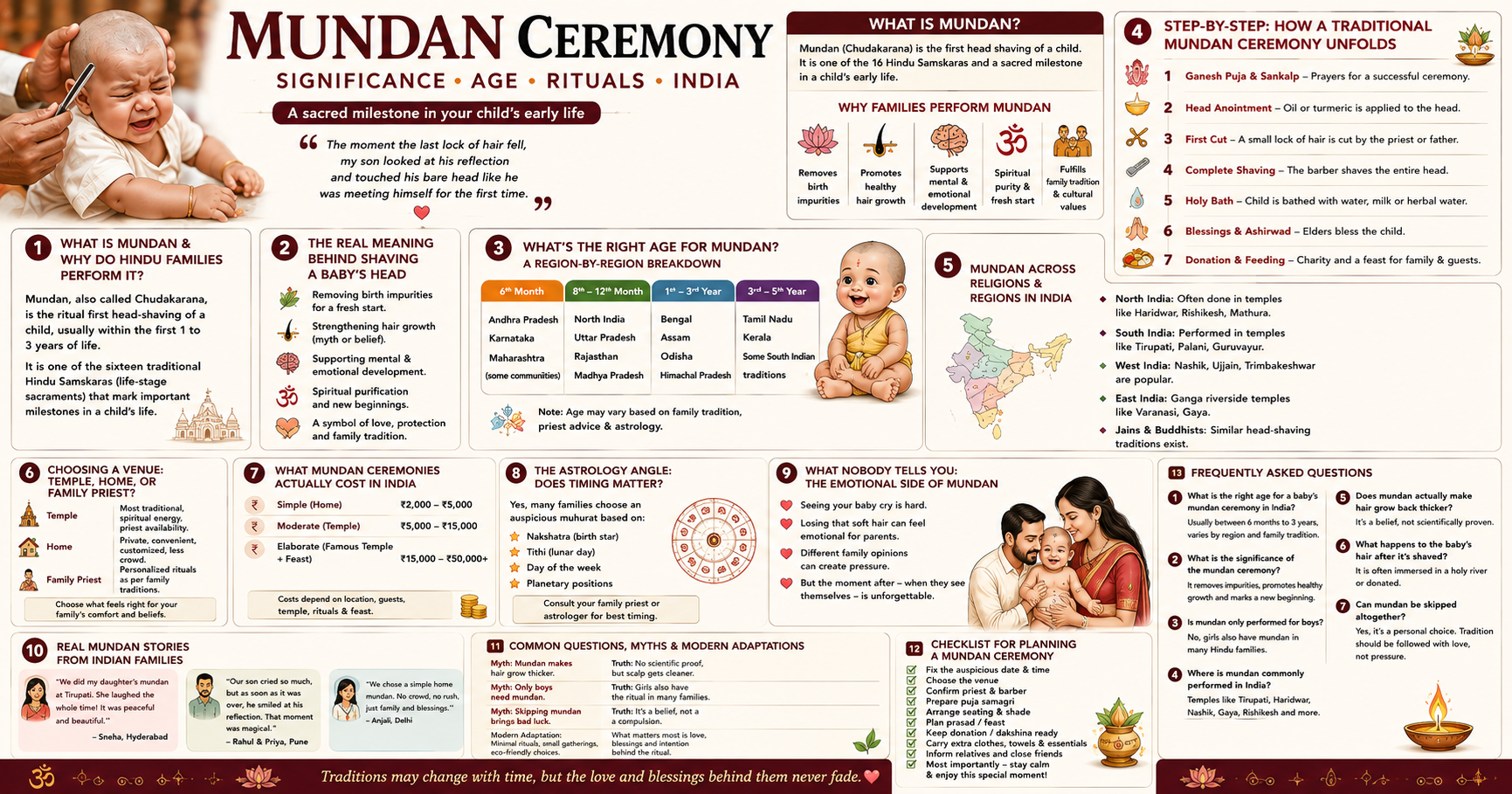
Priya’s son cried through most of it. Not from pain — the barber was gentle, practiced, the kind of man who’d shaved a thousand toddler heads at this same temple courtyard before hers — but from sheer confusion at being held still by four different relatives while strangers sang and threw rice. Her mother-in-law kept saying, over the crying, “Rone do, shubh hota hai.” Let him cry, it’s auspicious. Priya, a first-time mother who’d spent the morning googling “is mundan necessary,” wasn’t so sure anymore whether she believed that. But she also noticed something she hadn’t expected: the moment the last lock of hair fell, her son stopped crying entirely, blinked at his own reflection in the small mirror someone held up, and reached out to touch his bare head like he was meeting himself for the first time.
That small, strange moment — a baby genuinely startled by his own reflection — is one every parent who’s been through a mundan seems to remember with total clarity, years later. It’s a ceremony that looks, from the outside, like “just a haircut.” From the inside, families will tell you, it’s one of the more emotionally loaded rituals of early childhood — equal parts tradition, superstition, family politics, and, if you ask most mothers honestly, a small private grief about losing the baby-soft hair their child was born with.
This guide covers everything Indian parents actually search for around mundan: what it means, when to do it, how the rituals actually unfold region by region, what it costs, and the honest, sometimes conflicting feelings parents have about it — because very few articles online tell you that part.
Mundan, also called chudakarana in Sanskrit texts, is the ritual first head-shaving of a child, typically performed within the first one to three years of life. It’s one of the sixteen traditional Hindu samskaras (life-stage sacraments) that mark significant milestones from conception to death — sitting alongside naamkaran (naming), annaprashan (first solid food), and vidyarambha (start of education) as one of the formative rituals of early childhood.
Unlike naamkaran, which most families perform regardless of religious intensity simply because a baby needs a name, mundan is more visibly a matter of belief and choice today — some families follow it strictly as inherited tradition, some do it because grandparents insist, some skip it entirely, and a growing number do a small private version stripped of most ritual elements but keep the haircut itself as a milestone worth marking.
Ask five different families why they perform mundan and you’ll likely get five overlapping but slightly different answers, because the tradition carries several layers of meaning that have accumulated over centuries:
Removing birth impurities. The most commonly cited reason — the belief that hair grown in the womb carries impurities or negative traits from past lives, and shaving it clears the child for a fresh start, both spiritually and physically.
Strengthening hair growth. A widely held (and scientifically unproven, though not disproven for all individuals) belief that shaving stimulates thicker, healthier hair regrowth — this is often the reason cited by more secular or less religiously strict families who keep the practice for practical rather than spiritual reasons.
Fulfilling a religious vow. Many families perform mundan specifically at a deity’s temple as the fulfilment of a manat — a vow made during pregnancy or a difficult conception journey, where parents promised the child’s first haircut to a particular god or goddess in exchange for a safe birth or healthy child.
Symbolic detachment from ego and vanity. In more philosophical Hindu interpretations, shaving the head represents removing vanity and ego at the earliest possible stage of life — a theme that echoes through other Hindu head-shaving traditions, including those performed after a death in the family or during certain pilgrimages.
Cooling and strengthening the skull. A folk-medicine belief, especially strong in South India, that shaving stimulates the pressure points on a baby’s head and supports healthy brain development — again, more cultural belief than clinically established fact, but deeply held nonetheless.
Most families don’t consciously pick just one of these — the ritual tends to carry all of them at once, layered together, which is part of why it still feels significant even to parents who describe themselves as only moderately religious.
There is no single universally “correct” age — and this is genuinely one of the most searched, most debated questions among Indian parents. What follows is the general pattern, with real regional variation:
Most common window: 1st or 3rd year. Traditional texts generally recommend mundan take place before the child turns three, with the first birthday and the third birthday being the two most commonly chosen milestones. Even numbers (2nd year) are traditionally considered less auspicious in many family customs, which is part of why 1 and 3 dominate over 2.
North Indian families (Uttar Pradesh, Bihar, Rajasthan, Haryana, Delhi NCR) frequently favour the first birthday, often combining it with the birthday celebration itself, or perform it slightly later around 3 years tied to a specific temple visit.
South Indian families (Tamil Nadu, Andhra Pradesh, Karnataka, Kerala) often lean toward temple-specific timing — many South Indian families travel specifically to temples like Tirupati specifically for mundan, and the age is sometimes secondary to simply being able to make the pilgrimage, which can push the ceremony anywhere from 1 to 5 years depending on family logistics.
Bengali and Eastern Indian families sometimes perform a version of this ritual, though with somewhat less ritual intensity than North or South Indian traditions, often folded into other early-childhood ceremonies rather than standing entirely alone.
Odd-numbered years matter more than exact age in most traditions — meaning families are generally more flexible about doing it at 1, 3, or 5 than fixating on an exact month, as long as an odd year is respected.
Girls and mundan. Traditionally, mundan is more commonly associated with boys, though many families — particularly in South India and among Rajput and certain North Indian communities — perform it for girls too, sometimes with a lighter version of the ritual (a symbolic snip rather than a full shave) rather than skipping it altogether.
The honest, non-mystical version of this answer: most families choose an age based on what’s practically convenient — a trip to the ancestral temple, a visiting grandparent’s schedule, an auspicious date on the calendar that happens to align with travel plans — and retrofit the “why this age” explanation afterward. That’s not a criticism; it’s simply how most living traditions actually get practiced.
While regional variations exist, most Hindu mundan ceremonies follow a recognisable sequence:
1. Muhurat (auspicious timing) is finalised, usually by consulting a priest or panchang, ideally avoiding certain inauspicious periods like Rahu Kaal.
2. The venue is prepared — whether a temple courtyard, the family home, or occasionally a dedicated function hall for larger family gatherings.
3. A small puja (prayer ritual) precedes the haircut, typically invoking blessings for the child’s health, long life, and prosperity, often specifically addressed to the family’s chosen deity.
4. The child is seated, usually in the lap of the mother, maternal uncle (mama), or grandparent, depending on family custom — the maternal uncle’s role is especially significant in many North Indian traditions.
5. The barber (often a family-trusted or temple-affiliated nai) begins the actual head-shaving, typically starting with a symbolic first lock cut by the father or a senior family member before the barber completes the rest.
6. The shaved hair is collected, and in many traditions, offered to the deity, buried near a sacred tree (often a peepal or tulsi), or immersed in a river — rarely simply discarded, since the hair itself is considered part of the ritual offering.
7. The child’s head is cleaned and, in many families, a turmeric or sandalwood paste is applied, believed to soothe the scalp and, in some beliefs, support smoother regrowth.
8. A small aarti (light ritual) and prasad distribution close the religious portion, followed by blessings from elders — this is often the part relatives look forward to most, showering the child with small gifts of money or gold.
9. A family meal or celebration typically follows, ranging from an intimate lunch to, for some families, a full function with extended relatives, depending on how significant the family considers the milestone.
While mundan is most strongly associated with Hindu tradition, India’s regional and religious diversity means the practice — or something adjacent to it — shows up in varied forms:
Sikh families generally do not perform mundan, since uncut hair (kesh) holds deep religious significance in Sikhism; Sikh children’s hair is traditionally never cut.
Muslim families in India sometimes perform a related but distinct ritual called Aqiqah, which includes shaving a newborn’s head (usually on the 7th day) alongside a naming ceremony and charitable donation — conceptually similar in spirit but rooted in entirely separate Islamic tradition rather than Hindu samskara practice.
Christian families in India generally do not follow a formal head-shaving ritual, though regional cultural blending occasionally means some Christian families in heavily Hindu-influenced regions adopt informal, secularised versions.
Jain families often follow a version of mundan closely aligned with Hindu practice, given shared cultural roots, though specific temple and ritual details differ.
This regional and religious variation is worth knowing not just as trivia — it matters practically for content and for real families navigating interfaith marriages or mixed extended families trying to decide which traditions to honour.
Temple mundan is the most traditional and widely chosen option, particularly at temples known specifically for this ritual — Tirupati Balaji in Andhra Pradesh is probably the single most famous mundan destination in India, drawing families from across the country specifically for this ceremony, alongside temples like Palani in Tamil Nadu and various regional Devi and Hanuman temples believed to be especially auspicious for children’s rituals.
Home ceremonies conducted with a family priest are common for families who prefer intimacy, have logistical constraints around temple travel with a very young child, or simply follow a family tradition of home-based rituals over temple ones.
Combined approach — many urban families today do a simplified puja at home for convenience and comfort, then visit a temple later (sometimes months later) for a symbolic blessing, splitting the ritual across two more manageable occasions rather than one elaborate day.
The choice of venue is genuinely one of the more personal and family-specific decisions in the whole process — there’s no ranking of “more correct” venues in most traditions, despite what some overly rigid advice online might suggest.
This is another area most articles skip, but it’s exactly what parents planning the day actually need.
Basic home ceremony with family priest: roughly ₹2,000–₹8,000, covering priest fees, puja items, and a barber, varying significantly by city and priest reputation.
Temple mundan (standard, non-VIP) at popular temples like Tirupati: largely free or very low-cost for the ritual itself (temples typically don’t charge for the haircut), but families should budget for travel, accommodation, and temple donations, which can range widely — a modest trip might run ₹10,000–₹25,000 all-in for a family of four to five, while more elaborate trips with extended family cost considerably more.
VIP or special darshan packages at major temples, which some families opt for to reduce wait times with a young child, add anywhere from ₹500–₹5,000 depending on the temple and package tier.
Function hall celebration (for families who host a larger gathering after the ritual): costs vary enormously by city and guest count, similar to any other family function — anywhere from ₹15,000 for a modest home gathering to several lakhs for an elaborate celebration with catering and decor.
Photography/videography, increasingly common for this milestone: typically ₹5,000–₹20,000 depending on city and package, similar to pricing for other milestone family functions.
The wide range here reflects genuine diversity in how families choose to mark this day — a quiet home ceremony and an elaborate temple trip with fifty relatives are both entirely valid, common versions of the same ritual.
For families who follow astrological guidance closely, mundan timing often gets the same scrutiny as naamkaran. A priest or astrologer may be consulted to identify:
As with nakshatra naming, this isn’t a universally followed step — it ranges from families who won’t proceed without a priest’s confirmed muhurat, to families who simply pick a convenient weekend and consider the ritual itself, not the exact timing, to be what matters.
Most articles about mundan describe it purely as ritual and logistics. Talk to actual mothers, though, and a different, less discussed layer comes up almost every time: mundan is often the first moment a parent has to let go of something physical about their baby.
That first head of hair — however sparse, however unevenly it grew in — is something a parent has touched, smelled, photographed obsessively for months. Shaving it off, even for deeply held religious reasons, catches many mothers off guard emotionally in a way they didn’t expect going in. It’s common, and rarely discussed openly, for mothers to feel a small private sadness even while participating fully and happily in a ritual they believe in.
There’s also a real, practical anxiety many first-time parents carry into the day: will the baby get frightened by the noise and crowd? Will the barber be gentle? Will grandparents overrule the parents’ preferences about how elaborate the ceremony should be? These aren’t signs of “not being traditional enough” — they’re completely ordinary parts of navigating a meaningful ritual as a new parent, and worth naming honestly rather than only presenting the polished, purely joyful version of the day.
Priya, Mumbai — “I cried more than my son did, if I’m honest, and I hadn’t expected that at all. Everyone kept telling me it was auspicious and I should be happy, and I was — genuinely — but I also just missed his little curls the moment they were gone. Both things were true at once.”
Rajesh and Kavita, Andhra Pradesh — “We’d made a manat at Tirupati during a really difficult pregnancy — Kavita had two miscarriages before our daughter. Going back for her mundan wasn’t really about tradition for us, it was about keeping a promise we’d made when we were desperate for things to work out. That trip meant more to us than almost anything else we’ve done as a family.”
Sunita, joint family, Lucknow — “My mother-in-law wanted the full temple version with fifty relatives. I wanted something small and quiet at home. We compromised — small puja at home with immediate family, followed by a proper temple visit three months later when everyone could travel together. It worked out better than either of our original plans, honestly.”
Divya, interfaith marriage, Bengaluru — “My husband is Christian, I’m Hindu. We didn’t do the full ceremony, but I really wanted my son’s first haircut to feel intentional rather than just a random barbershop visit. We did a small, simple version at home with just my parents — no elaborate puja, just enough to honour where I come from without pretending we’re a fully traditional Hindu household, because we’re not.”
Myth: Mundan must be done exactly at age 1, or exactly at age 3, with no flexibility. Reality: while odd-numbered years within the first three are the most commonly followed pattern, family circumstances (health, travel, availability of a priest or family member) routinely shift the exact timing without any believed loss of auspiciousness, as long as it happens within the broadly accepted window.
Myth: Skipping mundan brings bad luck. Reality: this belief varies enormously by family and isn’t a universal religious requirement — many families choose not to perform it at all, for personal, religious, or simply preferential reasons, without reporting any sense of consequence.
Myth: Girls should never have a mundan ceremony. Reality: while less commonly performed for girls than boys in some regions, several Indian communities — particularly in South India — do perform it for daughters as well, sometimes as a full shave and sometimes as a lighter symbolic haircut.
Myth: A professional barber must perform the shave; a family member cutting hair “doesn’t count.” Reality: while a barber traditionally completes the shave, the first symbolic cut by a father, grandfather, or maternal uncle is itself considered the ritually significant part in most traditions — the professional barber’s role is largely practical, not spiritual.
Modern adaptation: combining mundan with a first-birthday party. Increasingly common among urban families balancing tradition with modern celebration culture — the ritual haircut happens earlier in the day, followed by a more contemporary birthday party later, giving families the best of both without two separate large gatherings.
Most families perform mundan within the child’s first three years, with the 1st and 3rd birthdays being the most commonly chosen ages, since odd-numbered years are traditionally preferred over even ones.
Mundan symbolically removes birth impurities, fulfils religious vows made during pregnancy, and marks one of the sixteen traditional Hindu samskaras (life-stage sacraments) performed during early childhood.
Traditionally more common for boys, but many communities, especially in South India, also perform mundan for girls, sometimes as a full shave and sometimes as a lighter symbolic haircut.
Tirupati Balaji temple in Andhra Pradesh is one of the most popular mundan destinations nationally, alongside other regional temples and, very commonly, family homes with a priest present.
This is a widely held cultural belief without strong scientific backing either way; hair texture and thickness are primarily determined by genetics, though shaving doesn’t harm the follicles either.
Depending on family and regional tradition, the hair is often offered to a deity, buried near a sacred tree like peepal or tulsi, or immersed in a river — rarely simply thrown away, since it’s considered part of the ritual offering.
Yes — it’s a matter of family belief and choice rather than a strict religious mandate for every Hindu family, and many parents choose not to perform it without any reported consequence.
This article describes cultural and religious traditions as commonly practiced across Indian families; specific rituals, timing, and beliefs vary by region, community, and individual family custom. For ceremony-specific guidance, it’s best to consult your family priest or a knowledgeable elder.