
There’s a specific moment a lot of Indian parents will recognize: it’s 8 PM, dinner still isn’t done, the baby is fussing, and someone — often a well-meaning grandparent — hands over a phone with a rhyme playing on it. Ten minutes of quiet follows. Nobody feels great about it, but nobody stops it either, because in that exact moment, it works.
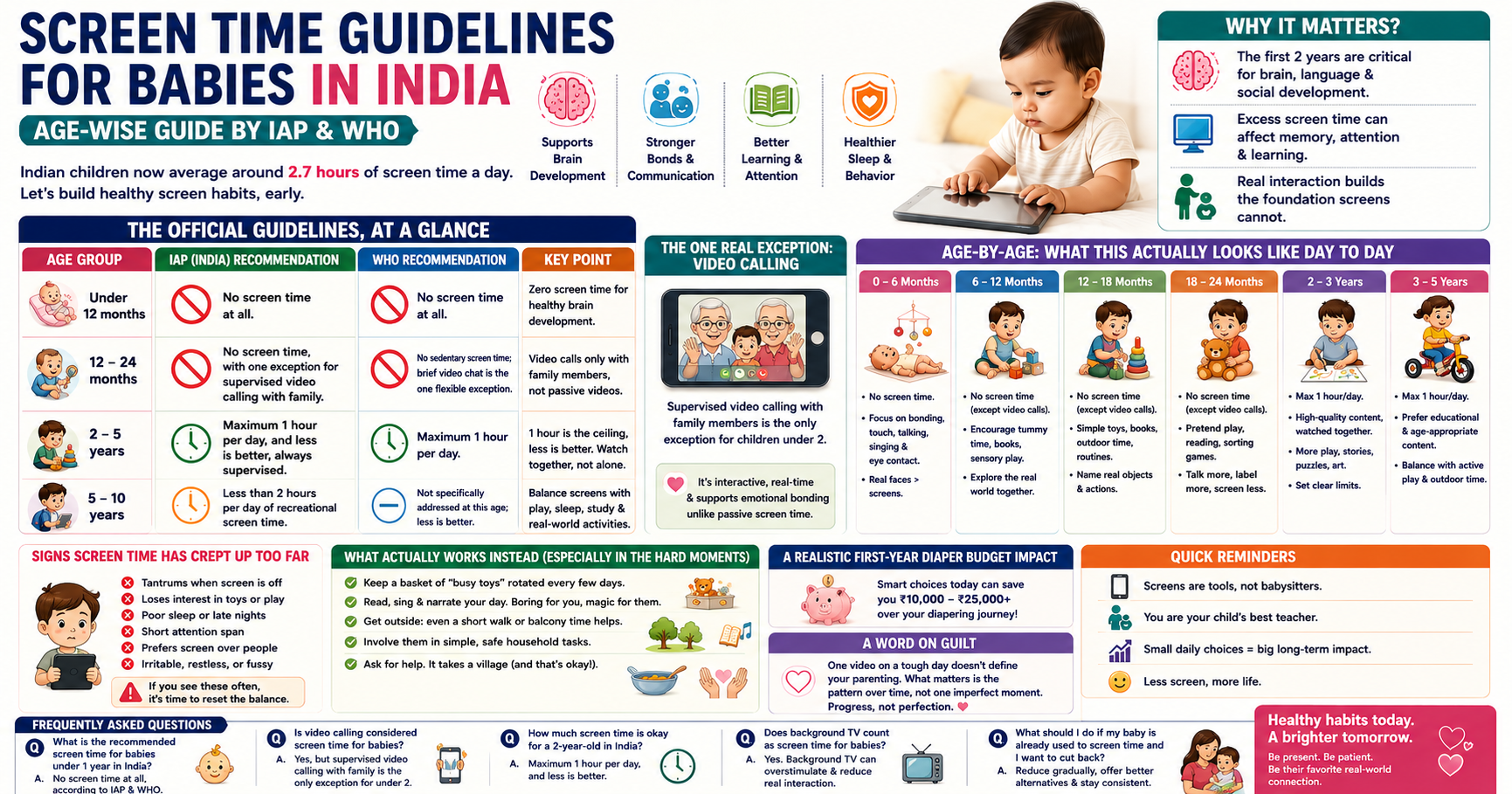
Screen Time Guidelines for Babies in India Age Wise
This article isn’t here to make you feel guilty about that moment. It happens in almost every household with young children, and one video during one hard evening isn’t the thing that shapes a child’s development. What actually matters is the pattern that builds up over months — and on that front, India has a genuine problem worth paying attention to. Recent data suggests Indian children are now averaging somewhere around 2.7 hours of screen time a day, a number that has climbed sharply since the pandemic years, when Zoom classes and stir-crazy toddlers made screens the default solution to a lot of hard days.
The Indian Academy of Pediatrics (IAP), along with the World Health Organization, released clear, age-specific screen time guidance a few years back — and it’s more specific, and honestly more useful, than most parents realize. This is a full breakdown of what those guidelines actually say, age by age, why the under-2 recommendation is as strict as it is, what the one real exception looks like, and — probably more usefully — what to actually do in the moments when a screen feels like the only option.
Table of Contents
The Official Guidelines, At a Glance
Before getting into the reasoning, here’s what the major pediatric bodies actually recommend, side by side:
| Age Group | IAP (India) Recommendation | WHO Recommendation |
|---|---|---|
| Under 12 months | No screen time at all | No screen time at all |
| 12–24 months | No screen time, with one exception for supervised video calling with family | No sedentary screen time; brief video chat is the one flexible exception |
| 24–59 months (2–5 years) | Maximum 1 hour per day, and less is better, always supervised | Maximum 1 hour per day |
| 5–10 years | Less than 2 hours per day of recreational screen time | Not specifically addressed at this age range; general “less is better” guidance continues |
A couple of things stand out here. First, the guidance for children under 2 isn’t “limit it” — it’s genuinely zero, with one narrow exception. Second, “1 hour” for the 2–5 age group is a ceiling, not a target — pediatricians are consistently clear that less than an hour, and screen time that’s high-quality and watched together with a caregiver, is meaningfully better than a full hour of solo, passive viewing.
Why the Under-2 Recommendation Is So Strict
It can feel almost extreme, especially compared to how normalized screens are in daily life now — a full ban, not even for educational content, not even for a “calm down” video. But the reasoning behind it is fairly specific, and worth actually understanding rather than just following as a rule.
The first two years of life are when a baby’s brain is building the foundational wiring for language, attention, and social connection — and it does that almost entirely through real, responsive, back-and-forth interaction. A baby babbles, a parent responds, the baby watches the parent’s face change, tries again, gets another response. That loop — sometimes called “serve and return” in child development research — is what actually builds language and social skills in the earliest years. A screen, even a well-designed one, can’t do that loop. It plays regardless of what the baby does.
There’s also a fairly consistent body of research linking excessive early screen exposure to lower scores on memory, reading, and general cognitive tests once children reach school age — not because a few videos are catastrophic, but because time spent watching a screen is time not spent on the interaction, exploration, and hands-on play that actually build those skills during the exact window when the brain is most primed to build them.
None of this means a baby who sees a video call with their grandparent, or catches ten minutes of something on a long train journey, has been harmed. It means the default for this age group should be no screen, not “a little screen is probably fine as long as it’s educational” — because at this age, there isn’t really educational content that outperforms real interaction, however well the packaging is designed to suggest otherwise.
The One Real Exception: Video Calling
Both the IAP and WHO guidelines carve out a specific exception even for children under 2: supervised video calling with family members.
This makes sense once you think about why the general rule exists in the first place. A video call is still interactive — the baby sees a real face responding in real time, hears their name, gets a reaction to their own babbling or expressions. It’s a different category of screen use entirely from a video autoplaying on loop. A ten-minute video call with a grandparent who lives in another city isn’t the same thing as ten minutes of a rhymes channel, even though both technically involve a screen.
If your family relies on video calls to stay connected with relatives who live far away — which describes an enormous number of Indian households — this exception is worth knowing about specifically so you’re not feeling unnecessary guilt over something the actual guidelines already account for.
Age-by-Age: What This Actually Looks Like Day to Day
0–6 Months
At this stage, the guidance is straightforward: no screen exposure. This includes background TV — a television playing in the same room, even if your baby isn’t directly looking at it, has been associated with reduced quality of parent-child interaction and disrupted attention in infants, simply because it’s a constant source of noise and light competing for attention in the room. If the TV is generally on in your house in the evenings, it’s worth being mindful of where your baby’s mat or bouncer is positioned relative to it during this stage.
6–12 Months
Same recommendation continues — no screen time. This is also the stage where babies are becoming genuinely curious about faces and objects, so redirecting that curiosity toward safe household objects, simple toys, and — most usefully — your own face and voice, does more for development than any screen-based alternative would.
12–18 Months
Still no screen time, video calls aside. This is the stage where a lot of Indian parents report the first real “screen creep” happening — often not from the parents themselves, but from a grandparent, an older sibling, or a domestic helper reaching for a phone during a fussy moment because it’s the fastest available tool. It’s worth having a gentle, non-confrontational conversation with everyone who regularly cares for your baby about this specific age bracket, since the guidance genuinely surprises a lot of caregivers who assume “it’s just a rhyme video, what’s the harm.”
18–24 Months
The zero-screen guidance still applies through this stage under IAP recommendations, though this is where some international guidelines (like the American Academy of Pediatrics) start to allow a small amount of high-quality programming watched together with a caregiver, rather than a hard zero. If you do choose to introduce anything at this stage, the Indian guidance is clear that co-viewing — sitting with your toddler, talking about what’s happening, pausing to ask questions — is what separates screen time that’s at least not purely passive from screen time that offers nothing.
2–3 Years
This is where the guidelines shift from zero to a genuine, defined limit: up to 1 hour a day, and less is genuinely better. At this age, quality starts to matter as much as quantity. Slow-paced, simple content with clear language and predictable structure (think a calm rhyme or story, not a fast-cut cartoon with constant scene changes) supports attention and language far better than high-stimulation, rapid-editing content, even within the same hour limit.
3–5 Years
The 1-hour ceiling continues, but this is the stage where screen habits often start solidifying into long-term patterns — the child who’s used to a tablet during every meal at 3 tends to still expect it at 6. This is a good window to be deliberate about when screens are used (not automatically at every meal, not automatically as the default wind-down before bed) rather than just how much.
Signs Screen Time Has Crept Up Too Far
A few practical signs worth watching for, regardless of your child’s exact age:
- Meltdowns specifically tied to the screen being turned off, disproportionate to how your child typically reacts to other transitions.
- The screen has become the only thing that calms your child down — when it’s the sole tool that works for a tantrum, mealtime, or car ride, that’s usually a sign it’s being reached for more often than intended, simply because it’s effective in the moment.
- Reduced interest in other activities your child used to enjoy — physical play, books, simple toys — especially if this shift has been gradual over a few months.
- Sleep disruption, particularly if screen use happens close to bedtime; the light and stimulation from screens can genuinely interfere with a young child falling asleep easily.
- You genuinely don’t know how much screen time happened today — because it came from multiple sources (your phone, a grandparent’s phone, a sibling’s tablet) rather than one deliberate, tracked block of time. This is extremely common in joint family and multi-caregiver households, and it’s worth a simple, shared understanding among everyone in the house about what the daily plan actually is.
None of these signs mean something has gone seriously wrong — they’re signals worth noticing and gently adjusting, not reasons for alarm.
What Actually Works Instead (Especially in the Hard Moments)
The honest reason screens get reached for isn’t laziness — it’s that they solve a real, immediate problem (a fussy baby, a needed ten minutes to cook dinner, a long wait at a clinic) faster than almost anything else. Swapping that out takes having a few genuinely workable alternatives ready, not just willpower in the moment.
For the “I need ten minutes” moments: a basket of two or three simple, safe household objects (a set of stacking steel bowls, a wooden spoon, a fabric scrap) kept specifically for these moments can buy a surprising amount of independent play time for a baby past 6 months, without any screen involved.
For long waits — clinics, trains, flights: a small “outing bag” with one or two novelty toys your child doesn’t see at home, kept exclusively for these situations, tends to hold attention nearly as well as a phone, precisely because the novelty (not the screen) is what’s actually capturing interest.
For the fussy evening stretch: if a screen has become the default here, a short, consistent alternative routine — a specific song, a five-minute wind-down activity, being carried around the house to look at specific objects — can replace it over one to two weeks of consistent repetition. It won’t work on night one; most habit swaps at this age need repetition before they stick.
For getting dinner cooked: a high chair or safe play area positioned where your baby can see you and you can talk to them while you work — narrating what you’re doing — gives a version of interaction and engagement a screen can’t, even though it obviously requires more from you than pressing play.
For managing multiple caregivers’ different comfort levels: rather than a strict no-screen rule that different family members interpret differently, a simple, explicit shared understanding — “no screens before 2, video calls with family are fine anytime” — tends to hold up better across a joint household than an unstated assumption that everyone will independently arrive at the same standard.
A Word on Guilt
If reading this has brought up some guilt about screen time that’s already happened — that’s genuinely not the point of this guide, and it’s worth saying directly: a hard evening here and there, a video call that ran a bit long, a flight where the tablet came out because there was no other option — none of that undoes months of otherwise normal interaction, play, and care. Guidelines describe an ideal pattern to aim for, not a strict daily test every family needs to pass perfectly. The goal is a general direction over time, not zero exceptions ever.
Frequently Asked Questions
What is the recommended screen time for babies under 1 year in India?
According to Indian Academy of Pediatrics and WHO guidelines, babies under 12 months should have no screen time at all, including background TV in the room, with no specific exception even for educational content at this age.
Is video calling considered screen time for babies?
Technically yes, but both IAP and WHO guidelines specifically exempt supervised video calling with family members even for children under 2, since it involves real, responsive interaction rather than passive viewing.
How much screen time is okay for a 2-year-old in India?
Indian Academy of Pediatrics guidelines recommend a maximum of 1 hour per day for children aged 24 to 59 months (roughly 2 to 5 years), with less being genuinely better and all screen time ideally supervised by a caregiver.
Does background TV count as screen time for babies?
Yes — research links background television, even when a baby isn’t directly watching it, to reduced quality of parent-child interaction and disrupted attention, so it’s worth being mindful of TV exposure in the room even when your baby seems focused on something else.
What should I do if my baby is already used to screen time and I want to cut back?
Reducing gradually with a consistent replacement routine — rather than an abrupt, unexplained stop — tends to work better, alongside getting other caregivers in the household aligned on the same plan, since inconsistent screen access between different family members is one of the most common reasons cutting back doesn’t stick.
Conclusion
The guidelines here are more specific than most parents expect — a genuine zero for children under 2 (video calls aside), a real 1-hour ceiling once your child turns 2, and a consistent message that quality and co-viewing matter as much as the clock. None of this requires a perfect household with zero exceptions; it requires a general direction that most days lean toward, with the hard evenings and long train journeys treated as exceptions rather than the new normal. If a screen has become the default answer to a fussy moment in your house, that’s worth noticing gently and adjusting over the next few weeks — not something to feel like you’ve failed at, since almost every household with young children in India is navigating exactly the same thing right now.
Curious how your baby’s other developmental milestones are tracking? Check out our Baby Age Calculator and Developmental Milestones guide to see what’s typical at each stage.