
Somewhere around the fourth or fifth month, most parents start doing a very specific kind of math in their head — comparing their own baby against the neighbour’s baby, a cousin’s baby, or that one video on Instagram of a five-month-old who seems to be doing things your five-month-old isn’t doing yet. It’s an almost universal instinct, and it’s rarely helpful, because babies genuinely develop at different paces within a wide, completely normal range.
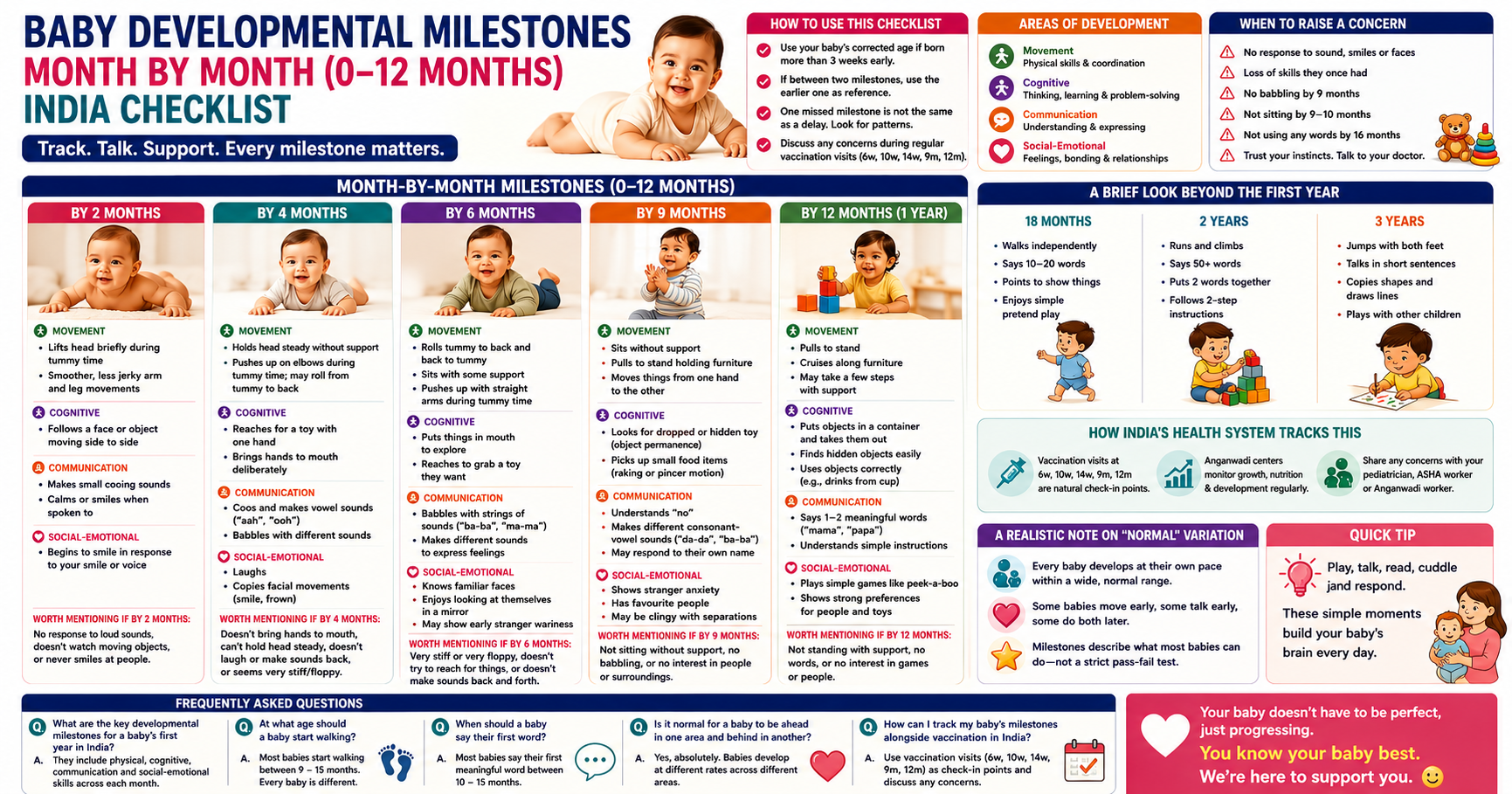
Baby Developmental Milestones Month by Month India Checklist
That said, there’s a real difference between healthy variation and a pattern worth flagging to your pediatrician — and the way to tell the difference isn’t guesswork, it’s knowing what the actual milestones are for each stage. This guide walks through what most babies are doing month by month across the first year — physical movement, thinking and problem-solving, communication, and social-emotional development — along with what’s worth mentioning at your next doctor visit if it hasn’t shown up yet. It also covers where India’s own health system, particularly the vaccination schedule and Anganwadi growth monitoring, naturally overlaps with this tracking, so you’re not managing two separate systems in your head.
A quick, important note before diving in: milestones describe what most babies (roughly three-quarters or more) can do by a given age — they’re not a strict pass-fail test, and a baby who’s a little ahead in movement and a little behind in babbling is still well within normal. This guide is meant to help you notice patterns worth discussing with your pediatrician, not to replace that conversation.
Table of Contents
How to Use This Checklist
A few practical notes that make this genuinely useful rather than anxiety-inducing:
- If your baby was born more than three weeks early, use their corrected age (age counted from the due date, not the birth date) for at least the first two years, rather than their actual birth date age.
- If your baby’s age falls between two milestones listed here, use the earlier one as your reference point — it’s a more accurate comparison than jumping ahead.
- One missed milestone in isolation is rarely meaningful. What matters more is a pattern — several milestones missing together, or a skill that was present and then disappeared, which is genuinely worth mentioning to a doctor regardless of age.
- Your baby’s regular vaccination visits are a natural, built-in check-in point. Since the Indian immunisation schedule already brings you to a pediatrician at 6 weeks, 10 weeks, 14 weeks, 9 months, and 12 months, these are good moments to mention anything on this list that hasn’t shown up yet, rather than waiting for a separate “milestone appointment.”
Month-by-Month Milestones (0–12 Months)
By 2 Months
| Area | What Most Babies Are Doing |
|---|---|
| Movement | Lifts head briefly during tummy time; smoother, less jerky arm and leg movements |
| Cognitive | Starts to follow a face or object moving from side to side with their eyes |
| Communication | Makes small cooing sounds; calms or smiles when spoken to |
| Social-Emotional | Begins to smile in response to your smile or voice — not yet a reflex smile, but a real social one |
Worth mentioning to your doctor if by 2 months: your baby doesn’t respond at all to loud sounds, doesn’t watch things moving in front of them, or never smiles at people, even briefly.
By 4 Months
| Area | What Most Babies Are Doing |
|---|---|
| Movement | Holds head steady without support; pushes up onto elbows during tummy time; may begin rolling from tummy to back |
| Cognitive | Reaches for a toy with one hand; brings hands to mouth deliberately |
| Communication | Coos and makes vowel sounds back and forth (“aah,” “ooh”); begins to babble with different sounds |
| Social-Emotional | Laughs; copies some of your facial movements, like a smile or frown |
Worth mentioning to your doctor if by 4 months: your baby doesn’t bring hands to their mouth, can’t hold their head steady, doesn’t laugh or make sounds back at you, or seems very stiff or very floppy.
By 6 Months
| Area | What Most Babies Are Doing |
|---|---|
| Movement | Rolls from tummy to back and back to tummy; begins to sit with some support; pushes up with straight arms during tummy time |
| Cognitive | Puts things in their mouth to explore; reaches to grab a toy they want |
| Communication | Babbles with strings of sounds (“ba-ba,” “ma-ma,” though not yet meaningfully directed); makes different sounds to express different feelings |
| Social-Emotional | Knows familiar faces; enjoys looking at themselves in a mirror; may show early stranger wariness |
Worth mentioning to your doctor if by 6 months: your baby seems very stiff (tight muscles) or very floppy (like a rag doll), doesn’t try to reach for things within their reach, or doesn’t make sounds back and forth with you at all.
By 9 Months
| Area | What Most Babies Are Doing |
|---|---|
| Movement | Sits without support; may start pulling to stand while holding furniture; moves things from one hand to the other |
| Cognitive | Looks for a toy that’s been dropped or hidden (object permanence beginning); picks up small food items using a raking or early pincer motion |
| Communication | Understands “no”; makes different consonant-vowel sounds (“da-da,” “ba-ba”); may respond to their own name |
| Social-Emotional | Shows clear stranger anxiety; has favourite people; may be clingy with familiar caregivers in new situations |
Worth mentioning to your doctor if by 9 months: your baby can’t sit even with support, doesn’t babble with consonant sounds, doesn’t respond to their own name, or doesn’t play any back-and-forth games with you (like peekaboo).
By 12 Months (1 Year)
| Area | What Most Babies Are Doing |
|---|---|
| Movement | Pulls to stand; may cruise along furniture; some babies take their first independent steps around this time, though many don’t walk until 13–15 months, which is still normal |
| Cognitive | Explores objects in different ways — shaking, banging, dropping; finds hidden objects easily; uses simple gestures like shaking their head “no” |
| Communication | Says one or two words beyond “mama” or “dada” that are used meaningfully; waves “bye-bye”; points at things they want |
| Social-Emotional | Plays simple interactive games (peekaboo, pat-a-cake); may be shy or clingy with unfamiliar people; shows fear in some situations |
Worth mentioning to your doctor if by 12 months: your baby doesn’t crawl or attempt to pull to stand, doesn’t search for things they see you hide, says no words at all, or doesn’t point to show you things.
A Brief Look Beyond the First Year
While the core focus here is the first 12 months, a few Indian parents find it useful to see what’s just ahead:
- 15 months: Most toddlers walk independently, use a few words meaningfully, and can follow a simple one-step instruction.
- 18 months: Walking is well-established, vocabulary is expanding (often 10+ words), and pointing to show interest (not just to request something) usually appears.
- 2 years: Two-word phrases (“more milk,” “mama go”) become common, running and climbing improve rapidly, and toddlers start following two-step instructions.
Areas of Development, Explained Simply
It helps to understand what each of the four tracked areas actually covers, since the terms get used loosely:
Movement (gross and fine motor): Gross motor covers big movements — rolling, sitting, crawling, walking. Fine motor covers small, precise movements — grasping a toy, moving objects between hands, eventually a pincer grip for picking up small items.
Cognitive: How your baby thinks, explores, and problem-solves — understanding cause and effect, remembering that a hidden object still exists, exploring objects through touch and mouth.
Communication (language): Both what your baby understands (receptive language, like responding to their name) and what they can express (expressive language, like babbling and eventually real words).
Social-Emotional: How your baby connects with you and others — smiling, laughing, showing preference for familiar people, and eventually playing interactive games.
Babies rarely progress evenly across all four areas at the same pace — a baby who’s an early talker might be a slightly later walker, and that’s completely typical. What pediatricians watch for is significant delay across multiple areas together, or the loss of a skill that was previously present, rather than a single area being a bit ahead or behind.
How India’s Health System Already Tracks This
You don’t need to build a separate tracking system from scratch — a few things already built into Indian healthcare and public health infrastructure overlap directly with milestone tracking:
Vaccination visits double as check-ins. Your pediatrician typically does a quick informal developmental check at each visit — 6 weeks, 10 weeks, 14 weeks, 9 months, and 12 months — even if it’s not formally labelled a “milestone visit.” It’s worth explicitly mentioning any concerns at these visits rather than assuming they’ll be caught automatically.
Anganwadi centres track growth and development too. Under the ICDS (Integrated Child Development Services) programme, Anganwadi workers routinely monitor growth (height, weight) and basic developmental indicators for children, particularly in government-supported settings. If you use Anganwadi services, this is a genuine, existing resource for tracking, not something you need to duplicate separately.
WHO growth charts are the standard used across most Indian pediatric practices for height, weight, and head circumference tracking — separate from, but often reviewed alongside, developmental milestones at the same visits.
A Realistic Note on “Normal” Variation
It’s worth saying plainly: the range of what’s considered typical is genuinely wide. Some babies sit at 5 months; others take until 7 months, and both are within normal range. Some babies say their first real word at 10 months; others don’t until 14 months. First-time parents especially tend to treat every skill as a race, largely because comparison is so easy now — a relative’s video, a parenting group post, an app notification saying “most babies can do X by now.”
The genuinely useful mindset is: track the general direction, not the exact date. Is your baby generally moving forward across these areas over weeks and months, even if a specific skill arrives a bit later than a chart suggests? That forward trajectory matters far more than hitting any single milestone on a specific day.
When to Actually Raise a Concern
A few patterns are worth a direct, unhurried conversation with your pediatrician, separate from the individual month-by-month notes above:
- Loss of a skill your baby previously had — this is different from a delay and is worth raising promptly regardless of your baby’s age.
- No eye contact or social smiling by around 3 months.
- No response to sounds or their name by around 9–12 months.
- No words at all by 15–18 months, or no gestures (pointing, waving) by 12–15 months.
- Very limited interest in people or interactive play, noticeably different from how they engage with objects.
- Significant, persistent floppiness or stiffness in muscle tone, noticed consistently rather than occasionally.
Raising these early doesn’t mean something is necessarily wrong — early intervention services, where needed, tend to be most effective precisely because they start early, so there’s real value in not waiting to see if it resolves on its own.
Frequently Asked Questions
What are the key developmental milestones for a baby’s first year in India?
Across the first year, babies typically progress through smiling and cooing (2 months), rolling and reaching (4–6 months), sitting and babbling with consonants (9 months), and pulling to stand, saying a word or two, and gesturing (12 months) — tracked across movement, cognitive, communication, and social-emotional areas.
At what age should a baby start walking?
Most babies take their first independent steps between 9 and 15 months, with 12–13 months being a common average. Walking anytime within this range is considered typical; it’s worth mentioning to your pediatrician specifically if your child hasn’t attempted to pull to stand or cruise along furniture by 12 months.
When should a baby say their first word?
Most babies say their first meaningful word (beyond “mama” or “dada” used generally) somewhere between 10 and 14 months, though the range extends further on both sides. Consistent babbling with a variety of consonant sounds by 9 months is a more useful early indicator than the exact age of the first word.
Is it normal for a baby to be ahead in one area and behind in another?
Yes, this is extremely common and generally not a concern on its own — babies rarely develop evenly across movement, cognitive, communication, and social-emotional areas at the same time. What’s worth discussing with a pediatrician is a significant delay across multiple areas together, not unevenness between just one or two.
How can I track my baby’s milestones alongside their vaccination schedule in India?
Since routine vaccination visits already happen at 6 weeks, 10 weeks, 14 weeks, 9 months, and 12 months, these are natural points to mention any milestone concerns directly to your pediatrician, rather than needing to schedule separate developmental check-ins.
Conclusion
Milestones are useful as a general map, not a strict test — a way to notice the overall direction your baby is moving in, and to know when something is genuinely worth a direct conversation with your pediatrician rather than a quiet worry you sit with alone. Most babies wander around these averages in both directions and turn out completely fine, and the parents who find this tracking most useful are usually the ones who use it to stay generally aware, not the ones checking every box on a specific day. Trust the pattern over time, use your baby’s existing vaccination visits as natural check-in points, and raise anything that’s genuinely nagging at you — that instinct is usually worth listening to.
Want to track your baby’s growth alongside these milestones? Try our free Baby Age Calculator to see exactly how many weeks and months old your baby is today.