
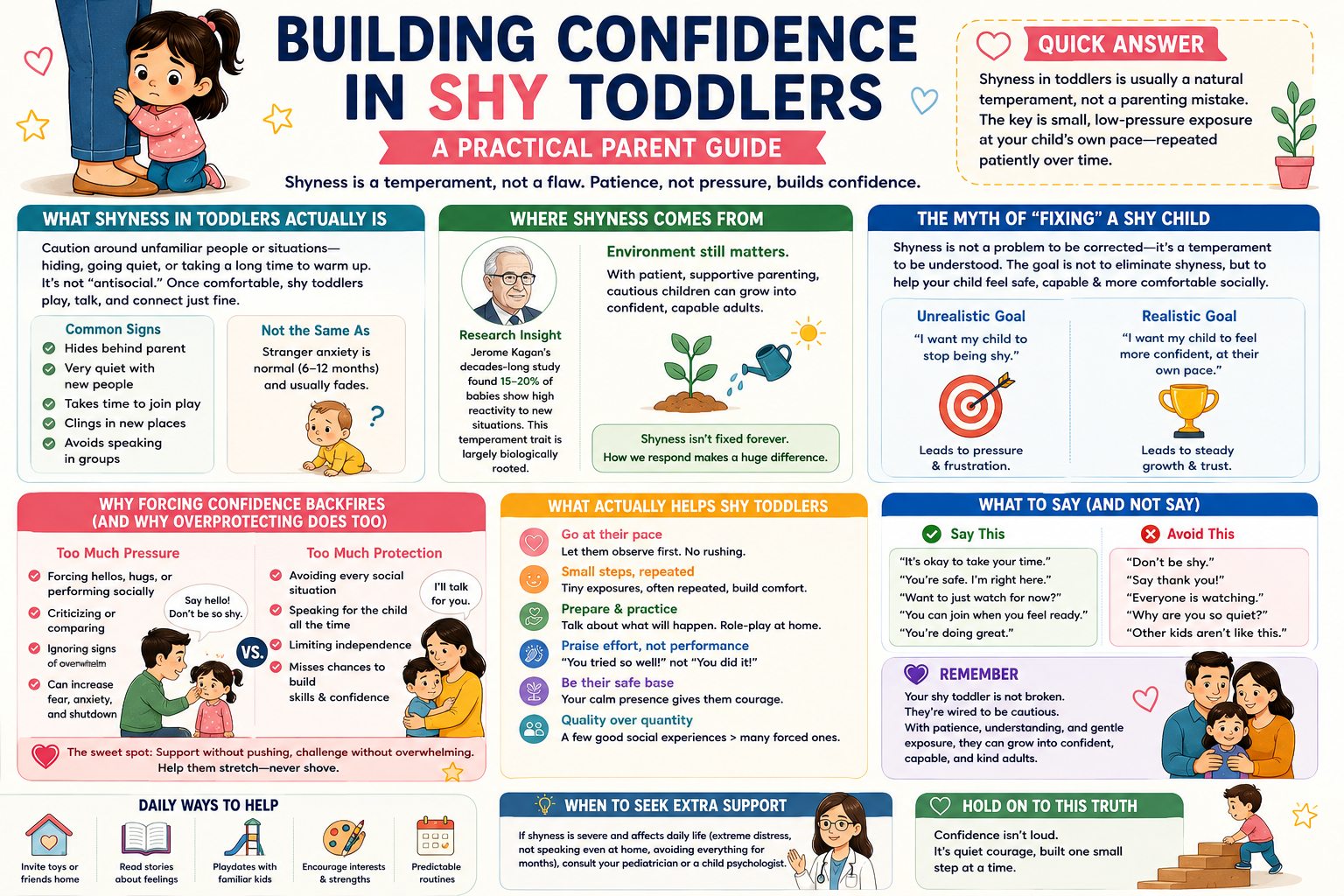
Quick answer: Shyness in toddlers is usually a temperament trait, not a flaw or a parenting mistake — research going back decades shows some children are simply born more cautious with new people and new situations. Trying to “cure” it by forcing a child to perform socially (hugging relatives, saying hello on command) usually backfires, and so does the opposite extreme of shielding them from every social moment. What actually builds confidence is small, low-pressure exposure at the child’s own pace, repeated patiently over time.
Building Confidence in Shy Toddlers Guide
Every Diwali, at every family function, there’s a version of the same scene. The car pulls into the driveway, the child is excited the whole way there, and then the second the front door opens and fifteen relatives turn to look, they vanish behind your leg like they’ve never met these people in their life. Someone — usually a well-meaning Chachi or Dadi — bends down with a big smile and says, “arey, itni sharmili kyun hai, namaste toh karo beta,” and the child burrows deeper, and you’re left standing there feeling like you have to apologise for your own toddler’s personality.
If this is a familiar scene in your house, the first thing worth knowing is that it doesn’t mean your child is antisocial, poorly raised, or in need of fixing. It usually means you have a child with a more cautious temperament, and that temperament responds very differently to pressure than it does to patience. This guide explains what’s actually going on when a toddler is shy, why the usual advice (“just push them a little”) tends to make things worse, and what genuinely helps — including what to say the next time a relative tries to force the issue.
What shyness in toddlers actually is
Shyness in early childhood usually shows up as caution around unfamiliar people or situations — hiding behind a parent’s leg, going quiet in new settings, taking a long time to warm up before joining play, or refusing to speak in front of people outside the immediate family. It’s different from being “antisocial” in the sense most people mean it: a shy toddler often plays happily, talks nonstop, and shows real warmth once they’re comfortable — the caution is specifically about the unfamiliar, not about people or connection in general.
It’s also worth separating shyness from simple stranger anxiety, which is a normal developmental stage most babies go through around 6–12 months and typically fades. Shyness as a lasting temperament trait is a longer-running pattern — a child who, well into toddlerhood and beyond, consistently takes longer than other children to warm up to new people, places, and situations.
Table of Contents
Where shyness comes from (temperament, not a parenting failure)
This is the part most family members skip past, often because it wasn’t common knowledge a generation ago: a meaningful amount of research points to shyness being rooted in temperament, not upbringing.
The developmental psychologist Jerome Kagan ran a well-known, decades-long study tracking infants from four months old into adulthood. He found that a noticeable minority of babies — commonly estimated around 15 to 20 percent — showed a pattern he called high reactivity: strong, easily triggered responses to new stimuli. These infants were significantly more likely to grow into toddlers and children who were cautious, wary of novelty, and slower to warm up socially — a trait researchers now often call behavioral inhibition. Importantly, this appears to have real biological roots, not just a parenting style behind it.
This doesn’t mean shyness is fixed forever, though. Kagan’s own follow-up research, along with later studies, found that the environment a temperamentally cautious child grows up in strongly shapes where they land as adults — some grow into confident, if still somewhat reserved, adults, while others develop lasting social anxiety. The parenting response matters enormously; it’s just not about eliminating the underlying temperament.
The myth of “fixing” a shy child
A lot of the anxiety Indian parents feel around a shy toddler comes from treating shyness itself as the problem — something to be corrected, the way you’d correct a habit. But if shyness is substantially a temperament trait, “fixing” it isn’t really the goal, any more than you’d try to fix a child for being high-energy or being a picky eater. The more useful goal is helping a naturally cautious child build genuine comfort and skill in social situations, at a pace that doesn’t overwhelm their nervous system — which is a very different project from making them stop being who they are.
This reframe matters practically, too. A parent chasing “fixed” shyness tends to keep pushing past the point that helps, because the goal (a child who’s simply not shy anymore) isn’t realistic. A parent aiming for “more comfortable, more capable” has a target that’s actually achievable.
Why forcing confidence backfires (and why overprotecting does too)
Research on children with cautious, inhibited temperaments consistently points to two parenting patterns that make things worse — and, notably, they’re opposites of each other.
Pushing too hard — forcing a child to perform socially before they’re ready (“go hug Mama’s friend,” “say hello properly,” making them stand and sing in front of guests) tends to increase the child’s distress in social situations rather than build comfort. It teaches the nervous system that new people are something to brace against, not something survivable.
Overprotecting — shielding a shy child from every uncomfortable social moment, always answering for them, never letting them sit with any social discomfort — prevents them from ever discovering they can actually manage these situations. Paradoxically, this can lock the fear in place rather than letting it fade with successful, manageable exposure.
The middle path — small, low-pressure exposure with the parent staying close and calm — is the one that research generally supports, and it’s also the one that’s hardest to stick to in the moment, especially with an audience of relatives watching and offering their own advice.
What genuinely builds confidence, age by age
18 months–2 years
At this age, “confidence-building” mostly means building a track record of safe, low-key exposure to new faces and settings, without any performance expectation attached.
- Let your toddler warm up on their own timeline at gatherings — position yourself where they can watch from your lap or your leg, rather than pushing them forward
- Narrate what’s happening in a calm voice (“that’s Naina Aunty, she’s saying hi, you don’t have to say anything back right now”) rather than prompting a specific response
- Keep exposing them to the same familiar relatives and family friends regularly — repetition with the same faces builds real familiarity faster than one big, unfamiliar gathering
- Avoid labeling them as “shy” out loud in front of them repeatedly — young children absorb these labels and can start acting into them
2–3 years
Around this age, children start being verbally capable enough to express discomfort, and cautious children may say things like “nahi jaana” or refuse outright. This is also the age where preschool or playgroup often starts, adding a new layer.
- Practice small social scripts at home in low-stakes play — “let’s practice how we’d say hi to Riya, want to try it with your teddy first?”
- Offer a “job” at gatherings instead of a performance — handing out a plate of snacks to one familiar relative is a task, not a social test, and gives a shy child a reason to approach someone without the pressure of conversation
- Validate the discomfort rather than dismissing it — “it feels like a lot of new people today, that’s okay” tends to calm a child faster than “don’t be silly, they’re family”
- Introduce new playmates one at a time rather than in a big group, since large groups are harder for a cautious temperament to enter than one-on-one interactions
3–4 years
By this age, many children are ready for a bit more structured practice and can start to understand the idea of “trying something a little uncomfortable.”
- Role-play specific situations before they happen — rehearsing what they might say at a birthday party or at nursery drop-off reduces the surprise factor that cautious children find hardest
- Give specific, low-pressure praise for effort, not performance — “you looked at Dada and smiled today, that took some courage” lands better than “see, that wasn’t so hard, why can’t you always do that”
- Build a repeated positive routine around one recurring social setting (a weekly playdate, a regular Sunday visit to the same cousins) so confidence can compound in a familiar setting before generalizing elsewhere
- Read books or talk about characters who feel shy or nervous and figure things out — this gives a child language and a model for their own experience without singling them out directly
Shy toddlers and family gatherings — the Indian context
This is often where the real pressure lives, and it’s worth naming directly: Indian family culture, with its emphasis on greeting elders, touching feet, and being visibly “milansaar” (sociable) in front of guests, can put a genuinely cautious toddler in a spotlight several times a week — at pujas, birthdays, weddings, and casual evening visits from relatives.
A few things help specifically in this setting:
- Prepare your child briefly before you arrive somewhere — “we’re going to Mama’s house, Dadi and Bua will be there, you don’t have to talk to anyone if you don’t want to, we’ll stay close”
- Give relatives a heads-up in advance where possible — a quiet word to a grandparent (“please don’t ask him to perform in front of everyone, he does better if you just chat with him quietly first”) often prevents the exact scene you’re trying to avoid
- Model the behavior yourself rather than instructing it — greeting people warmly yourself while your child watches teaches more than any instruction to “say namaste” does
- It’s completely reasonable to gently and respectfully redirect a relative who keeps pushing: “voh apni jagah pe comfortable ho jayegi, thodi der do” (she’ll get comfortable in her own time, just give her a bit) tends to land better than an argument about parenting philosophy in the middle of a gathering
Shy toddlers at preschool and playdates
Preschool drop-off is often where shyness becomes most visible to outsiders, since it’s the first time a child is regularly navigating unfamiliar adults and peers without a parent physically present.
- Talk to the teacher directly about your child’s temperament rather than assuming it will just be noticed and handled — a specific note (“she takes a while to warm up, she’s not upset, just observing”) helps a teacher respond appropriately rather than misreading quiet caution as distress
- Keep goodbyes brief and consistent rather than lingering — a longer goodbye, however well-intentioned, often increases anxiety for a cautious child rather than reducing it
- Ask if the school allows a settling-in period with a parent present for the first few days, if your child is finding the transition especially hard — many preschools already build this in
- Resist comparing your child’s adjustment timeline to other children’s out loud, especially in front of them — cautious temperaments often take genuinely longer to settle, and that’s a difference in pace, not a problem to solve urgently
What to say instead of “say hello, beta”
| Instead of | Try |
|---|---|
| “Say hello to Uncle, beta” (command) | “Uncle’s here, you can wave when you’re ready” (invitation, no pressure) |
| “Don’t be shy, it’s just Dadi” (dismissal) | “It’s a lot of new faces today, isn’t it” (validation) |
| “Why can’t you be more like your cousin” (comparison) | “Everyone warms up at their own speed” (normalizing) |
| Answering for the child every time they’re asked something | Waiting a beat, then gently: “do you want to tell them, or should I?” — giving them the choice |
| “She’s just very shy” said repeatedly in front of the child (labeling) | Describing the specific moment instead: “she’s taking her time saying hi today” |
When it might be more than shyness
Most shyness, even fairly intense shyness, is a normal temperament variation that softens with patient, low-pressure support over months and years. It’s worth mentioning to your pediatrician or a child counsellor — not as an emergency, just as a conversation — if you notice:
- Your child consistently doesn’t speak at all in specific settings (like school) for more than a month or two, despite speaking freely and comfortably at home — this pattern, when persistent, is sometimes associated with selective mutism, which benefits from early professional support rather than just “waiting it out”
- Significant, ongoing physical distress around social situations (not just reluctance, but real panic, prolonged crying, or physical illness before every social event)
- Shyness that seems to be worsening rather than gradually easing as your child gets older, especially alongside other signs of high anxiety
- Any noticeable regression in language or social skills your child previously had
None of these are cause for alarm on their own, and none of them are something to diagnose from an article — they’re simply the kind of pattern worth having assessed directly by someone qualified to look at the full picture.
Real moments parents recognize
You might spend the entire car ride coaching your toddler on how they’ll greet Dadi, only to watch all of it evaporate the second the door opens — and that’s not a failure of your coaching, it’s just how a cautious nervous system responds to the actual moment of exposure versus the rehearsal.
Or you might notice your child chatting non-stop, singing, and being completely uninhibited at home, then going almost silent the moment a family friend walks in — which can feel confusing until you remember that shyness is specifically about the unfamiliar, not a general personality trait that should show up everywhere.
Or a relative might comment, not unkindly, “hamare zamane mein toh bacche itne sharmile nahi hote the” (children weren’t this shy in our time) — and it’s worth remembering that temperament research genuinely didn’t exist in the way it does now, so that comparison is coming from a different era’s understanding, not a fair read of your parenting.
Is my toddler shy or antisocial?
Almost always shy, not antisocial. A genuinely shy toddler usually shows real warmth, talkativeness, and connection once comfortable — the caution is specifically about unfamiliar people and situations, not a lack of interest in connection itself.
Will my shy toddler grow out of it?
Some children do become noticeably more outgoing over time, while others remain naturally more reserved into adulthood — research suggests the underlying temperament often persists in some form, but with supportive parenting, most cautious children develop genuine social comfort and skill even if they stay naturally quieter than average.
Should I force my shy toddler to socialize?
No — research generally shows that forcing social performance tends to increase distress rather than build confidence. Gentle, low-pressure exposure with a parent staying close tends to work far better than pushing.
What’s the difference between shyness and social anxiety in a child?
Shyness is a temperament trait involving caution with the unfamiliar that usually eases with time and gentle exposure. Social anxiety is a more intense, persistent, and distressing pattern that can interfere significantly with daily functioning, and it’s worth discussing with a professional if you’re seeing this level of intensity.
Is shyness in toddlers genetic?
Temperament research suggests a meaningful biological and hereditary component to a cautious, inhibited temperament, though environment and parenting response strongly shape how that temperament develops over time.
How do I handle relatives who keep pushing my shy child to perform?
A brief, calm redirect works better than an in-the-moment debate: “she’ll come around in her own time, let’s give her a few minutes” tends to defuse the pressure without an argument, especially if you’ve given the relative a heads-up beforehand.
What not to say to a shy child?
Avoid commands (“say hello now”), comparisons (“why can’t you be like your cousin”), and repeated labeling in front of them (“she’s just so shy”). These tend to increase self-consciousness rather than build comfort.
How can I help my shy toddler at preschool drop-off?
Keep goodbyes brief and consistent, talk to the teacher directly about your child’s temperament, and consider asking about a settling-in period if the transition seems especially hard.
Are shy children less intelligent or less capable?
No — shyness reflects a temperament style around social caution, not cognitive ability. Many shy children are highly observant, verbally strong in comfortable settings, and thoughtful in ways that aren’t always immediately visible to others.
When should I be concerned about my toddler’s shyness?
If your child goes completely silent in specific settings like school for an extended period despite talking freely at home, shows intense physical distress around social situations, or seems to be getting more anxious rather than gradually more comfortable over time, it’s worth mentioning to your pediatrician or a child counsellor.
Final thoughts
A shy toddler hiding behind your leg at a family function isn’t telling you something has gone wrong — they’re telling you their nervous system needs a little more time than the child next to them. The instinct in an Indian household is often to smooth this over quickly, either by pushing the child forward or by apologising on their behalf, but neither actually helps as much as simply staying calm, staying close, and letting them approach the world at their own pace. Given patience rather than pressure, most shy toddlers grow into genuinely confident people — just ones who take a little longer to warm up, which was probably never really the problem in the first place.