Physical Address
304 North Cardinal St.
Dorchester Center, MA 02124
Physical Address
304 North Cardinal St.
Dorchester Center, MA 02124

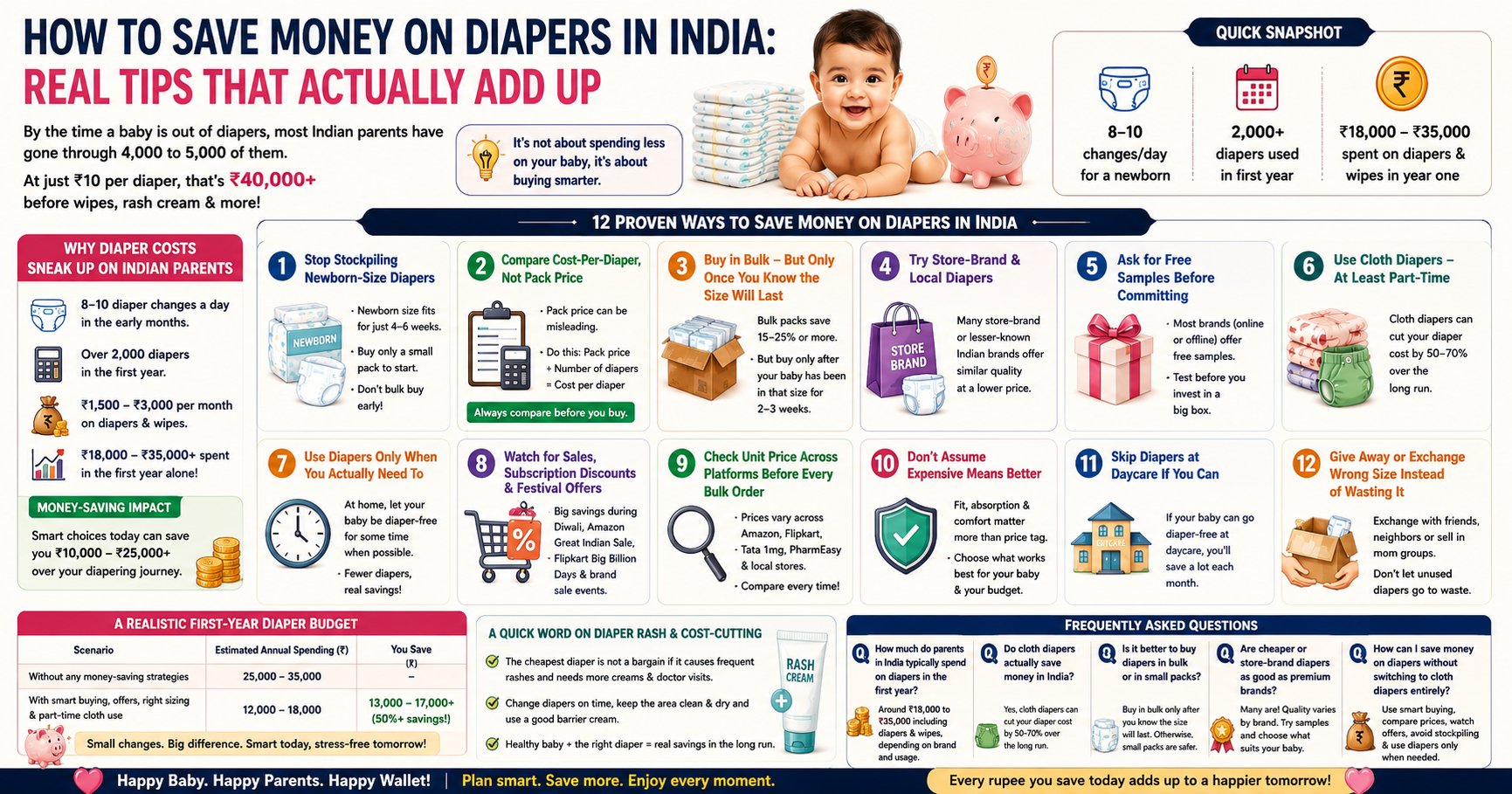
By the time a baby is out of diapers, most Indian parents have gone through somewhere close to 4,000 to 5,000 of them. Do the math on even a modest ₹10 per diaper and you’re already looking at ₹40,000-plus, and that’s before you count wipes, rash cream, and the inevitable “wrong size” packs sitting unused in a cupboard somewhere.
Nobody budgets for diapers the way they budget for, say, a stroller or a crib. It’s a small, boring, recurring expense — which is exactly why it quietly becomes one of the biggest line items in a baby’s first two or three years. The good news is that diaper spending is also one of the easiest categories to bring down, often without changing a single thing about how you’re actually caring for your baby. It’s mostly about buying smarter, not doing less.
This is a practical, India-specific list of what actually works — not generic advice copied from a US parenting blog where diapers, brands, and prices work completely differently. Some of these tips will save you a few hundred rupees a month. A couple of them, if you’re willing to try them, can save you tens of thousands over the diapering years.
A newborn goes through 8 to 10 diaper changes a day. By six months, that usually settles to around 6 to 8. Multiply that out and you’re changing somewhere north of 2,000 diapers in the first year alone — and that’s just year one.
Most parents don’t feel this as one big number. They feel it as a ₹500–₹800 pack disappearing every 8 to 10 days, which doesn’t seem like much until you actually add up a year of it. Depending on the brand and whether you’re buying premium or budget diapers, the average Indian family spends somewhere between ₹1,500 and ₹3,000 a month on diapers and wipes combined in the first year — so somewhere around ₹18,000 to ₹35,000 just for year one.
None of this is a criticism of spending on diapers — a good diaper is genuinely worth paying for. But there’s a real difference between “spending what’s needed” and “spending more than needed because nobody sat down to compare options,” and most families fall into the second category simply because nobody has the time to think about diapers that hard while also, you know, raising a newborn.
This is probably the single most common way Indian parents waste money on diapers, and almost nobody realizes it until the second baby.
Newborn-size diapers fit for roughly four to six weeks — sometimes less if your baby is a bigger newborn. Parents who buy a big discounted “bulk pack” of newborn-size diapers before delivery, thinking they’re being smart, often end up with a stack of unused diapers once the baby outgrows the size, sometimes within a month.
What to do instead: buy one small pack of newborn diapers to start with — enough for a week or two — and then buy the next size only once you actually see how quickly your baby is growing into it. Yes, this means slightly more frequent shopping trips in the first couple of months. It also means you’re not sitting on ₹1,000–₹2,000 worth of diapers your baby has already outgrown.
Here’s a trap that catches even careful shoppers: two packs, same brand, similar price — but one has 34 diapers and the other has 42. If you’re only glancing at the sticker price, you’ll assume they cost the same, when one is actually meaningfully cheaper per diaper.
Before buying, do a quick division: pack price ÷ number of diapers in the pack. It takes about ten seconds and it’s genuinely the most reliable way to compare across brands and pack sizes, especially when e-commerce sites run “discount” pricing that isn’t really a discount once you check the count.
This matters even more when comparing across platforms — the same brand and size can be priced differently on Amazon, Flipkart, and a local pharmacy, sometimes by a fair margin. A five-minute price comparison before a bulk order is time well spent.
Bulk buying is usually the single biggest lever for cutting your per-diaper cost, often by 15–25% compared to buying small packs regularly. The catch, as covered above, is that it only actually saves money if your baby stays in that size long enough to use the whole pack.
A rough rule that works well for most Indian parents: don’t bulk-buy a size until your baby has been in it for at least two to three weeks and you have a decent sense of how long that size is likely to last. Once you’re past the newborn stage and into a size that typically lasts two to three months (roughly sizes M and L), bulk buying becomes low-risk and genuinely worth doing — that’s where the real savings show up.
This one takes a bit of trial and error, but it’s worth doing. Several Indian marketplaces and pharmacy chains sell their own store-brand diapers, and quite a few regional and lesser-known Indian brands make diapers that perform just as well as the big international names — for noticeably less money.
The honest truth is that diaper quality varies baby to baby. Some babies do fine in almost anything; others need a specific brand to avoid rashes or leaks. You won’t know until you try. Buy one small pack of a cheaper, less-known brand and test it for a few days before committing to a bulk order. If it works, you’ve just found a permanent way to cut your monthly diaper bill. If it doesn’t, you’ve lost the cost of one small pack, not a large one.
Most diaper brands in India will send free sample packs if you ask — through their website, a parenting app, or sometimes just by messaging their Instagram page. Baby product companies want new parents to try their diapers, and they know that once a baby is comfortable in a brand, parents rarely switch.
This is a small tip, but it adds up over the early months when you’re testing multiple brands anyway to find the one that fits and performs best for your baby. Why pay for that testing phase when several brands are happy to send you free samples to test with?
This is the tip with the biggest long-term savings potential, and also the one most Indian parents hesitate on, usually because of the laundry involved.
Here’s the actual math. A baby using around 6 disposable diapers a day, at roughly ₹10 per diaper, for two and a half years, works out to somewhere around ₹54,000–₹55,000 in disposables alone. A full cloth diaper stash — enough diapers to rotate through washing cycles comfortably — typically costs somewhere between ₹6,000 and ₹12,000 in India, and those same diapers can be reused hundreds of times. Even accounting for the extra water and electricity from washing, most families come out tens of thousands of rupees ahead by the time their child is potty trained.
You don’t have to go all-in to benefit from this. A genuinely popular middle path in Indian households is: cloth diapers at home, where washing is manageable, and disposables when you’re out, travelling, or it’s simply not a good day to deal with laundry. Even switching half your diaper changes to cloth can meaningfully cut your monthly spend, without asking you to become a full-time cloth-diapering household overnight.
If you do go this route, a few practical notes: buy 15–20 diapers to start with rather than a huge stash upfront, since you’ll want to test fit and absorbency on your specific baby first. Diaper liners help a lot with cleanup and can extend the life of the diaper itself. And washing in slightly larger batches — rather than every single day — saves both water and electricity, without letting soiled diapers sit long enough to become a hygiene issue.
This sounds almost too obvious to mention, but a lot of Indian households — especially joint families with help around the house — default to keeping a baby in a diaper at all times, including for long stretches at home when it isn’t strictly necessary.
At home, especially once your baby is past the newborn stage, using cloth nappies or just letting your baby have some nappy-free time on a mat can cut down your daily diaper count without any real downside — and it’s genuinely good for reducing rash risk too, since some time without a diaper lets the skin breathe. This isn’t about being frugal at your baby’s expense; it’s simply using diapers for the situations where they’re genuinely needed (outings, night sleep, illness) rather than defaulting to them for every single hour of the day.
Indian e-commerce platforms run diaper discounts constantly — around festivals, on “baby days” or “mom and baby” sale events, and through ongoing subscription programs on sites like Amazon that knock a percentage off recurring diaper orders. If you already know roughly how many diapers you’ll need in a given month, setting up a subscription for your regular size can lock in a lower price automatically, without you having to remember to check for a sale every time you’re running low.
It’s also worth following your preferred brand’s own website and social pages directly — many brands run offers exclusively for their own site or app that don’t show up on the big marketplaces.
This is really an extension of tip #2, but it deserves its own mention because prices genuinely shift often. The exact same diaper pack can be priced differently between Amazon, Flipkart, a baby-focused app like FirstCry, and your local pharmacy — sometimes by ₹100–₹200 on a large pack, which is a meaningful difference when you’re reordering monthly.
Before placing a bulk order, a quick two-minute check across two or three platforms is worth the effort — especially since most of these apps let you save your usual size and brand, making future comparisons even faster.
It’s an easy assumption to make, especially as a first-time parent — surely the pricier, more premium-looking pack must perform better? In practice, that’s often not true. Several budget and mid-range diaper brands in India perform just as well on absorbency and comfort as the premium options, and the price gap often comes down to marketing and packaging rather than a meaningfully better product.
The smartest approach is to judge a diaper on how it actually performs for your baby — no leaks overnight, no rash, comfortable fit — rather than assuming price is a reliable signal of quality. Once you find a diaper that genuinely works well for your baby, that’s the one worth sticking with and buying in bulk, regardless of where it sits on the price spectrum.
If your baby attends daycare, ask directly whether they provide diapers as part of the fee, or whether you’re expected to send your own. Some centres include diapering in their overall pricing; others don’t, and parents end up buying an entirely separate set of diapers just for daycare hours on top of what they use at home.
If diapers aren’t included and cost is a genuine concern, it’s worth asking the centre directly whether cloth diapers are permitted during the day — some are fine with it, especially for toddlers, and this alone can meaningfully cut your daycare-specific diaper spend.
If you do end up with an unopened pack in the wrong size — it happens to almost every parent at some point — most stores and online platforms will allow an exchange, even without a receipt in many cases. It’s worth asking directly rather than assuming it’s non-returnable.
If an exchange isn’t possible, local parenting groups on WhatsApp, Facebook, and community apps are full of parents happy to swap sizes with each other. One family’s “too small” pack is often exactly what another family needs that week. This is a genuinely underused option in India, where these hyperlocal parenting groups are common in most residential societies and apartment complexes.
To put some real numbers against all of this — here’s roughly what a first year of diapering looks like with and without a deliberate cost-saving approach:
| Approach | Estimated First-Year Diaper + Wipes Spend |
|---|---|
| No particular strategy — buying whatever brand, whatever pack size, as needed | ₹28,000 – ₹35,000 |
| Smart disposable shopping (bulk buying correctly, comparing unit prices, avoiding newborn overstock) | ₹18,000 – ₹24,000 |
| Hybrid — cloth at home, disposables outside | ₹10,000 – ₹16,000 |
| Mostly cloth, disposables only for travel and sleep | ₹6,000 – ₹10,000 |
These are directional ranges, not a promise — your actual numbers will shift depending on your city, the brand you settle on, and how quickly your baby grows through sizes. But the pattern holds fairly consistently: the gap between “no strategy” and “a bit of deliberate planning” is often ₹10,000 or more in year one alone, without any real sacrifice in what your baby is actually getting.
One thing worth saying plainly: none of these tips should push you toward a diaper that’s genuinely causing rashes or discomfort just because it’s cheaper. If a budget brand or a cloth diaper setup is leading to persistent rash, leaking, or skin irritation, that’s not actually saving you money once you factor in rash cream, disturbed sleep, and a genuinely unhappy baby. The goal here is smarter spending, not the cheapest possible option regardless of fit — those are two different things, and it’s worth keeping them separate as you experiment with brands and formats.
Most families spend somewhere between ₹18,000 and ₹35,000 in the first year on diapers and wipes combined, depending on the brand, city, and how much of that spend is disposable versus cloth diapers.
Yes, significantly, over the full diapering period. A complete cloth diaper stash typically costs ₹6,000–₹12,000 in India and can be reused for years, compared to roughly ₹54,000–₹55,000 in disposables over two and a half years of daily use at typical Indian prices.
Bulk buying is usually cheaper per diaper, but only once your baby has settled into a size that will last a while — buying newborn-size diapers in bulk is one of the most common ways parents waste money, since babies typically outgrow that size within four to six weeks.
Often, yes — several budget and store-brand diapers in India perform comparably to premium brands on absorbency and comfort. It’s worth testing a small pack before assuming a higher price means better quality for your specific baby.
Comparing cost-per-diaper rather than pack price, avoiding newborn-size overstock, watching for subscription and festival discounts, and trying a mid-range or store-brand diaper can meaningfully lower your monthly spend without changing your overall diapering approach.
Diapers are one of those baby expenses that never feels like a big decision in the moment — you just grab whatever’s on the shelf when you’re running low — which is exactly why the costs quietly stack up over the year. None of the tips here ask you to compromise on your baby’s comfort or hygiene; they’re mostly about buying a little more deliberately: checking the actual cost per diaper, not over-buying sizes your baby will outgrow in weeks, and being open to trying a cloth diaper, a store brand, or a different platform before assuming the familiar, expensive option is the only one that works. Small changes here, repeated every month for two to three years, add up to real money — often enough to cover a meaningful chunk of another first-year expense entirely.
Want to see how your diaper spend fits into your baby’s overall first-year budget? Try our free Baby Budget Calculator to build a complete picture, from delivery to daycare.