For most of Indian parenting history, this question barely existed. A baby was cared for by whoever was home — a grandparent, an aunt, an elder sibling — and childcare wasn’t really a “decision” so much as a natural extension of joint family living. That’s changed fast. With more nuclear families, more dual-income households, more parents relocating away from their hometowns for work, and more working mothers returning to office within months of delivery, the question that used to answer itself now needs a real, deliberate plan: daycare, a nanny, or grandparents — and what actually works for your specific family?
Daycare vs Nanny vs Grandparents in India
There’s no universally “best” answer here, and most parenting content doesn’t help much, because it’s usually written from a Western context where grandparent care isn’t even on the list of realistic options. This guide treats all three as genuinely valid, comparing them honestly across cost, safety, child development, flexibility, and the emotional dimension that Indian families in particular tend to navigate — because the “right” choice depends entirely on what your household actually has access to, not on which option sounds best in theory.
Table of Contents
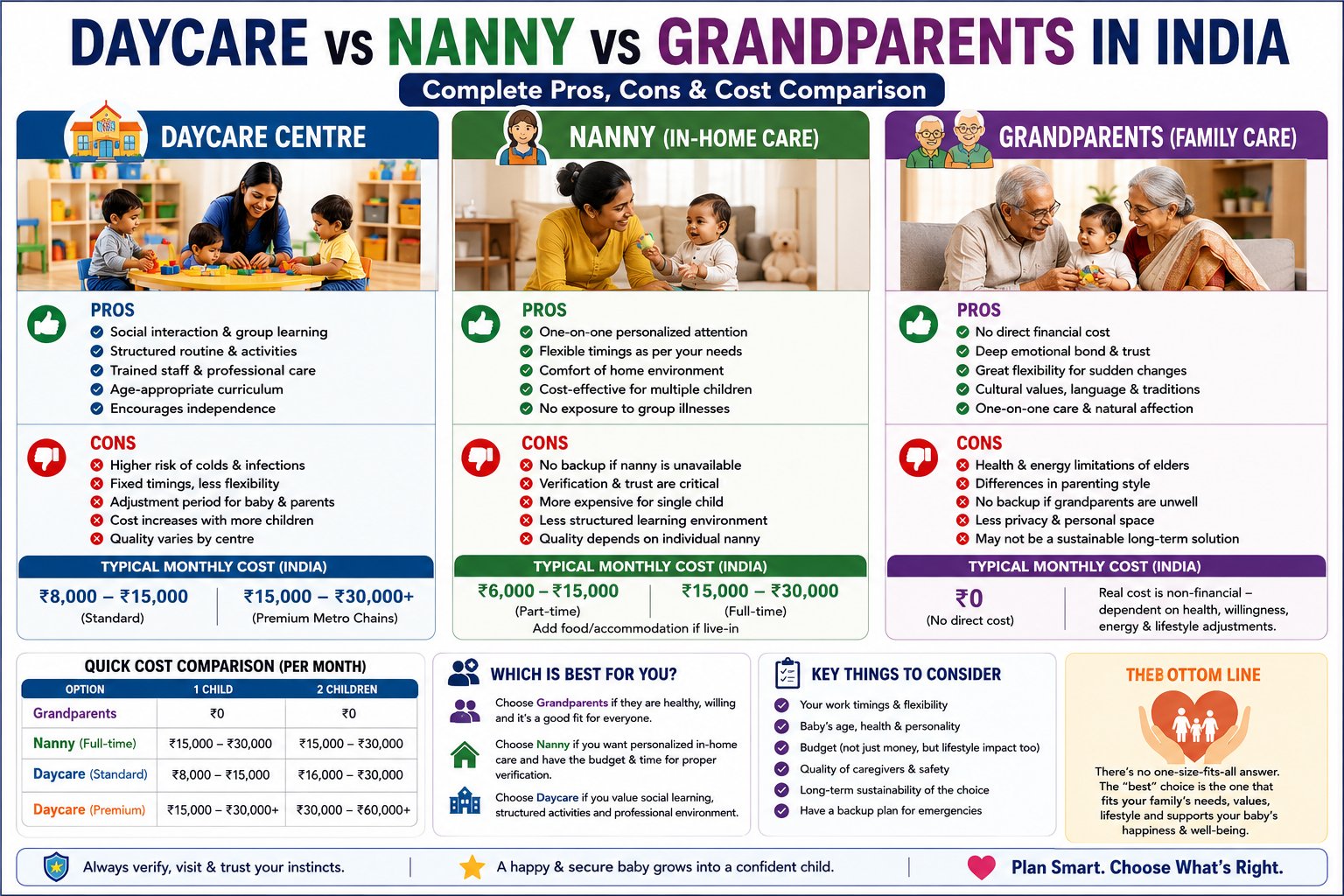
Part 1: Quick Cost Comparison
Option
Typical Monthly Cost (India)
Notes
Grandparents (living with family)
₹0 direct cost
Real cost is non-financial — dependent on their health, energy, and willingness; often involves reduced privacy or parenting-style compromises
Part-time nanny (few hours/day)
₹6,000 – ₹15,000
Lower cost, but limited to specific hours; not a full workday solution alone
Full-time nanny (in-home)
₹15,000 – ₹30,000
Varies by experience, city, and whether live-in or live-out; add food/accommodation costs if live-in
Daycare centre (infant/toddler)
₹8,000 – ₹15,000 (standard), ₹15,000 – ₹30,000+ (premium metro chains)
Priced per child; cheaper per child if you have only one baby, more expensive with multiple children
A nanny’s cost stays roughly flat regardless of how many children you have, since it’s usually a flat monthly rate — this makes a nanny comparatively more cost-effective for families with more than one young child, while daycare, priced per child, scales up in direct proportion to family size.
Part 2: Grandparent Care — Pros and Cons
Advantages
No direct financial cost, which matters enormously for families already managing a new baby’s other first-year expenses.
Deep emotional bond and trust — grandparents caring for their own grandchild bring a level of investment and patience that’s hard to replicate with paid care.
Flexibility with sudden schedule changes — a grandparent living in the house can usually absorb an unexpected late meeting or a sick day far more easily than a daycare with fixed hours.
Cultural and language continuity — many Indian parents specifically value grandparents passing on language, family stories, and traditions during these early years.
One-on-one attention, similar to a nanny, without the cost.
Disadvantages
Physical and energy limitations. Caring for an infant is genuinely demanding, and grandparents managing their own health conditions may find full-day, every-day care unsustainable over months, not just difficult on a hard day.
Differing views on parenting choices — feeding schedules, sleep training, screen time, and discipline are common friction points between parents and grandparents, and childcare arrangements can make these disagreements a daily occurrence rather than an occasional one.
No backup system. If a nanny or daycare worker is unavailable, there’s an institutional or family backup plan; if the grandparent providing full-time care falls ill, the family can be left with no childcare at all, often with very little notice.
Reduced parental privacy and autonomy, particularly in a smaller home, which is a real (if rarely discussed) cost of this option for some couples.
Best Fit For
Families where grandparents are healthy, willing, and genuinely want this role — not families where it’s assumed by default without an honest conversation about sustainability and boundaries.
Part 3: Nanny Care — Pros and Cons
Advantages
One-on-one, personalized attention at home, in a familiar environment, without the baby needing to adjust to a new setting.
Flexible scheduling that can often be negotiated around a family’s specific work hours, unlike a daycare’s fixed operating window.
Cost-effective for multiple children, since most nannies charge a flat rate regardless of how many children in the household need care.
No exposure to group-setting illnesses, which matters especially in the first year when a baby’s immune system is still developing.
Disadvantages
No institutional backup. If your nanny is sick or leaves the job, you have no childcare that day (or, in a worse case, no childcare until you find a replacement) — unlike a daycare centre, which continues operating even if one staff member is absent.
Higher cost per child than daycare for a single-child family, particularly for full-time, experienced, or live-in nannies in metro cities.
Verification and trust concerns. Since a nanny works alone in your home, background verification, references, and a genuine trial period matter enormously — this is arguably the single highest-stakes hiring decision most new parents will make.
Less structured developmental stimulation compared to a daycare’s age-appropriate curriculum, unless you specifically look for a trained early-childhood caregiver rather than a general domestic helper.
Best Fit For
Families who want personalized, at-home, one-on-one care, have the budget for it, and are willing to invest real time in background verification and a proper trial period before fully relying on the arrangement.
Part 4: Daycare — Pros and Cons
Advantages
Institutional continuity. A daycare centre keeps operating even if one caregiver is unavailable — a meaningful advantage over a single nanny or a single grandparent as the sole care source.
Structured, age-appropriate developmental activities, often including early social interaction, songs, sensory play, and routines designed around specific developmental stages.
Early social exposure, which many parents value as their baby gets closer to toddlerhood, since daycare offers a level of peer interaction a solo caregiver at home can’t replicate.
Regulated staff-to-child ratios. Under India’s National Early Childhood Care and Education (ECCE) Policy, infant rooms at most organised daycare centres are expected to maintain a caregiver-to-baby ratio of roughly one caregiver for every four to six infants — worth confirming directly with any centre you’re considering, since actual compliance varies.
Fixed, transparent pricing in most cases, compared to a nanny relationship where costs can shift with bonuses, festivals, and negotiations over time.
Disadvantages
Higher exposure to common childhood illnesses in a group setting — a very real and common concern, especially in the first year, though it’s worth noting this exposure also gradually builds immunity over time.
Fixed operating hours, which can be a genuine constraint for parents with unpredictable or long work schedules.
Less individualized attention than one-on-one nanny or grandparent care, even with good staff ratios.
Commute and drop-off logistics add a real daily time cost that in-home care (nanny or grandparent) doesn’t require.
Best Fit For
Families who want structured, institutionally-backed care with built-in continuity, and whose work schedule reasonably fits fixed daycare hours.
Part 5: Comparing All Three Side-by-Side
Factor
Grandparents
Nanny
Daycare
Direct cost
None
Moderate–High
Moderate
Backup if unavailable
None (unless another family member steps in)
None (unless agency-provided)
High (institution continues)
One-on-one attention
High
High
Lower (shared among a group)
Illness exposure
Low
Low
Higher (group setting)
Scheduling flexibility
High (informal)
Moderate–High (negotiable)
Low (fixed hours)
Structured early learning
Low–Moderate (informal)
Depends on caregiver’s training
High (structured curriculum)
Emotional/trust factor
Very high (family bond)
Depends on vetting and tenure
Depends on specific centre and staff
Sustainability over months
Depends on health/energy
Depends on retention
High (institutional)
Part 6: A Practical Decision Framework
Rather than picking based on what feels “traditional” or what feels “modern,” work through these questions honestly:
How predictable are your work hours, really? If your schedule shifts often or runs long, a daycare’s fixed hours may create more stress than they solve — a nanny or grandparent offering flexible hours may fit better.
Do you have a genuine backup plan if your primary childcare option falls through for a day, a week, or longer? This is the single most underplanned factor in Indian childcare decisions. If the honest answer is “no backup at all,” that alone is a reason to lean toward daycare’s institutional continuity, or to build in a specific backup (a part-time nanny alongside grandparent care, for instance).
If grandparents are an option, has the family had an honest conversation about sustainability and boundaries — not just “can you help,” but specifically how many hours, for how long, and what happens if their health changes? Assumed, undiscussed arrangements are where most family friction later develops.
How many children need care? A nanny’s flat-rate pricing often makes more financial sense with two or more young children; daycare’s per-child pricing scales up directly.
What matters most to you specifically — early social exposure, one-on-one attention, or built-in institutional continuity? There’s no universally correct answer; naming your actual priority makes the choice far clearer.
Part 7: Many Indian Families Actually Use a Hybrid
In practice, a growing number of Indian households don’t pick one option exclusively — they blend two:
Grandparents for the base care, with a part-time nanny for backup on days the grandparent isn’t well or needs rest.
A part-time daycare for social exposure a few days a week, combined with grandparent or nanny care the rest of the time.
A nanny for the youngest child at home, with an older sibling attending daycare or school — splitting care by age rather than choosing one model for the whole family.
This hybrid approach directly solves the single biggest weakness of any one option used alone — the lack of backup — while still keeping cost and emotional priorities in balance.
Part 8: If You Choose a Nanny — A Basic Verification Checklist
Since a nanny works alone in your home with your baby, this decision deserves real diligence:
Get references from at least two previous families, and actually call them — not just review a written reference letter.
Run a police verification where feasible; several city police departments and agencies offer this service for domestic staff.
Start with a trial period where a parent or grandparent is present in the house, before leaving the nanny alone with the baby.
Discuss and write down expectations clearly — feeding schedule, nap routine, screen time, what to do in a medical emergency, and emergency contact numbers.
Trust your own observation over convenience. If something feels off during the trial period, it’s worth acting on that observation rather than dismissing it because the logistics are otherwise convenient.
Part 9: If You Choose Daycare — What to Actually Check During a Visit
Ask directly about the caregiver-to-infant ratio in the specific room your baby will be in, not just the centre’s general policy.
Visit unannounced at least once, if the centre allows it, in addition to a scheduled tour.
Ask about their illness policy — at what point a sick child is sent home, and how they handle an outbreak in the infant room.
Check hygiene practices directly: how bottles and feeding equipment are sanitized, how often diaper-changing surfaces are cleaned, and whether staff wash hands between children.
Ask what a typical day actually looks like hour by hour, not just the marketing description of the curriculum.
Frequently Asked Questions
Is daycare or a nanny better for a baby in India?
Neither is universally better — a nanny offers one-on-one, flexible, at-home care, while daycare offers structured activities and institutional continuity even if a staff member is unavailable. The right choice depends on your work schedule, budget, and whether you have a backup plan either way.
Is it okay to rely on grandparents for full-time childcare in India?
It can work very well when grandparents are healthy, willing, and there’s been an honest conversation about hours, boundaries, and what happens if their health or energy changes — problems tend to arise more from assumed arrangements than from grandparent care itself.
How much does a full-time nanny cost in India?
Full-time nannies typically cost ₹15,000 to ₹30,000 per month depending on experience, city, and whether they live in, with additional costs for food and accommodation for live-in arrangements.
What is a safe caregiver-to-baby ratio at an Indian daycare?
Under India’s National ECCE Policy guidance, infant rooms at most organised daycare centres aim for roughly one caregiver per four to six infants — it’s worth confirming this specific ratio directly with any centre you’re evaluating, since actual practice varies between centres.
Can I combine daycare, a nanny, and grandparent care?
Yes — many Indian families use a hybrid approach, such as grandparent care with a part-time nanny for backup, or part-time daycare combined with at-home care the rest of the week, specifically to solve the lack-of-backup problem that comes with relying on any single option alone.
Conclusion
There’s no single right answer to daycare versus nanny versus grandparents — only the answer that’s honest about your family’s actual work schedule, budget, backup plan, and what each caregiver in your specific situation can realistically sustain over months, not just days. The families who navigate this most smoothly aren’t the ones who pick the “correct” option — they’re the ones who have the honest conversations early, build in a real backup plan, and stay willing to adjust the arrangement as their baby’s needs (and their own circumstances) change.
At ParentNest, our mission is to provide parents with reliable, practical, and easy-to-understand information about parenting, baby safety, and child development.