Physical Address
304 North Cardinal St.
Dorchester Center, MA 02124
Physical Address
304 North Cardinal St.
Dorchester Center, MA 02124

Finding out a baby is on the way is one of the most exciting moments in a couple’s life — and also one of the most financially confusing. Almost every new parent in India asks the same question at some point during pregnancy: “How much will the first year actually cost us?”
The honest answer is: it depends. A family in a metro city choosing a private hospital, imported baby gear, and a full-time nanny will spend very differently from a family in a tier-2 city relying on breastfeeding, hand-me-down clothes, and a joint family support system. But almost no first-time parent has a clear number in front of them — which is exactly why so many families feel blindsided in month three or four, when the “small” recurring costs (diapers, formula, doctor visits) start adding up faster than the one-time “big” expenses like hospital bills.
This guide is built as a working baby budget planner — not just a list of prices, but a structured way to break your baby’s first year into one-time costs, monthly recurring costs, and city-tier variations, so you can build a realistic number for your own family before the baby arrives. We’ll walk through delivery costs, gear checklists, diapering and feeding budgets, healthcare and vaccination costs, daycare planning, and government schemes that can offset some of the burden. At the end, you’ll find a simple month-by-month framework you can copy into a spreadsheet — or use directly with our free Baby Budget Calculator tool.
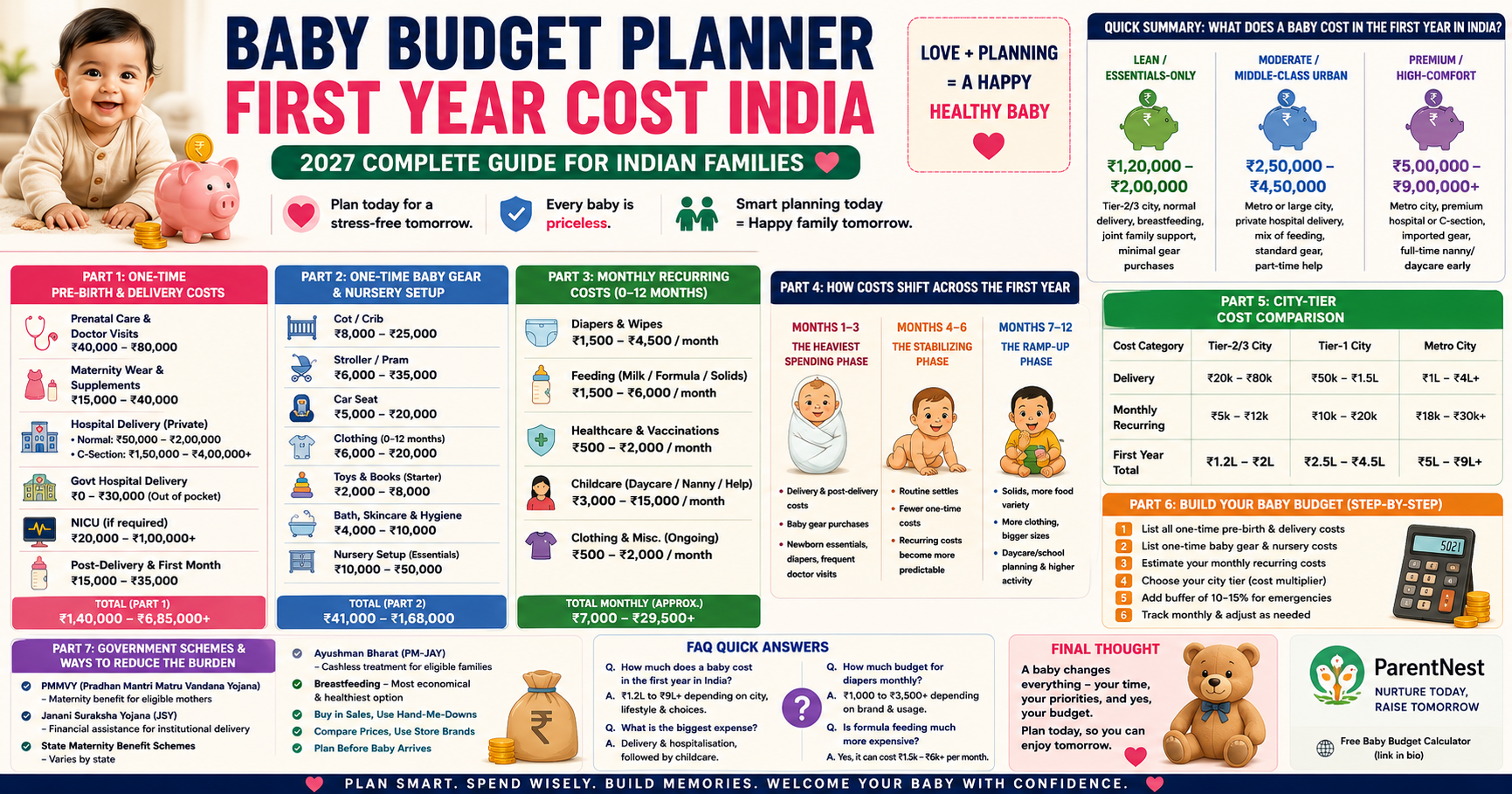
Based on current cost patterns reported by financial planning platforms and parenting cost studies, most Indian families can expect first-year baby expenses to fall into one of three broad tiers:
| Budget Tier | Typical First-Year Total (India) | Profile |
|---|---|---|
| Lean / Essentials-only | ₹1,20,000 – ₹2,00,000 | Tier-2/3 city, normal delivery, breastfeeding, joint family support, minimal gear purchases |
| Moderate / Middle-class urban | ₹2,50,000 – ₹4,50,000 | Metro or large city, private hospital delivery, mix of breastfeeding and formula, standard gear, part-time help |
| Premium / High-comfort | ₹5,00,000 – ₹9,00,000+ | Metro city, premium hospital or C-section, imported gear, full-time nanny or daycare from early months, private pediatrician |
These are directional ranges, not fixed numbers — your actual first-year spend will depend on your city, whether you deliver in a government or private hospital, your feeding choice, and whether you need paid childcare help. The rest of this article breaks each category down so you can build your own number.
The single largest and most unpredictable cost of the first year is usually the delivery itself, and it’s the one most first-time parents underestimate.
Across the pregnancy, most families budget for regular gynecologist consultations, ultrasound scans, blood work, and pregnancy-specific injections and supplements. Combined, this typically runs ₹40,000 to ₹80,000, though it can be lower if you’re using a government hospital’s OPD services and higher if you’re consulting a senior specialist privately with monthly scans.
Maternity wear and prenatal nutrition supplements (iron, calcium, folic acid, protein powders) usually add another ₹15,000 to ₹40,000 across the nine months.
This is where the range widens dramatically:
If your baby needs NICU observation for even a few days — which is common with premature births or low birth weight — add ₹20,000 to ₹1,00,000+ depending on the duration and hospital.
Budgeting tip: Even with health insurance, most policies require an upfront deposit at admission and reimburse later. Keep at least ₹50,000–₹1,00,000 in a liquid fund or savings account that you can withdraw within 24 hours, purely for hospital admission costs.
The first month after birth brings its own mini-budget: postnatal checkups for the mother, the baby’s first pediatrician visits, the first round of vaccinations, and immediate baby supplies (diapers, wipes, baby soap, oil, and clothing bought in a hurry). Families typically spend ₹15,000 to ₹35,000 in this first month alone, on top of the hospital bill.
Before or shortly after the baby arrives, most families invest in a core set of gear. Here’s a realistic checklist with typical Indian price ranges:
| Item | Budget Option | Mid-Range | Premium |
|---|---|---|---|
| Crib / cradle / bedside bassinet | ₹2,500 – ₹5,000 | ₹6,000 – ₹12,000 | ₹15,000 – ₹30,000+ |
| Mattress and bedding set | ₹1,500 – ₹3,000 | ₹3,000 – ₹6,000 | ₹7,000+ |
| Stroller / pram | ₹3,000 – ₹6,000 | ₹7,000 – ₹15,000 | ₹18,000 – ₹40,000+ |
| Car seat | ₹3,500 – ₹6,000 | ₹7,000 – ₹12,000 | ₹15,000+ |
| Baby carrier / sling | ₹800 – ₹1,500 | ₹2,000 – ₹4,000 | ₹5,000+ |
| Feeding essentials (bottles, sterilizer, nursing pillow) | ₹2,000 – ₹4,000 | ₹5,000 – ₹8,000 | ₹10,000+ |
| Clothing (first year, all sizes) | ₹8,000 – ₹15,000 | ₹15,000 – ₹30,000 | ₹35,000+ |
| Bath and grooming kit | ₹1,000 – ₹2,000 | ₹2,500 – ₹4,000 | ₹5,000+ |
| High chair | ₹2,000 – ₹4,000 | ₹5,000 – ₹9,000 | ₹12,000+ |
| Baby monitor | Skip / ₹0 | ₹2,500 – ₹5,000 | ₹8,000+ |
Added together, most urban families spend ₹40,000 to ₹80,000 on one-time gear and clothing across the first year, with heavier purchases in the first three months (crib, stroller, feeding gear) and lighter, ongoing purchases later (bigger clothes, a high chair around month six, walking gear closer to month ten or eleven).
Money-saving note: Baby gear is one of the easiest categories to reduce without compromising on baby’s needs. Strollers, cribs, and car seats are used for a short window and are commonly passed between family members or bought gently-used through verified parenting resale groups. This single decision can realistically cut ₹20,000–₹40,000 off your first-year budget.
This is the category most first-time parents underestimate, because no single monthly bill feels large — but stacked over 12 months, it usually becomes the biggest line item in the whole first-year budget.
Diapering is a near-universal recurring cost. At an average of 5–6 changes per day, a baby uses roughly 1,800–2,000 diapers in the first year. Depending on the brand (local versus premium imported), most families spend ₹1,500 to ₹3,000 per month on diapers and wipes combined, adding up to roughly ₹18,000 to ₹35,000 for the year. Costs are typically highest in the newborn stage (more frequent changes) and taper slightly as the baby grows into larger, more efficient diaper sizes.
Cloth diapering is a popular way to reduce this cost long-term in India, with an upfront cost of ₹5,000–₹10,000 for a full set, though it adds a laundry and time cost that not every household can absorb, especially without domestic help.
Feeding costs vary more than almost any other category, based entirely on your feeding choice:
Across the full year, feeding costs commonly range from ₹15,000 (largely breastfed, minimal solids spend) to ₹70,000+ (formula-fed with premium baby food brands).
India’s vaccination schedule in the first year includes several rounds of essential and optional vaccines. Government hospitals offer core vaccines free under the national immunization program, but many parents opt for combination vaccines and additional protection (like pneumococcal or rotavirus vaccines) at private clinics, which increases cost. Across the year, families typically spend ₹10,000 to ₹40,000 on vaccinations, pediatrician consultations, and any illness-related visits.
Add a baby-specific health insurance rider or a family floater top-up, which usually adds ₹3,000 to ₹8,000 per year in premium, and it’s well worth the peace of mind given how unpredictable infant hospital visits can be.
This is the single most variable cost of the entire first year, because it depends entirely on whether one parent takes extended leave, whether grandparents are available to help, or whether the family needs paid support.
Salaried mothers in India are entitled to 26 weeks (about six months) of paid maternity leave under the Maternity Benefit Act, 1961, for their first two children — though this protection may not extend to self-employed parents, freelancers, or those at very small companies. If you’ll need paid childcare from month six or seven onward, that’s typically 6 months of childcare costs to plan for within the first year, not a full 12 months.
Beyond the initial wardrobe, babies grow out of clothes every 2–3 months in the first year, so budget an additional ₹2,000 to ₹5,000 every couple of months for size upgrades — roughly ₹10,000 to ₹20,000 across the year on top of the initial purchase.
Rather than spreading evenly, first-year baby costs tend to cluster in three distinct phases:
This phase includes the hospital delivery bill, the bulk of one-time gear purchases (crib, stroller, car seat, feeding gear), and the first round of vaccinations. Many families spend 40–50% of their entire first-year budget in these first three months alone.
Recurring costs (diapers, feeding, minor healthcare) settle into a predictable monthly rhythm. This is typically the lightest-spending phase of the year, assuming no major medical needs arise, and is a good window to rebuild any emergency savings used during months 1–3.
Solid foods begin, a high chair and additional gear get added, the baby becomes mobile (adding babyproofing costs like corner guards and gates), and — for many working parents — childcare costs begin as maternity leave ends. This phase often sees a second spending spike, particularly if daycare or a nanny is being added to the monthly budget for the first time.
Where you live meaningfully changes almost every category in this guide:
| Category | Metro City (Delhi, Mumbai, Bangalore) | Tier-2 City | Tier-3 / Smaller Town |
|---|---|---|---|
| Private hospital delivery | ₹80,000 – ₹2,00,000+ | ₹40,000 – ₹1,00,000 | ₹25,000 – ₹60,000 |
| Monthly diapers + wipes | ₹2,000 – ₹3,000 | ₹1,500 – ₹2,500 | ₹1,200 – ₹2,000 |
| Daycare / nanny (monthly) | ₹10,000 – ₹25,000 | ₹6,000 – ₹12,000 | ₹4,000 – ₹8,000 |
| One-time gear budget | ₹60,000 – ₹1,00,000 | ₹35,000 – ₹60,000 | ₹25,000 – ₹45,000 |
| Estimated first-year total | ₹3,50,000 – ₹6,00,000+ | ₹2,00,000 – ₹3,50,000 | ₹1,20,000 – ₹2,20,000 |
The gap between a metro and a smaller town isn’t just about prices being higher — it’s also about choices being more available in metros (premium daycare chains, imported gear, specialist pediatricians), which naturally pulls average spending upward even for families who don’t intend to overspend.
Rather than relying on someone else’s average, here’s a simple framework to build your own number:
Use our free Baby Budget Calculator tool on ParentNest to plug in your own city, feeding choice, and childcare plan, and get a personalized first-year estimate instantly.
A few support systems can meaningfully reduce your out-of-pocket first-year cost:
Most Indian families spend somewhere between ₹1,20,000 and ₹6,00,000+ in the first year, depending on city tier, hospital choice, feeding method, and whether paid childcare is needed. A moderate, middle-class urban budget typically lands between ₹2,50,000 and ₹4,50,000.
For most families, it’s either the hospital delivery cost (especially for a C-section) or childcare (a nanny or daycare) once maternity leave ends — whichever applies depends on your individual circumstances.
Most families spend ₹1,500 to ₹3,000 per month on diapers and wipes combined, tapering slightly as the baby grows into larger, more efficient sizes.
Yes — formula feeding typically adds ₹4,000 to ₹10,000 per month in direct costs, while exclusive breastfeeding mainly adds indirect costs through the mother’s nutrition needs.
The biggest savings usually come from three decisions: choosing gently-used or shared gear (strollers, cribs, car seats), using government hospital and immunization services where available, and delaying non-essential purchases (like a baby monitor or a second stroller) until you know you actually need them.
There’s no single “correct” number for what a baby costs in the first year in India — but there is a correct process: separate your one-time costs from your recurring ones, decide your feeding and childcare approach early, weight your budget toward the heavier months 1–3 and 7–12, and build in a buffer for the unexpected. Do that, and you’ll walk into your baby’s first year with a plan instead of a guess — which, for most new parents, turns out to be the biggest source of relief of all.
Ready to build your exact number? Try the free Baby Budget Calculator on ParentNest — just enter your city, feeding plan, and childcare choice for a personalized first-year estimate.