Joint Family Parenting Tips India and Guide
Parenting in a joint family setup is one of the most distinctly Indian experiences of raising children — offering built-in support, deep intergenerational bonds, and constant company for your child, while also bringing unique challenges around differing opinions, boundaries, and personal parenting autonomy.
This guide is written specifically for new parents navigating joint family life in India — whether you live with your in-laws, your own parents, or an extended multi-generational household. It focuses on practical, respectful strategies to balance your parenting choices with family harmony, without pretending the tension doesn’t exist.
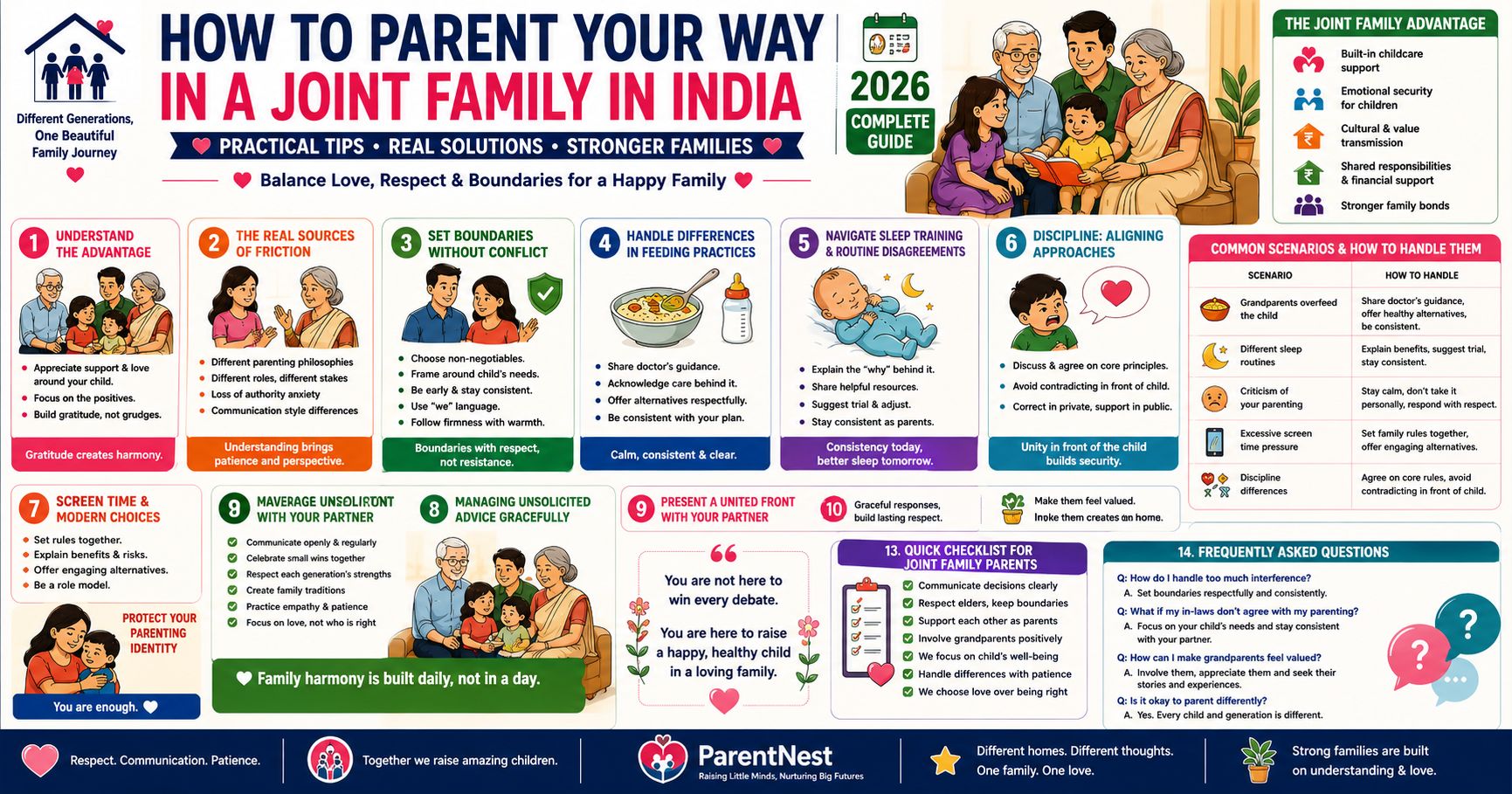
1. Understanding the Joint Family Advantage
Before addressing the challenges, it’s worth appreciating what joint family living genuinely offers — because this context shapes how you approach any friction that arises.
Built-in childcare support is one of the most practical benefits — having trusted family members available reduces dependency on external help and offers flexibility during illness, work emergencies, or simply needing a break.
Emotional security for children often comes from growing up surrounded by multiple caring adults, building a wider sense of belonging and multiple secure attachment figures beyond just parents.
Cultural and value transmission happens more naturally when grandparents are directly involved in day-to-day life, passing on language, traditions, and family history in ways that are harder to replicate in a nuclear setup.
Shared financial and household responsibilities, in many cases, ease the practical burden of raising children, particularly during the demanding early years.
Recognizing these genuine benefits helps frame the friction points discussed below not as reasons to reject joint family living, but as normal adjustments within an arrangement that offers real, meaningful advantages.
2. The Real Sources of Friction (and Why They Happen)
Most joint family parenting tension traces back to a few recurring sources:
Generational shifts in parenting philosophy. Practices considered standard a generation ago — strict feeding schedules, certain discipline methods, specific beliefs about illness or development — have often shifted based on updated understanding. This isn’t about one generation being “wrong,” but about genuinely different information environments shaping each generation’s approach.
Different stakes and different roles. Grandparents often parent from a place of experience and love, but without the same day-to-day responsibility or consequences that parents carry — this can create friction when advice feels disconnected from the practical realities the parent is managing.
Loss of authority anxiety. Some grandparents may feel that a new parent asserting their own choices implies criticism of how they themselves raised their children — leading to defensiveness that isn’t really about the current disagreement at all.
Communication style differences. Indirect communication, common in many Indian family dynamics, can mean disagreements get expressed through comments, sighs, or involving other family members rather than direct conversation — which often escalates rather than resolves tension.
Understanding these underlying dynamics — rather than reacting only to the surface disagreement — tends to lead to calmer, more effective conversations.
3. Setting Boundaries Without Creating Conflict
Boundaries in a joint family don’t have to mean confrontation. A few principles that help:
- Choose your non-negotiables carefully. Reserve firm boundaries for genuine safety or core values issues, and stay flexible on lower-stakes preferences — this makes your firm boundaries more credible when you do assert them.
- Frame boundaries around your child’s needs, not as rejection of family input. For example: “The doctor recommended this routine for her sleep” lands very differently than “I don’t want you doing that.”
- Set boundaries early and consistently, rather than allowing a practice to continue for months before objecting — sudden pushback after long silence often feels more jarring to family members than an early, calm conversation.
- Use “we” language when possible, framing decisions as something you and your partner decided together, rather than positioning yourself against the family.
- Follow up boundaries with genuine warmth, not just firmness — this signals that the boundary is about the specific issue, not a rejection of the relationship itself.
4. Handling Differences in Feeding Practices
Feeding is one of the most common friction points in joint family households, from timing and quantity to specific food beliefs.
Practical approaches:
- Share your pediatrician’s specific guidance directly, framing it as medical advice rather than personal preference — this often reduces pushback since it’s positioned as “the doctor said,” not “I decided.”
- Acknowledge the care behind the pressure. Comments about a child “not eating enough” usually come from genuine concern, even when they feel frustrating — acknowledging this (“I know you just want her to be healthy”) before restating your approach tends to reduce defensiveness.
- Pick your battles around food. Minor preferences (a particular snack, an extra sweet occasionally) may be worth letting go, while reserving firmer boundaries for genuinely important practices.
- Involve grandparents in meal planning where possible, giving them a sense of contribution rather than feeling excluded from a core caregiving activity.
5. Navigating Sleep Training and Routine Disagreements
Sleep practices — particularly structured sleep training approaches — are often unfamiliar or even seen as harsh by older generations who may have followed very different, typically more co-sleeping-oriented, traditions.
- Explain your reasoning simply, without needing to justify every detail of the specific method you’re using
- Set a consistent, visible routine (bath, story, lights out) that family members can observe and support, rather than an invisible, hard-to-explain schedule
- Ask for specific cooperation during your child’s adjustment period (e.g., “please don’t pick her up if she cries for a few minutes, we’re helping her learn to settle herself”) rather than a vague general request
- Expect an adjustment period for the whole household, not just your child — sudden changes to established family patterns take time for everyone to adapt to
6. Discipline: Aligning Approaches Across Generations
Discipline approaches often carry the most emotional weight, since they touch on deeply held beliefs about child-rearing.
- Have a private conversation with your partner first to align on your shared approach before discussing it with extended family — presenting a united front prevents children from learning to “play” different adults against each other
- Explain the “why” behind your approach, not just the rule itself — grandparents are often more receptive when they understand the reasoning, not just a directive
- Invite grandparents to participate in age-appropriate discipline in a way that aligns with your approach, rather than excluding them entirely, which can create a sense of being sidelined
- Address disagreements privately, not in front of children — public disagreement between parents and grandparents about discipline can confuse children and undermine authority on both sides
7. Screen Time and Modern Parenting Choices
Many modern parenting practices — structured screen time limits, specific developmental milestones tracking, gentle parenting approaches — are relatively new concepts that older generations may not be familiar with.
- Share simple, credible sources (pediatrician recommendations, official guidelines) rather than just personal opinion when introducing newer practices
- Explain modern practices in relatable terms — connecting new approaches to values grandparents already hold (e.g., “we’re limiting screens so she plays more, like we did as kids”) tends to land better than purely clinical explanations
- Be patient with the adjustment curve — practices that feel obvious to a parent who has researched them extensively may take longer for family members encountering them for the first time
8. Managing Unsolicited Advice Gracefully
Unsolicited advice is often the single most common source of daily friction in joint family parenting. A few approaches that help manage this without ongoing conflict:
- Develop a few neutral, non-committal responses for advice you don’t plan to follow: “That’s interesting, I’ll think about it” — this acknowledges the input without agreeing to act on it
- Distinguish between advice worth considering and advice to politely set aside — not all advice needs the same response; sometimes there’s genuine wisdom worth incorporating
- Avoid debating every piece of advice in the moment — a calm, brief acknowledgment often ends the conversation faster than an extended justification of your choices
- Choose your moments for pushback carefully — reserve direct disagreement for advice that meaningfully conflicts with your approach, letting smaller comments pass without response
9. Presenting a United Front With Your Partner
One of the most protective factors in joint family parenting is a strong, aligned partnership between parents:
- Discuss parenting decisions privately before they come up in front of family, so you’re not visibly negotiating your approach in real time
- Support each other publicly, even if you disagree on a specific point — address disagreements privately afterward rather than contradicting each other in front of family or the child
- Divide the “family diplomacy” role based on who has an easier relationship with which family member, rather than assuming this falls entirely on one partner (often, in Indian households, this labor falls disproportionately on the mother, particularly with her in-laws)
- Check in with each other regularly about how the joint family dynamic is affecting each of you individually, since the experience can differ significantly between partners
10. Involving Grandparents Meaningfully (Not Just Managing Them)
Rather than treating joint family dynamics purely as something to navigate or manage, actively involving grandparents in meaningful ways tends to reduce friction naturally:
- Assign specific roles that play to their strengths and interests — storytelling, a particular skill, cultural or religious teaching — giving them genuine ownership rather than just “help”
- Ask for their experience-based input on things where it’s genuinely valuable, such as managing common childhood illnesses they’ve navigated before or family traditions worth preserving
- Create rituals that specifically involve grandparents — a weekly activity, a bedtime story night — which builds connection outside of caregiving logistics
- Express specific appreciation regularly, rather than general thanks — naming exactly what you valued (“thank you for handling her nap today, it really helped me focus on that work call”) reinforces the value of their contribution concretely
11. Protecting Your Own Parenting Identity
Especially for new mothers, joint family living can sometimes make it harder to feel a strong sense of individual parenting identity, since decisions are made within a larger family system rather than independently.
- Give yourself permission to make final decisions on core parenting matters, even while remaining respectful and collaborative on everyday choices
- Keep a few parenting rituals that are entirely yours — an activity, a bedtime routine element, a phrase — that reinforces your individual bond with your child within the larger family structure
- Seek support from other parents facing similar dynamics, since the specific challenges of joint family parenting are often best understood by others navigating the same context
- Remind yourself that seeking support doesn’t diminish your parenting authority — a well-supported parent, not an isolated one, is generally better positioned to raise a secure, well-adjusted child
12. Common Scenarios and How to Handle Them
Scenario: A grandparent feeds the child something outside the agreed diet. Address it calmly and specifically, framing it around the child’s wellbeing: “I know you love giving her treats — can we keep sweets to weekends so her diet stays balanced during the week?” Avoid framing it as a rule violation.
Scenario: Discipline undermined in front of the child (e.g., a grandparent overriding a time-out). Address privately afterward, not in the moment in front of the child. Something like: “I know it’s hard to see her upset, but when the discipline gets undone right away, she doesn’t learn the boundary — can we talk about this later, away from her?”
Scenario: Comparisons to how you or your partner were raised. Acknowledge without necessarily agreeing: “I know that approach worked for your generation — we’re trying something a bit different based on what we’ve read, but I appreciate you sharing your experience.”
Scenario: Disagreement about religious or cultural practices for the child. These often carry deep emotional significance — consider which practices are genuinely important to preserve for family connection versus areas where flexibility is possible, and have this conversation privately with your partner before addressing it with extended family.
13. Building Long-Term Family Harmony
Beyond individual disagreements, a few overarching habits support long-term harmony in joint family parenting:
- Regular, low-stakes family time — meals, outings, casual conversations — builds goodwill that makes occasional disagreements easier to navigate
- Periodic, calm “state of things” conversations with your partner and, where appropriate, with grandparents, rather than only addressing issues reactively when tension arises
- Flexibility on your side, where genuinely possible, signals good faith that makes family members more receptive when you do need to hold firm on something important
- Remembering that most friction comes from love, even when it’s expressed in frustrating ways — grandparents are, in the vast majority of cases, deeply invested in the child’s wellbeing, even when their specific approach differs from yours
Frequently Asked Questions
How do I handle it when my in-laws’ parenting advice conflicts directly with my pediatrician’s guidance?
Share the specific medical guidance clearly and calmly, framing it as professional advice you’re following rather than a personal preference. Most family members respect medical guidance even when they might disagree with a purely personal parenting choice.
What if my partner doesn’t back me up in front of their parents?
This is worth a private, calm conversation focused on how it affects you, rather than an accusation. Frame it around wanting a united approach for your child’s consistency, rather than as a conflict between partner and their parents.
How do I stop feeling guilty about setting boundaries with people who help me so much?
Remember that boundaries and gratitude aren’t mutually exclusive — you can deeply appreciate the support while still asserting your own parenting choices. Most functional relationships include both appreciation and boundaries simultaneously.
Is it normal for joint family parenting tension to ease over time?
Yes, many families report that early tension — often concentrated in the first year or two — eases significantly as routines become established and grandparents see the outcomes of new approaches firsthand.
Should I involve a third party (counselor, elder relative) if tension becomes serious?
If tension significantly affects your daily wellbeing or family relationships, involving a neutral third party — whether a trusted elder relative who can mediate, or a family counselor — can be genuinely helpful and isn’t a sign of failure.
15. Final Checklist for Joint Family Parents
- Identify your genuine non-negotiables versus flexible preferences
- Align privately with your partner before raising sensitive topics with family
- Frame boundaries around your child’s needs, not as personal criticism
- Share pediatrician/professional guidance directly when relevant
- Address disagreements privately, away from your child
- Assign grandparents meaningful, specific roles
- Express specific, concrete appreciation regularly
- Protect a few parenting rituals that are uniquely yours
- Build regular low-stakes family time to strengthen overall goodwill
- Seek outside support (other parents, counselor) if tension becomes significant
Read Also