Physical Address
304 North Cardinal St.
Dorchester Center, MA 02124
Physical Address
304 North Cardinal St.
Dorchester Center, MA 02124

Balancing a career and motherhood is one of the most demanding — and most common — realities for millions of women across India today. According to labor force data over the past decade, urban working mothers increasingly juggle full-time jobs, long commutes, school logistics, and household management, often without the structured support systems available in other countries.
This guide goes deep into practical, India-specific strategies that actually work in real households — not idealized advice that ignores the realities of joint families, unpredictable domestic help availability, traditional gender expectations, and demanding Indian work culture. Whether you’re returning to work after maternity leave, managing a toddler alongside a demanding job, or navigating a hybrid work schedule, this guide is built around real constraints rather than aspirational routines.
Before diving into practical tips, it’s worth naming the specific pressures Indian working mothers navigate, because generic global parenting advice often misses these entirely.
Longer commute times in major Indian cities mean many working mothers spend 2–3 hours daily simply traveling, compressing the time available for both work and family. Joint family living arrangements, while offering built-in support, can also come with expectations and opinions about parenting choices that add emotional labor. Domestic help availability is often unpredictable — a single day’s absence can throw an entire household’s schedule into disarray, unlike in contexts where formal daycare systems are more standardized and reliable.
Additionally, many workplaces, despite policy commitments to flexibility, still operate on cultural norms that implicitly reward long visible hours over efficient output — creating tension for mothers trying to leave on time for school pickups or bedtime routines.
Recognizing these specific pressures isn’t about complaining — it’s about designing strategies that actually fit the real environment you’re operating in, rather than importing advice built for very different circumstances.
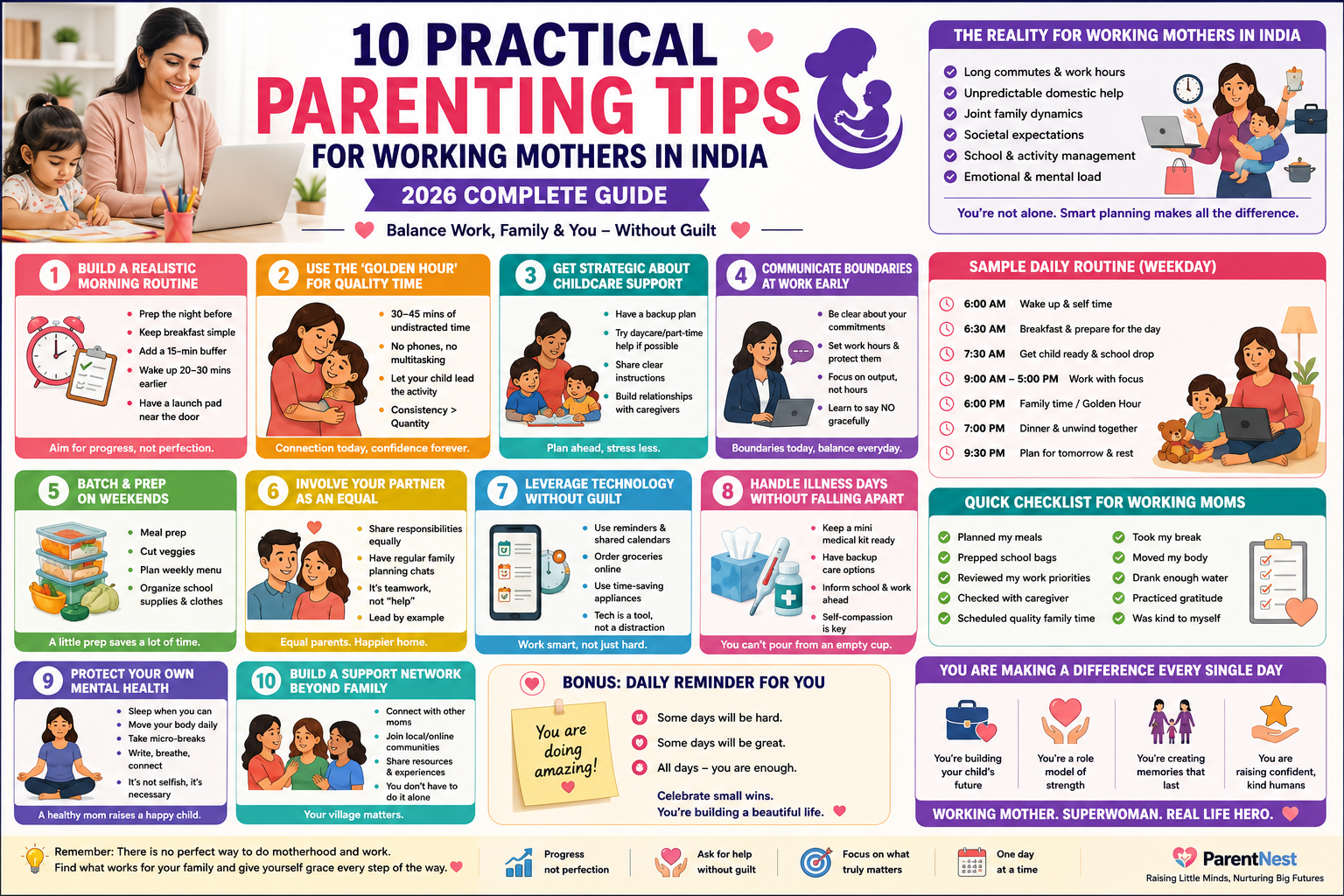
Most parenting content shows picture-perfect morning routines that rarely survive contact with a real Indian household — a crying toddler, a delayed cook, unpredictable traffic, or a school bus running late.
Instead of an idealized routine, build one around your actual constraints:
The goal isn’t perfection — it’s a routine flexible enough to absorb chaos without falling apart completely. Many working mothers find that the biggest improvement doesn’t come from waking up earlier, but from reducing the number of decisions that need to be made in the moment.
Working mothers often carry guilt about limited hours with their children. Rather than measuring parenting success by quantity of time, focus on quality, undistracted time — even if it’s just 30–45 minutes a day.
Pick a consistent time window (often right after you get home, or right before bedtime) and treat it as sacred:
Children often remember the consistency and presence of this time far more than the total hours spent together. Developmental research on attachment consistently emphasizes responsiveness and predictability over sheer quantity of contact time — a consistent, engaged 30 minutes daily builds more security than several distracted hours.
It also helps to involve your child in naming or shaping this ritual — some families call it “special time” or give it a fun name the child chooses, which increases their own investment in protecting it too.
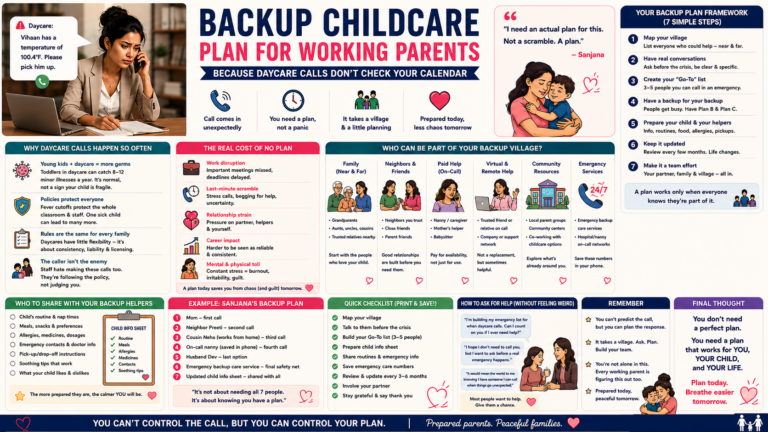
Childcare in India often involves a mix of domestic help, family support, daycare, or a combination of all three. Being strategic (rather than reactive) about this saves enormous stress:
Many working mothers report that the single biggest source of daily stress isn’t the job itself, but the fragility of childcare arrangements — investing time upfront in backup options pays off repeatedly. It’s also worth periodically reassessing your childcare setup as your child grows — what worked for an infant often needs to change significantly by toddlerhood or school age.
Indian work culture can sometimes expect long hours or last-minute demands without much regard for caregiving responsibilities. Setting boundaries early — rather than apologetically after a crisis — tends to work better:
This isn’t always easy, especially in more traditional workplaces, but framing boundaries as logistics rather than favors tends to get better long-term results. Over time, consistent, calm boundary-setting tends to shift workplace expectations more effectively than occasional, apologetic requests.
Weekday evenings are often the most stretched time for working mothers. Shifting some of that load to weekends can meaningfully reduce weekday stress:
This isn’t about turning weekends into more work — it’s about redistributing a fixed amount of mental load to reduce weekday overwhelm. Many working mothers find that even 60–90 minutes of focused weekend prep saves several hours of scattered weekday stress.
Research and lived experience consistently show that when caregiving is framed as “the mother’s job with occasional help,” mental load stays unevenly distributed even in dual-income households.
Practical ways to shift this:
The goal isn’t a rigid 50-50 split of every task, but a genuinely shared sense of ownership over the household and childcare, rather than one partner “managing” and the other “assisting.”
Screen time guilt is common among Indian parents, but used thoughtfully, technology can genuinely ease the load without harming your child’s development:
The goal isn’t zero guilt about screen time — it’s using technology intentionally rather than reactively, and not letting guilt override genuinely useful tools. A helpful mental shift: judge technology use by whether it’s purposeful and time-bound, rather than by the total minutes alone.
Child illness is one of the most disruptive realities for working parents — and Indian households often lack the flexible sick-leave norms common elsewhere.
Planning for illness days in advance, rather than treating each one as a crisis, significantly reduces the stress when they inevitably occur.
It’s easy for working mothers to place their own wellbeing last on a long list of priorities. But sustainable parenting requires some baseline self-care, not as a luxury but as a functional necessity:
If you’re finding it difficult to cope, speaking with a counselor or your doctor is a reasonable and often very helpful step — there’s no need to manage everything alone.
Not every working mother has an extended family nearby or available for support. Building an alternative support network can fill this gap meaningfully:
Many working mothers in India live in or near joint family setups, which brings both significant support and unique friction points.
The support side: grandparents or other family members can offer flexible, trusted childcare that’s often unavailable through formal daycare, particularly valuable during illness or unexpected work demands.
The friction side: differing opinions on parenting choices — feeding practices, screen time, discipline approaches — can create tension, especially when a working mother feels she has less time to “defend” her choices compared to a stay-at-home counterpart.
Practical approaches that help:
While not strictly a “parenting tip,” financial planning significantly affects a working mother’s stress levels and is worth brief mention:
The return-to-work period is often one of the most emotionally and logistically challenging phases for working mothers. A few practical strategies that ease this transition:
| Time | Activity |
|---|---|
| 6:00 AM | Wake up, quiet time before child wakes |
| 6:30 AM | Get ready, prep breakfast/tiffin |
| 7:00 AM | Wake child, morning routine |
| 8:00 AM | School drop-off / bus |
| 8:30 AM – 5:30 PM | Work hours |
| 6:00 PM | Golden hour — undistracted time with child |
| 7:00 PM | Dinner, homework/reading time |
| 8:30 PM | Wind-down routine, bedtime story |
| 9:00 PM | Child’s bedtime; personal time / partner time |
This is a template, not a rule — adjust based on your specific work hours, commute, and family structure.
Infancy (0–1 year): The biggest challenges are typically feeding logistics (especially if breastfeeding and working), sleep disruption, and finding reliable, trusted infant care. Building a clear routine sheet for caregivers is especially important during this phase.
Toddler years (1–3 years): Separation anxiety often peaks during this period, making childcare transitions harder. Consistency in caregiver and routine helps significantly, as does a predictable, calm goodbye ritual at drop-off rather than prolonged departures.
Preschool (3–5 years): Communication becomes easier, and children can start participating in simple routines (choosing their own clothes, helping pack their bag), which both builds independence and reduces the parent’s logistical load.
School age (5+ years): Homework management, extracurricular scheduling, and increasing social dynamics become the primary focus. This is also a good stage to start involving children more actively in household responsibilities appropriate to their age, further easing the overall family load.
Focus on the quality and consistency of the time you do have rather than the total hours. Children generally respond more to a present, engaged parent for a short window than a distracted parent for a longer one.
Start by understanding your company’s official parental leave and flexibility policies — often underutilized simply because employees don’t ask. If genuinely unsupported, it may be worth having a direct conversation with HR or considering whether the workplace culture aligns with your long-term needs.
This is where having 2–3 backup options (a neighbor, part-time help, or a trusted daycare) becomes invaluable. Building this network before you need it, rather than scrambling during a crisis, makes a significant difference.
Some degree of tiredness is common among working parents, but persistent, overwhelming exhaustion that doesn’t improve with rest may be worth discussing with a doctor, as it can sometimes point to burnout or other underlying issues that benefit from professional support.
Frame conversations around specific, ownable tasks rather than vague requests for “more help.” Calm, regular check-ins about workload tend to work better than confrontations after resentment has already built up.
Set a few clear non-negotiables early, remain flexible on lower-stakes preferences, and address concerns as a united front with your partner rather than in the moment during a disagreement.
This is a deeply personal decision depending on financial circumstances, career considerations, and personal preference — there’s no universally “right” answer, and it’s worth revisiting periodically rather than treating it as a permanent decision either way.