Physical Address
304 North Cardinal St.
Dorchester Center, MA 02124
Physical Address
304 North Cardinal St.
Dorchester Center, MA 02124

It started with a cardboard box, six pine cones, and a set of old measuring spoons.
Priya had spent a Saturday morning setting up the “perfect” activity for her three-year-old — a colour-sorting craft with pre-cut pieces and a glitter glue stick. Twelve minutes in, her daughter had abandoned it entirely and was carefully arranging pine cones in a line next to a measuring spoon, muttering something about a “pine cone family going to the market.”
Priya almost intervened. Instead, she watched. And watched. For forty-three minutes.
That pine cone play? That was loose parts play — and it’s one of the most research-backed, creativity-nurturing, developmentally rich forms of play your child can do. The best part: you don’t need to buy anything special to start.
In this guide, you’ll discover exactly what loose parts play is, why it works, how to set it up at every age, and how to keep it going without turning your home into a craft supply store.
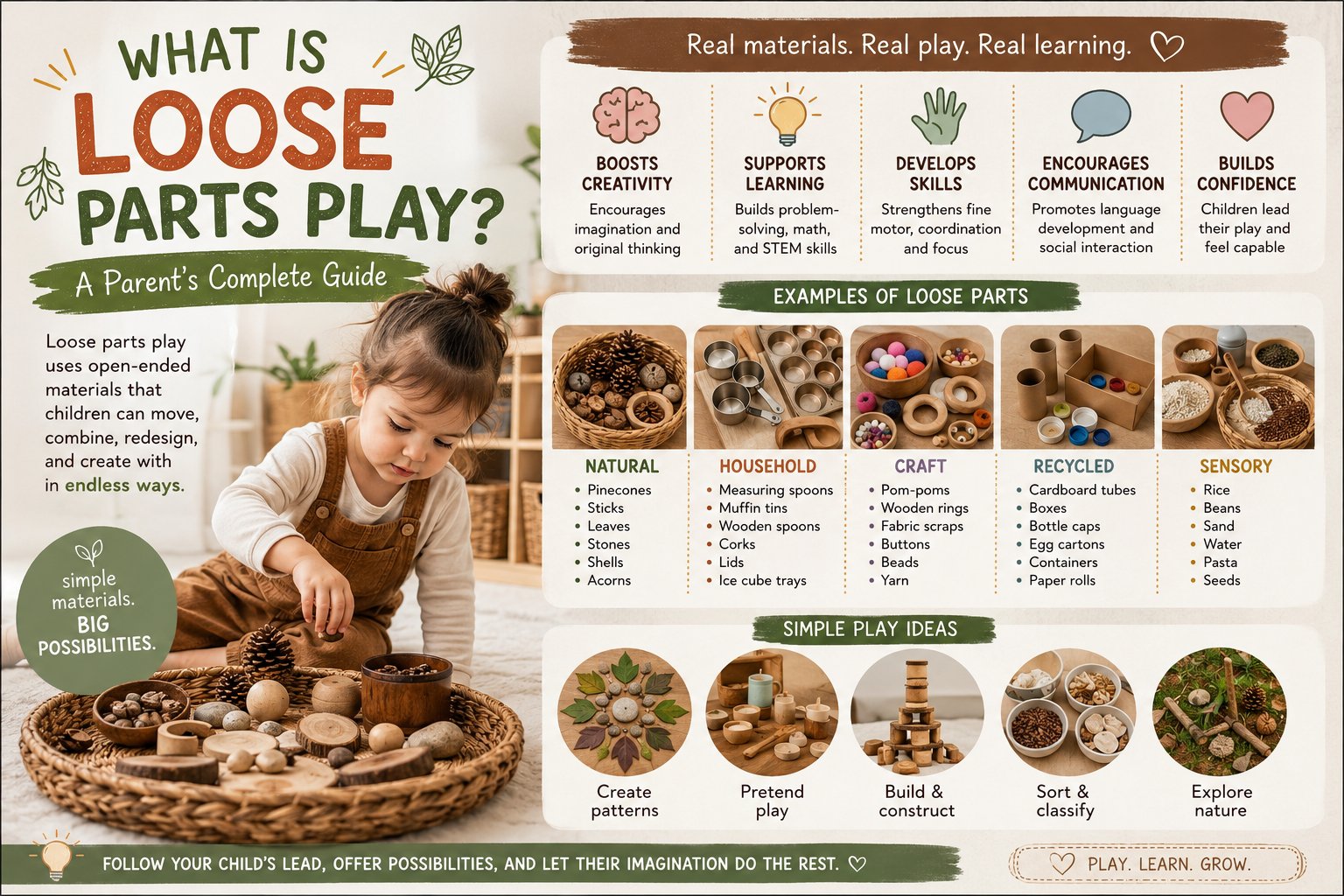
Loose parts play is a type of open-ended, child-led play using materials that can be moved, arranged, combined, redesigned, and used in multiple ways. There are no instructions, no right answers, and no set outcome.
The term was coined by architect Simon Nicholson in 1971, who proposed his “Theory of Loose Parts” — the idea that environments rich in moveable, adaptable materials inspire far more creativity and problem-solving than fixed, single-use toys.
Think: pebbles, fabric scraps, wooden rings, bottle caps, sticks, shells, old keys, spools of thread. The defining quality isn’t what the material IS — it’s what it can BECOME in a child’s hands.
| THE PARENTNEST DEFINITION Loose parts play is any play where a child uses open-ended, moveable materials to build, sort, create, or imagine — without a predetermined goal or outcome. It’s child-directed, infinitely repeatable, and costs almost nothing to start. |
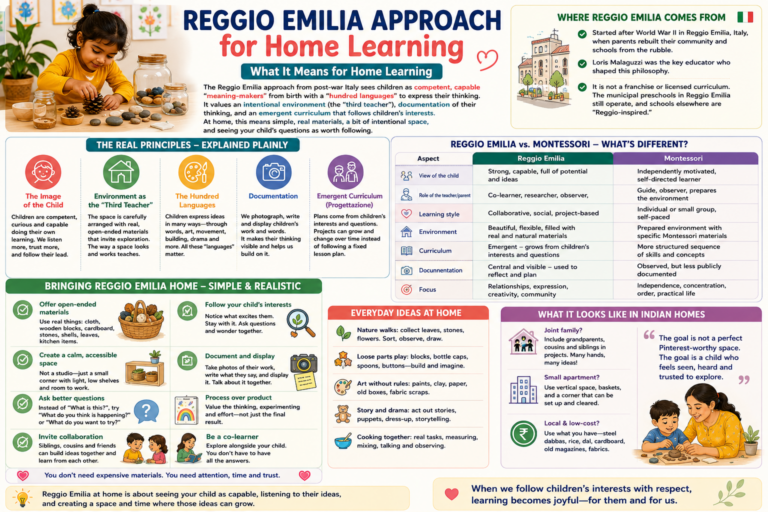
Loose parts play is frequently mentioned alongside Montessori and Reggio Emilia philosophies, and while they share DNA, they’re not identical:
| Approach | Focus | Role of Materials |
| Loose Parts Play | Child-led creativity & exploration | Open-ended, no correct use |
| Montessori | Independence & order within structure | Purposefully designed for specific skills |
| Reggio Emilia | Child as researcher; environment as teacher | Beautiful, natural, provocative |
| Heuristic Play | Sensory discovery (0–2 years) | Everyday household objects in a basket |
Loose parts play can coexist with all three. It’s a method, not a philosophy — you can layer it onto whatever parenting approach you already use.
This isn’t just a trend — there is a robust body of child development research supporting loose parts play as one of the most effective forms of early learning.
When a child decides to “build a bridge” with sticks and stones — setting a goal, gathering materials, problem-solving when it falls, and adapting their plan — they are exercising the exact mental muscles that underpin school readiness, emotional regulation, and lifelong learning: executive function skills.
Picking up small pebbles, threading spools, balancing wooden discs, and stacking bottle caps all strengthen the fine motor pathways children need for writing, drawing, and self-care. Large loose parts — planks, crates, fabric lengths — engage whole-body coordination.
Because loose parts play has no right or wrong outcome, children experience genuine internal satisfaction when they create something. This is qualitatively different from completing a puzzle or colouring inside the lines — and research suggests intrinsically motivated play leads to deeper engagement and longer attention spans.
Children playing with loose parts narrate their own play (“this is the rocket, this is the fuel…”), negotiate with siblings, and develop rich vocabulary around shape, size, quantity, and texture — naturally, without flashcards.
Towers fall. Bridges collapse. Plans change. Loose parts play quietly teaches children that failure is a design step, not an endpoint — building the emotional resilience that is increasingly identified as a core life skill.
| RESEARCH SPOTLIGHT A 2020 study published in the International Journal of Environmental Research and Public Health found that children in loose parts play environments showed significantly greater physical activity, engagement, and social interaction compared to traditional playground settings — even when the loose parts were simply recycled materials and natural objects. |
Almost anything can be a loose part — but the best loose parts share a few qualities: they’re open-ended, interesting to touch and handle, safe for the age of the child, and varied in texture, shape, size, or colour.
| SAFETY NOTE Always match loose parts to your child’s developmental stage. For children under 3, avoid anything smaller than a 50p/50 cent coin, sharp objects, or parts that could splinter. Supervise sensory and small-parts play with toddlers at all times. |
Loose parts play looks different at every developmental stage. Here’s a practical breakdown so you know exactly what to offer — and when.
At this stage, loose parts play takes the form of a heuristic basket — a collection of interesting, safe household objects for a baby to explore through touch, taste, and sound. Think: a wooden spoon, a metal whisk (smooth edges), a velvet ribbon, a natural sponge, a shell. Keep it supervised and stimulating.
Best loose parts: Fabric textures, wooden objects, safe kitchen utensils, natural items with varied textures.
What to watch for: Mouthing, grasping, banging, examining. All of this IS the play.
Toddlers at this age are obsessed with containment — filling a pot with pebbles, emptying it, and filling it again is not aimless repetition. It’s early mathematical thinking and spatial reasoning in action. Resist the urge to “add more complexity.” The simple act is the complexity.
Best loose parts: Pebbles, large buttons, wooden rings, cups, bowls, scoops, natural objects.
Setup tip: A low tray with two or three materials is plenty. Less is genuinely more.
This is the golden age of loose parts play. Two to four year olds use materials to sort (“all the round ones here”), construct (“I’m making a house”), and narrate (“this pebble is the baby”). Imaginative play blossoms when materials don’t look like anything specific — because then they can be everything.
Best loose parts: Varied pebbles, wooden discs, fabric scraps, pine cones, shells, buttons, sticks.
The magic moment: When your child picks up a stone and says “this is my phone” — that’s symbolic thinking. That’s language development. That’s loose parts play working.
Older preschoolers use loose parts with increasing intentionality. They’ll spend an hour building a “town” from pebbles and sticks, create transient artworks with flowers and leaves, or engineer elaborate marble runs from tubes and sloped cardboard. This is sophisticated STEM thinking — without a STEM kit.
Best loose parts: Cardboard tubes, planks, larger pebbles, natural materials, wire (soft craft wire under supervision), shells, tiles.
By school age, children can sustain loose parts projects across multiple days — returning, adding, adjusting. Encourage them to document their creations (a photo, a drawing, a few words) to build metacognitive awareness alongside creativity.
Best loose parts: More complex materials — mirrors, glass gems, wire, rope, pulleys, larger natural items, sand and water play with tools.
| Age | Play Style | Best Loose Parts | Setup Tip |
| 0–12m | Treasure basket exploration | Fabric, wood, metal objects | Basket on the floor, baby seated |
| 1–2 yrs | Fill, pour, empty, repeat | Pebbles, cups, rings, scoops | Low tray, 2-3 materials only |
| 2–4 yrs | Sort, build, narrate | Stones, discs, pine cones, shells | Open floor space, no instructions |
| 4–6 yrs | Engineer, art, worlds | Tubes, planks, wire, natural items | Rotate materials every 2-3 days |
| 6–8 yrs | Projects, systems | Complex materials + tools | Let them document their creations |
The most common reason parents don’t try loose parts play isn’t lack of interest — it’s overwhelm. “Where do I even start?” Here’s a simple, sustainable system.
Walk through your home with fresh eyes. The kitchen is a goldmine: bottle caps, corks, measuring spoons, jar lids, wooden pegs. The garden: pebbles, sticks, leaves, seed pods. A charity shop run yields buttons, ribbon, and fabric scraps. You likely have 20+ loose parts within reach right now.
Your First Loose Parts Collection (Start Here):
Loose parts play doesn’t need a dedicated playroom. It needs an inviting presentation. The 3-Second Rule: if a child walks past and isn’t drawn in within 3 seconds, it needs to be more visually compelling. This usually just means:
This is the hardest part for most parents. Once the invitation is set, your job is done. Resist the urge to demonstrate, direct, or suggest. If your child picks up a pebble and licks it, that’s data collection. If they arrange everything by size and then sweep it all to the floor, that was a complete, satisfying play sequence. Trust the process.
| THE PARENTNEST ‘3-SECOND RULE’ IN PRACTICE Set up a simple tray of mixed natural materials on your child’s low shelf before they wake up. When they come downstairs and spot it, you’ll see what “invitation” really means — the materials should practically reach out and grab their attention. |
One of the great misconceptions about loose parts play is that it requires outdoor space. While outdoor play with natural materials is wonderful, some of the most magical loose parts play happens at a kitchen table.
| Setting | Best Materials | Ideal For | Parent Prep Time |
| Kitchen table | Buttons, spools, fabric, lentils | Rainy days, winter, babies | 5 minutes |
| Floor mat | Wooden discs, pebbles, sticks | Toddlers, construction play | 5 minutes |
| Light table | Translucent gems, shapes, loose parts | Ages 2–6, sensory & art | 10 minutes |
| Garden / patio | Sticks, mud, water, pebbles | Summer, gross motor play | Minimal |
| Sandbox | Scoops, tubes, natural items | All ages, sensory immersion | Initial setup only |
| Balcony / terrace | Lightweight natural materials | Urban families | 5 minutes |
For families in India and other monsoon-climate regions, wet-weather loose parts play is an art form in itself. Muddy play is one of the richest sensory experiences available — and monsoon mud is nature’s best loose parts gift. Try:
Many parents discover loose parts play specifically as a screen-free alternative — and it is one of the most powerful. But framing it as “instead of screens” can backfire, because it positions play as a restriction.
A more effective framing: loose parts play as an attraction. When materials are beautiful, accessible, and interesting, children choose them. The screen doesn’t win because the alternative is better — it wins because the alternative isn’t visible or compelling. Make the materials visible. Make them compelling. Watch what happens.
| Common Mistake | What to Do Instead |
| Buying expensive kits before gathering what you have | Do the ‘home sweep’ first — you likely have 20+ loose parts already |
| Giving too many materials at once | Start with 3–5 items on a tray. Add gradually over days |
| Directing or suggesting what to make | Observe silently. Narrate only if asked. |
| Tidying up the ‘wrong’ arrangement | Preserve what they’ve made until they’re done — even if it’s on the floor |
| Expecting long engagement on Day 1 | Play depth increases over time. The first session may be 8 minutes. |
| Only offering in dedicated ‘play time’ | Make materials permanently accessible for self-initiated play |
| Buying only beautiful materials | Ugly, random household items are often more interesting |
Loose parts play was practically designed for budget-conscious families. Here’s a curated list of 30 materials you can collect, find, or repurpose at zero cost:
| Natural (Free to Collect) | Household (Free to Repurpose) |
| Pine cones | Bottle caps and lids |
| Smooth river pebbles | Cardboard tubes (toilet roll, kitchen roll) |
| Sticks and twigs | Fabric scraps and ribbons |
| Dried leaves and bark | Old buttons |
| Seed pods (varied shapes) | Wooden pegs / clothespins |
| Shells (beach or market) | Old keys |
| Acorns / conkers | Corks |
| Dried flowers and petals | Metal washers / nuts |
| Feathers (clean) | Jar lids |
| Sand or fine gravel | Egg cartons (cut apart) |
| Dried beans, lentils, rice | Spools of thread (empty) |
| Moss (from garden) | Measuring cups and spoons |
| Flat stones | Cardboard pieces (varied sizes) |
| Dried grass / reeds | Mesh bags (from fruit/veg) |
| Bamboo pieces | Plastic bottles (varied sizes) |
One of the most helpful things you can do before starting loose parts play is picture what it actually looks like in real homes — not curated Instagram photos, but real life.
“I put out a small wooden tray with seven pebbles and three jar lids while making dinner. He spent 25 minutes moving the pebbles in and out of the lids, lining them up, tipping them on the floor, and starting again. I think he sorted them by size at one point, though it might have been random. He told me the big pebble was ‘Papa.’ I didn’t say anything. It was the most peaceful dinner prep of my life.”
“After the rains stopped, I put a collection of pine cones, sticks, and an old tin tray in the garden. Both kids were out there for 45 minutes building what they called a ‘forest restaurant.’ The five-year-old was taking ‘orders’ in stick-scratch marks on a piece of bark. I left them to it.”
“We have a small floor basket of wooden discs, shells, and fabric scraps near her bookshelf. Some days she ignores it completely. Other days I’ll come in to find she’s arranged everything in an elaborate circular pattern and is sitting in the middle of it, quietly. I’ve learned not to ask what it is. It’s whatever she needs it to be.”
The Reggio Emilia approach, originating in northern Italy after World War II, treats the environment as “the third teacher” — a space designed to invite curiosity, exploration, and collaboration. Loose parts are central to this philosophy.
Reggio-inspired educators refer to the presentation of materials as a “provocation” or “invitation” — a carefully considered arrangement designed to spark a question, inspire exploration, or extend a current interest. This is a beautiful framework for parents to borrow, even informally:
This doesn’t require training or a philosophy degree. It requires attention — which most parents are already giving their children every day.
You do not need a playroom, a large garden, or extensive storage to offer rich loose parts play. Some of the most creative invitations work beautifully on a 30cm x 40cm tray.
Loose parts play is open-ended, child-led play using moveable, adaptable materials — pebbles, sticks, fabric scraps, bottle caps — that have no fixed purpose or instructions. Children use them to build, sort, create, and imagine freely.
You can begin loose parts play from birth, starting with heuristic treasure baskets for babies under 12 months. The materials, complexity, and scale evolve with the child’s developmental stage all the way through primary school years and beyond.
Yes, when materials are age-appropriate. For children under 3, always choose materials larger than a 50mm diameter (choking hazard threshold), avoid sharp edges, and supervise closely. Natural objects like large pebbles, smooth sticks, and pine cones are excellent safe options.
You likely have 20+ loose parts at home already: bottle caps, jar lids, fabric scraps, cardboard tubes, wooden pegs, old keys, buttons, corks, measuring spoons, and ribbon. Natural materials from your garden or local park — pebbles, sticks, leaves, pine cones — are also perfect.
Regular toy-based play often has a fixed outcome (a completed puzzle, a set LEGO structure). Loose parts play has no correct outcome — the child decides entirely what the materials become. This openness is precisely what drives creativity, problem-solving, and intrinsic motivation.
Set up a simple, visually interesting invitation on a tray at child height, then leave it and walk away. Resist directing or demonstrating. The absence of instruction is the invitation. Most children will approach a well-presented loose parts invitation within a few minutes.
No. The best loose parts play starts with what you already have. A home sweep and an outdoor walk will provide everything you need for weeks of rich play. You can gradually add beautiful natural or wooden materials over time, but starting with zero spending is completely valid.
The Reggio Emilia approach uses loose parts as central to its ‘environment as teacher’ philosophy, calling intentional material presentations ‘provocations’ or ‘invitations.’ You don’t need to follow Reggio Emilia to use this approach — simply presenting materials thoughtfully and observing your child’s response captures the essence.
There’s a reason loose parts play has been embraced by early childhood educators, developmental psychologists, and the parents who’ve tried it around the world. It works because it trusts children — it trusts them to be curious, capable, creative, and competent when given the materials and the space.
You don’t need a special setup, an expensive curriculum, or hours of free time. You need a tray, a few interesting objects, and the willingness to step back and watch what your child creates.
Start small. Start today. The pine cones are waiting.