Physical Address
304 North Cardinal St.
Dorchester Center, MA 02124
Physical Address
304 North Cardinal St.
Dorchester Center, MA 02124

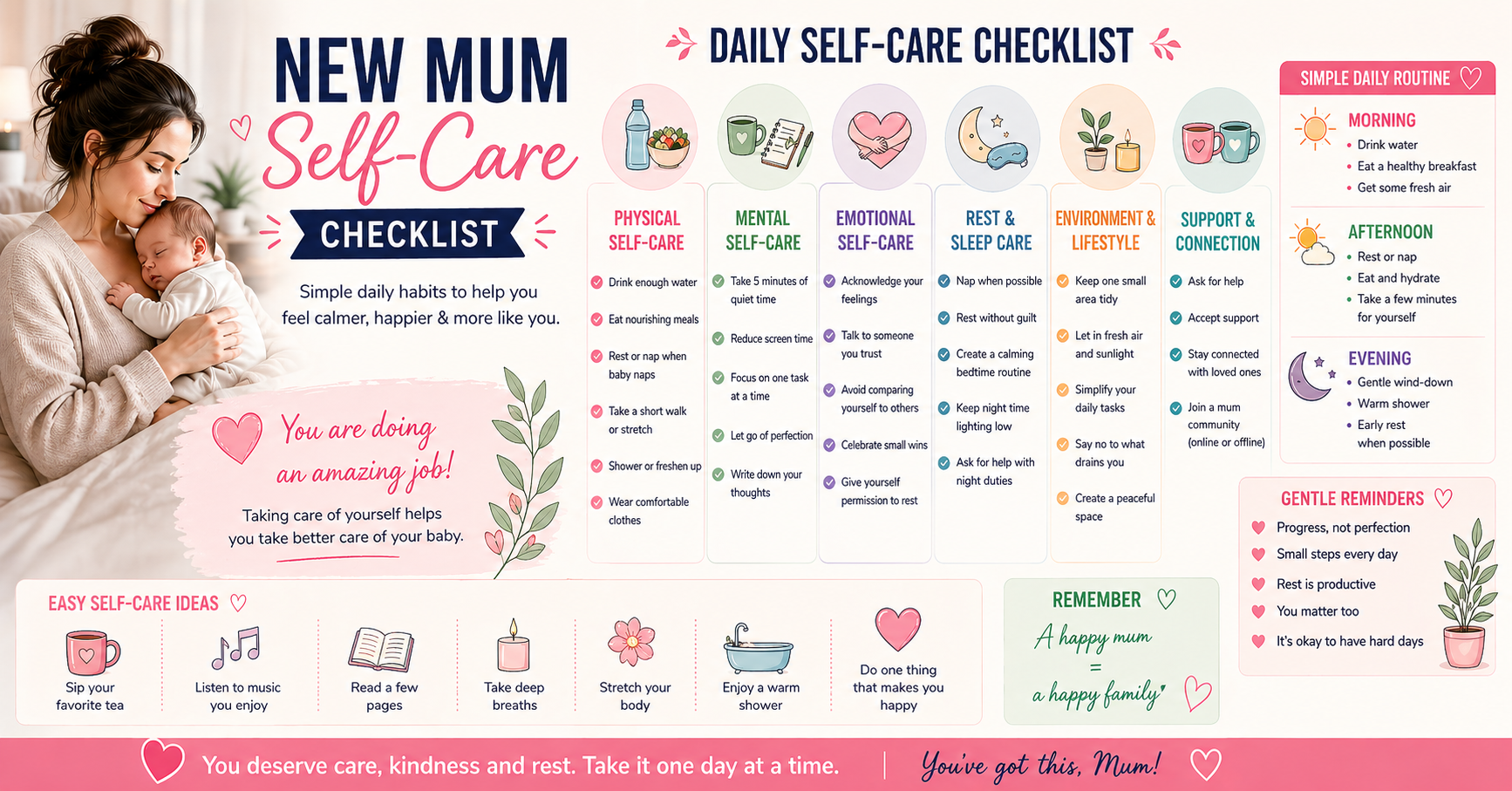
Here is something that sounds simple and is actually quite radical:
You matter too.
Not instead of the baby. Not more than the baby. But alongside the baby — as a full human being with physical needs, emotional needs, and a legitimate claim on her own care and attention.
The cultural narrative around new motherhood is relentlessly baby-focused, which makes sense in some ways — newborns are helpless, demanding, and completely dependent. But the effect of this narrow focus is that new mums regularly fall through the gaps. The midwife visits taper off. The health visitor checks the baby’s weight. The six-week appointment is rushed. And in between all of these, nobody is systematically checking whether the mum is drinking enough water, sleeping at all, feeling like a person rather than a human milk machine, or holding up under the weight of the biggest transition of her adult life.
This checklist is an attempt to fill that gap.
A new mum self-care checklist isn’t about spa days or elaborate routines or having it together. It’s about the basics — the fundamental acts of tending to yourself that get dropped first when a baby arrives and that matter more than almost anything for your recovery, your mental health, your ability to feed and love and function through the hardest weeks of parenthood.
This is not a list of things you should be doing perfectly every day. It’s a framework — something to come back to when you’ve lost the thread of yourself, something to use as a gentle audit of which of your own needs have been quietly forgotten.
Print it. Screenshot it. Save it to your phone. Keep it somewhere you’ll see it.
And on the days when you’ve ticked literally nothing — when the baby hasn’t put you down since 7am, when you’re still in yesterday’s clothes, when “self-care” feels like a dark joke — this checklist is also permission to start again tomorrow. Without guilt. Without the inner critic. Just: tomorrow.
Before we get into the checklist itself, I want to address the thing that stops most new mums from using one: the guilt.
The voice that says you should be focused entirely on the baby. That self-care is indulgent when there’s so much to do. That good mums put themselves last. That you’ll focus on yourself “when things settle down.”
Things don’t settle down in the way that voice is promising. The baby grows, the demands shift, but there’s always a reason to put yourself last. If you wait for a natural pause in which to start looking after yourself, you will wait for a very long time.
Here is the practical reality: the research on maternal wellbeing is unambiguous. Mums who receive adequate support, rest, nutrition, and social connection have better mental health outcomes, are more emotionally available to their babies, experience lower rates of postnatal depression, and report higher satisfaction with early parenthood. The inverse is also true — mums who consistently deprioritise their own needs are at significantly higher risk of burnout, anxiety, depression, and the kind of depletion that makes everything harder.
Looking after yourself is not in competition with looking after your baby. It is part of it.
The new mum self-care checklist is not a luxury document. It’s a survival tool.
A few notes before we begin, because how you use this matters as much as the content.
Don’t try to do everything every day. This is a complete checklist — a comprehensive reference — not a daily to-do list that has to be completed in full. On a good day, you might tick many things. On a hard day, one thing counts as a win.
Adapt it to your stage. The first week postpartum looks completely different from week eight or week sixteen. Some items on this list won’t be appropriate until you’re further into recovery. Use what applies to where you are.
Be specific, not vague. “Self-care” as a concept is too big and too vague to actually do. Breaking it into specific, small, concrete actions — drink a glass of water, step outside for five minutes, write three sentences — makes it achievable when you have nothing left.
Share it with your partner or support person. This checklist is not just for you to read alone and quietly try to implement without anyone knowing. It’s a conversation starter. Show the people who love you what you need. Let them help you tick things off.
Come back to it when you’ve lost yourself. Which you will, at some point. Every new mum does. The checklist is an anchor — something to return to when you’ve forgotten that your own needs exist.
These are the foundational physical needs that have to be met before anything else is possible. They sound almost embarrassingly simple. They are also the first things to go when a baby arrives, and their absence compounds every other difficulty.
This is the single most commonly neglected new mum self-care basic. If you’re breastfeeding, your needs are closer to 2.5-3 litres. Dehydration causes headaches, fatigue, reduced milk supply, constipation, impaired wound healing, and worsened mood — all of which are problems you already have enough of.
Keep a large water bottle — at least one litre — within arm’s reach at all times. Drink before you feel thirsty. Make drinking water as automatic as possible by pairing it with feeding: every time the baby feeds, you drink.
Breastfeeding mums often experience a sudden, intense thirst at the moment milk lets down — known as “milk thirst” — and keeping water beside you when you nurse is both practical and important.
Not a biscuit from the kitchen counter while standing up. Not the leftovers from whoever visited last. Two actual meals — ones that contain protein, carbohydrate, and something resembling a vegetable or fruit.
New mums are notoriously bad at feeding themselves. The baby’s needs are so constant and immediate that eating falls off the radar entirely, and then you find yourself at 3pm running on a cup of tea and half a piece of toast and wondering why you feel terrible.
If cooking is not happening — and in the early weeks, it may genuinely not be happening — this is where the meal train of friends and family comes in. Frozen meals. Easy one-handed snacks kept beside the nursing chair. A meal delivery service subscription as a gift or self-gift. Eating matters. Make it as frictionless as possible.
It sounds base. It is base. And yet — ask any new mum and she’ll tell you about the days she realised it was 4pm and she hadn’t managed it yet.
A shower, even a five-minute one, does something important beyond the hygiene function. It is a moment that is yours alone, where the water is warm and the baby (temporarily, loudly) is someone else’s responsibility, and you are briefly just a person in a shower rather than a parent on duty. That shift in context matters.
Make it easier: if you can’t leave the baby, put them in a bouncy chair in the bathroom. If you can’t shower, a warm flannel and a change of clothes still counts. Something is better than nothing.
Not “rest” meaning sitting on the sofa scrolling your phone while the baby sleeps on your chest. Genuine rest — eyes closed, body horizontal, phone in another room.
The quantity of sleep available to a new mum is largely determined by external factors outside her control. The quality, to some extent, can be influenced. Sleeping during the baby’s longest sleep period rather than using it for tasks. Accepting a shift from your partner. Asking a visitor to take the baby while you sleep for two hours.
Even twenty minutes of genuine rest has measurable restorative effect. Even a rest that doesn’t result in sleep — lying in the quiet dark with your eyes closed — allows your nervous system to downregulate in ways that running on empty simply doesn’t.
Fresh air, natural light, and a change of environment are three things that cost nothing and deliver disproportionate returns in the early weeks of new motherhood.
Morning light within the first hour of waking — even just standing on the doorstep — helps regulate your circadian rhythm and supports better nighttime sleep. Nature exposure, even briefly, reduces cortisol levels and lowers the physiological markers of stress. Getting out of the house, even for a ten-minute walk to the end of the road and back, breaks the four-walls claustrophobia that builds quickly during the newborn period.
You don’t need to go far. You don’t need to get dressed up. You just need to step outside, feel some air, and look at something that isn’t the inside of your house.
Postnatal vitamins — particularly vitamin D, which is commonly deficient in the UK, and iron if you had significant blood loss during birth — support physical recovery. If you’re breastfeeding, a supplement that includes iodine is recommended by the NHS.
Any medication prescribed postpartum — pain relief, iron supplements, antibiotics for a wound, antidepressants if that’s where you are — needs to be taken consistently, not skipped when the day gets chaotic.
Set a phone reminder. Keep vitamins somewhere visible. This is not optional.
This is the self-care item new mums most consistently intend to do and most consistently forget. The pelvic floor — the group of muscles that support your bladder, bowel, and uterus — has been under significant strain during pregnancy and delivery and needs deliberate rehabilitation.
Even a gentle set of ten contractions — squeeze, hold for a count of five, release — done several times through the day begins the recovery process. These can be done lying down, sitting, standing, during a feed, waiting for a kettle — they require no equipment and no dedicated time.
Set a trigger: every time you feed the baby, do ten pelvic floor contractions. By the end of one day, you’ve done more than most new mums manage in a week.
Physical basics are the floor. But the new mum self-care checklist would be incomplete without a genuine emotional audit — because the mental and emotional demands of early motherhood are as significant as the physical ones, and considerably more likely to go unaddressed.
Not “fine.” Not the version you tell visitors. How are you actually doing?
Name it, even just to yourself. Overwhelmed. Lonely. More in love than you knew was possible. Terrified. Bored. Anxious. Numb. All of these at the same time, which is also a valid answer.
Naming an emotional state gives you a small amount of distance from it — enough to recognise it as weather rather than permanent reality. It also creates the possibility of doing something about it, or talking to someone about it, which you can’t do if you’re still performing “fine.”
Not a performance of coping. Not the edited version. Tell one person something real about how today is going.
This can be your partner in bed at night. A text to a friend. A message in a new mum WhatsApp group. A call to your mum. The midwife at a check-up, if that’s when the opportunity arises.
The specific person and medium matter less than the honesty. Connection is one of the most powerful buffers against postnatal depression and anxiety — not generic social interaction, but genuine, honest communication with someone who actually knows you.
Every new mum has bad days. That’s different from a pattern of persistent difficulty that isn’t shifting.
The Edinburgh Postnatal Depression Scale (EPDS) is a validated, ten-question tool available online and used by health visitors at your postnatal check-ups. It takes about two minutes to complete and gives you a structured way to assess whether what you’re experiencing falls within the range of adjustment or whether it might indicate postnatal depression or anxiety that deserves professional attention.
Use it honestly. Share the results with your health visitor or GP.
Signs that deserve medical attention: mood that doesn’t lift after two weeks, inability to feel pleasure in anything, intrusive thoughts about harm to yourself or your baby, feeling like your family would be better off without you, persistent inability to sleep even when the baby is sleeping, or anxiety that is present all the time and doesn’t have an obvious external cause.
This one surprises people. Grief and new motherhood aren’t concepts that sit easily alongside each other in the cultural narrative of joy and gratitude.
But many new mums experience real losses alongside the arrival of their baby: the loss of a career identity, at least temporarily. The loss of bodily autonomy and physical freedom. The loss of the relationship with their partner as it was before. The loss of spontaneity. The loss of the version of themselves they used to know well.
These losses are real. They deserve to be named, not suppressed. Feeling grief for something you’ve lost is not the same as being ungrateful for what you have. Both things are true simultaneously. Both are allowed.
Not for the baby. Not for the household. Not because it needs doing. One thing — even a very small thing — that you would choose for yourself.
A podcast you love. Ten minutes with a novel. A face mask while the baby has a nap. Sitting outside with a good coffee and no phone. Ringing a friend whose voice makes you feel better. Whatever it is — it needs to be genuinely yours, not a performance of self-care and not a task dressed up as one.
This item on the new mum self-care checklist is the one most likely to get skipped and the one that matters most for your sense of identity beyond your role as a parent. Guard it accordingly.
New parenthood is fertile territory for catastrophic thinking. Every unusual cry, every refused feed, every percentile on a growth chart can spiral into worst-case-scenario territory in seconds. A brain running on no sleep and maximum stress is not a reliable narrator.
This checklist item isn’t about forcing positivity or dismissing legitimate concerns. It’s about noticing when the thought spiral has started and gently interrupting it.
Ask: is this an emergency right now, in this moment? If yes — address it. If no — breathe. Write it down. Look it up once rather than repeatedly. Ask your health visitor or GP rather than consulting a search engine at midnight.
Whether you’re breastfeeding, formula feeding, or combination feeding, the way you feed your baby has self-care implications for you too — and those often get ignored entirely in the focus on the baby’s nutritional needs.
If you’re breastfeeding: your comfort during feeds is not a secondary consideration. Nipple pain beyond the first few days of feeding is not something you simply endure — it’s a signal that something (latch, positioning, a tongue tie, thrush) may need attention. Contact your midwife, health visitor, or a breastfeeding support organisation (the Association of Breastfeeding Mothers, La Leche League, or your local infant feeding team) rather than suffering through it.
Nipple cream — Lansinoh HPA Lanolin is the gold standard — applied after every feed in the early weeks significantly reduces soreness and supports healing. This is self-care for your body, not a luxury.
If you’re formula feeding: release the guilt. Fed is fed. Formula feeding is a valid, loving choice, and the mental and emotional relief of formula feeding — for mums for whom breastfeeding is physically, emotionally, or practically not working — is itself a form of self-care.
Whether nursing or bottle-feeding, you spend a significant portion of early parenthood stationary during feeds. Make that space serve you.
Within arm’s reach of where you most frequently feed: a large water bottle, a one-handed snack (oat bars, nuts, fruit, whatever you like), your phone charged and with headphones if you use them, a pillow for your own back support, a remote control if the TV is nearby, and anything else that makes the feed itself comfortable and the time yours to use.
This sounds obvious. Most new mums don’t do it until someone tells them to.
Breastfeeding mums especially, but all new mums — your body has typically gone without food for several hours (or what passes for several hours in a fragmented new baby night). Blood sugar management in the early postpartum period affects mood, energy, and cognitive function more than you might realise.
Something accessible and not requiring cooking: a bowl of porridge, toast and peanut butter, yoghurt and fruit, a banana and a handful of nuts. Not a dietary masterpiece. Just something, promptly.
This is the checklist item with the most resistance and the highest stakes.
Feeding difficulties — whether breastfeeding challenges or difficulty with bottle acceptance or anything in between — have a way of escalating quickly. A difficult latch that’s painful at day three becomes cracked, bleeding nipples at day seven if left unaddressed. An anxious mum who is unsure her baby is getting enough milk spirals into genuine distress within days without the reassurance of a knowledgeable supporter.
Ask today. Not when it gets worse. Not when you’ve given it another few days. Contact your midwife, your health visitor, a breastfeeding counsellor, or a lactation consultant today if feeding is not going well. The support is available. Use it.
Sleep and new motherhood exist in permanent tension. Here is what the self-care checklist version looks like.
Not every sleep window. The longest one. This is typically the baby’s longest stretch — which in the early weeks may be three to four hours, and which moves and lengthens as the baby grows.
Whatever that window is — protect it. Don’t use it for tasks unless absolutely essential. Sleep in it. Or, if you genuinely cannot sleep, rest in it with your phone in another room and your eyes closed.
One night per week where your partner handles all nighttime waking and you are genuinely not disturbed. Not “I’ll help if it gets too bad” — a full night’s handover where you’re in another room if necessary, genuinely unplugged from night duty.
Research consistently shows that even one good night’s sleep per week has measurable positive impact on mood, cognitive function, and physical health. One night. It’s worth negotiating for.
Your brain has to learn when sleep is available — it won’t do this automatically in the chaos of early parenthood. A consistent wind-down signal: dimming the lights, phone away, herbal tea, ten minutes of something quiet. Even if sleep doesn’t immediately follow, the signal teaches your nervous system to downregulate.
Start this in the first few weeks and it becomes more effective over time, not less.
The nighttime phone scroll is one of the most common and most damaging new mum sleep habits. You’re awake anyway, so it feels like the time to catch up with the world. But the blue light suppresses melatonin and the content — news, social media, comparison — elevates cortisol at exactly the moment you need it to fall.
Put the phone down. Eyes closed. Even if sleep doesn’t come, rest is happening.
New motherhood can be paradoxically the loneliest time in a woman’s life — surrounded by visitors and attention in the early days, then strangely isolated as the world returns to normal around her while her own world remains completely upended. Social self-care is not a luxury addition to this checklist. It’s a clinical protective factor.
A text. A phone call. A message in a group chat. Something that connects you to the world beyond your home and your role as a new mum.
This doesn’t have to be a deep conversation. “Having a rough day” to a friend who gets it. A funny meme sent to your sister. A voice note to your best friend. The content matters less than the act of reaching out and being received.
The new mum community that makes the difference is not the one where everyone performs coping. It’s the one where someone says “I haven’t showered in two days and I cried in the Tesco car park this morning” and three other people immediately reply “same.”
Local baby groups, NCT postnatal courses, PANDAS peer support, online new mum communities, NHS-facilitated new mum groups — these are worth finding and trying at least once. The first visit is usually the hardest. The community that forms after a few visits can be genuinely sustaining.
There’s a relationship trap in the new baby period where all conversation between partners becomes logistical: who is doing the next feed, has the nappy bag been restocked, when is the next health visitor visit. The relationship becomes an operational unit rather than a partnership.
Once a week — or as regularly as you can manage — have a conversation that isn’t about the baby or the household. Ask each other how you’re actually doing. Acknowledge what’s hard. Acknowledge what’s good. Stay connected as people, not just co-parents.
Boundaries in the new mum period might look like: asking visitors to call before coming rather than arriving unannounced. Saying no to hosting anyone this weekend. Telling your mother-in-law that you’re not ready for overnight visits yet. Asking a specific person to stop offering unsolicited feeding advice.
Setting one boundary and holding it is a profound act of self-respect. It is also permission to every other area of the new mum self-care checklist: if you can protect your space and energy from external demands, more of that energy is available for your actual recovery.
These are the self-care items that feel like admin but are actually healthcare. They get neglected because new mums are focused on the baby’s appointments and their own medical needs fall down the priority list.
The six-week check is brief. It does not cover everything. Come with a written list of what you want to raise, because you will forget under the pressure of the appointment.
Things worth raising at the six-week check:
Do not leave until you’ve raised the things on your list.
If you haven’t done this already — do it this week. Not eventually. This week.
Every woman who has given birth — vaginally or by caesarean — benefits from pelvic floor physiotherapy. The NHS can refer you or you can often self-refer. Private women’s health physiotherapists typically have shorter waiting lists if budget allows.
This is healthcare, not pampering. Untreated pelvic floor dysfunction can lead to prolapse, incontinence, and persistent pelvic pain that affects quality of life for years. The investment of time and energy in addressing it now saves a great deal of suffering later.
The Edinburgh Postnatal Depression Scale is available online, takes two minutes, and is validated as a screening tool for postnatal depression and anxiety. Complete it honestly. If your score suggests you might benefit from professional support, please follow through — contact your GP or health visitor with the result.
This is worth doing once at around two weeks postpartum, again at six weeks, and at any point through the first year where your mood has shifted and you’re not sure whether it’s within normal adjustment or something that needs attention.
The new mum tendency to cancel or deprioritise her own medical appointments because the baby’s schedule is complicated is one of the more self-defeating patterns of new motherhood.
Your dental check-up. The smear test you rescheduled from pregnancy. The GP appointment about the thing you’ve been vaguely ignoring. Your own blood test if you had iron-deficiency anaemia postpartum.
You cannot pour from an empty cup — and a cup with unaddressed medical issues is emptying faster than it needs to.
Pain relief. Iron supplements. Antibiotics for a wound infection. Antidepressants if that’s where you are. Thyroid medication if you’ve been diagnosed with postpartum thyroiditis.
All of these require consistent taking, not sporadic taking when you remember. Set a phone alarm. Keep medication visible. Rope in your partner to remind you if necessary.
This section is the one most likely to seem unnecessary in the early weeks — and the one that becomes increasingly important as time goes on. Maintaining a sense of self beyond parenthood is not indulgent. It’s how you sustain the capacity to parent well over years rather than just weeks.
Not so you can feel sad that you can’t do it. So you can identify a thread of yourself that still exists, that will eventually have space again, and that deserves to be kept alive even in small ways.
You used to like something — reading, running, cooking new recipes, painting, watching particular films, playing guitar, gardening, following a specific sport. Whatever it was, it’s still part of who you are. Keeping that thread means not having to fully rebuild from scratch when the acute newborn phase passes.
Creativity doesn’t have to mean art. It means making something: a voice note, a photograph of the baby taken thoughtfully, a sentence in a journal, a drawing done next to your child’s drawing, a meal that has a bit more intention than survival food.
Creative acts engage the brain in ways that break the monotony of early parenthood and give you a sense of authorship over something — a small but meaningful antidote to the feeling of being entirely reactive all day.
Not for an audience. Not to remember — though you will, later, be glad you did. Just one true thing about today, written honestly.
It might be: “I was so tired I sat on the kitchen floor and cried while the pasta cooked and it was actually sort of funny in retrospect.” Or: “She fell asleep on my chest and for twenty minutes everything was completely still and I felt it.” Or: “Today was genuinely terrible. I can’t find anything good in it. Tomorrow.”
All of these are true things worth recording. The practice of writing them — of being honest in writing about the experience you’re actually having — is itself a form of self-care. It witnesses your own life rather than simply surviving it.
New mums are notoriously bad at acknowledging what they’re doing. The baby fed: they focused on whether the latch was good enough. The baby slept: they focused on the fact that the house wasn’t cleaned during the window. The baby is safe, warm, and loved: they are thinking about all the ways they could be doing it better.
The new mum self-care checklist includes, explicitly, the practice of saying — out loud, or in writing, or to your partner tonight — “I did a good thing today. I kept this baby alive and I looked after myself even a little bit and those things are both worth noting.”
Not because everything you’re doing is perfect. Because most of what you’re doing is good enough, and good enough is genuinely enough.
Beyond the daily checklist items, there are things worth doing on a weekly or monthly basis — slightly bigger resets that take more time but deliver proportionally more.
Two hours. Per week. Where you are not responsible for the baby, you are not managing the household, you are not on call. You are just a person doing something she chooses.
This requires logistical coordination — your partner, a family member, a trusted friend — and it requires you to actually leave the house or at least the room, rather than hovering anxiously nearby. The physical separation is part of the point.
What you do with it doesn’t matter: a long bath, a walk, a coffee shop, a gym class if you’re cleared for exercise, a friend’s sofa, a film in a cinema — anything that is yours and no one else’s.
This is the weekly item on the new mum self-care checklist with the highest return on investment. Two hours per week is not a lot. It is also often the first thing that new mums say they can’t manage, and the thing they say made the biggest difference when they did.
Five minutes. A brief honest assessment. What felt sustainable this week? What felt impossible? What did you need that you didn’t get? Is there one specific change — one conversation to have, one request to make, one task to drop — that would make next week more manageable?
This is the self-care version of a performance review. Brief. Practical. Forward-facing.
Are you recovering physically as expected? Is your mood where it was a month ago, better, or worse? Are there things you’ve been meaning to address — a GP appointment, a physio referral, a conversation with your partner — that keep getting deferred?
The monthly check-in is also a moment to notice progress. The things that were impossible at two weeks that are possible now. The ways your body has healed. The confidence you’ve developed in caring for your baby. The relationship with your child that has deepened month by month.
New motherhood is a period of intense, rapid change. Noticing that change — rather than only measuring yourself against where you want to be — is a meaningful form of self-compassion.
On a day when nothing is possible, do one thing on this list. One physical basic. One moment of connection. One honest acknowledgment of how you’re feeling.
One thing is not nothing. One thing, done consistently, builds into a habit. A habit builds into a life in which you are reliably a person who tends, in some small way, to herself.
If you have to narrow this entire checklist down to three daily practices — three things that must happen regardless of how difficult the day is — make them:
These three things won’t fix the hard days. They’ll prevent the hard days from taking everything.
Print this checklist. Share it. Ask your partner to read it — not to take it over, but to understand what your needs actually look like in concrete, practical terms. Many partners want to help and don’t know how. This checklist tells them how, specifically. Use it as a conversation rather than a secret document.
Because a checklist that you fail at makes you feel worse, not better. And a new mum self-care checklist that becomes another source of guilt and self-criticism has done the opposite of its job.
Some days the baby won’t be put down from 7am. Some days you’re so depleted that the checklist is genuinely not the thing you need. Those days, the checklist sits quietly and waits. Tomorrow is a new day. Tomorrow you try again.
A comprehensive new mum self-care checklist should cover: physical basics (hydration, eating, sleep or rest, going outside, showering), emotional and mental health (honest check-ins, monitoring mood for patterns, social connection), feeding self-care (your comfort during feeds, feeding station setup, asking for help when needed), medical care (pelvic floor exercises, attending the six-week check, booking physiotherapy, taking prescribed medication), relational care (connecting with your partner beyond logistics, finding a new mum community, setting boundaries), and identity care (something that is purely yours each day, remembering who you are beyond your role as a parent). The checklist is a reference, not a daily to-do list — use what applies to where you are.
The key insight is that self-care for new mums works best when it’s integrated into existing time rather than requiring entirely new time. Drinking water during every feed. Doing pelvic floor exercises while feeding. Stepping outside during the school run or pram walk you’re already doing. Listening to a podcast or audiobook during feeds or household tasks. Eating a proper meal instead of skipping it. The other essential is asking for specific help — a protected sleep night, two hours on a Saturday morning, a friend who drops a meal. Self-care doesn’t require time you don’t have. It requires making better use of the time that exists and being honest with the people around you about what you need.
No — self-care for new mums is the opposite of selfish. It is a direct investment in your capacity to care for your baby. The research on maternal wellbeing consistently shows that mums who receive adequate rest, nutrition, social support, and emotional care have better mental health outcomes, lower rates of postnatal depression, and greater emotional availability to their babies. The cultural expectation that good mothers put themselves last is not only incorrect — it is actively harmful to outcomes for both mum and baby. Looking after yourself is part of looking after your family, not in competition with it.
The most critical self-care basics for a new mum — the ones that everything else depends on — are: drinking enough water (at least 2 litres daily, more if breastfeeding), eating at least two proper meals per day, sleeping or resting during the baby’s longest sleep window, going outside for at least ten minutes each day for light and air, taking any prescribed medication consistently, doing pelvic floor exercises daily, and telling one person honestly how you’re doing. These seven things, done imperfectly but consistently, form the foundation of postpartum recovery and mental health protection.
A new mum should contact her GP or midwife if: her low mood persists beyond two weeks without improving, she experiences intrusive thoughts about harming herself or her baby, she feels hopeless about the future or that her family would be better off without her, she has persistent anxiety that isn’t associated with any specific external cause, she notices physical symptoms that aren’t improving (such as wound pain, significant hair loss beyond expected levels, or persistent fatigue out of proportion to sleep deprivation), or her Edinburgh Postnatal Depression Scale score suggests concern. Please reach out earlier than you think you need to. Early intervention for postnatal depression and anxiety leads to significantly better and faster recovery.
The fourth trimester refers to the approximately twelve weeks after birth — a period increasingly recognised as a distinct phase of significant physical and emotional transition for the mother, requiring deliberate support and care. Understanding the fourth trimester reframes the expectation of rapid postpartum recovery and makes the case for a systematic approach to new mum self-care rather than the cultural default of focusing entirely on the baby’s needs. During the fourth trimester, a new mum’s self-care checklist should prioritise rest above activity, nutrition above efficiency, emotional honesty above performed wellbeing, and medical follow-up above deferral.
The new mum self-care checklist works when it’s adapted to real life rather than used as an all-or-nothing standard. Use the “one thing rule” — on difficult days, doing one item on the list is a genuine win. Identify three non-negotiables (water, an honest moment, one thing for you) that happen regardless of the day. Share the checklist with your partner so they understand your needs in concrete terms and can actively support them. Review the checklist weekly rather than daily — a brief honest assessment of what’s working and what needs to change. And give yourself explicit permission to skip the checklist entirely on the hardest days, returning to it when capacity allows. Guilt defeats the purpose of a self-care tool.
A new mum with a toddler at home faces a compounded version of the standard new mum challenge — the demands are layered and the opportunities for rest are more limited. The self-care checklist is even more important in this context, and the specific priorities shift slightly: accepting any and all help that’s offered (particularly with the toddler), being very deliberate about sleep protection during the toddler’s nap time, finding activities that can include both children (a walk that works for the pram and the toddler on a scooter), leaning heavily on your support network, and being realistic about what’s possible. The emotional self-care items on this checklist — connection, honesty, identity maintenance — are particularly important for mums who feel invisible in the demands of caring for multiple small children simultaneously.
A printable new mum self-care checklist is genuinely useful — having it on paper, somewhere visible (fridge, nursery wall, bedside table), means it functions as a daily reminder rather than something you have to remember to look up. You can adapt this checklist to create a one-page version with just the checklist items (without the explanatory text) and print it, laminate it if you want to use a dry-wipe marker to tick and reset it daily, or simply keep it in a notebook you return to regularly. The physical act of ticking items creates a small but meaningful sense of accomplishment on days when nothing else feels achievable.
A new mum self-care checklist is specifically calibrated to the physical, hormonal, emotional, and relational landscape of the postpartum period — which is significantly different from general self-care advice in several ways. It prioritises physical recovery basics (hydration, pelvic floor care, wound management, sleep) that are specific to the postpartum body. It addresses the specific mental health risks of the postpartum period (postnatal depression, postpartum anxiety, the baby blues) with concrete screening and help-seeking steps. It acknowledges the specific social and relational dynamics of new parenthood (isolation, relationship strain, identity loss) rather than offering generic “see your friends” advice. And it is designed to be achievable in one-minute increments rather than requiring dedicated self-care time that new mums rarely have.
You are in one of the most demanding periods of your adult life. Your body is recovering from something significant. Your hormones are in genuine flux. Your identity is undergoing a profound and largely unacknowledged transformation. You are learning to care for another human being while simultaneously trying to function as one yourself.
The new mum self-care checklist is not a standard you have to meet. It’s a map of the things that matter for your wellbeing — a reminder, on the days when you’ve lost the thread, that your needs are real and your care is worth tending.
You don’t have to do it all. You don’t have to do it perfectly. You don’t have to do it every single day without fail.
You just have to keep coming back to it. Keep choosing, in whatever small way is available to you, to treat yourself as someone who deserves to be looked after.
Because you do.
You genuinely, unambiguously do.