Physical Address
304 North Cardinal St.
Dorchester Center, MA 02124
Physical Address
304 North Cardinal St.
Dorchester Center, MA 02124

Two babies. Two of everything. One pair of hands.
Every twin parent knows the maths: double the vests, double the spit-ups, double the laundry, and half the time. And somewhere in the middle of it all, someone asks, “Wait, which one is this?”
Stay with me. In this article, I will show you a simple A/B system, a colour code that even your mother-in-law can follow, and a Same, Coordinated or Different meter that ends the “should they match?” debate for good. No fancy buying. Just a calmer cupboard.
Meghna was folding laundry at 6 AM on a Saturday in Jaipur, with a baby asleep on each side of the bed, when she realized she had no idea whose vest she was holding.
Her twin boys, Vivaan and Vihaan, were four months old. Identical. Same hair, same dimples, same tiny frown when they were hungry. And, as it turned out, almost exactly the same size, which meant that every vest, every pyjama, every swaddle looked like it could belong to either of them.
That was fine, at first. She had thought, “Same size, same clothes, who cares?” But then the real problems began to show up, quietly, one by one.
One twin had a rash on his thigh, and she could not remember which outfit he had worn the day before. Her mother-in-law kept calling Vivaan “Vihaan,” and then dressed them both in the wrong coloured caps. The cupboard was a single pile of tiny clothes, and every morning she dug through it with one hand while holding a crying baby in the other. The laundry basket looked like a small mountain by Tuesday. And once, a very tired Meghna put the same pair of socks on one twin twice in one day, because she could not tell which socks were clean.
“Do bachche, do guna kaam, aur ek hi dimaag,” she told her husband that night, half laughing. Two babies, double the work, and one brain.
That weekend, she did something small. She gave Vivaan the colour yellow and Vihaan the colour green. She stuck a coloured dot on every shelf, every box and every hamper. And she divided the cupboard into two identical halves, like a mirror. The next Tuesday, her mother-in-law dressed both boys in under ten minutes, without a single mix-up, and without asking Meghna once.
If you are expecting twins, or you are already deep in the double-diaper life, this article is for you. I will share 9 practical tricks for twin baby wardrobe organization and matching tips, including twin clothes labeling, colour coding, handling double laundry, and choosing matching outfits without the stress. Most of it costs nothing, and all of it works in a small Indian home.
Quick note: I am a parent and content writer, not a doctor or a twin-care specialist. Twins are often born smaller or earlier than single babies, and every twin pair is different. For feeding, growth, health and safe sleep questions, please talk to your pediatrician. This article is only about clothes, laundry and organisation.
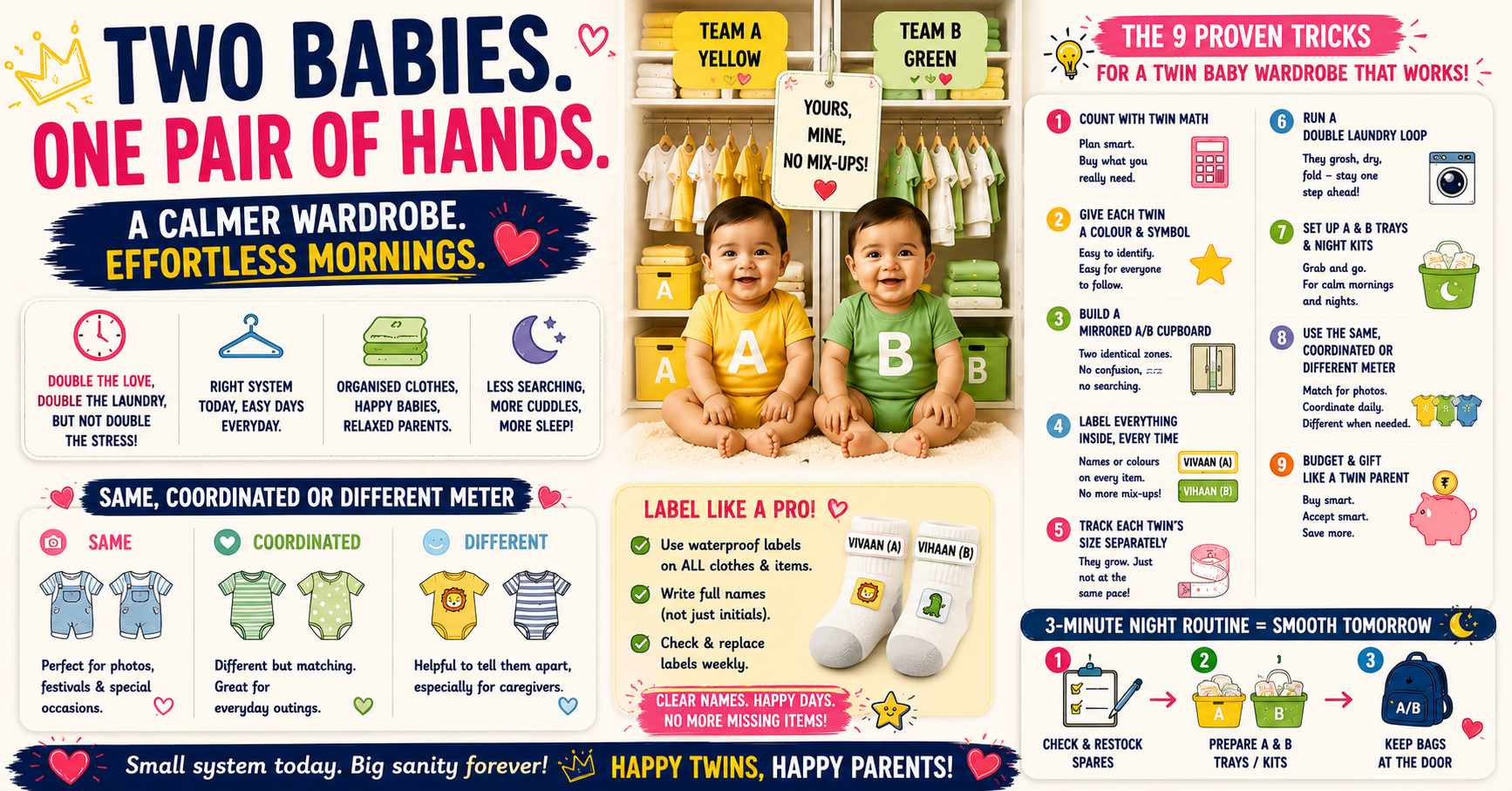
To organise a twin baby wardrobe, give each twin their own colour, shelf and box in a mirrored A/B layout, label every item inside with the twin’s name or colour, track each twin’s size separately, run a simple double laundry loop, set up two ready-to-grab night kits, and choose matching outfits by a simple rule: same for photos, coordinated for everyday, and different when you need to tell them apart.
Here are the 9 tricks at a glance:
| # | Trick | What it does |
|---|---|---|
| 1 | Count with Twin Math | Shows how many clothes you really need for two |
| 2 | Give each twin a colour and a symbol | Anyone can tell whose is whose |
| 3 | Build a mirrored A/B cupboard | Two identical zones, no searching |
| 4 | Label everything inside, every time | Stops mix-ups, even with identical twins |
| 5 | Track each twin’s size separately | Twins rarely grow at the same pace |
| 6 | Run a double laundry loop | Keeps clean and dirty clothes from piling up |
| 7 | Set up A and B trays and night kits | Calm, quick mornings and nights |
| 8 | Use the Same, Coordinated or Different meter | Ends the matching debate |
| 9 | Budget and gift like a twin parent | Cuts the cost of buying everything twice |
Now let me explain each one, starting with the part that shocks most new twin parents: the maths.
Before the tricks, let me say something kindly: if your twin wardrobe feels out of control, you are not doing anything wrong. Twin wardrobes are harder than single-baby wardrobes, for real reasons.
1. Everything doubles, but your time does not. Two babies mean two sets of outfits, two changes after every feed, two sets of spit-ups, two diaper blowouts. But there are still only twenty-four hours in a day.
2. Identical or similar sizes cause mix-ups. When two babies wear the same size, clothes look interchangeable. That is useful for sharing, and confusing for sorting.
3. Laundry piles up fast. Many twin parents tell me that they feel like they are always doing laundry. A daily wash can be two or three times bigger than for a single baby.
4. Twins may be in different sizes. One twin may be bigger or smaller, and one may outgrow a size earlier. So you may need two size systems at once.
5. Many hands help. In a twin household, there are often grandparents, relatives, a helper and a spouse, all handling clothes. A system that only you understand will not last.
6. Gifts come in pairs, and in chaos. People love gifting matching outfits. You may get two of everything, in the same size, which is lovely and also a lot.
7. Fatigue is real. When you are very tired, small decisions feel big. A wardrobe that needs thinking is too hard.
The tricks below are designed for exactly this: fewer decisions, clearer labels, and a system anyone can follow.
Many parents panic and think, “I need double of everything.” You do not. Here is how to count smartly.
Split your clothes into two groups.
This method saves money, space and laundry. You do not need two separate stacks of 30 pieces. You need one good pool, plus a small personal set for each.
Here is a rough planning guide, for twins who are about the same size, in a family that washes every day or every two days. These are illustrative numbers, not rules. For the single-baby version, see our baby capsule wardrobe guide.
| Item | For one baby | For twins (shared pool, same size) | Why it is less than double |
|---|---|---|---|
| Everyday tops and bottoms | 14 | About 22 to 26 | Shared pool, same sizes |
| Bodysuits | 4 | About 7 to 8 | Shared pool |
| Sleepwear | 3 | About 5 to 6 | Two babies, shared pool |
| Special outfits | 1 | 2 (one each) | Personal |
| Layers (cardigans, jackets) | 2 | About 3 to 4 | A few shared |
| Muslin swaddles and wraps | 4 | About 7 to 8 | More wraps needed, but shared |
| Burp cloths and bibs | 8 to 10 | About 12 to 14 | Shared, but more spit-ups |
| Socks, caps, mittens | A few pairs | Double the pairs, labelled | Easy to lose, so label |
If your twins are in different sizes, you will need two separate sets for each size. We cover that in Trick 5.
If you want a simple rule, try this: count what one baby needs, multiply by 1.6 to 1.8 for the shared pool, and add one personal outfit for each twin. This is only a guide, and your own laundry routine matters more. If you wash daily, you will need less. If you wash once or twice a week, you will need more.
And please check what has already come as gifts and hand-me-downs before buying. (See our hand-me-down guide and our baby clothes budget guide.)
This is the trick that rescued Meghna’s Saturday morning. Instead of trying to remember which baby owns which item, give each twin a colour and, if you like, a symbol.
Many twin parents use the same colours for feeding logs, medicine charts (with your doctor’s advice), diaper tracking, bottles, sleep items and hospital paperwork. When everything shares the same colour, it becomes a habit that the whole family knows. It also helps with record-keeping, which can be very useful at pediatrician visits.
What this saves you: the daily “which one is this?” And it makes it possible for anyone, including grandparents and helpers, to help without a manual.
Here is the idea I love most: build your twins’ wardrobe as a mirror. Whatever is on Twin A’s side is also on Twin B’s side, in the same place, in the same order.
Your brain learns the layout once. After a week, you can reach for “the left side, top shelf, vests” without thinking. A tired parent at 3 AM does not need to remember who is who. She only needs to know where things are.
Divide your cupboard, drawer or shelf into two equal halves, one for Twin A and one for Twin B.
| Zone | Twin A (colour 1) | Twin B (colour 2) |
|---|---|---|
| Top (cold zone) | Out-of-season and bigger sizes, labelled | The same, in the same order |
| Eye level (hot zone) | Current size and season | The same |
| Next shelf (warm zone) | Next size | The same |
| Bottom | Towels and bedsheets | The same |
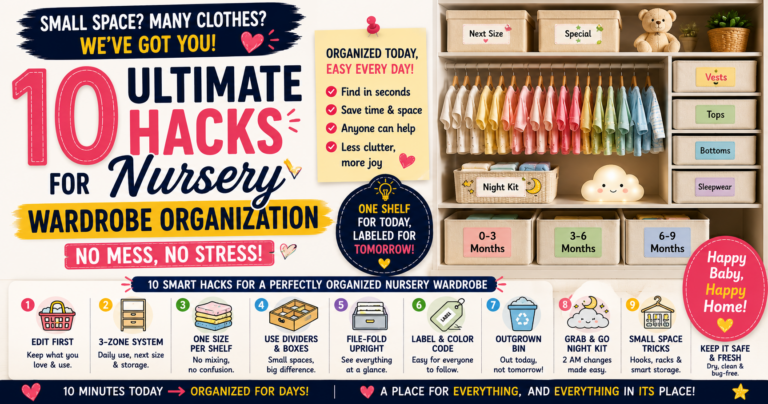
(For the three-zone system, dividers and the file-fold method, see our nursery wardrobe organization guide. The twin system is the same, just doubled and mirrored.)
If you do not have space for two shelves, use a hanging organizer with two columns, one for each twin. Or use two bags hung on a hook. Colour-code each column. It takes only a few minutes to set up, and it works very well in a small flat.
What this saves you: the daily search, and the “is it A’s or B’s” guessing game.
This is the trick that stops mix-ups, and it matters most when your twins look alike and wear the same size.
| Method | How to use it | Best for | Note |
|---|---|---|---|
| Colour dot or thread | A small dot of coloured fabric marker, or a coloured stitch on the care label | Every garment, quick to do | Check it survives washing, and retouch |
| Initial on the care label | Write A and B, or the first letter of each name, with a laundry marker | Any garment | Clear for anyone who can read |
| Sew-in or iron-on name tapes | Fabric labels with the name or colour | Long-term items, daycare clothes | Place them so they do not itch |
| Stick-on waterproof labels | Peel-and-stick, with a colour dot | Bottles, bags, shoes, boxes | Not for fabric that touches skin |
| Coloured ribbon or tag | A tiny soft ribbon on the hanger or bag | Bags, jackets, blankets | Keep away from babies, so no loose ribbons in cots |
If your twins are the same size and you use a shared pool, you do not need to label the basics. But label the pieces you want to track. For example, if one twin gets a rash, you may want to know which clothes he wore. Many parents use a dot system: a green dot on the pieces Twin B wore today, placed on a small tag, or a quick note in the log. You can also keep a simple daily note of who wore which sleepsuit, which is easy to do with a phone.
Your spouse, grandparents and helper need to understand the system on day one. So:
What this saves you: mix-ups, arguments and the “who wore this?” mystery at 2 AM. For daycare days, see our daycare clothes checklist for a labelling system that works outside the home, too.
Here is a truth that surprises many parents of twins: twins do not always grow at the same pace. One may be bigger at birth, or catch up later. One may outgrow a size a few weeks before the other. This is common, and it is not a problem by itself. If you are ever worried about your twins’ growth, please ask your pediatrician.
For clothes, it means you may need to run two size systems at the same time.
This is a simple, brilliant habit. Keep one labelled bag for each size, called “Next up.” When one twin outgrows a size, move those clothes into the bag for the other twin, if he still fits them, or into the outgrown bin. This reduces waste, and keeps your cupboard tidy.
What this saves you: the discovery that you bought ten matching 0-3M outfits and one twin is already in 3-6M.
Laundry is the biggest hidden job of twin parenting. Let us make it simple.
Two babies means about twice the dirty clothes, twice the muslin cloths, twice the burp cloths, and twice the bedsheets. So plan a daily or every-other-day wash, if you can. Small, frequent loads are easier to manage than one huge pile. (See our guide on washing baby clothes separately from adult clothes for the basic routine, and our cloth diaper guide if you use cloth nappies.)
Keep one spare set per twin in the diaper bag, in a pouch with a colour dot. When you go out, you will not have to guess who needs the dry outfit.
What this saves you: the endless pile, and the 5 PM discovery that nobody has a clean vest.
Here is the trick that makes mornings and nights calmer. Instead of searching for clothes while both babies are crying, prepare everything in advance, one tray per twin.
A tray can be a small basket, a shoe box lid, a cloth bag or a stack tied with a soft cloth. Each tray holds a complete outfit for one twin, for the next change.
Each evening, take ten minutes (or two minutes!) to prepare:
In the morning, you do not decide anything. You grab Tray A, dress Twin A, then grab Tray B, dress Twin B.
Prepare two night kits, one for each twin, with two or three complete sets, a spare muslin, and a fresh diaper and wipes. Keep them within arm’s reach. At 2 AM, when both babies leak, you can change both without searching. (See our nursery wardrobe organization guide for the single-baby version.)
Here is a general idea many twin parents find helpful. Please adapt it to your own home, and follow your pediatrician’s advice on safe handling.
If both babies need changing at the same time, change the one who is more urgent, or more upset, first, and talk to the other one while you work.
If your twins wear two or three outfits a day, you can prepare daily sets in advance. Fold clothes into sets on laundry day, one stack per twin, and place them in the A and B trays. The more decisions you make in advance, the fewer you make while tired.
What this saves you: the 7 AM scramble, and the “I do not know where anything is” feeling. A calmer morning is not magic. It is just preparation.
Now the fun part, and the question every twin parent hears: “Will you dress them the same?”
Here is a simple tool that ends the debate. I call it the Same, Coordinated or Different meter. For every outfit, you decide which of three levels you want.
| Level | What it means | Best for | Example |
|---|---|---|---|
| 🟢 Same | Identical outfits | Photos, festivals, family functions, birthdays | Two identical cotton kurta sets |
| 🟡 Coordinated | Same colour family or theme, different pieces | Everyday wear, outings, daycare | One in a yellow top, the other in a green top, both with cream pants |
| 🔵 Different | Clearly different, so you and others can tell them apart | Busy days, group settings, when one needs a specific item | A yellow cap for Twin A and a green cap for Twin B |
1. Build a twin palette. Choose three or four colours that go together, as in our capsule wardrobe guide, and buy most clothes in those colours. Then every top goes with every bottom, for both twins.
2. Use the colour code as your coordinating tool. Twin A gets a yellow accent (a cap, socks or a bib), and Twin B gets green. The rest of the outfit can match.
3. Buy basics in pairs, and specials in two colourways. Plain cotton vests can be identical, and one-off outfits can be the same style in two colours.
4. Keep “twin sets” for events. One matching pair for each major festival or function. Store them together, in labelled bags.
5. Do not force sameness every day. Matching outfits are fun, but they take extra effort, and if one twin spits up, you have to change both, or lose the match. Many parents choose coordinated outfits for the same reason.
6. Plan around the messy twin. If one twin has a leak, the match is gone. Keep a second matching set ready for photos, and treat matching as a bonus, not a rule.
7. For boy-girl twins, coordinate by colour or pattern: the same fabric in two cuts, a matching border, or the same colours in a kurta and a frock.
8. For festivals, choose a comfortable matching set, and a plain cotton backup for each twin. (See our festival outfits guide for the 5-point comfort test, and our daycare clothes guide for Mess Meter ideas on special days.)
Many parents of twins find that, as the children grow, they start to enjoy being seen as individuals. It can help to give each twin something that is theirs alone: their own colour, their own blanket, their own soft toy, their own favourite outfit. This does not need to be a big thing. A small colour code can be a quiet way of saying, “You are you, and your brother is your brother.”
Matching is a choice, and so is not matching. There is no right way. Choose what makes your days easier, and your twins happy.
Two babies, two sets of costs. But with a few smart habits, you will not pay double.
As in Trick 1, buy shared basics once, and personal pieces one per twin. This alone cuts the clothes you need to buy by a lot.
Gifts for twins often arrive in pairs, in the same size, and in the smallest sizes. Here is how to handle it with grace.
Set a monthly number, and write it down. Use the three-number formula from our budget guide: pieces to buy, price per piece, and an extras fund, then adjust for twins with the pool method. Keep a small buffer for the surprise: one twin growing faster than the other.
Twin parents are experts at making one thing do two jobs. Your clothes budget can do the same.
Bring clothes for both babies, and expect that one or both may need newborn size or a smaller size, or may stay longer, depending on their health. Ask your hospital team what to pack. Pack in two colour-coded pouches, with a going-home outfit for each. (See our newborn clothes checklist for the single-baby list, and double it.)
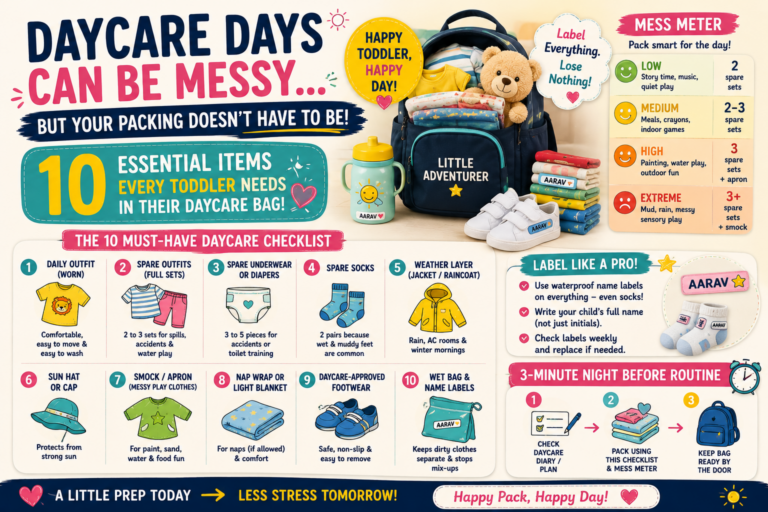
If your twins go to daycare, keep the colour code, and send two separate spare bags, one for each twin, with a label and a colour dot. Tell the teacher your code. (See our daycare clothes checklist for the full list.)
Pack one pouch per twin, each with an outfit per change, plus a shared pouch for muslin cloths, bibs and wipes. A colour-coded wet bag for each twin is helpful. Keep one complete outfit for each twin in your hand luggage.
If one twin is sick, has a rash or needs extra care, keep his clothes in his own box, and ask your pediatrician about washing, and about anything special. Do not guess. Their guidance comes first.
Anchor tall furniture to the wall, as in our nursery wardrobe organization guide, and keep storage dry and out of reach, as in our storage guide. For safe sleep for twins, including whether they should share a sleep space, please follow your pediatrician’s advice. I am not able to give medical advice here.
Here are the mistakes I see most often.
If you want to begin right away, here is an easy week. Each step takes 20 to 30 minutes, which you can do in short bursts.
By the end of the week, you will have a wardrobe that works for two babies, and for every person who helps you.
Set up:
Labels:
Tracking:
Laundry:
Routines:
Matching:
Go back to Meghna, folding laundry at 6 AM on a Saturday, with a baby asleep on each side of the bed, and a vest in her hand that could belong to either.
Here is what I would tell her. You are not failing. You are doing the work of two parents, with one brain and two babies. Give each boy his colour, build a cupboard that looks the same on both sides, and label everything inside. Keep a size note for each twin. Do a small load of laundry every day. Prepare two trays at night. And dress them the same only when it is fun. Then, the next time your mother-in-law dresses them, she will not need to ask you a single question.
So, if you are looking for twin baby wardrobe organization and matching tips, remember the whole idea in one breath: count with twin math, give each twin a colour, build a mirrored cupboard, label everything inside, track each size separately, run a double laundry loop, prepare A and B trays, use the Same, Coordinated or Different meter, and budget like a twin parent.
Twin life is double the work and, as every twin parent will tell you, double the joy. A good wardrobe system will not remove the work, but it will make room for the joy. And that is what an effortless morning really is: not a perfect one, but one with a little more space to smile.
Give each twin a colour and a symbol, build a mirrored A/B cupboard with identical zones for each twin, label every item inside, track each twin’s size separately, run a small daily laundry loop, and prepare two trays and two night kits in advance. Use a shared pool for basics and personal sets for special items.
Usually less than double what one baby needs, because twins of the same size can share basics like plain vests, swaddles and muslin cloths. As a rough planning guide, count what one baby needs, multiply by about 1.6 to 1.8 for the shared pool, and add one personal outfit for each twin. If you wash daily, you need fewer.
Use a colour code: give each twin a colour, and mark the inside of every garment with a coloured dot, thread or initial. Label boxes, shelves and hampers with the same colours, and put a colour key inside the cupboard door so family and helpers can follow it.
It is a personal choice. A simple approach is: same outfits for photos and festivals, coordinated outfits for everyday wear, and clearly different items, like a coloured cap, when you need to tell them apart. Match by colour rather than size if your twins are different sizes.
Write a letter or colour on the care label with a laundry marker, add a coloured dot or thread, or use sew-in or iron-on name tapes for long-term items. Use stick-on waterproof labels on bottles, shoes and bags. Keep labels inside the clothes, away from the skin, and avoid writing full names or addresses on the outside.
Wash a small load every day or every other day, wash baby clothes separately from adult clothes, and wash soiled items separately. Use colour-coded hampers or one hamper with two compartments, fold into two piles, use landing baskets, and keep extra swaddles and muslin cloths. Ask family to help with folding.
This is common, and not a problem in itself. Track each twin’s size separately, keep two size boxes, buy one of each size when unsure, choose adjustable styles like jhabla and wraps, and use a pass-along bag for clothes one twin has outgrown. If you are concerned about growth, ask your pediatrician.
Twins are often born smaller or earlier than single babies, so some may need newborn size for a few weeks. Ask your hospital team what sizes to expect, buy a small stock of newborn pieces for each twin, and put most of your money into the next size.
Prepare an A tray and a B tray each evening with a full outfit for each twin, and keep two night kits within reach. Change one baby at a time on a safe, flat surface, with the other in a safe place within sight.
Use a shared pool for basics, buy packs and split them, accept hand-me-downs and swaps, guide gifts toward larger sizes and swaddles, buy fewer special outfits, and set a monthly budget. Pass on outgrown pairs to other twin families.
Pack clothes for both babies in two colour-coded pouches, including a going-home outfit for each, with a few newborn pieces and the next size up. Check your hospital’s own list, and ask what size your babies may need.
If they are the same size, sharing basics saves money and laundry. Keep special and personal items separate, and label what you want to track. If one twin is unwell or has a skin problem, ask your pediatrician about washing his clothes separately.