Physical Address
304 North Cardinal St.
Dorchester Center, MA 02124
Physical Address
304 North Cardinal St.
Dorchester Center, MA 02124

Let me start with a small story.
Imran and Nida live in Bhopal. Their son was born on a quiet Tuesday morning, and by Thursday the family WhatsApp group had 143 unread messages, all about one thing: his name.
Dadi wanted a heavy, classical name. Nida’s cousin sent a list that looked like it came straight from a baby app, with names she could not even pronounce. Imran’s friend said, “Yaar, rakho kuch modern, school mein bachche tease karenge warna.”
And then there was Nida herself, sitting with the baby in her arms at 2 a.m., whispering names to see which one felt right.
If you are reading this, I think you already know that feeling. You want a name that is beautiful, has a meaning you can be proud of, and is easy enough that the teacher will not mispronounce it on the first day of school. You want it to be modern, but not so strange that Nani goes quiet when she hears it.
That is exactly what this guide is for.
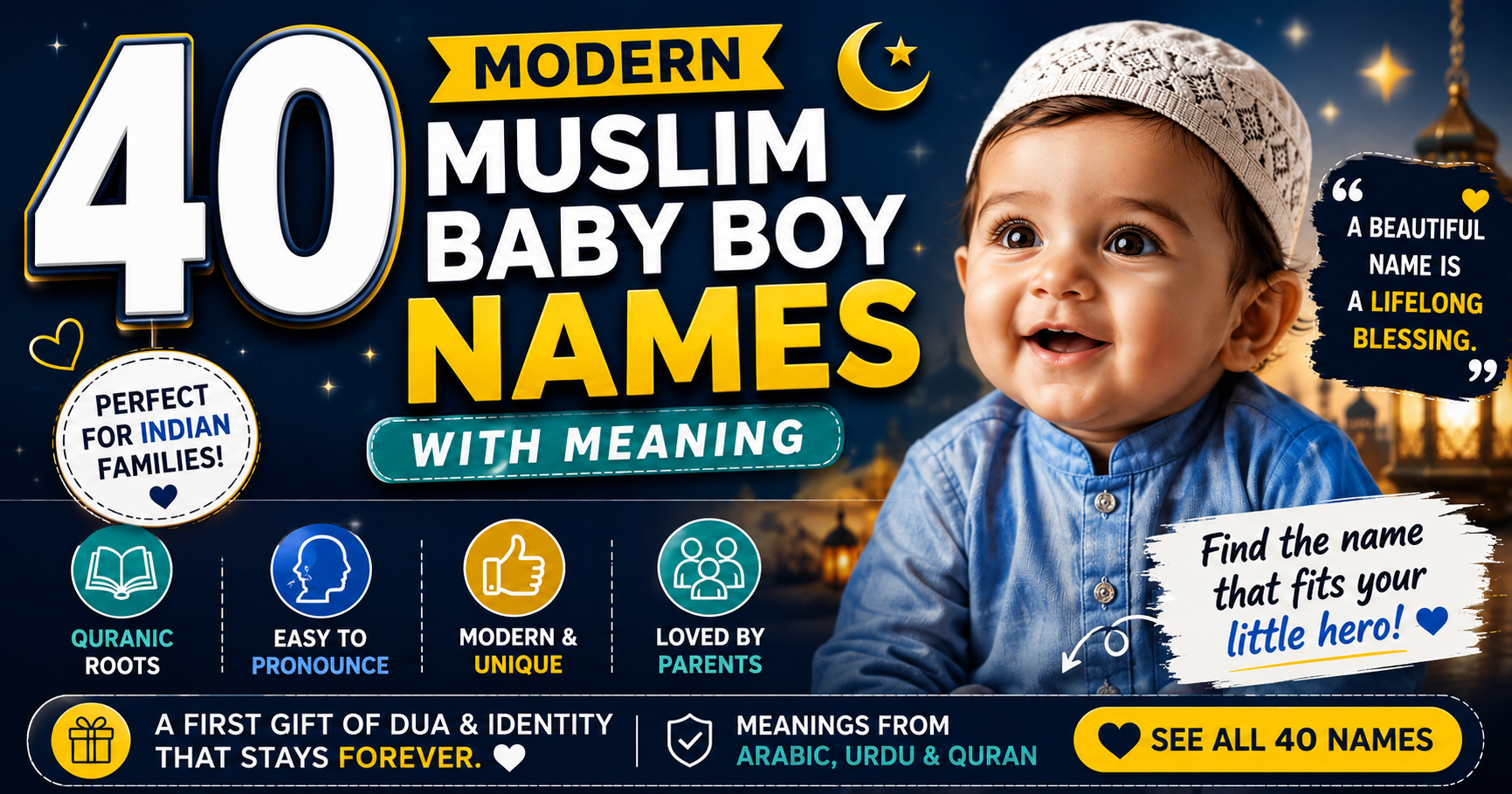
Below you will find 40 modern Muslim baby boy names with meaning, each one short or easy to say, rooted in Arabic, Urdu or the Quran, and popular with Indian families today. I have also added a simple way to choose, a few common mistakes to avoid, and a small FAQ at the end for the questions parents actually ask me.
One honest note first: I am a parent-content writer, not a religious scholar. Name meanings can vary slightly between sources and spellings. Before you finalise any name, please check its meaning and spelling with your local imam or a trusted Islamic scholar. I will remind you again near the end.
Ready? Let us find your son’s name.
If you want the short answer before the long guide, here it is. Some of the most loved modern Muslim baby boy names in India right now are Ayaan, Zain, Rayyan, Zayan, Hamza, Yusuf, Adam, Arham, Rehan and Ibrahim. They are short, easy to pronounce in both Hindi and English, and have clear, positive meanings in Arabic or Urdu.
Keep reading for the full list of 40 with meanings, so you can pick the one that fits your family.
When parents say “modern,” they usually do not mean new. They mean three simple things.
1. Short and smooth. Two syllables are the sweet spot. Zain. Adam. Rayyan. Names like these are easy for a child to write in a Class 1 notebook and easy for a teacher to call out.
2. Easy across languages. Your son will be called by his name in a Hindi-medium school, an English office, maybe an airport in another country one day. A name that holds its shape in all of these is a gift.
3. Rooted in something real. A modern name does not have to be shallow. Most of the names in this list come from the Quran, from the family of the Prophet (peace be upon him), from the Sahaba, or from the Arabic and Urdu languages with a clean meaning.
In simple words: modern Muslim baby boy names are old meanings in new, easy sounds.
Before the list, a few small things that often get lost in the excitement. I will keep this simple.
In Islamic teaching, parents are encouraged to give their child a good name. The Prophet (peace be upon him) is reported to have said that on the Day of Judgement, people will be called by their names and their fathers’ names, so choose good names. Many families take this very seriously, and honestly, it makes the whole naming process feel less like a trend and more like a first gift of duaa.
There is no single rule that every family follows. Many families name the baby on the seventh day, along with the aqiqah, when the baby’s head is shaved and a sacrifice is offered as an act of gratitude. Others name the baby earlier, even at birth, and that is also widely accepted. If you are unsure, ask your local imam what your family tradition follows.
Many families recite the adhan in the baby’s right ear soon after birth, and some also place a little softened date on the baby’s palate, which is called tahneek. These are family and community traditions, so it is perfectly fine to follow what your elders do.
Scholars generally advise avoiding names with a bad or harsh meaning, names that suggest worshipping anyone other than Allah, and names that belong to Allah alone without a proper prefix. A good example: the names of Allah, like Al-Kabir or Al-Hadi, are usually given with Abd (servant of), as in Abdul Kabir or Abdul Hadi. Some families keep the short form too, and you should check what your own community accepts.
Now, the fun part.
I have grouped the names so it is easier to scan. Each one has the meaning, where it comes from, and a small note about how it feels in everyday Indian life.
These are for parents who want something quick to say, quick to write, and hard to get wrong.
Meaning: Beauty, grace, elegance. Origin: Arabic.
Zain is one of those names that never seems to go out of style. It is only four letters, it sounds good with almost any family name, and it has a gentle meaning. In India you will also find it spelled Zayn, so decide on one spelling early and keep it the same on every document.
Nickname ideas: Zainu, Zee.
Meaning: Growth, abundance, increase. Origin: Arabic.
Zaid is a name with deep roots. It was also the name of Zaid ibn Haritha, a much-loved companion of the Prophet (peace be upon him). If you want a name that is simple and strong without sounding heavy, Zaid is hard to beat. Some families spell it Zayd.
Meaning: Commonly understood as “gift of God” (meanings can vary slightly by source). Origin: Arabic and Urdu usage.
If there is one name that has taken over Indian nurseries in the last few years, it is Ayaan. It is soft, it is warm, and it works beautifully in Hindi, English and Urdu. You may also see it written as Ayan. Because it is so popular, expect to meet two or three little Ayaans in the same class. That is not always a bad thing. Some parents love that their son will have friends who share his name.
Tip: Pair it with a longer first name, such as Muhammad Ayaan, if you like a more traditional feel.
Meaning: “Ar-Rayyan” is the name of a gate of Paradise reserved for those who fast; the word also carries the sense of lush, well-watered and flourishing. Origin: Arabic, connected to Islamic tradition.
There is something lovely about naming your son after a gate of Jannah. Rayyan has a gentle, almost musical sound, and it is both modern and meaningful. You will also see Rayan used, but the double y is the more common Arabic transliteration of this particular word, so check which one you prefer.
Meaning: Good fortune, happiness, blessings. Origin: Arabic.
Saad is a short and happy name. Sa’d ibn Abi Waqqas, one of the well-known companions, carried this name. In India it is easy to say and hard to mispronounce, which makes it a quiet favourite for parents who want something classic but light.
Meaning: One who guides, a guide. Origin: Arabic.
Hadi is a gentle name with a beautiful meaning. Remember that Al-Hadi is also one of the names of Allah, so many families prefer Abdul Hadi for the full form and use Hadi as the pet name. Ask your imam what your family tradition prefers.
Meaning: The first human and the first Prophet, often explained as being linked to “earth.” Origin: Arabic, Quranic.
Adam is a name that crosses every border. It is clean, it is short, and it is instantly recognised in any country. For parents who travel or who have relatives abroad, Adam is a very practical choice.
Meaning: Friendliness, affection, companionship. Origin: Arabic.
Anas ibn Malik served the Prophet (peace be upon him) as a young boy and is remembered with great love. The name feels warm and sociable. One small caution for Indian families: say it aloud with your surname before you decide, since a few surname combinations may sound awkward.
Meaning: Flourishing, long-lived. Origin: Arabic.
Umar ibn al-Khattab is one of the most respected figures in Islamic history, and this name carries that weight with quiet dignity. In India you will see Umar, Omar and Umer. Choose one and stick with it.
Meaning: Blessed, fortunate, one on the right side. Origin: Arabic.
Ayman sounds a little like Ayaan, so if you like the sound but want something less common, this is a good middle path. It is positive, it is short, and it is easy to spell.
Many parents search for Quranic baby boy names with meaning because they want their son to carry a name connected with the Book. These are some of the most loved prophet names, and most of them are simple enough to feel modern.
Meaning: Linked to the Hebrew meaning “God increases.” Origin: Arabic, Quranic. The name of Prophet Yusuf (Joseph), peace be upon him.
There is an entire surah of the Quran named after him, and his story is often called one of the most beautiful stories. The name is warm, gentle and strong. In India, Yusuf is both classic and quietly stylish.
Meaning: Often explained as “father of many.” Origin: Arabic, Quranic. The name of Prophet Ibrahim (Abraham), peace be upon him.
Ibrahim is a name that grandparents love and young parents are bringing back. The short form Ibby or Ibu makes it easy for little ones. It is a name with huge respect in the Muslim world.
Meaning: Often explained as “God hears.” Origin: Arabic, Quranic. The name of Prophet Ismail (Ishmael), peace be upon him.
Ismail has a calm, thoughtful sound. In many Indian homes, the short pet name Ismu or Ishu comes naturally. The spelling Ismaeel is also common, so pick one for documents.
Meaning: Commonly linked with learning and study. Origin: Arabic, Quranic. The name of Prophet Idris, peace be upon him.
Idris is rare enough to feel special, but easy enough that no one will struggle with it. If you want a name that is not on every classroom list, Idris is a fine pick.
Meaning: “He lives.” Origin: Arabic, Quranic. The name of Prophet Yahya (John), peace be upon him.
Yahya has a lovely, hopeful meaning. It is unusual outside Muslim circles, but inside the community it is very well loved. Parents sometimes worry about the pronunciation, but “Yah-yaa” is easy once you hear it once.
Meaning: Linked to Prophet Musa (Moses), peace be upon him. Origin: Arabic, Quranic.
Musa is the prophet mentioned most often by name in the Quran. The name is short, powerful, and travels well across languages. It also suits both a traditional and a modern family.
Meaning: Often explained as “beloved.” Origin: Arabic, Quranic. The name of Prophet Dawood (David), peace be upon him.
Dawood has a strong, noble ring to it. You may also see Dawud or Daud. In India, Daud is the more common spoken form.
Meaning: Linked to peace and wisdom; the name of Prophet Sulaiman (Solomon), peace be upon him. Origin: Arabic, Quranic.
Sulaiman is a little longer, but it has a lovely rhythm. For parents who like traditional names but want a handy nickname, Suli or Sully sometimes comes up in family circles.
Meaning: Associated with patience and perseverance; the name of Prophet Ayyub (Job), peace be upon him. Origin: Arabic, Quranic.
For parents who believe patience is the biggest quality a person can have, this name carries that beautiful reminder every time it is spoken. Ayub is the common Indian spelling.
Meaning: The Arabic form of the name Elijah; the name of Prophet Ilyas, peace be upon him. Origin: Arabic, Quranic.
Ilyas is crisp and sounds modern even though it is ancient. It is also easy to say for Hindi speakers, so it tends to be a safe choice.
These names carry courage, loyalty and character. If your family loves history, this group will feel like home.
Meaning: Strong, steadfast; often linked with the lion. Origin: Arabic. Hamza ibn Abdul Muttalib, the Prophet’s uncle, is remembered as a brave protector.
Hamza is easily one of the top Muslim boy names in India today. It is bold without being harsh, and it sounds good from a toddler’s first day to a grown man’s business card. If you are searching for Muslim baby boy names that mean strength, this belongs at the top of your list.
Meaning: Often linked with moisture or refreshing water. Origin: Arabic. Bilal ibn Rabah was the first muezzin of Islam.
The story of Bilal is one many families tell their children: a man who stayed steady through great hardship, and whose voice called people to prayer. A name like this carries a whole story inside it. It is also very easy to say in every Indian language.
Meaning: Long-lived, one who builds and lives a full life. Origin: Arabic. Ammar ibn Yasir was a respected companion.
Ammar is a name that sounds modern but is deeply rooted. Be careful with spelling: Ammar and Amar look similar but can be read differently, and Amar is also used in other communities. A clear spelling saves a lot of paperwork confusion later.
Meaning: Safe, secure, at peace. Origin: Arabic. Salman al-Farsi was a well-known companion.
Salman is a name many Indian families already know because of its wide popularity. It sounds calm and dignified, though parents who want something less common may prefer to keep it as a middle name.
Meaning: Knight, horseman, a brave rider. Origin: Arabic.
Faris feels like a name from an old adventure story. It is short, crisp and has a confident sound. It is not as common as Ayaan, so your son is less likely to share it with half his class.
Meaning: Often linked with prosperity, a long and flourishing life. Origin: Arabic. The “family of Imran” is mentioned in the Quran.
Imran has been a trusted name for generations. For parents who want something familiar yet respected, it still works beautifully. A fun twist: use it as a second name, like Muhammad Imran, and give the baby a lighter pet name.
Meaning: Pleasure, approval, contentment. Origin: Arabic.
Rizwan carries a calm, peaceful feeling. The word is connected with the idea of Allah’s pleasure. It is a classic name in India, so grandparents will usually approve straight away.
Meaning: The name of the wise man for whom a surah of the Quran is named. Origin: Arabic, Quranic.
If you want your son’s name to remind him of wisdom, Luqman is a lovely pick. It is less common, which means it stands out in a gentle way. The advice of Luqman to his son in the Quran is often read to children, and that makes this name special for storytelling families.
Meaning: Chosen, selected. Origin: Arabic. It is also one of the titles used for the Prophet (peace be upon him).
Mustafa is a classic that has never really left. Many families use it in combination, such as Ghulam Mustafa or Muhammad Mustafa, so check what your family and imam prefer.
Meaning: Most praised, one who praises Allah a lot. Origin: Arabic. Ahmad is mentioned in the Quran as a name connected with the Prophet.
Ahmad is a name that never goes out of fashion. In India it is also written Ahmed or Ahmad, and both are widely accepted. For parents who want something deeply traditional and still simple, this is a safe and beautiful choice.
This last group is for parents who like a softer, more poetic sound. Many of these are loved in Urdu and Persian culture and feel stylish in modern India.
Meaning: Fragrant, sweet basil; a sweet-smelling plant. Origin: Arabic (Rayhan). The word rayhan appears in Surah Ar-Rahman.
Rehan has a gentle, almost scented feeling, and it is one of my favourite names on this list. You may also see Rayhan or Rihan in use. It sounds soft in Hindi and Urdu alike.
Meaning: Often explained as elegant, graceful, beautiful. Origin: Arabic and Urdu usage; sometimes seen as a variant of Zain.
Zayan has become a big favourite in Indian homes over the last few years. It has a modern, almost cinematic ring. Since meanings for this name can vary by source, please confirm with a scholar before you finalise.
Meaning: Commonly given as merciful, kind, compassionate. Origin: Arabic, related to the root for mercy.
Arham is a gentle name with a lovely meaning that parents often search for. It has gained popularity quickly in India and has a modern sound. As always, confirm the meaning and spelling with a trusted scholar.
Meaning: Abundance, bounty, grace. Origin: Arabic and Urdu.
Faizan has a warm and generous sound. It is a good option if you want something traditional-sounding but still easy for children to say. The pet name Faizu is a common favourite.
Meaning: Majestic, noble, of high standing. Origin: Persian and Urdu.
Zeeshan is a name that sounds confident, and it is widely loved across North India. It is a bit longer than most of the names on this list, but the sound is rhythmic and easy to remember.
Meaning: Knowledge, wisdom, learning. Origin: Persian and Urdu.
Danish is a name many parents choose when education is a family value. It is quick to say and hard to forget. A small practical note: in some countries the word “Danish” is also a nationality, so think about your family’s future travel plans if that matters to you.
Meaning: Wish, longing, a cherished desire. Origin: Urdu and Persian.
Armaan is a lovely name for the baby you waited for. Many parents say, “Yeh humara armaan tha,” and the name carries exactly that feeling. It is used across communities in India, which makes it very easy for everyone to pronounce.
Meaning: Great, large, powerful. Origin: Arabic.
Kabir sounds fresh and sharp, and it is used in many Indian communities. One point to remember: Al-Kabir is one of the names of Allah, so a lot of families prefer Abdul Kabir for the full name. Some families do keep Kabir alone, so ask your imam about your own tradition.
Meaning: Linked to the angel Mikail (Michael), who is traditionally associated with rain and provision. Origin: Arabic.
Mikail is distinctive and polished. It is more unusual than Ayaan or Zain, so it makes a lovely choice for parents who want something unique but not strange. You may also see Mikaeel as a spelling.
Meaning: The name of Surah Ya-Sin; the exact meaning of the opening letters is known to Allah. Origin: Arabic, Quranic.
Yaseen is used with great love in Muslim families, and many people read Surah Yaseen at special moments of life. It is a name that feels both soft and strong. Because scholars discuss the meaning of the opening letters of some surahs, many families choose to confirm their preference with an imam before using it as a name.
By now you may have five favourites and no winner. That is perfectly normal. Here is a method I would suggest, nothing complicated.
Write them on a piece of paper. Do not discuss them with the whole family yet. Let the two of you agree first.
Meanings are the heart of the name. Check each one with a trusted scholar or a reliable Islamic source. Names can have more than one meaning depending on the root and the language, so do not rely only on a baby-name app.
Say the full name ten times. Say it the way a teacher will call it on the first day. Say it the way a friend will shout it across the playground. If it feels easy and warm, you are close.
Ayaan or Ayan. Rayyan or Rayan. Umar or Omar. Pick one spelling and use it everywhere: hospital records, birth certificate, Aadhaar, school forms and passport. Many parents regret changing spelling later, because corrections can take a lot of time and paperwork.
Every Indian child ends up with at least two or three nicknames. Make sure the shortened version is something you will be happy to hear at home. Zain becomes Zainu. Ibrahim becomes Ibu. Hamza becomes Hammu. Do you like all of them?
Sometimes the name you keep coming back to at 2 a.m. is the one. Trust that feeling. Nida, from our story, picked her son’s name that way, and no list helped her more than that quiet moment.
Here is a quick way to think about it.
There is no wrong answer. The best name is the one your family will say with love for the next eighty years.
I have seen these again and again in parenting groups. A little care now saves a lot of stress later.
1. Choosing a name only because it is trending. Trends move fast. A name that feels fresh today may feel common in five years. Choose for meaning first, and sound second.
2. Not verifying the meaning. Many baby-name websites copy from each other, and errors travel quickly. Please confirm the meaning with a scholar or a trusted Islamic source.
3. Ignoring spelling consistency. The same child may be called Ayaan on one paper and Ayan on another. This causes real trouble with school and government documents.
4. Picking a name that is hard for elders to say. If Dadi cannot say it, she will invent her own version. Sometimes that is cute. Sometimes it is not.
5. Forgetting the name of Allah rule. Names like Al-Kabir or Al-Hadi are usually given with the prefix “Abd.” Check what your tradition and imam say.
6. Forgetting the sibling match. If your elder son is Hamza, you may want the next name to sound nice beside it. Say them together.
Some short and easy Muslim baby boy names are Zain, Zaid, Saad, Adam, Hadi, Anas and Ayaan. They are simple to pronounce in Hindi, Urdu and English, and they have clear, positive meanings.
If you want something less common, consider Idris, Faris, Luqman, Mikail, Arham or Rehan. They are meaningful and easy to say, but you will not hear them in every classroom.
Quranic baby boy names include Yusuf, Ibrahim, Ismail, Idris, Yahya, Musa, Dawood, Sulaiman, Ayyub, Ilyas, Adam and Luqman. Most of these are names of prophets or figures mentioned in the Quran.
Hamza (strong, steadfast), Faris (knight, brave rider), Ammar (long-lived, builder) and Zeeshan (majestic, noble) are popular choices. You can also read our guide on baby names that mean strength for more ideas.
Many families name the baby on the seventh day along with the aqiqah, while others name the baby earlier. Both practices are commonly followed, so ask your local imam which one your family should follow.
Yes. Naming a child after a prophet or a companion is a very common and loved practice in Muslim families. Many parents choose it as a way of hoping their child will carry some of that character.
No. Many families like to add “Muhammad” before the name, and it is a loved tradition, but it is not compulsory. Families make this choice based on their own custom and what feels right to them.
Ask a local imam or a trusted Islamic scholar, and cross-check with more than one reliable source. Meanings can vary slightly by root, language and spelling, so a single app is not enough.
A name is the first gift you give your son, and he will hear it more than any other word in his life. It will be on his school bag, in his first cricket team list, on his nikah card one day, and, God willing, in the duaas of his own children.
So take your time. Read the meanings. Say the names aloud. Talk with your family, listen to your elders, and then listen to that quiet voice inside you.
Imran and Nida finally chose their son’s name on the sixth night, just before the aqiqah. They did not pick the most trending one. They picked the one that made them both smile in the dark.
I hope this list helps you find yours too.
If you liked this guide, you might also enjoy our article on baby names that mean strength, and our guide to twin and nakshatra baby names. And if you have already chosen a name, tell us in the comments. We would love to hear your story.
Important note: Name meanings can vary by source, root and spelling. Please verify the meaning, spelling and religious suitability of any name with a qualified local imam or Islamic scholar before finalising. This article is for general information and does not replace religious guidance. The story of Imran and Nida is an illustrative example.