Physical Address
304 North Cardinal St.
Dorchester Center, MA 02124
Physical Address
304 North Cardinal St.
Dorchester Center, MA 02124

By 11 AM, your toddler’s daycare outfit has usually survived a painting session, a puddle, a juice spill and someone else’s mango.
Did the clothes survive? Did the right clothes come home? And did the name inside still say your child’s name, or somebody else’s?
Keep reading. I will give you a 10-item daycare clothes checklist, a “Mess Meter” that tells you what to pack on a messy day, a labelling trick that stops lost clothes, and a 3-minute packing routine for the night before. No fancy shopping. No stress.
Nisha stood outside the gate of her daughter’s daycare in Gurugram, on the first Friday of the month, holding a plastic bag that was not hers.
It was the end of week one. Her daughter, Aanya, was twenty months old, bright-eyed and delighted with life, and she had walked into daycare on Monday in the cutest little printed frock with a matching hairband. Nisha had packed one spare outfit, “just in case.” She felt very prepared.
By Wednesday, she had received three notes in the daycare diary. Paint on frock. Two accidents. Wet from water play. Used spare clothes. Please send more.
On Thursday, the teacher had called. “Ma’am, Aanya is wearing a spare from our box today. Her clothes were all wet, and she had no more.”
On Friday, she opened the bag the teacher handed her, and found a soggy pair of pyjamas, a small checked shirt that she had never seen before, and no sign of Aanya’s blue cardigan. Somewhere in that daycare, another mother was opening a bag with a blue cardigan in it, and wondering the same thing.
“Itne saare kapde bheje, aur phir bhi kuch nahi mila,” Nisha said to her husband that night, half laughing and half in tears. I sent so many clothes, and still I have nothing.
That weekend, she did what many of us do when we are tired and a little embarrassed. She made a list. She bought a laundry marker. She put three full sets in a bag with a label on every single piece. And the following Monday, nothing went missing. Not one sock.
If you are about to start daycare, or you are a few weeks in and drowning in lost-and-found, this article is for you. I will walk you through what clothes to send to daycare for a toddler in India, with a simple 10-item checklist, how to label everything, what to avoid, what to pack for monsoon, summer and winter, and how to handle potty training days. It is practical, light and based on how real daycare days go.
Quick note: I am a parent and content writer, not a childcare professional. Every daycare has its own rules about clothes, spare items, sunscreen, naps and diapers. Please follow your daycare’s written policy first, and use this article as a helpful guide.
Send your toddler in a comfortable, easy-wash cotton outfit, and pack a bag with 2 to 3 labelled spare outfits, spare underwear or diapers, extra socks, a weather layer, a sun hat or raincoat as needed, an old smock or play outfit for messy days, a nap wrap, daycare-approved footwear, and a wet bag. Label every single item inside, and check your daycare’s list first.
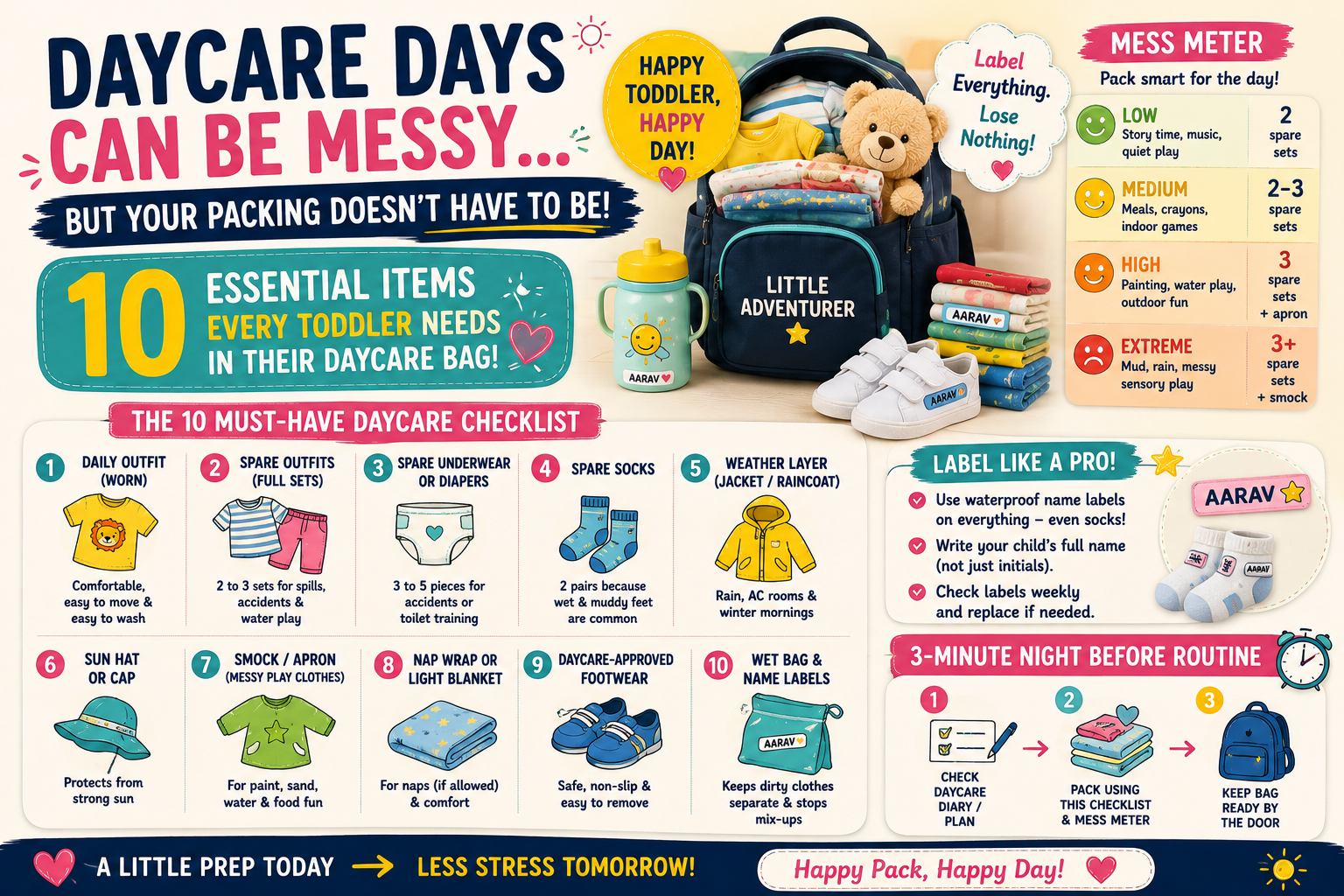
Here are the 10 items at a glance:
| # | Item | How many | Why it matters |
|---|---|---|---|
| 1 | Daily outfit (worn to daycare) | 1 per day | Comfort, movement, easy washing |
| 2 | Spare outfits (full sets) | 2 to 3 | Spills, accidents and water play happen daily |
| 3 | Spare underwear or diapers | 3 to 5 | Toilet accidents, especially during training |
| 4 | Spare socks | 2 pairs | Wet and muddy feet are common |
| 5 | Weather layer (cardigan, jacket or raincoat) | 1 | Rain, AC rooms and winter mornings |
| 6 | Sun hat or cap | 1 | Outdoor play in summer |
| 7 | Smock, apron or “messy play” clothes | 1 | Paint, sand, water and food |
| 8 | Nap wrap or light blanket | 1 | Naps, if the daycare allows personal bedding |
| 9 | Daycare-approved footwear | 1 pair | Safe, easy-to-remove, non-slip |
| 10 | Wet bag and name labels | 1 bag and labels for all items | Keeps dirty clothes sealed, and stops mix-ups |
Now let me explain each one, why daycare days are so messy, and how to pack without losing your mind.
If you have never seen a daycare day from the inside, here is what usually happens. This is not a complaint. It is just the life of a toddler.
The good news is that none of this is a problem, if you pack well. A messy day with the right clothes is a fun day. A messy day with the wrong clothes is a stressful one for the child, the teacher and you.
Here is the eye-catching tool I promised. Many daycares run a schedule with different activities on different days. If you know the schedule, you can pack for the mess level.
| Mess level | Typical activities | What to send |
|---|---|---|
| 🟢 Low | Story time, music, quiet play, puzzles | Normal outfit, 2 spare sets |
| 🟡 Medium | Meals, art with crayons, indoor games | Normal outfit, 2 to 3 spare sets, bib or apron |
| 🟠 High | Painting, clay, sand or water play, sensory bins | Old or dark outfit, smock, 3 spare sets, extra socks |
| 🔴 Extreme | Mud play, sprinklers, field trips, festival colours or messy celebrations | Play clothes you do not mind ruining, 3 to 4 spares, a towel, extra socks and shoes |
A small tip: ask your daycare for a weekly activity schedule, or check the notice board. A day with finger painting needs a very different bag from a day with story time.
Every daycare is different. A short chat or a look at the handbook will save you many mistakes. Here are the questions I would ask.
Write the answers in your phone, or stick them inside the bag. It takes ten minutes and saves weeks of trouble.
(If you are still choosing between a daycare and a nanny, our guide on Daycare vs Nanny will help you compare the two, including the practical side of clothes, routines and daily care. [Insert link to Daycare vs Nanny article])
Before the 10 items, here are the rules I use. They apply to any toddler, any daycare and any season.
Rule 1: Comfort and movement first. Your toddler will crawl, climb, jump and squat. Choose soft, stretchy, loose clothes that do not restrict movement.
Rule 2: Easy for the child and the teacher. Elastic waists, pull-on pants and wide necks are best. Skip hard buttons, many small snaps, belts and tight fastenings. A teacher with ten toddlers cannot spend five minutes on a button.
Rule 3: Cotton and easy-wash fabrics. Soft cotton and cotton blends breathe, take sweat and wash well. Avoid dry-clean-only clothes, stiff fabrics and anything that needs special care.
Rule 4: Dark and patterned beats pale and plain. Prints and mid-tones hide paint, mud and food stains much better than white or pastel plain colours.
Rule 5: Label everything. Every sock. Every time. This is the single most powerful rule on the list. (More in the labelling section below.)
Rule 6: Send clothes you can afford to lose. Even the best daycare cannot guarantee that every garment will survive. Keep the precious and the pricey for weekends.
Here is each item in detail, with what to look for, how many to send, and what to avoid. I have kept the numbers for a toddler of about 1 to 3 years in a full-day daycare. Adjust them for your child, your daycare and your laundry routine.
How many: one per day, plus enough for the week. If you wash daily, 5 to 6 daily outfits are usually enough.
This is the outfit your toddler wears from home. It should be the most comfortable thing in the cupboard.
What to look for:
What to avoid:
My view: the cute frock can wait for the weekend. A soft cotton T-shirt and elastic pants will give your toddler more fun and give you less stress.
How many: 2 to 3 complete sets, from top to socks. Send 3 to 4 during potty training, messy seasons or monsoon.
This is the heart of the checklist. A complete set means a top, a bottom, underwear or a diaper, and socks. Do not send only a top or only pants. Spills do not stay in one place.
How to pack spare sets:
What to look for: the same comfort rules as the daily outfit. Spare clothes should be a size that fits right now, not too big. A trouser that is too big will fall during play.
Why 2 to 3? Think about a typical day: one outfit for a morning mess, a second for lunch or water play, and a third for an accident or a very wet afternoon. If you send only one, you may get that sad diary note.
A tip: use hand-me-downs or old, soft, washed cotton clothes for spare outfits. They do not need to be new. (See our hand-me-down guide for how to clean and reuse them safely.)
How many: 3 to 5 pieces of underwear or pull-ups for a toddler who is toilet training, and a day’s worth of diapers (as per your daycare’s rule) for a toddler in diapers.
For toddlers in diapers:
For toddlers who are toilet training:
(There is a longer section on potty training days below.)
How many: 2 pairs.
Muddy puddles, water play and sweaty shoes mean wet feet. Wet socks make toddlers cranky and cold, even in a warm room. Two spare pairs are cheap insurance.
What to look for:
Label each pair, or tie them together with a small labelled fabric loop. Socks are the number one lost item in every daycare.
How many: 1 layer for the season. In monsoon, send a raincoat or a quick-dry jacket. In winter, a warm cardigan or fleece. In a strongly air-conditioned daycare, a light cotton cardigan year-round.
By season:
What to look for:
A tip: if you send a jacket in the morning for the cool commute, tell the teacher so it does not get lost in the shuffle. Many daycares have a hook for each child. Label the hook too, if allowed.
How many: 1, in the hot season. Many daycares also like one in the bag all year round.
Indian summers are strong, and toddlers play outside early in the morning or late in the afternoon. A soft cotton sun hat protects the head and face.
What to look for:
For sunscreen and shade, please follow your daycare’s policy and ask your pediatrician what is suitable for your child.
How many: 1 smock or apron, or 1 old outfit set aside for messy days.
For art, clay, sand and water play, a smock keeps the daily outfit clean. If your daycare does not use smocks, send a dedicated “mess outfit” on messy days: old, soft, dark clothes that you do not mind ruining.
Smock tips:
Messy play outfit tips:
Use the Mess Meter table above to decide when to send it.
How many: 1, only if your daycare allows personal bedding for naps.
Some daycares provide bedding. Others ask parents to send a small sheet or a light cotton wrap. Follow the daycare’s rule.
What to look for:
Wash it often. Nap wraps collect sweat, drool and crumbs. Wash it once or twice a week.
How many: 1 pair, as per your daycare’s rule.
Some daycares let children play in socks or barefoot indoors, and have outdoor shoes for the garden. Others have indoor slippers. Ask.
What to look for:
What to avoid: heavy boots, hard-soled formal shoes, slippery sandals, and flip-flops, which can fall off and cause trips.
How many: 1 wet bag, and enough labels for every single item.
The wet bag: A zip pouch or cloth bag with a waterproof lining, where the teacher can put wet or soiled clothes. It keeps the rest of the bag dry and clean.
The name labels: these are not clothes, but they are the most important item on the checklist. I have given them their own section below.
Here is a rough guide for a toddler in a full-day daycare, for a family that washes clothes daily or every two days. These are illustrative planning numbers, not rules. Adjust them with your daycare’s advice.
| Situation | Daily outfits at home | Spare sets in the bag | Extras |
|---|---|---|---|
| Toddler (1 to 2 years), in diapers | 5 to 6 | 2 | Extra diapers, socks |
| Toddler (2 to 3 years), mostly toilet trained | 5 to 6 | 2 to 3 | Extra underwear, socks |
| Toddler in active potty training | 6 to 7 | 3 to 4 | 4 to 5 underwear, extra bottoms |
| Monsoon | Add 1 to 2 | Add 1 | Raincoat, extra socks |
| Winter | Same | 2 to 3 | Cardigan, cap, thick socks |
| High-mess week (painting, water play) | Same | 3 to 4 | Smock, towel |
For a bigger picture of how to plan your child’s wardrobe in general, see our capsule wardrobe guide. For how to keep your wardrobe under control, see our baby clothes budget guide.
If your toddler is learning to use the toilet, daycare days need extra planning. Accidents are part of the process, and they are not a sign that your child, or you, are doing anything wrong.
What to do:
If your toddler seems uncomfortable, has pain when passing urine or stool, or has sudden changes in toilet habits, please talk to your pediatrician.
If your child is under one year, a few things are different.
Older toddlers (3 years and above) may need fewer spares, but still need at least 2 sets.
This is the section that saved Nisha’s weekends. In a daycare, many children wear similar clothes. The same striped T-shirt, the same blue cardigan, the same white socks. If nothing has a name, nothing comes home.
Everything. Really. Every item the child wears or carries:
| Method | How it works | Good for | Watch out for |
|---|---|---|---|
| Permanent laundry marker | Write the name on the care label or a plain inside area | Quick, cheap, any garment | Can fade with many washes, so retouch it |
| Sew-in name tapes | Fabric labels sewn into the neck or waistband | Lasting, cotton clothes | Takes time. Place them so they do not itch |
| Iron-on labels | Heat-fixed labels | Cotton and cotton blends | Can peel after many washes. Press firmly |
| Stick-on waterproof labels | Peel-and-stick labels for items | Bottles, lunch boxes, shoes, bags | May not stay on fabric. Best on hard surfaces |
| Fabric stamp or stamp pad | A name stamp used on care labels | Many items at once | Test on one item first |
| Safety-pin free colour tags or ribbons | A small colour tag in a set pattern | Socks, tiny items | Check that tags are soft and secure |
A tailor in your neighbourhood can also stitch in small labels for a modest fee, if you give them a bundle.
A safety tip: try to avoid writing your child’s full name, address or school details in large letters on the outside of bags or clothes, where strangers can read them in a public place. Labels inside the clothes, and a simple name tag inside the bag, are safer. A colour tag or a symbol on the outside is enough.
The best daycare clothes are the ones that go through the wash a hundred times and still look fine. Here is what works.
A small stain kit for daycare mornings: a small bottle of mild detergent, a soft brush and a bucket for soaking. For yellow or old stains, see our stain routine in the hand-me-down guide.
Daycares often celebrate festivals, with costumes or festive wear. Choose soft, comfortable, easy-change outfits, and keep a plain cotton change in the bag. (See our guide to comfortable festival outfits for ideas.) For colour play, send old clothes, and ask the daycare about the plan.
Here is a short list, mostly for safety and comfort.
When in doubt, check your daycare’s rules.
I promised a quick routine. Here it is, and it really takes about three minutes once you have the bag set up.
Minute 1: Empty and restock. Open yesterday’s bag. Take out dirty clothes and put them straight into the wash. Put clean spare sets back in.
Minute 2: Check the list. Glance at the packing list inside the bag: spare sets, underwear or diapers, socks, weather layer, hat or raincoat, smock, wet bag, bottle, nap wrap. Check the weather and the Mess Meter, and add or remove an item.
Minute 3: Lay out tomorrow’s outfit. Lay out the daily outfit, the shoes and the jacket where you can reach them in the morning. Put the bag by the door.
A little extra: on Sunday, take ten minutes to check that every item still has a label, that the spare sets are the right size, and that nothing is too small. (Toddlers grow quickly. See our size chart guide for how to check.)
Daycare clothes get dirty, stained and sometimes lost. So it makes sense to spend less on them.
Here are the mistakes I see most often.
If daycare begins soon, here is an easy week.
By the end of the week, you will be ready for your first, and every, daycare day.
Worn to daycare:
In the bag:
Habits:
Go back to Nisha, standing at the daycare gate with a soggy bag that was not hers, and a blue cardigan that is still missing.
Here is what I would tell her. You were not careless. You were prepared for a clean day, and daycare is not a clean day. Send three full spare sets, label every single thing, and let your toddler wear clothes that can survive a puddle. Ask the daycare for its list. And please do not buy the next cute frock until you have packed the checklist. Your toddler will not remember the clothes. She will remember that she was free to splash.
So, if you are wondering what clothes to send to daycare for a toddler in India, remember the whole idea in one breath: comfortable, easy-wash clothes, 2 to 3 labelled spare sets, extra underwear and socks, a weather layer, a hat or raincoat as needed, a smock for messy days, a wet bag, and a label on everything. Ask your daycare for its list, and restock the bag every night.
Daycare days will always be a little messy. That is part of the fun. But with the right clothes in the bag, a messy day becomes a happy day, and a happy day sends a smiling toddler home.
Send your toddler in a comfortable, easy-wash cotton outfit with an elastic waist, and pack a bag with 2 to 3 labelled spare outfits, spare underwear or diapers, extra socks, a weather layer, a sun hat or raincoat as needed, an old smock or play clothes, a wet bag, and any nap wrap or footwear your daycare asks for. Check your daycare’s own list first.
Two to three complete sets is a good starting point. Send three to four during potty training, in monsoon, or on messy activity days. A complete set means a top, a bottom, underwear or a diaper, and socks.
Soft, stretchy, loose cotton or cotton-blend clothes that are easy to wash and easy for a teacher to change. Elastic-waist pants, simple T-shirts and two-piece sets work best. Dark or patterned colours hide stains better than white or pastels.
Label every item inside, using a permanent laundry marker on the care label, sew-in name tapes or iron-on labels. Use stick-on waterproof labels for bottles, lunch boxes and shoes. Label both socks, and put a colour tag or symbol on the outside of the bag instead of a full name.
Avoid hoodies with neck drawstrings, long dupattas and scarves, jewellery and accessories, small buttons or beads, slippery shoes or flip-flops, tight clothes and belts, dry-clean-only clothes, and new or sentimental outfits. Follow your daycare’s rules.
Old, dark or patterned, easy-wash cotton clothes that you do not mind ruining, along with a smock or apron, extra socks and a few spare sets. Use the Mess Meter table in this article to decide what to pack.
Elastic-waist pants or shorts that are easy to pull down, with soft cotton underwear. Skip dungarees, belts and tight clothes. Send four to five spare underwear and bottoms, a wet bag and wipes, and talk to the teacher about your routine.
Quick-dry cotton clothes, a foldable raincoat or light waterproof jacket, three to four spare sets, extra socks and a cloth wet bag. Avoid heavy denim and thick cotton that stays damp.
A cotton base layer, a soft cardigan or pullover and a light jacket for the commute, plus socks and a soft cap if needed. Remove heavy layers inside, and avoid scarves and loose mufflers on toddlers.
Only if your daycare allows personal bedding. A light cotton wrap or small sheet works well in warm weather. Choose one with no loose strings or beads, label it, and wash it once or twice a week. For young children, please follow safe sleep guidance from your daycare and pediatrician.
Follow your daycare’s rule first. Often, closed-toe sandals or sneakers with a grip and Velcro or slip-on fastening work well. Avoid laces, heavy boots, slippery soles and flip-flops, and label the inside.
Label every item inside, including each sock, use one consistent label style, add colour dots to spare outfit pouches, check the lost-and-found box weekly, and send clothes you can afford to lose. Politely ask the teacher to help check labels at pick-up.
Rinse off food and mud in cool water, pre-treat stains, then wash with a mild, fragrance-free detergent, separating soiled items. Dry in the sun, or in a ventilated space in monsoon, and restock the spare bag the same evening.