Physical Address
304 North Cardinal St.
Dorchester Center, MA 02124
Physical Address
304 North Cardinal St.
Dorchester Center, MA 02124

It is 5:47pm.
You have just walked through the front door. Your coat is still on. Your work bag is half on, half off your shoulder. Your phone is buzzing with something work-related that came in as you turned the key.
The children are already talking. Not to each other. At you. Simultaneously. One of them is holding something up for assessment — a drawing, a Lego creation, a grievance involving the other one. The second is already in the kitchen opening a cupboard because apparently dinner should have happened twenty minutes ago. The third, if there is a third, is somewhere you cannot immediately locate, which carries its own category of low-level alarm.
The house is not in the state you left it, because it never is. There is something on the counter from yesterday that technically still needs dealing with. There is a school letter asking you to confirm something by Friday, which is tomorrow.
And somewhere in all of this, you are supposed to: cook dinner, manage homework, do bath time, deliver bedtime, and also — apparently — be a person who has an evening.
If this is your 5:47pm, this post is for you.
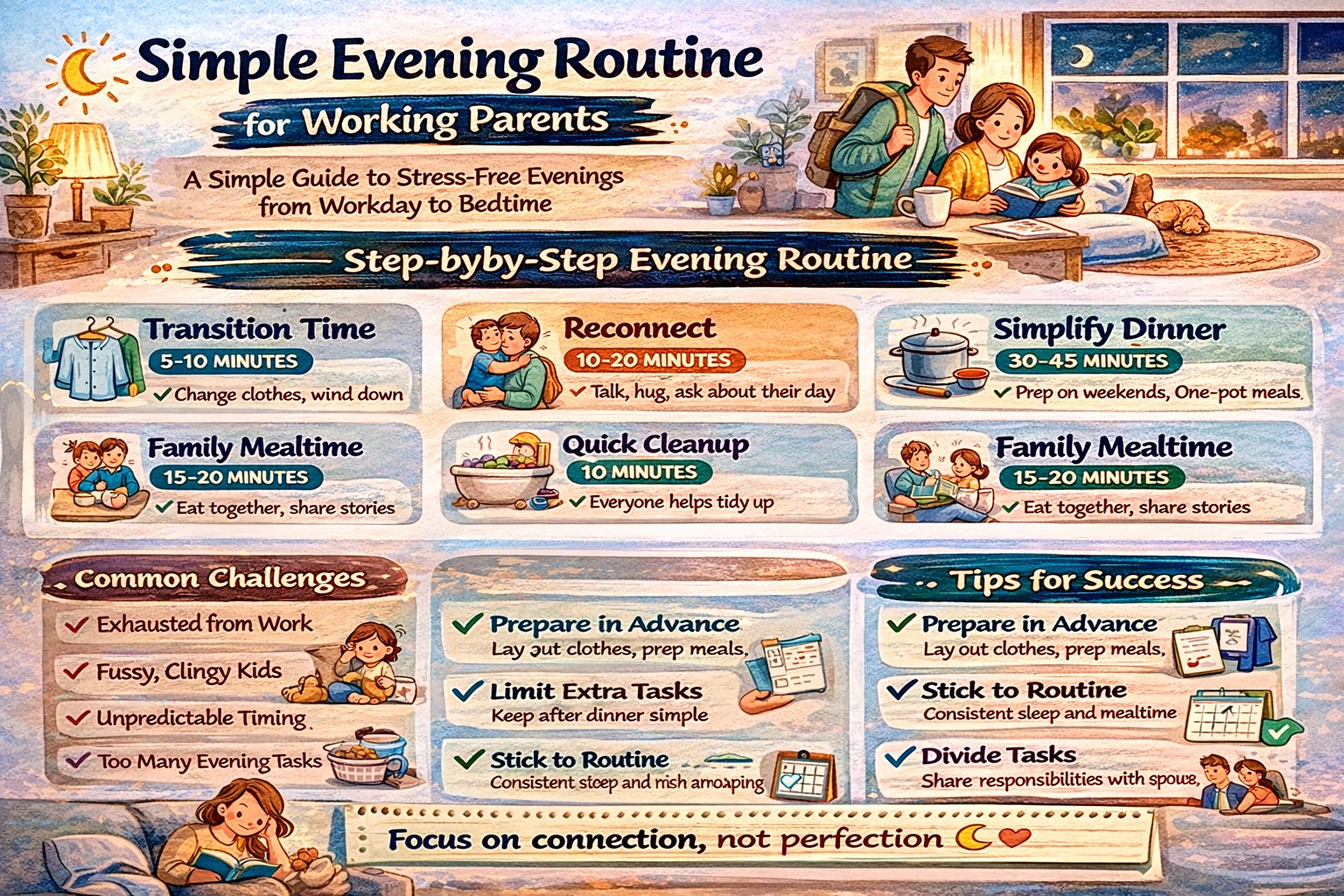
A simple evening routine for working parents is not about having everything under control. It is not about a pristine schedule that runs like a corporate project plan. It is about building just enough structure into those hours between work and bed that you stop feeling like you’re permanently putting out fires — and start feeling, occasionally, like you’re actually living your life rather than just surviving it.
Let’s build that routine.
Before the practical framework, let’s name the problem clearly. Because understanding exactly why evenings are so hard for working parents is what makes the solutions stick.
The hours between leaving work and getting the children to bed require one of the most demanding cognitive and emotional transitions an adult makes on a daily basis. You are shifting from one complete context — the workplace, with its specific demands, relationships, and rhythms — to an entirely different one: home, with its entirely different demands, emotional register, and people who need things from you immediately and cannot wait for you to complete the transition.
This is genuinely hard. Neurologically hard. Your brain needs time to shift modes. It rarely gets any. You walk through the door and you are expected to be immediately available, emotionally present, patient, warm — while you are still processing whatever happened at 4pm and trying to hold the reminder about tomorrow’s 9am meeting.
The result is that many working parents spend evenings in a kind of split state: physically at home, mentally still partly at work, fully in neither place. This produces friction, impatience, and the hollow feeling of being in your own life without actually inhabiting it.
By the time a working parent arrives home, they have made hundreds of decisions during the working day. Every decision, large or trivially small, depletes a finite cognitive resource. Coming home to an unplanned evening means facing yet more decisions in real time — what to cook, when to do bath, what to do about the homework, whether tonight is a screen night. Without a routine, all of this happens under pressure, by a brain already running on empty.
The result is reactive rather than intentional parenting. Snapping at small things. Choosing the path of least resistance in ways that don’t sit right afterward. Feeling guilty about it on the commute the next morning.
A simple evening routine removes most of these decisions from the real-time equation. The structure does the deciding. You just follow it.
For working parents, the evening is the primary opportunity for connection with their children on a weekday. The dinner conversation, the bath time chat, the bedtime story — these are the interactions that your children carry with them and that your relationship with them is built on.
When evenings are chaotic, unplanned, and stressful — when everyone is reactive, overtired, and just getting through to the other side — that connection does not happen in any meaningful way. You are in the same room. But you are not together in the way that counts.
A routine does not manufacture connection. But it removes the friction that prevents it.
Before you read the phases of this routine, one note: this is a framework, not a prescription. Every family has different ages of children, different work schedules, different living arrangements, different things that matter most. Take what works. Leave what does not. Add what is missing for your specific life.
The goal is a routine that is deliberately chosen rather than the default chaos of no routine at all. The deliberateness is what makes it yours.
This phase happens before you get home. It is one of the most underused tools available to working parents, and it consistently makes the biggest difference to how the evening begins.
Whether your commute is forty minutes on a train or ten minutes in the car, it is transition time. Use it with intention.
If you drive: skip the talk radio. Skip the work podcast. Put on music you love or drive in silence. Use the journey to consciously begin leaving work behind — not to solve work problems on the drive, not to replay the difficult meeting at 3pm, but to begin the mental shift toward home.
A simple prompt: think of three specific things you are looking forward to when you get home. Not tasks — things. The smell of dinner if someone else is cooking. The specific way one of your children will immediately tell you something. Sitting down. Small things. Real ones. This is not positive-thinking performance — it’s a deliberate reorientation of attention toward what’s coming rather than what’s behind you.
If you work from home and there is no physical commute, this is harder because the transition does not exist naturally. Create it artificially: a short walk around the block before the school pickup becomes your commute. Changing out of work clothes the moment the working day ends signals a context shift your brain will learn to recognise. Closing the laptop — not minimising it, closing it — matters more than it sounds.
Spend five minutes at the end of the working day writing down everything that needs to happen tomorrow: tasks in progress, things you’re worried about, anything you might forget. A notebook, a notes app, your work task manager — wherever works.
The purpose of this is specific: once something is written down, your brain does not have to keep holding it. Working parents who skip this step often find themselves thinking about work at the dinner table, during the bedtime story, lying awake at midnight — not because they want to, but because their brain is trying not to drop something.
Written down, it is safe. The brain can let it go until morning.
The first ten minutes after you walk through the door set the emotional tone for everything that follows. This is where the routine either begins well or begins badly — and where most working parents get it wrong, through no fault of their own.
Most working parents walk in the door and immediately begin executing tasks: checking what’s in the fridge, sorting the post, dealing with whatever is most visibly urgent. The transition is skipped. The children get a distracted, half-present parent for the first few minutes, which sets a dynamic that can persist for the whole evening.
Before any task. Before the post. Before the fridge. Five minutes that are specifically for arriving.
Put the bag down. Take the coat off. Hug your children. A proper hug — not the one-armed, still-looking-at-your-phone version. The full kind, that lasts a couple of seconds longer than feels strictly necessary.
Then ask one specific question. Not “how was your day” — which produces “fine” from any child over the age of four with the reliability of a natural law. Something specific: “What was the funniest thing that happened today?” or “What did you have for lunch?” or “Did anything annoying happen?” Something that requires an actual answer.
This five-minute landing ritual does something that is disproportionate to its length: it communicates to your children that you are here now, you are present, and the transition is complete. It communicates the same thing to yourself.
After the landing: shoes off, hands washed, clothes changed if you want to, and into the evening proper.
This small, mundane act has an outsized psychological effect. Changing out of work clothes closes the work chapter in a way that remaining in your suit or office outfit does not.
It is the physical version of the mental handover. Different clothes, different context, different version of you showing up for the people who need you most.
Dinner is simultaneously the most logistically demanding part of the working parent evening and the most important opportunity for daily connection. Getting it right — or getting it “good enough” — is worth prioritising.
A weekly meal plan. Written on Sunday. Five weeknight dinners decided in advance. Ingredients shopped for or delivered. Posted on the fridge.
Arriving home without knowing what you are cooking when you are tired and the children are hungry and everyone is slightly at their worst is one of the most reliable generators of working parent evening chaos. By the time you have mentally audited the fridge, assessed what everyone will eat, confirmed you have the ingredients, and remembered that someone doesn’t eat the thing you were going to make — it is 6:15pm and nobody has eaten anything since lunch.
A meal plan removes this entire sequence from the real-time evening. Monday is pasta bake. Tuesday is something from the freezer. Wednesday is stir-fry. Thursday is the easy one everyone likes. Friday is takeaway or something deliberately relaxed.
The plan does not have to be ambitious or varied or nutritionally optimised. It has to be decided before 5pm so that at 5:30pm you are executing rather than deliberating.
The weeknight cooking principles that actually work:
Thirty minutes maximum. Weeknight dinners should take no longer than thirty minutes from starting to serving. Anything that takes longer belongs to the weekend when you have time and energy for it. Save the ambitious recipes for Saturday.
Rotate proven favourites. Have fifteen to twenty meals that your family reliably eats and that you can cook without having to think too hard. Rotate these. Wednesday at 6pm is not the moment for culinary experimentation.
Batch cook and freeze. When you make bolognese or curry or soup at the weekend, make double and freeze half. These become your “something from the freezer” nights and they are the best working parent evenings of the week because dinner is simply reheating.
Accept the convenience options. A rotisserie chicken from the supermarket and a bag of salad is dinner. Pasta with good quality jarred sauce is dinner. Heated soup and toast is dinner. This is not failure — it is pragmatically feeding your family on a weeknight while also doing everything else. The children will not remember whether the sauce was from scratch. They will remember whether dinner was calm.
However basic the dinner is, eat it together at the table. Even if “together” means the toddler is flinging pieces of everything and the conversation is more noise than content.
Research from Harvard’s Family Dinner Project consistently finds that regular family mealtimes are associated with better academic outcomes, stronger family communication, lower rates of anxiety and depression in children, and higher family cohesion. The dinner table is quietly one of the most important places in your home.
It does not need to be long. Twenty minutes. Phones away — yours included. Something resembling conversation. This is what quality time looks like on a working Wednesday, and it delivers disproportionate relational return for the time invested.
The conversation prompt that works: “What was the best part of your day, and what was the worst part?” — sometimes called “rose and thorn.” Go around the table. Everyone answers. Parents too. This prompt consistently produces better dinner conversation than open questions, because it gives children something specific to respond to rather than the vast, vague invitation of “how was your day.”
The period between dinner finishing and bath time beginning — roughly 6:30pm to 7pm for many working families — is where evening routines most commonly fragment. Everyone is fed, the evening theoretically should be winding down, and yet children are often at their most energetic and parents are at their most depleted.
If your children have school homework, it belongs earlier in the evening — either at a snack immediately after pickup, or at a fixed time before dinner — not after dinner when their capacity for effortful concentration is lowest and your capacity for patient facilitation is also lowest.
Post-dinner homework is one of the most consistently difficult working parent battles specifically because of this timing mismatch. You are asking a child to do something cognitively demanding at the exact point in the day when cognitive demand is hardest to meet. The resulting battle is real but mostly unnecessary.
If you genuinely cannot get home early enough for pre-dinner homework, flex the expectation. Not everything has to happen in one sitting. Reading can happen at bedtime. Smaller tasks can split across two evenings. And if the homework load is genuinely unmanageable within the available working evening time, this is a conversation worth having with your child’s teacher — it is a reasonable one.
Screens in the post-dinner gap are the source of more working parent evening tension than almost anything else, because children want them and parents want to limit them and the nightly negotiation is exhausting.
The most effective solution is consistency rather than daily control: a fixed daily allowance, agreed in advance, with a clear timer and non-negotiable stop time.
“Screen time on school nights is from six until six-thirty. When the timer goes, screens go.” This is more effective than negotiating in the moment because the rule is the rule — you are not making a judgment call by a tired child who will resist it. The timer is the bad guy. You are simply the person who set the timer.
Set it externally. Use a timer, not your voice. The moment the boundary is mechanical rather than parental, the struggle diminishes significantly.
Children struggle with abrupt transitions — not because they are being deliberately difficult, but because their developing prefrontal cortex genuinely makes sudden context switches harder for them than for adults.
“Ten minutes until bath time.” A real pause. “Five minutes.” Another pause. “Bath time now.”
This sequence takes the same amount of elapsed time as a sudden announcement of bath time, but reduces the resistance and upset significantly. It is worth the thirty seconds of advance warning.
Bath time is frequently experienced by working parents as a logistical challenge: wet floors, protests, missing pyjamas, two children who need different water temperatures, everyone tired. It is also, consistently, one of the best connection windows of the entire working day.
The warm water, the contained space, the absence of screens and other stimulation — bath time is where children often say the things they have not managed to say all day. The question asked while you wash hair. The worry mentioned while they play with the bubbles. The funny thing that happened at lunch that only came out now because the environment is right for it.
The conversations that happen at bath time are frequently the best conversations you will have with your child on a weeknight. Not because you planned them. Because the context created them.
Making bath time sustainable:
Not every night is necessary unless the children are genuinely dirty — which younger children have a gift for being, so this applies more to school-age children. Every other day for older children is normal, common, and something many families quietly do without telling anyone.
Bathing siblings together where safe and age-appropriate is a time-saver that most families figure out by instinct. Getting everything ready before the bath starts — pyjamas out, towels on the rail, toothbrushes laid out — saves significant time mid-bath when a wet child is standing in a puddle waiting for you to find their pyjamas.
Bedtime is the anchor point of the entire simple evening routine for working parents. When bedtime works — consistently, predictably, without extended battle — the whole evening feels manageable. When bedtime doesn’t work — when it becomes a two-hour negotiation — the whole evening suffers.
Children’s bodies and brains respond genuinely to consistent sleep timing. A fixed bedtime — the same time every school night within thirty minutes — supports the circadian rhythm, makes falling asleep easier, and removes the nightly negotiation because the question of when bedtime is does not need to be answered fresh each evening.
General age guidelines from NHS sleep recommendations:
Twenty to thirty minutes. The same sequence every night.
1. Pyjamas and teeth first. Non-negotiable. Not negotiated. Done before anything else and not used as a bargaining chip.
2. Ten minutes of quiet activity. Low stimulation — a book, some colouring, quiet conversation in the bedroom. This is not screen time. The transition from daytime stimulation to sleep requires a buffer, and skipping it means longer to fall asleep.
3. The story. One book, or one chapter for older children. Ten minutes. This is the single most worth-protecting ritual of the working parent weeknight evening. The research on reading aloud to children is unambiguous: it builds vocabulary, literacy, imagination, and the association between books and pleasure. It also builds your relationship with your child in a daily, consistent, low-pressure way that is hard to replicate in any other format. Ten minutes. Every night. Do not sacrifice this one.
4. The check-in. One question: “Is there anything you want to tell me about today?” One minute. In the dark, at the end of the day, with the pressure of the day behind you — this is when many children say the things they’ve been carrying. You don’t have to fix anything. You just have to be there and listen.
5. The goodbye ritual. A consistent, brief, always-the-same closing. A phrase, a forehead kiss, a specific hand squeeze — whatever it is for your family, make it the same every night. The sameness is what gives it its power as a signal that the day is genuinely done.
Once bedtime is complete and the child is in their room, each child gets one return to the parent — for water, for one more thing, for the worry that only appeared when the lights went off. After the one return, the expectation is that they stay in their room.
This is predictable. Predictability is what children’s nervous systems need to settle. The endless returns — each one plausible in isolation, collectively stretching bedtime by an hour — keep children’s arousal elevated and sleep delayed. One return. Then the rule is clear and held.
The children are in bed. You have navigated the gauntlet in whatever form it took tonight. The house is quiet.
Now what?
For many working parents, the honest answer is: collapse on the sofa, look at the phone for longer than intended, watch something forgettable on streaming, go to bed later than planned feeling vaguely like the evening escaped without anything satisfying happening.
This is understandable. It is also the thing that makes tomorrow harder and the overall experience of working parenthood more depleting than it needs to be.
The post-bedtime hours are the only uninterrupted time a working parent has in a weekday that belongs entirely to them. How those hours are spent has a material effect on sustainability.
Before sitting down — before the phone, before anything — do the evening prep tasks that will make tomorrow morning noticeably easier.
This takes twenty minutes. Set a timer. Only do what is on the list. Stop when it goes off.
The evening prep checklist:
This list seems minor. The morning it produces is meaningfully different from the morning that follows an evening of none of it. Working parent morning stress is substantially determined by working parent evening preparation — the causality is direct and reliable.
Once the prep is done, the evening belongs to you. What you do with it matters — not in a productivity sense, but in the sense that how you spend this time determines whether you arrive at tomorrow more or less able to do it again.
Some questions worth sitting with:
What do you actually need tonight? Not what you think you should want. What does your specific depleted self at this specific point in this specific week need? Sometimes it is noise and stimulation — a gripping drama, a funny podcast, a long call with a friend. Sometimes it is quiet — a bath, a book, music, a stretch. Knowing the difference and giving yourself what you actually need rather than what is easiest is a form of self-respect that has a material return.
Are you and your partner actually connecting? If you have a partner, the post-bedtime window is the primary opportunity in a working weekday for you to interact as people rather than as logistics coordinators. Fifteen minutes of actual conversation — not about the children, not about the schedule, but about something either of you cares about — is worth protecting. Many working parent couples describe feeling like strangers who happen to cohabit. This window is where the course corrects.
Is your phone robbing you of your evening? If you come to the end of most evenings feeling like time passed without anything satisfying happening, your phone is almost certainly involved. A phone-free hour — or even thirty minutes — in the evening consistently improves mood, sleep quality, and the subjective experience of having had an evening that was actually yours.
A simple evening routine for working parents does not have to be identical across five nights. In fact, for most families it should not be — the week has its own natural rhythm and working with it rather than against it reduces friction considerably.
A realistic working week evening shape:
Monday — Structured, consistent, early. Monday is hard and the most important night for routine reliability. Make it simple. Make it early. Use the structure as a foundation for the rest of the week.
Tuesday — Easiest dinner option from the plan. Slightly more flexible if things are going well. The routine holds but without Monday’s need for strictness.
Wednesday — Activity day if the children have after-school clubs. The schedule flexes around the activity. Dinner is later. Bath might be quicker. The routine adapts to the day rather than fighting it.
Thursday — The best evening of the week. The working week’s heaviest days are behind you. The weekend is in sight. Make Thursday evening something to look forward to — a slightly more intentional dinner, a film together, something that feels like a choice rather than a default.
Friday — The treat night. Later bedtime within reason. Relaxed dinner. Family film or game or just staying up together. Friday is where the routine breathes. This is the reward for the structure that held Monday through Thursday.
Because it will fall apart. Regularly. A child is sick. Work ran until 7:30pm. There was an incident at pickup that shifted everything. You are, on this particular evening, beyond the beyond.
Here is what the routine looks like on those nights:
Feed them something. Cereal. Toast. Anything in the house that does not require cooking and will be eaten without protest. This is dinner tonight. It is enough.
Abbreviate everything else. No homework tonight. Quick bath or skip it. One short story. Bedtime ten minutes later than ideal. Survivable.
Name it out loud to the children: “Tonight is going to be different. It has been a hard day. We are doing a quick version of the evening.” Children who are told what is happening are more cooperative than children who sense something is off without knowing what it means.
And be kind to yourself about it tomorrow. The routine exists to make evenings better, not to become another standard against which you fail. One chaotic night does not undo weeks of consistency. Come back to it tomorrow.
After distilling everything: these are the four specific changes that working parents consistently name as highest impact.
A meal plan posted on the fridge, decided on Sunday. Eliminates more weeknight friction than anything else. Ten Sunday minutes. Five dinners decided. Transformative.
Bags packed and by the door the night before. Every working parent who does this consistently says the same thing: it changes mornings. Every working parent who does not has the same morning every day.
A bedtime timer, not a bedtime negotiation. Fixed time, external timer, non-negotiable. You are not the bad guy. The clock is.
A consistent bedtime that does not flex on school nights. Thirty minutes of flexibility nightly adds up to two and a half hours of lost children’s sleep per week, which compounds directly into the dysregulated behaviour that makes the following evenings harder. Hold the bedtime.
A simple evening routine for working parents is a consistent, flexible structure for the hours between arriving home from work and going to bed — covering the transition home, dinner, children’s activities and homework, bath and bedtime, evening prep for the next day, and protected time for the parents themselves. The goal is not a rigid schedule but a predictable sequence that removes the need to make dozens of decisions in real time after a full working day, reduces stress and conflict, creates daily family connection, and leaves working parents with something left for themselves at the end. Simple is the operative word — the most effective working parent evening routines are sustainable rather than ambitious.
Working parents face specific challenges that make unplanned evenings particularly damaging: the cognitive transition from work to home, decision fatigue after a full working day, limited weeknight time for connection with children, and the need to prepare for tomorrow while managing today. An evening routine addresses all of these by establishing a predictable structure that reduces real-time decision-making, protects consistent connection rituals like dinner together and bedtime reading, ensures the preparation that makes mornings calmer, and carves out time for the parents’ own rest. Research shows family routines including consistent mealtimes and bedtimes are associated with better emotional wellbeing and academic performance in children.
Most working parent evening routines effectively begin at the moment of arrival home — typically between 5pm and 6:30pm depending on work schedules. The earlier the routine can start, the more time is available before children’s bedtime and the less rushed each phase becomes. If you regularly arrive home late (after 6pm), the routine needs to compress: a quicker dinner, a shorter wind-down, possibly a slightly later bedtime that still allows connection time. The non-negotiables — a meal together, a consistent bedtime ritual, a story — should be protected regardless of how late the evening starts. Everything else compresses around these anchors.
The most effective way to reduce evening chaos is to make as many decisions as possible in advance rather than in the moment. A weekly meal plan eliminates the dinner decision at 5:30pm. Pre-packed school bags eliminate morning chaos that spills backward into evenings. A fixed bedtime eliminates the nightly negotiation about when children go to bed. A screen time timer eliminates the screen argument. A five-minute landing ritual reduces the emotional friction of the work-to-home transition. Each of these changes removes one decision or conflict point from the real-time evening. Together, they transform the experience significantly and sustainably.
Weeknight dinners for working parents work best when they are: decided in advance using a weekly meal plan, cookable in thirty minutes or less, reliably eaten by the family, and varied enough to avoid protest but not so varied as to require constant new recipes. Practical staples include pasta dishes, stir-fries, tray bakes, soup with bread, omelettes, fish with vegetables, and rice dishes. Batch-cooked freezer meals — bolognese, curries, soups made on weekends and frozen in portions — are one of the most valuable working parent weeknight tools. Accepting convenience options without guilt — rotisserie chicken, quality jarred sauces, ready-made components — is pragmatic use of limited weeknight time, not failure.
Getting children to bed consistently at the right time requires: a fixed bedtime that does not flex on school nights; a consistent pre-bed sequence that starts at the same time each evening; transition warnings (ten minutes, five minutes, then bath time) that replace abrupt announcements; no screens in the thirty to sixty minutes before bed; and a consistent closing ritual that signals the day is done. Within one to two weeks of a fixed bedtime, most children begin to naturally feel tired at that time as their circadian rhythm adjusts. The first two weeks require the most consistency and feel the hardest — hold the bedtime and the pattern establishes itself.
Working parents find time for themselves by treating the post-bedtime window as intentional rather than default. This means doing the evening prep tasks (bags, lunches, tomorrow’s plan) in a fixed twenty-minute block immediately after bedtime so the rest of the evening is genuinely free. It means deciding in advance what you actually need — rest, stimulation, connection with your partner, something creative — rather than defaulting to whatever is most passive. And it means protecting the post-bedtime hours from the task-filling and scrolling that leave you arriving at your own bedtime feeling like the evening passed without anything satisfying happening.
Yes — and the guilt itself is often the most exhausting part of working parenthood. The cultural expectation that working parents should compensate for time away from their children with perfect, fully present, nutritious, screen-free, educational evenings is both unrealistic and not evidence-based. A working parent who has a consistent, warm, imperfect evening routine — who is mostly present, makes dinner even when it is basic, reads at bedtime most nights — is doing well. The standard of compensating for working is worth examining and, for most working parents, worth releasing. Guilt impairs the very presence it is trying to produce.
The most effective bedtime routine for working parent families is one that is consistent enough to be automatic, short enough to be sustainable every night, and contains at least one connecting ritual. The reliable sequence is: pyjamas and teeth first (non-negotiable), ten minutes of quiet activity in the bedroom (not screens), one book or chapter, a brief check-in question (is there anything you want to tell me about today), and a consistent goodbye phrase or gesture that signals the end. This sequence, done the same way each night, typically takes twenty to thirty minutes and becomes progressively easier as the pattern becomes the expectation rather than the negotiation.
The working parent weeknight connection opportunities are specific and worth protecting rather than left to chance: the five-minute landing ritual when you arrive home (a real hug, a specific question); dinner at the table with phones away and a conversation prompt; bath time (which consistently produces the best conversations of the day in its low-pressure warm-water context); the bedtime check-in question; and the story — the single most consistent connecting ritual available on a weeknight. The quality of these specific windows matters far more than the quantity of time spent in the same house. A working parent who is fully present for twenty focused minutes does more relational work than one who is physically present but mentally elsewhere for two hours.
The 5:47pm walk through the door does not have to mean bracing for impact.
It can mean something else. Not the fantasy of perfect family evenings in warm lighting where everything runs smoothly and everyone is grateful. Something more honest than that — and more achievable. An evening with enough structure that you are not making it up under pressure. Enough connection that the good stuff actually happens. And enough left at the end that you go to bed having had something that was yours.
A simple evening routine for working parents is not about adding more to an already full life. It is about making decisions in advance so you stop making them in real time when you have nothing left. About protecting the specific moments — dinner together, the bedtime story, the check-in question in the dark — that actually build the relationship with your children on a Tuesday in February.
And about leaving something for yourself at the end. Not much. Not elaborate. Just something.
Start with one thing this week. The meal plan. The bedtime. The twenty minutes of prep after the children are in bed. One thing that changes this week.
Build from there.