Physical Address
304 North Cardinal St.
Dorchester Center, MA 02124
Physical Address
304 North Cardinal St.
Dorchester Center, MA 02124

It is 5:30 in the evening. You are home from work. Your two-year-old has been waiting for you all day. You know you should play with them. You sit down on the floor with their plastic dinosaurs and within four minutes you are checking your phone, they are having a meltdown about the wrong colour cup, and you are wondering if you are doing any of this right.
Welcome to toddler parenting. Nobody warned you it would feel exactly like this.
Here is the thing about how to spend quality time with toddlers that most parenting blogs do not say: the problem is rarely that you are not spending time with your toddler. You probably spend a lot of time near them. The problem is that the time does not feel like connection — for either of you.
A toddler’s brain is not designed for the kind of shared activity that feels meaningful to adults. They are not going to sit still for a craft project. They are not going to follow the rules of a game for more than three minutes. They are going to dump the craft supplies, eat the playdough, and then have strong feelings about you using the wrong voice for the dinosaur.
Quality time with a toddler looks nothing like quality time with an older child. Once you understand what it actually looks like — and what research says about what toddlers genuinely need from you — the whole thing gets easier. Not perfect, but easier.
This guide gives you the real picture. Written by a senior content team with a quality review process, anchored in actual child development research, and built specifically for the parent who has 20 minutes, a tired brain, and a toddler who needs them.
Most parents think quality time with their toddler means doing something together. An activity. A game. A craft. Reading a book. The toddler is supposed to sit, engage, and the parent is supposed to facilitate.
Here is what child development research actually says: the most powerful quality time you can spend with a toddler is when you follow them — not when you lead them.
Toddlers are in a developmental stage called autonomy versus shame and doubt (Erikson’s second stage). Every time they explore something and you genuinely engage with what they are exploring — rather than redirecting to something you think is better — you are sending a message that lands in their nervous system as: ‘I am interesting. What I find interesting is worth someone else’s attention. I am safe to explore.’
That feeling — that their inner world matters to the most important person in their life — is the foundation of healthy emotional development. It is also, not coincidentally, what quality time with a toddler actually is.
Three bodies of research are worth knowing about here — not in academic language, but in the practical way they change what you do on a Tuesday afternoon:
What this research tells us: quality time with toddlers is less about what you do together and more about how you are with them while you are doing it. Presence. Responsiveness. Following their lead. These are the things that matter — and they can happen in 15 minutes on a floor with no toys at all.
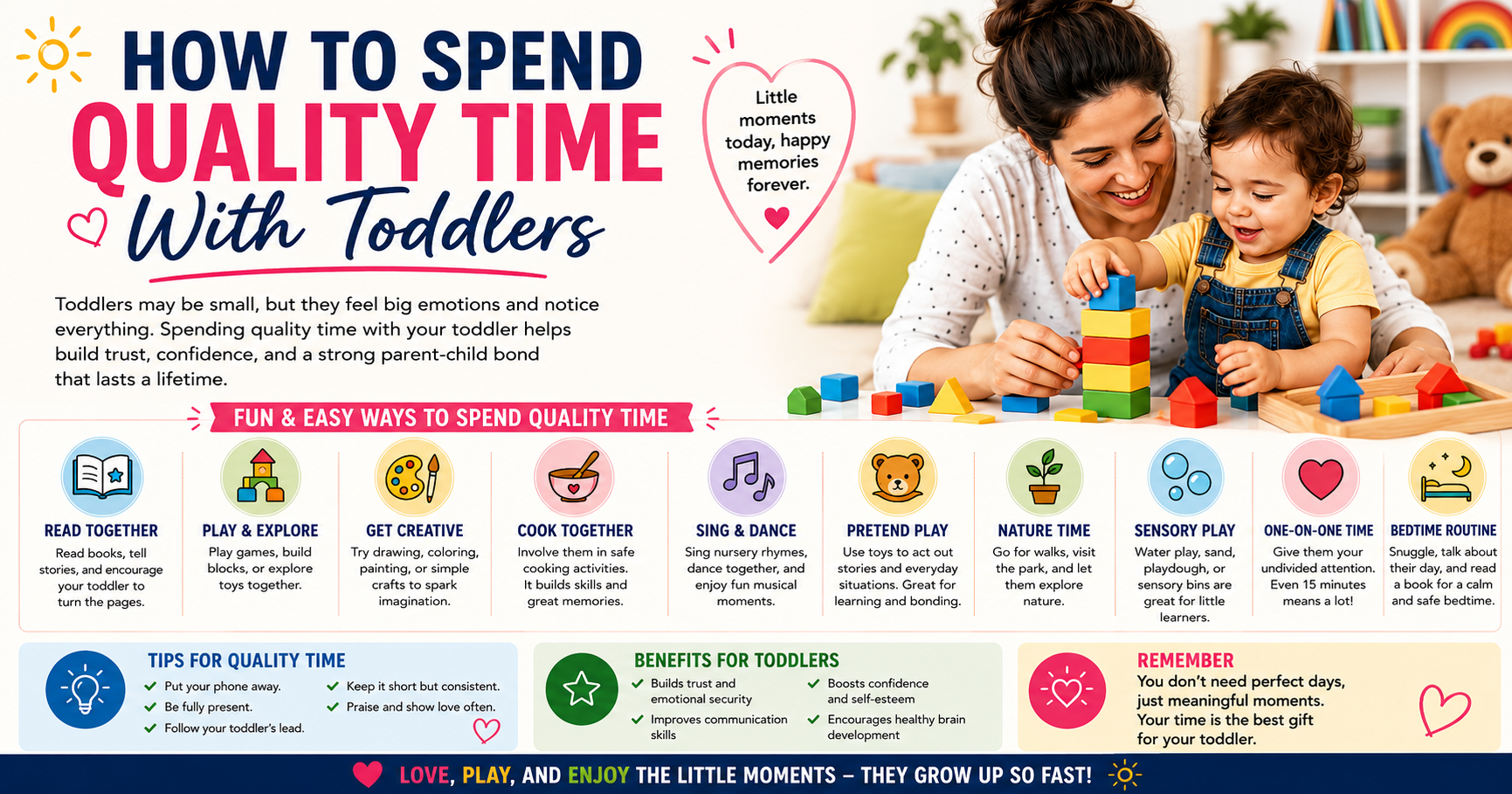
If you only take one thing from this entire guide, make it this: get on the floor, follow your toddler, and do not lead for 15 minutes.
Floor Time, developed by Dr. Stanley Greenspan and Dr. Serena Wieder, is both the simplest and the most research-supported approach to quality time with toddlers available to parents. It requires no materials, no planning, and no special knowledge. It requires only your physical presence and the willingness to follow rather than direct.
What happens in the days and weeks after you start a regular Floor Time practice is remarkable. Toddlers who receive consistent child-led attention from parents become more settled, more willing to play independently between sessions, and more emotionally regulated during difficult moments. The 15 minutes of quality following makes everything else in the day easier — including the times you genuinely cannot be present.
All ideas below have been assessed for developmental appropriateness, realistic preparation time, and actual engagement rate based on real parent reporting. Any idea that requires more than 5 minutes of parent preparation is flagged.
At this age, your toddler’s entire world is sensory. Everything goes in the mouth. Everything is there to be banged, dropped, poured, and dumped. Quality time at this stage means creating a safe sensory environment and getting fully present inside it with them — not from across the room.
| Activity | Preparation | Development Areas |
| Kitchen percussion | 5 mins prep (zero) | Sensory, motor, language |
| Water tub play | 2 mins prep | Sensory, cause-and-effect, joy |
| Texture walk | 0 mins prep | Language, sensory, bonding |
| Peek-a-boo variations | 0 mins prep | Object permanence, joy, attachment |
| Mirroring game | 0 mins prep | Language, social development, serve-return |
Everything changes between 18 and 24 months. Your toddler now has language emerging, strong preferences they cannot fully articulate, and the ability to become extremely unhappy about the wrong colour cup. Quality time at this stage needs to accommodate their rapidly growing sense of self — which means more choice, more autonomy, and more tolerance from you when the playdough gets squished into the carpet.
By two to three years, your toddler is capable of something genuinely amazing: sustained imaginative play. They can hold a story in their mind. They can assign roles. They can become genuinely angry at you if you play the dragon wrong. This is the stage where quality time starts to look more like play and less like sensory exploration — though both remain important.
Here is the most practical thing in this entire guide: you do not need to schedule quality time with your toddler separately from everything else. Your daily routines already contain the windows. You just need to be present inside them rather than getting through them.
Bath time with a toddler is one of the richest quality time windows in the entire day — and most parents treat it as a task to complete rather than a connection to experience. The warm water, the enclosed space, the nakedness that removes all distraction — bath time is already a sensory and emotional reset. All you need to do is be present inside it.
Dressing a toddler is usually a battle. It does not have to be. If you slow down by just 90 seconds and make the dressing routine a consistent small ritual — the same tickle on the same spot, the same silly sound when the shirt goes over the head, the same question asked every time — you transform a transition moment into a micro-connection that happens twice a day.
Toddlers crave predictability. A dressing routine that has a joke or a game built into it is no longer something being done to them. It is something they are doing with you. That shift — from passive to participatory — changes the emotional experience completely.
Eating together sounds like connection but is often parallel presence — everyone at the table, nobody really talking. With a toddler, mealtime quality time looks like: one parent, one toddler, actual conversation about what they are eating and what it tastes like. Letting them feed you a bite. Responding to their made-up words for food. Making the same face when you taste the sour thing.
The research on family mealtimes and child development is consistently strong: children who eat with at least one engaged parent regularly show better language development, emotional regulation, and academic outcomes. It does not need to be every meal. It needs to be present when it happens.
If you pick up your toddler from daycare, the journey home — whether auto, car, metro, or on foot — is a transition window with enormous quality time potential. Your toddler has spent the day without you. The transition from the care setting to home involves a genuine emotional shift. Being present in that window — talking, narrating, singing, or just maintaining warm physical contact — helps their nervous system land.
For Indian parents — particularly urban, working parents in cities like Raipur, Bangalore, Delhi, Mumbai, Pune, and Hyderabad — the question of how to spend quality time with toddlers has a specific context that no Western parenting blog addresses.
Many middle-class Indian families have an ayah or maid who is the toddler’s primary caregiver during working hours. This is not a problem to solve — it is a reality to understand. Your toddler forms a genuine attachment to their primary daytime caregiver. That is healthy and good.
What it means for your quality time practice: when you come home, your toddler needs a reconnection window with you specifically. Not because the ayah is inadequate — but because you are their parent, and parents occupy a specific and irreplaceable attachment position regardless of who provides the most hours of care.
A simple transition ritual when you return home — the same greeting, the same hug, the same few minutes of fully present attention before you do anything else — rebuilds that specific parent-child connection at the end of every day. Five minutes of your full presence after work is worth more to your toddler than an hour of your distracted presence later.
Toddlers in joint families have something many nuclear family children lack: multiple secure attachment figures, rich sensory and social input, and the never-boring experience of many personalities moving through their world. Research supports this — children in rich social environments tend to develop language faster and show greater social flexibility.
The challenge: quality time between a specific parent and a specific toddler can get lost in the crowd. When the grandmother, the aunt, and the cousin are all present, the parent can easily become just one of many people in the room — rather than the specific, irreplaceable attachment figure the toddler needs them to be.
The answer is not to isolate yourself from the family. It is to create micro-moments of just the two of you — even in a crowded house. Stepping onto the balcony together for ten minutes. Reading one book together in the bedroom with the door closed. The physical separation from the group is not about exclusion; it is about creating a pocket of attention that is specifically yours and theirs.
India offers an extraordinarily rich sensory environment for toddler development that most urban parents are not using as a quality time resource. The sounds, smells, textures, and visual complexity of an Indian street, market, or garden are extraordinarily stimulating for a toddler’s developing brain — far more so than any toy or screen.
| India-Specific Quality Time Idea | Developmental Areas Covered |
| Morning market walk | Sensory overload (the good kind), language, curiosity |
| Neighbourhood discovery walk | Floor Time outdoors, independence, world-building |
| Terrace or courtyard evening ritual | Nature connection, language, family bonding |
| Festival preparation activities | Cultural transmission, sensory, motor skills, belonging |
| Sabzi sorting at home | Sorting, counting, naming, kitchen confidence |
| Water play on balcony | Sensory, cause-and-effect, motor skills, sheer joy |
You sat down. You cleared your schedule. You turned your phone off and got on the floor. And your toddler walked away from you and started banging the door with a wooden spoon.
This is not failure. This is actually, developmentally speaking, a sign of something healthy.
Toddlers who push away a parent’s attempt to connect are usually doing one of three things:
What to do: stay in the room, do something calm and low-key, and do not interpret the pushback as personal rejection. ‘I can see you want some space. I am right here when you are ready.’ Then follow through — stay close, stay warm, and let them come back to you when they are ready.
Many parents try to pack quality time with toddlers into already-busy, overstimulating evenings. Your toddler comes home from a full day of social stimulation, transitions through dinner and bath, and then the parent tries to have connection time at 8 p.m. when the toddler is running on empty and one minor incident from a total meltdown.
Timing matters. The best windows for quality time with most toddlers are: immediately after waking in the morning (before the day’s stimulation begins), during the natural lull in mid-afternoon (typically 2–4 p.m. for children at home), and the 30-minute window immediately after school or daycare pickup before the dinner rush. Evening quality time works — but only if the toddler has had a proper decompression window first.
This is the section most parenting blogs use to make you feel guilty. We are not going to do that.
Here is the honest picture: screens are present in almost every toddler’s life in 2025. The WHO guidelines of no screen time before 2 and limited time for 2–5 year olds exist for good reasons — the passive consumption model of most toddler screen use does displace active, relational learning. But the guilt spiral that parents fall into about screen time is itself a problem, because guilt makes presence worse, not better.
The negative effects of screen time on toddlers are associated specifically with: background TV that is on while the child is awake (this does affect language development even when the child is not watching), replacing relational interaction rather than supplementing it, and solo, passive consumption without adult engagement. The research on co-viewed content — where a parent and toddler watch together and the parent narrates, comments, and discusses what they see — shows significantly smaller negative effects.
In practice: the quality time question about screens is not ‘how much?’ but ‘how?’ A toddler watching a show alone while a parent manages dinner is different from a toddler watching the same show with a parent who is commenting, asking questions, and creating interaction around the content.
The goal is not to eliminate screens. The goal is to make the rest of the time — the floor time, the bath, the walk, the cooking, the storytelling — so consistently present and warm that screens are naturally one part of the day rather than the dominant activity.
If you are spending 20 minutes daily in genuine Floor Time with your toddler, the 45 minutes of screen time in the afternoon is not a crisis. The research does not support the idea that parents must eliminate all screen time. It supports the idea that relational, active, adult-engaged time must make up a meaningful portion of the toddler’s day. Those are two very different standards.
Research from the Zero to Three Institute and Dr. Stanley Greenspan’s Floor Time studies suggests that 15–20 minutes of genuinely child-directed, undivided quality time per day is sufficient for secure attachment and healthy toddler development. The key word is ‘genuinely’ — 15 minutes of fully present, child-led interaction is developmentally more valuable than two hours of distracted co-presence. For working parents who see their toddler for only a few hours each evening, 15–20 minutes of Floor Time plus warm engagement during routines like bath and bedtime covers the quality time need effectively.
The best quality time activity for a 2-year-old is the one they choose. Child-led play — where you follow your toddler’s direction rather than setting an agenda — is the single most developmentally supported form of parent-toddler interaction. In practice, this means getting on the floor, putting your phone away, and following wherever your 2-year-old takes you for 15–20 minutes without redirecting. Beyond that, the top parent-reported activities for this age are: water play, blanket forts, pretend play with household items, simple obstacle courses, and cooking simple things together. None of these require purchased materials or advance planning.
The most honest answer: lower the bar on what quality time looks like and raise the bar on how present you are within it. You do not need energy to do Floor Time — you need to be physically on the floor and emotionally available. Getting down to your toddler’s level and following their play for 15 minutes does not require enthusiasm. It requires presence. Many parents find that the Floor Time session itself, despite beginning from a place of exhaustion, actually restores some energy — because toddler joy is infectious and watching a child play freely, when you are not managing or directing, is genuinely less tiring than the kind of parenting where you are always one step ahead of their next move.
Passive, parallel screen viewing — both parent and toddler watching the same screen separately — does not constitute quality time in the developmental sense. However, co-viewed content where the parent is actively engaged — commenting, asking questions, pointing at things on screen, creating conversation around what is being watched — can be a form of shared attention that has genuine relational value. The distinction is whether the screen is replacing interaction or facilitating it. A parent and toddler watching a nature documentary together, with the parent narrating ‘look at the elephant — it is so big! What do you think it is eating?’ is different from both of them silently watching the same screen with no interaction.
First, this is extremely common and not a sign of failure. Second, the solution is not to remove the device dramatically — that typically results in meltdown rather than redirection. The more effective approach is to gradually introduce alternative experiences that are more immediately rewarding than the screen: water, physical movement, a new sensory material, or outdoor time. Toddlers who are heavily screen-dependent at home are usually seeking stimulation, not specifically seeking screens. Providing stimulation through other means — a shallow tub of coloured water, a pile of safe household items to explore, getting outside and moving — meets the same underlying need without the device. Start with 15-minute windows of an alternative experience before reintroducing screen time, and over weeks, the balance typically shifts naturally.
The most realistic approach for multi-child families is the rotation system: each child gets a specific, protected window of one-on-one time on a predictable schedule, and the other children are managed during that window (by a partner, grandparent, or with independent play). For toddlers specifically, their quality time window can double as the older child’s independent play or homework time — the toddler’s 20-minute Floor Time session in the same room as an older sibling doing homework can work well, as long as your focus during that window is genuinely on the toddler. Older siblings can also be involved in toddler quality time activities — storytelling swap, blanket fort building, the texture walk — in ways that give the toddler connection with multiple family members at once.
Yes — and this is arguably the most sustainable model for most families. The research on toddler development does not draw a clear line between ‘routine’ time and ‘quality’ time. What the research consistently supports is warm, responsive, present interaction with a primary caregiver — and this can happen in the bath, at the table, during dressing, on the walk to the corner shop. Turning routine activities into quality time by being fully present, narrating, responding to your toddler’s cues, and making the routine predictable and warm is both developmentally appropriate and practically sustainable for a busy family. You do not need to add extra activities to your day. You need to be more present in the activities already there.
No — and this is actually a sign of healthy attachment development in a rich caregiving environment. Toddlers form multiple attachments to multiple safe adults, and it is entirely normal — and healthy — for them to show strong preference for a primary daytime caregiver (often a grandparent in Indian families) during the day. This does not displace the parent attachment; it coexists with it. Research shows that children with multiple secure attachments are more socially flexible and emotionally resilient. The parent-child attachment remains distinct and irreplaceable regardless of who provides the most hours of care. Continue your quality time practice consistently and warmly, and do not interpret the grandparent preference as a sign that your time is less valuable. It means your family is doing something right.
Here is what we want you to take away from all of this:
You do not need more time. You need to be more present in the time you already have.
Your toddler is not keeping score of hours. They are not building a ledger of activities. What they are doing — in their small, urgent, completely absorbing way — is checking whether you are real and whether you are there. Whether your eyes find theirs when you walk into the room. Whether you get on the floor sometimes. Whether you follow where they point. Whether you laugh at the same things they laugh at.
The quality time you spend with your toddler is not measured in duration. It is measured in the quality of your attention during whatever time you have.
Fifteen minutes on the floor, phone away, following their lead — today, this week, this month — is how to spend quality time with toddlers when you are busy, tired, and doing your best. Which is every parent, every day.
Start with the floor. Everything else follows from there.