Physical Address
304 North Cardinal St.
Dorchester Center, MA 02124
Physical Address
304 North Cardinal St.
Dorchester Center, MA 02124

It is 7:45 in the evening. Your toddler has been awake since 6 a.m. They look exhausted. You are more exhausted. And somehow, inexplicably, they are running in circles around the living room at full speed, laughing like it is the funniest thing that has ever happened to anyone.
This is the second wind. Every toddler parent knows it. The moment right before sleep when your child’s body fights back against being tired — and the next 45 minutes can go either way.
The right relaxing bedtime activities for toddlers before sleep can be the difference between a child who drifts off by 8:30 and one who is still bouncing at 10. The wrong activities — anything stimulating, anything screen-based, anything competitive or exciting — will fuel that second wind until everyone is in tears.
This guide gives you the complete bedtime wind-down system. Not just a list of activities — a sequence, a schedule, age-specific ideas, a printable routine chart, a sensory section, and honest advice about what happens when none of it works. Because sometimes it doesn’t, and you deserve to know what to do then too.
Toddlers are not small adults. Their sleep architecture is genuinely different from ours — and understanding it for five minutes will change how you approach every bedtime from tonight forward.
A toddler’s brain produces melatonin (the sleep hormone) in response to darkness, quiet, and low stimulation — but only when the cortisol (stress/alertness hormone) level drops first. The second wind you see at 7:45 p.m.? That is a cortisol spike — the body’s last-ditch effort to stay alert in response to whatever stimulating thing happened in the last hour. Screens, rough play, bright lights, and exciting conversation all spike cortisol right when you need it to fall.
The 45-minute wind-down routine works because it systematically lowers cortisol. Each activity in the sequence reduces stimulation one level further, allowing melatonin to rise naturally. By the time you are reading the last page of the bedtime book, your toddler’s body is already primed for sleep — not because you forced it, but because you removed all the obstacles.
The American Academy of Sleep Medicine and multiple peer-reviewed studies on toddler sleep hygiene confirm that consistent pre-sleep routines reduce the time it takes toddlers to fall asleep, reduce night wakings, and improve total sleep duration. This is not opinion. It is one of the most consistently supported findings in child sleep research.
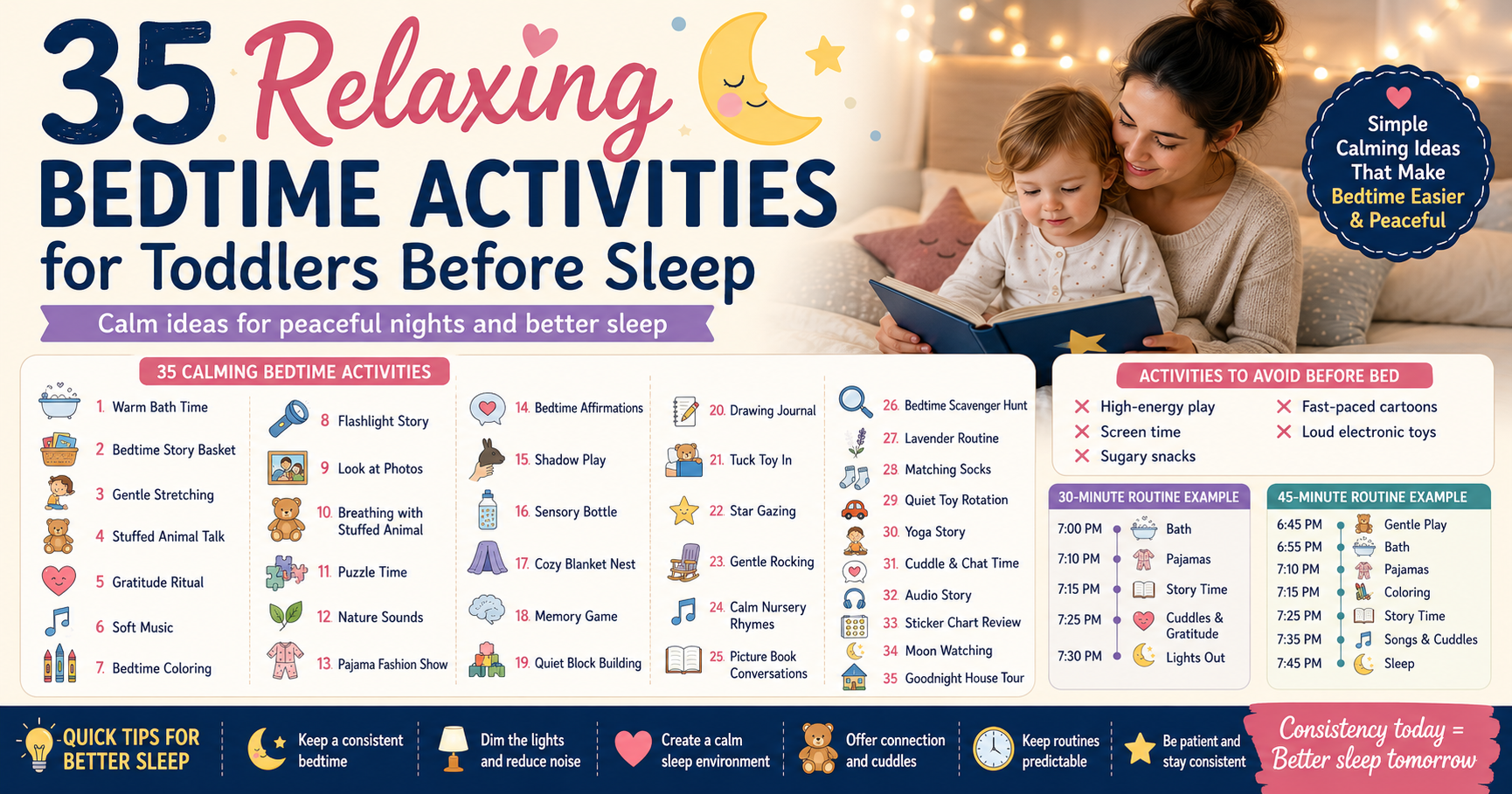
| Time Window | Activity and Why It Works |
| 60 mins before sleep | Turn off TV, reduce room brightness, switch from active to quiet play |
| 45 mins before sleep | Warm bath — body temperature drop after bath triggers sleep signal |
| 35 mins before sleep | Pyjamas, dim lighting, soft music or white noise begins |
| 25 mins before sleep | Quiet activity: puzzles, soft toy play, simple drawing |
| 15 mins before sleep | Bedtime book — one or two slow-paced stories, same ones if possible |
| 10 mins before sleep | Breathing exercise, lullaby, or guided relaxation — consistent every night |
| 5 mins before sleep | Cuddle, final goodnight phrase, lights off or night light only |
These activities are organised from most to least calming based on cortisol-reducing evidence and real parent feedback. The first five are your foundation. The rest are variations and supplements.
If you do nothing else from this list, do the warm bath. The science behind it is straightforward: a warm bath raises core body temperature. When your toddler steps out, their temperature drops rapidly. That temperature drop is one of the strongest physiological signals for sleep onset the body knows.
Make it a ritual, not a chore. Same time. Same temperature. Same gentle song you hum while washing their hair. Same towel they choose. These sensory anchors become part of the relaxation response — over weeks, just running the bath begins to calm your toddler’s nervous system before they even get in.
Reading to a toddler at bedtime is almost universally recommended. But most parents do not know why it works physiologically — and knowing why helps you do it more effectively.
Slow-paced narrative lowers heart rate. The predictability of a familiar story — especially one they have heard before — allows the language processing parts of the brain to work at low effort rather than high effort. A new, exciting story activates curiosity and alertness. A known, gentle story creates the mental equivalent of a slow exhale.
Auditory input does not stop at sleep — it continues processing throughout the night. This is why the right auditory environment at bedtime matters so much. Silence in a noisy household is actually more disruptive than consistent low-level sound, because every unexpected noise registers as a potential threat signal.
The best options for toddlers: lullabies sung by a known caregiver (most powerful — familiar voice + familiar melody is the strongest auditory sleep cue possible), instrumental lullaby music, brown or pink noise (softer and more soothing than white noise for most children), and gentle nature sounds without sudden volume changes.
Melatonin production is directly suppressed by blue light exposure. Most home lighting — overhead lights, tablets, TV screens — emits blue light. Transitioning to warm, dim light 45–60 minutes before sleep is not optional in a sleep-optimised bedtime routine. It is the physiological prerequisite for everything else to work.
This one surprises many parents. Yes, a 2-year-old can learn a simple breathing exercise — and the child who can take a slow breath when they feel wound up before bed is also learning the foundational skill of emotional self-regulation that serves them for the rest of their life.
Keep it completely simple and make it a game, never a demand:
For toddlers who are not yet ready for the final wind-down but need the stimulation level to drop, a simple quiet puzzle, shape sorter, or block stacking activity at the start of the wind-down window is ideal. The activity occupies hands and eyes without raising heart rate or stimulating language beyond a gentle commentary from the parent.
The key: choose an activity that is familiar and slightly below their challenge level. A toddler working hard at a new puzzle is cognitively activating. A toddler confidently putting in the same puzzle they have done fifty times is cognitively soothing.
From around 18 months, a toddler’s relationship with a comfort object — a soft toy, a blanket, a specific pillow — is a genuine attachment relationship that can be used very effectively in the bedtime routine.
Create a simple ‘goodnight ritual’ with the comfort toy: say goodnight to the toy, tuck it in, give it a kiss, tell it what will happen tomorrow. This ritual serves multiple purposes: it gives the toddler a sense of agency and closure at the end of the day, it externalises the parent’s final goodnight message (the toy being ‘safe and ready for sleep’ is the message the toddler internalises about themselves), and it provides a consistent sequence the toddler can eventually perform independently.
Infant and toddler massage is among the most research-supported calming interventions available to parents. Studies show that 10–15 minutes of gentle massage before sleep reduces cortisol, increases oxytocin, improves sleep onset time, and reduces night waking in toddlers. The Touch Research Institute at the University of Miami has produced decades of supporting research.
You do not need to know formal massage techniques. Slow, gentle, predictable strokes — back, legs, feet — while the child lies on their front on the bed, preferably with a warm room and soft music playing, is all that is required.
From around 2.5–3 years, a very simple guided visualisation at bedtime can be extraordinarily effective. This is not complex — it is a short story that the parent narrates in a slow, soft voice that guides the toddler through a calming imaginary environment.
Example: ‘Close your eyes. Imagine you are in a very soft, warm cloud. The cloud is floating slowly through the sky. It is very quiet up here. You can see stars below you. You are very warm. Your eyes are heavy…’ Continue for 3–5 minutes. Most children are asleep before you finish.
This technique is used by child psychologists, occupational therapists working with sleep disorders in children, and many experienced parents who stumbled upon it accidentally. It fills a genuine gap in parenting content.
The lullaby that a parent sings to a toddler — even if the parent cannot sing well — is one of the most powerful sleep cues in the human toolkit. The combination of a familiar voice, a specific melody, a consistent set of lyrics, and the physical proximity of the parent creates a multi-sensory sleep trigger that no sleep app can replicate.
If you do not have a family lullaby, choose one now and make it yours. Sing it only at bedtime. Sing it in the same spot. Sing it the same way every night. Within two to three weeks, you will see your toddler’s eyes grow heavy the moment you begin.
Getting dressed for bed sounds mundane, but the pyjama ritual is one of the most overlooked sleep-signalling opportunities in the entire evening. The act of putting on sleep-specific clothing is a physical cue that helps even very young toddlers understand that the day is ending.
Make it warm and sensory: warm pyjamas from the radiator, soft fabric your child loves, a consistent sequence (‘first the shirt, then the bottoms, now the socks’). The physical warmth and the familiar sequence contribute to the overall cortisol reduction of the wind-down.
For families with a balcony, garden, or terrace — and especially in India where many homes have outdoor access — 5–10 minutes of quiet outdoor time in the early evening can be a beautiful addition to the bedtime wind-down. Cool evening air lowers body temperature (the sleep signal), the darkness of the outdoors begins the melatonin cue, and looking at the sky with a parent is a naturally slow, meditative shared experience.
Point at the moon. Count the stars you can see. Name one cloud shape together. This costs nothing, takes 8 minutes, and is genuinely connecting in addition to being calming.
Warm milk before bed has been practised across cultures for centuries — and there is a reason it persists. Warm liquid raises core temperature (the same mechanism as the bath) and then triggers the temperature drop that signals sleep. Milk also contains tryptophan, a precursor to serotonin and melatonin, though the quantity is unlikely to be pharmacologically significant at toddler portions.
The ritual matters more than the chemistry. The act of sitting quietly with a warm cup in the dim kitchen, with the same parent, at the same time, saying the same gentle things — this is the sleep cue, not the tryptophan.
This surprises most parents — but 5 minutes of very gentle, slow yoga at the start of the wind-down window is an excellent transition activity for physically active toddlers who need their body to discharge residual energy before they can be still.
Keep it extremely simple: child’s pose (‘make yourself into a little ball’), tree pose (‘can you balance on one foot like a tree?’), and happy baby pose (‘hold your feet and rock like a happy baby’) are all easily understood by 2–3 year olds and are inherently calming. The stretching also activates the parasympathetic nervous system — the ‘rest and digest’ mode that is the opposite of the cortisol spike.
For toddlers aged 2.5 and above, a brief day-closure conversation in bed can be one of the most meaningful and calming things you do before sleep. It does not need to be long. Two questions, asked gently, while lying beside them in the dim room:
These two questions take three minutes. The conversations you will remember five years from now — the things your two-year-old says when the lights are low and they feel safe — happen in exactly this kind of moment.
This is the full sequence — built from the science above and designed to take a stimulated, second-wind toddler to a settled, sleepy state in 45 minutes consistently. Adapt the timing to your toddler’s current bedtime, counting backward from your target sleep time.
| Time + Step | What Happens and Why |
| T-45 min: TRANSITION SIGNAL | Turn off screens and bright overhead lights. Switch to a warm lamp. Say: ‘It is nearly bedtime. We are starting to get ready.’ This is the formal beginning of wind-down. |
| T-42 min: WARM BATH | Run bath, 5–8 minutes at a comfortable warm temperature. No exciting bath toys. Pouring cups only. Hum or sing softly while washing. Predictable ending — same phrase, same warm towel. |
| T-30 min: PYJAMAS + WARM DRINK | Warm pyjamas, warm milk or herbal drink. Dim room, soft music already playing. This is the transition from bathroom warmth to bedroom warmth. |
| T-25 min: QUIET ACTIVITY | One calm activity: puzzle, soft toy ritual, simple drawing, or gentle yoga. Parent is present but quiet. No phone. No screen. This is decompression time, not engagement time. |
| T-15 min: BEDTIME BOOK | One or two slow-paced books, read in a low, slow voice. In bed if possible, or in a specific reading chair used only at bedtime. Same books preferred over new ones. |
| T-8 min: BREATHING + MASSAGE | Simple belly breathing game (3–5 rounds) or 5-minute gentle back massage. White noise or lullaby music continues. |
| T-3 min: LULLABY + GOODNIGHT RITUAL | One consistent lullaby. Goodnight to the soft toy. Goodnight to each family member, said in the same order. Final phrase: the same words you say every single night without exception. |
| T-0: LIGHTS OFF | Night light on if needed. Parent leaves or lies beside child depending on your approach. White noise continues. |
At this age, the bedtime routine is almost entirely sensory. Your toddler cannot understand explanations about sleep. What they can understand is temperature, touch, sound, and your presence. The bath, the warm swaddle or sleep sack, your voice, and your physical closeness are the entire routine at this stage.
| Activity | Why It Works at This Age | Parent Note |
| Warm bath | Essential — most powerful sleep cue at this age | Do nightly without exception |
| Parent singing lullaby | Voice is the primary sleep cue — no app replaces it | Same song, same place, every night |
| Feeding to drowsy (if still feeding) | Natural sleep association at this age | Gradually move toward drowsy-but-awake |
| Gentle rocking or swaying | Vestibular input calms the nervous system | Slow, rhythmic, consistent |
| Soft toy introduction | Begin comfort object association now | Always the same toy in the same spot |
Between 18 and 24 months, toddlers develop a genuine understanding of routine sequence. They begin to know that bath comes before pyjamas, that the book comes before the lullaby. This sequence awareness is enormously useful — the routine itself becomes a sleep cue, because the toddler’s nervous system learns what comes next.
At two to three years, your toddler is ready to own parts of their bedtime routine. Giving them specific choices within the routine — ‘Which book tonight, this one or this one?’ — creates the dual benefit of autonomy satisfaction and routine maintenance. The choice is real; the routine is fixed.
Some toddlers are neurologically wired to seek more sensory input than average — they are harder to calm because their nervous system is still seeking the input it needs to regulate. Standard bedtime routines often fail for these children not because the routine is wrong, but because the sensory component is insufficient.
If your toddler regularly shows these signs at bedtime — crashing into furniture, needing to be held very tightly, unable to tolerate soft touch, seeking heavy pressure — they may have higher-than-average sensory processing needs. These activities are specifically helpful:
| OCCUPATIONAL THERAPIST NOTE If your toddler consistently requires significant sensory support to calm before sleep and standard routines are not working, a paediatric occupational therapist can provide a personalised sensory diet — a daily plan of sensory activities timed to regulate the nervous system throughout the day so bedtime is less of a battle. This is not a medical treatment; it is a practical support service that many families find transformative. |
For Indian parents, the bedtime routine has a rich cultural context that Western sleep advice completely ignores. Traditional Indian practices are, in many cases, more sophisticated sleep interventions than anything modern sleep science has invented — because they have been refined over generations of mothers who understood the toddler nervous system intuitively.
| India-Specific Challenge | Practical Solution |
| Joint family noise at bedtime | Establish one quiet room as the designated sleep room from bedtime onward. White noise machine addresses ambient family sounds effectively. |
| Power cuts interrupting routine | Keep a charged small lamp or torch available. The routine can continue by candlelight or torchlight — the dim warm light is actually ideal. |
| Heat in summer months | A cooled-down room before sleep onset is important in Indian summers. Fan plus thin cotton sleep suit. Avoid AC set below 24 degrees for toddlers. |
| Pressure from family to keep toddler awake for visiting relatives | Set the bedtime window as protected. ‘She sleeps at 8. She can meet everyone before 7:30.’ Most relatives respect this when it is communicated consistently. |
| Multiple caregivers with different bedtime approaches | One consistent routine, followed by all caregivers. Print and laminate the routine chart and post it in the baby’s room. |
A visual routine chart is one of the most effective toddler sleep tools available — and it costs almost nothing to create. Here is what to include and exactly how to use it:
| Chart Item | Icon Idea |
| Turn off screens | TV/tablet icon — first step of the wind-down |
| Bath time | Bathtub icon with bubbles |
| Pyjamas on | Pyjama/sleeping suit icon |
| Warm drink | Cup with steam icon |
| Quiet play / puzzle | Puzzle piece icon |
| Bedtime book | Open book icon |
| Brush teeth | Toothbrush icon (include if dental routine is separate) |
| Breathing / lullaby | Musical note or heart icon |
| Goodnight hugs | Hug/star icon |
| Lights off / sleep | Moon and stars icon |
Design tip: laminate the chart and give your toddler a small dry-erase marker or sticker to check off each step as it is completed. The act of checking off each step gives them a sense of agency and forward momentum through the routine — ‘I did the bath, I did the book, now I do the sleep.’ This is surprisingly effective from around 20 months onward.
Display the chart at toddler eye level in the bedroom or bathroom — not up high where only adults can see it. The chart is theirs, not yours.
This section does not exist in any other article on this topic. But every parent needs it.
There will be nights when the bath becomes a battle. When your toddler refuses the book. When the lullaby makes them laugh instead of sleep. When the routine that worked perfectly for three weeks suddenly stops working on a Wednesday for no apparent reason.
This is normal. It does not mean the routine is broken. It almost certainly means one of five things:
We are not going to lecture you about screen time. If you are reading a 5,000-word article about toddler bedtime activities, you are clearly trying. This section is practical, not preachy.
The specific reason screens are problematic at bedtime — and it is worth knowing the specific reason rather than just being told ‘no screens’ — is blue light wavelength. Screens emit blue-spectrum light that suppresses melatonin production. Research published in the Journal of Clinical Endocrinology and Metabolism found that even two hours of screen exposure before bed can halve melatonin production in children. Half. That means the body’s natural sleep-onset mechanism is running at 50% capacity on screen nights.
Knowing this changes the ‘no screens’ rule from an arbitrary restriction into a biological fact you are choosing to respect. That reframe — from rule to reason — is usually what makes the change sustainable.
The single best calming activity for a toddler before bed is a warm bath followed immediately by being wrapped in a warm towel and transitioning to a dim, quiet room. The physiological mechanism — warm water raising core temperature followed by rapid temperature drop — is the strongest natural sleep-onset trigger available. Combine the bath with a consistent parent-sung lullaby during the process and you have the most scientifically supported pre-sleep calming sequence available for toddlers of any age.
A toddler bedtime routine should be 30–45 minutes long. Shorter than 20 minutes does not allow enough time for cortisol to drop and melatonin to rise sufficiently. Longer than 60 minutes becomes counterproductive as the toddler may cycle back into alertness. The 45-minute window — starting 45 minutes before your target sleep time — is the research-supported sweet spot for most children aged 12 months to 3 years.
This is the ‘second wind’ — a cortisol spike triggered by the body’s attempt to fight off tiredness. It is completely normal and happens when the bedtime window is slightly missed (the toddler has passed their ideal sleep onset time) or when stimulating activities — screens, rough play, bright lights — have occurred in the hour before bedtime. The solution is to move bedtime 15–20 minutes earlier and begin the wind-down routine before the second wind kicks in. Once the cortisol spike has happened, it takes 30–45 minutes of low-stimulation activity to bring it back down.
All screens should be avoided for at least 45–60 minutes before toddler bedtime. This includes tablets, smartphones, televisions, and gaming devices. The reason is blue light emission: all screens emit blue-spectrum light that suppresses melatonin production, the hormone responsible for sleep onset. Even low-brightness screen use reduces melatonin by up to 50% according to research published in the Journal of Clinical Endocrinology and Metabolism. Replace screen time with a bath, books, or quiet play in warm, dim light.
The best bedtime routine for a 2-year-old includes: screens off 45 minutes before sleep, a 5–8 minute warm bath, pyjamas and a warm drink, one quiet activity such as a simple puzzle or soft toy play, two slow-paced picture books read aloud in a low voice, a simple breathing game (belly breathing with a stuffed animal), a consistent lullaby, a goodnight ritual with the comfort toy, and lights off with a warm night light. The entire sequence takes 35–45 minutes. The consistency of the sequence matters more than perfection in any individual step.
Bedtime fighting in toddlers is almost never caused by something the parent is doing ‘wrong.’ The most common causes are: a bedtime window that is slightly too late (the toddler has become overtired and cortisol has spiked), a routine that is inconsistent (varies by 30+ minutes night to night or changes frequently), stimulating activities too close to sleep time, or a developmental leap in progress. The solution in most cases is: move bedtime 15–20 minutes earlier, hold the routine completely consistently for 2 weeks, remove all screens from the 45-minute wind-down window, and add a warm bath if not already included. Most families who do all four report significant improvement within 5–10 days.
Yes — and for many toddlers, particularly those in noisy households or those who are sound-sensitive, a white noise machine or gentle music playing throughout the night is actively beneficial. It creates an auditory ‘buffer’ that prevents environmental sounds from disrupting sleep cycles. The ideal volume is 50–65 decibels — similar to a quiet conversation. Softer sounds like pink noise or brown noise are generally preferred over white noise for toddlers as they are less stimulating at equivalent volumes. Music with lyrics is less ideal than instrumental music for sleep maintenance, as language processing continues even during early sleep stages.
For single parents managing bedtime alone at the end of an already full day, the key is radical simplification. You do not need 45 minutes. You need three non-negotiables: a warm bath, one book, and a consistent lullaby or phrase. These three things, done every night without exception, deliver 80% of the benefit of a full routine. Everything else in this guide is supplementary. The bath is the cortisol reducer. The book is the language and bonding signal. The lullaby or phrase is the sleep cue. Start there. Add one element at a time when you have the capacity. And please know: the parent who shows up to bedtime exhausted and still gives their toddler a warm bath and one book and a kiss is doing something genuinely profound, regardless of how it feels in the moment.
Here is what we want you to carry away from all of this: the bedtime routine you build with your toddler is not a sleep training programme. It is not a performance review. It is not something you pass or fail.
It is the way the day ends. It is the accumulation of small consistent acts — the same warm water, the same low voice, the same goodnight words — that tell your child: you are safe, the day is done, I am here, you can rest now.
Your toddler does not need perfection. They need predictability. They need your warm presence. They need to know that the sequence they fell asleep to last night is going to happen again tonight.
Start with the bath. Add the book. Sing the song. Say the words. Do it again tomorrow.
Over weeks, something remarkable happens: you will see your toddler begin to relax before you even start. The bath running, the lamp going on, your voice beginning to change register — these things will reach their nervous system before the routine even formally begins. That conditioned calm is what you are building. And it is one of the most loving things you will ever make.