Physical Address
304 North Cardinal St.
Dorchester Center, MA 02124
Physical Address
304 North Cardinal St.
Dorchester Center, MA 02124

November rolls in and something shifts in your chest. Part excitement. Part dread. Because the holidays with young kids are genuinely magical — and genuinely expensive — and nobody tells you how to hold both of those things at the same time.
The lists start. Your toddler, who has no idea what any of this means but has learned the word ‘want’, is suddenly pointing at everything in every shop. Your older child is reciting a gift list like it is a formal document. Your family is asking what the children want. Adverts are everywhere. And somewhere in the background, your bank account is quietly side-eyeing all of it.
This guide is not here to tell you that gifts do not matter or that the holidays are about family time, not things. You know that. What you need is a system. A real, practical, category-by-category plan for how to budget for the holiday season with young kids — with actual numbers, a printable tracker, and honest advice for the specific situations other budgeting articles pretend do not exist.
Single parents. Indian families are navigating Diwali and Christmas simultaneously. Families with three children and one income. Families dealing with guilt from relatives who buy more than you do. This guide is for all of you.
Before we talk about money, we need to talk about memory. Because this one section might save you more than any budgeting tip in this guide.
Research on childhood memory and holiday experience consistently shows the same thing: children under 7 do not remember specific gifts. They remember feelings. They remember sensory experiences. They remember rituals. The study of ‘fading affect bias’ in memory research shows that emotional memories — how something felt — persist far longer than factual memories — what something was.
Your three-year-old is not going to remember the specific toy you bought them this December. They are going to remember: the smell of whatever you cooked. The specific song that was playing. The way the room looked. Whether they felt safe and warm and included. Whether the adults around them seemed happy or stressed.
This is not a reason to spend nothing on gifts. It is a reason to stop spending money on guilt. The Rs. 8,000 toy you bought because you felt you ‘should’ spend more? Your toddler will play with the box. The Rs. 300 bag of sensory materials you played with together on Christmas morning? That might be the clearest memory they carry.
Knowing this changes the budget conversation entirely — from ‘how do I spend enough’ to ‘how do I allocate what I spend toward what they will actually experience and remember?
This is the step most families skip — and it is why most families overspend.
The common approach is to start with a category: ‘How much do I spend on gifts?’ Then add another: ‘How much for the Christmas dinner?’ Then travel. Then decor. Then activities. The numbers add up separately and the total is only visible in January, on the credit card statement.
The right approach is the opposite. You decide the total number first — before any category — and then work backward. Every category allocation comes out of the total. When the total is gone, the spending stops.
Whatever number that calculation produces — that is your holiday budget. Write it down before you read anything else in this guide. The number feels real when it is written. A mental calculation feels negotiable.
| Family Profile | Realistic India Range | Approximate Global Range |
| Single parent, 1 child, tier-2 Indian city | Rs. 5,000–12,000 | $70–$160 |
| Two-income household, 1 child, metro India | Rs. 12,000–25,000 | $150–$320 |
| Two-income household, 2 children, metro India | Rs. 20,000–40,000 | $250–$500 |
| Two-income household, 3 children, metro India | Rs. 30,000–55,000 | $380–$700 |
| Single income, 2 children, tier-2 city India | Rs. 8,000–18,000 | $100–$230 |
| Dual income, 1 child, UK/US | $200–$600 | Adjust for local costs |
| Dual income, 2 children, UK/US | $400–$1,000 | Adjust for local costs |
These ranges are real — not aspirational. They account for gifts, food, decor, a small activity or outing, and incidentals. They do not account for travel, which is a separate budget category for families who travel during the holidays.
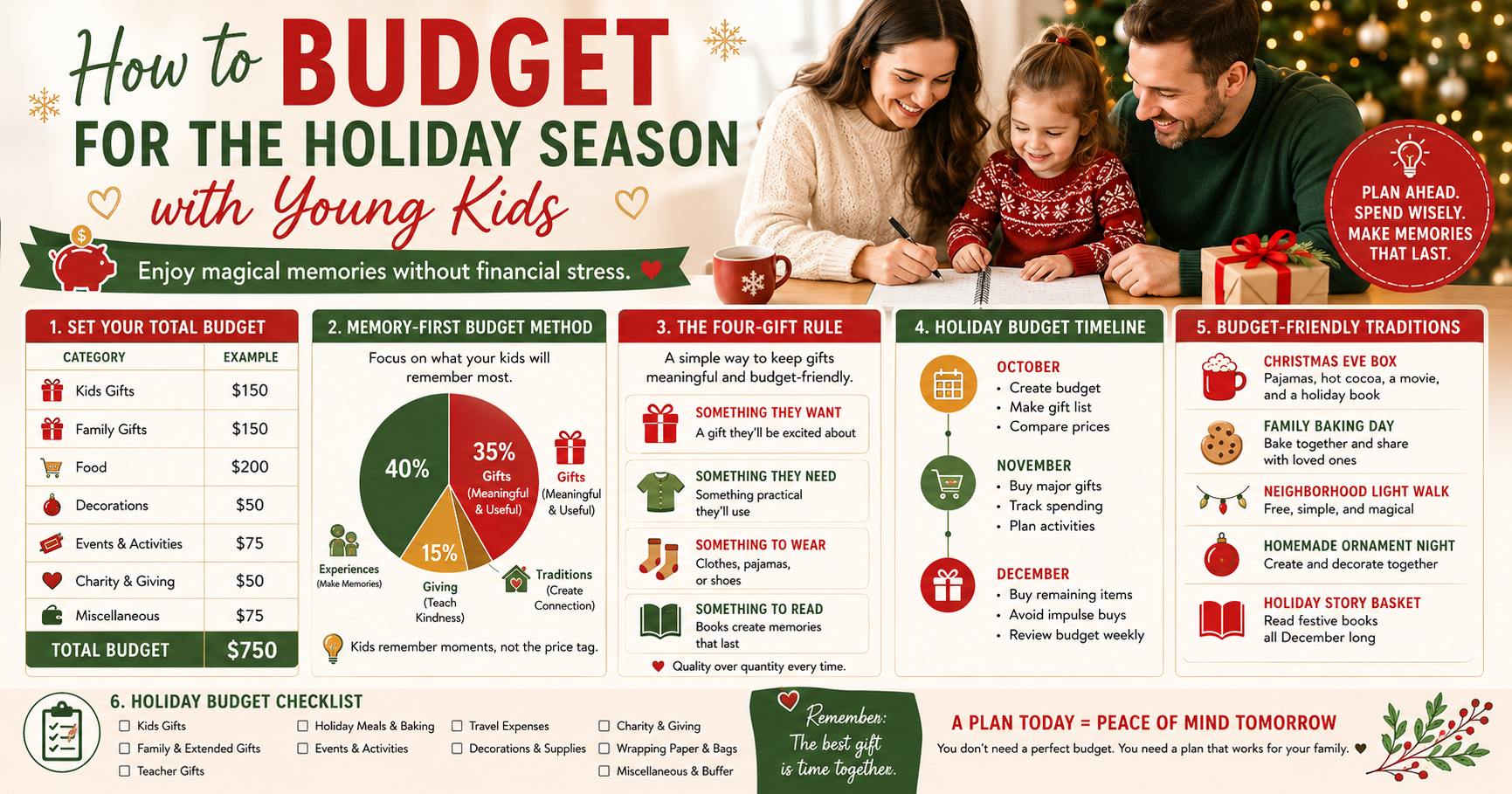
Once you have your total, divide it across six categories. Here are the recommended percentage allocations — these are averages based on real family spending data and can be adjusted based on what matters most to your family:
| Category | Recommended Allocation |
| GIFTS (children + adults + teachers + helpers) | 40–50% of total budget |
| FOOD (special meals, baking, entertaining guests) | 20–25% of total budget |
| ACTIVITIES + EXPERIENCES (outings, events, craft materials) | 10–15% of total budget |
| DECOR (tree, lights, rangoli supplies, general festive decor) | 5–10% of total budget |
| CARDS + WRAPPING + PACKAGING | 3–5% of total budget |
| BUFFER (unexpected costs — always appear) | 10% of total budget |
Applied to a Rs. 20,000 total budget:
| Category | Amount (Rs. 20,000 Total) |
| Gifts | Rs. 9,000 (45%) |
| Food | Rs. 4,500 (22.5%) |
| Activities + experiences | Rs. 2,500 (12.5%) |
| Decor | Rs. 1,500 (7.5%) |
| Cards + wrapping | Rs. 700 (3.5%) |
| Buffer | Rs. 2,000 (10%) |
| TOTAL | Rs. 20,200 — slightly over, trim decor or wrapping to rebalance |
The buffer is not optional. Every holiday season produces unexpected costs — a relative who drops in unexpectedly with a gift for your child (creating reciprocal pressure), a school event that requires a small contribution, a toy that breaks the day after Christmas and needs replacing. The parent who has no buffer overspends every time. The parent with a Rs. 2,000 buffer handles these moments without stress.
Here is the most important rule about holiday gift budgets for young children: the per-gift number matters less than the per-child total. A toddler who receives four Rs. 200 gifts — a set of crayons, a small puzzle, a small story book, a pair of fun socks — is as delighted as a toddler who receives one Rs. 800 toy. Often more so, because more items means more opening, and opening is the actual joy for under-5s.
| Child’s Age | Recommended Gift Budget | Parent Note |
| 0–12 months | Rs. 500–1,500 / $10–25 | Babies genuinely do not know it is a holiday. This budget is for the parents and the photo. |
| 1–2 years | Rs. 800–2,000 / $15–35 | Sensory toys, board books, bath toys. They care about the wrapping paper more than the gift. |
| 2–3 years | Rs. 1,200–2,500 / $20–40 | Simple imaginative play items. Three small gifts beat one big one at this age. |
| 3–5 years | Rs. 1,500–3,500 / $25–55 | They understand gifting now. A wish list is possible. Still quality-over-quantity age. |
| 5–8 years | Rs. 2,000–5,000 / $35–80 | More specific preferences. They compare with friends. Budget transparency begins here. |
| 8–12 years | Rs. 3,000–7,000 / $50–120 | Strong preferences. May want experiences over objects. Involve them in budget conversation. |
The numbers in the youngest age categories will feel low. That is intentional. A one-year-old does not know they received a Rs. 500 gift. The photos look the same. The joy is equal. The financial pressure on January’s credit card statement is not.
One of the most popular and genuinely effective holiday gift frameworks for young children is the three-gift rule: one thing they want, one thing they need, and one thing to read. It simplifies the gift question entirely, keeps spending contained, and creates a consistent framework children can understand and look forward to as they grow.
Total cost for a toddler following this framework: Rs. 600–2,000. Total joy generated: identical to a Rs. 8,000 pile.
This is the section no budgeting guide ever writes. And it is the one most parents need most.
The holiday budget pressure does not come only from within your own family. It comes from extended family who love your children and express that love through gifts. It comes from in-laws who have different financial norms. It comes from grandparents who want to give everything. It comes from the comparison between what your child received and what their cousin received.
How to handle this with grace, honesty, and your budget intact:
When family members ask what your child wants, a specific wish list does two things: it gives them something to act on, and it guides them toward items in a reasonable price range. A wish list that includes three items at Rs. 300–500, two at Rs. 800–1,200, and one ‘big wish’ at Rs. 2,000–3,000 gently sets the range without saying ‘please do not spend more than X.’
Most grandparents and relatives actually appreciate a specific list. ‘What does Anna want?’ is a genuinely anxious question — they want to get it right. You are helping them, not restricting them.
For the family members you are close enough to be direct with — a spouse’s parents, a sibling — the honest conversation is the most effective tool. Phrased with warmth:
‘We are being really intentional about our holiday spending this year. We have decided to cap gifts at [amount] per child across everyone. We would love it if you wanted to join us in that — it takes the pressure off everyone and honestly the kids are happy with anything at this age. But no pressure either way.’
Most families, when approached this way, are relieved rather than offended. The parent who says this first is almost always told: ‘Thank goodness — we have been wanting to say the same thing.’
For large families where multiple adults are buying for one child, the group gift is both more financially sustainable and more satisfying. Pool what four adults would have spent individually on four separate small gifts and buy one genuinely meaningful shared gift — a beautiful book collection, an experience, a piece of equipment for a hobby the child is developing. The child gets something better. The adults spend less. Everyone wins.
| TRACKER DESIGN BRIEF One A4 page. Six category boxes with total allocation and running spend columns. Per-child gift list section with individual cap field. Calendar strip for November-December with spend markers. Total budget box prominent at top. Warm festive colour palette — not garish. Works both printed and on-screen (PDF fillable version as upgrade). ParentNest branding and URL at bottom. |
The maths of holiday budgeting with multiple children is not additive — it is multiplicative in complexity, if not always in cost. Two children means two wish lists, two sets of relative expectations, two different developmental stages that require different gift considerations, and the additional challenge of fairness perception — the moment a 4-year-old starts comparing their pile to their sibling’s.
The simplest and most conflict-resistant approach: set the same per-child budget for every child. If you spend Rs. 2,500 on the 3-year-old, you spend Rs. 2,500 on the 7-year-old. The gifts look different — the 7-year-old may get one larger item, the 3-year-old may get five smaller ones — but the number is the same. This approach is also defensible to children as they grow old enough to notice differences.
The equal-spend rule also prevents the ‘younger child syndrome’ where the youngest consistently receives less because the household is further into its parenting journey and has either bought things already or has less financial attention to spare.
An alternative approach that some families prefer: older children receive a larger gift budget because their interests are more developed, their items are typically more expensive, and they have more awareness of what gifts cost. Under this model, the budget increases by approximately Rs. 500–800 per year of age difference. A family with a 2-year-old and a 6-year-old might allocate Rs. 1,500 and Rs. 3,000 respectively.
Neither model is wrong. The important thing is that you choose one intentionally and communicate it clearly between co-parents before the shopping begins — not mid-December when one parent has already spent Rs. 4,500 on the older child and Rs. 1,800 on the younger.
One of the most budget-efficient approaches for families with multiple young children is to allocate a significant portion of the gift budget toward shared experiences: a zoo membership, a day trip, a craft supply kit that belongs to all of them, a family game. The cost is incurred once. The experience is shared. The memory is genuinely equal.
For toddlers and preschoolers who play together anyway, shared gifts are often more enjoyed than individual ones — because toddlers intrinsically want what the other toddler has, and a shared gift removes the conflict entirely.
For Indian parents, the holiday season is not one season — it is a marathon. From Navratri through Diwali, then onward to Christmas, Eid (where applicable), and into Pongal, Lohri, and Makar Sankranti in January. Each festival carries its own spending expectations: gifts, clothes, sweets, contributions to collective celebrations, puja supplies, and the social reciprocity that is embedded in Indian festive culture.
The cumulative financial pressure of this marathon is genuinely distinct from the Christmas-only holiday season that most budgeting articles address. And yet zero articles about holiday budgeting with kids address the Indian multi-festival reality. We do.
| Festival | Realistic Budget Breakdown |
| Diwali | Gifts: Rs. 1,500–4,000 per child. Sweets and distribution: Rs. 500–1,500. Diyas and puja supplies: Rs. 200–600. Clothes (one new outfit per child): Rs. 500–2,000. Fireworks: optional — many families are moving away for environmental reasons, saving Rs. 500–2,000. |
| Christmas (for celebrating families) | Gifts: per-child budget as above. Tree and decor (if applicable): Rs. 500–1,500. Food and baking: Rs. 500–1,500. Cards: Rs. 100–300. |
| Eid (for celebrating families) | Eidi (cash gifts): culturally expected, budget per child Rs. 100–500 from each giving adult. New clothes: Rs. 800–2,500. Seviyan and food: Rs. 300–800. Gifts: optional, increasingly common, Rs. 500–2,000. |
| Pongal / Lohri / Makar Sankranti | Lower commercial pressure. Food-centred — Rs. 300–800 for pongal preparation or til laddoos. Children’s activities (kite flying etc.): Rs. 100–300. |
One of the most underappreciated costs in Indian festival budgeting is social reciprocity — the obligation to give sweets, gifts, or money to others’ children when they give to yours. This cost is real, culturally embedded, and rarely accounted for in any budget guide.
A simple approach: build a ‘reciprocity allocation’ as a separate line item in your festival budget. This is money set aside specifically for reciprocal gifts — not from the children’s gift budget, not from the food budget. A family that visits four or five homes during Diwali and takes a box of sweets or a small gift to each home needs Rs. 1,500–3,000 for this purpose alone.
Knowing this number in advance — and shopping for reciprocal gifts in bulk before the season starts — is the single most effective way to prevent this category from quietly destroying your festival budget.
In joint families or closely connected extended family networks, holiday spending often happens collectively in ways that are both beautiful and financially stressful. A grandmother who gives each grandchild a generous Diwali gift creates an implicit expectation that is difficult for a couple with a tighter budget to match.
The most effective approach: a family council conversation before the festival season begins, ideally in October for Diwali. ‘This year we want to keep gift budgets around Rs. X per child — would everyone be comfortable with that?’ Framed as a family decision rather than a personal limitation, this conversation almost always goes better than expected. Most elders are relieved to have a clear guideline rather than guessing.
This section is for every parent doing this alone — whether by circumstance, by choice, or by the complicated middle ground of shared custody and separate households. The holiday season as a single parent carries a specific kind of financial pressure that no generic budget guide acknowledges.
The comparison is relentless. What the other parent is providing. What a two-income household can do. What the Instagram parents are doing. None of it is real. All of it is felt.
Here is the truth: a single parent who gives their child genuine presence, a consistent festive ritual, and one meaningful gift is giving more than the most lavishly resourced household that fills the room with things but not with warmth. Your child will not score your parenting against a spreadsheet. They will score it against whether they felt held, seen, and part of something that was specifically yours and theirs.
You do not owe your toddler a budget explanation. A two-year-old does not need to know you have a holiday budget. But from around age four, children are capable of understanding simplified versions of financial reality — and the families who have age-appropriate money conversations consistently produce children with stronger financial literacy than those who never mention money at all.
How to have this conversation at different ages:
At this age, the festive experience is entirely created by you. There is no comparison, no expectation management required. Just follow through on the budget with confidence.
‘This year, Father Christmas is bringing you two things you really love. We are going to make sure those two things are really special.’ Or: ‘We have a certain amount of money for our celebrations this year, and we are going to use it for the things that matter most to our family.’ Children this age can accept a framework if it is presented with calm confidence. Their resistance comes from sensing your anxiety, not from the content of the message.
This is the age where a simplified but real conversation about holiday budget is genuinely appropriate and valuable. ‘Our family has Rs. X to spend on gifts this season. That covers everyone. I want you to pick three things you really want so I know what is most important to you.’ Involving the child in prioritisation teaches financial decision-making and reduces the likelihood of post-holiday disappointment.
This section does not appear in any other holiday budgeting article — and it is one of the most needed.
If you read this guide in January and the credit card statement is worse than you planned, this section is for you. First: do not catastrophise. One overspent holiday season is not a financial crisis. It is one month of repair. Here is the plan:
For children under 5, a realistic and generous gift budget is Rs. 800–2,500 per child ($15–40) in India, or $30–80 in the US/UK. Children under 5 do not understand or compare gift values. They respond to the experience of unwrapping and playing — and a Rs. 300 puzzle and a Rs. 200 book are as exciting as a single Rs. 2,500 toy to a toddler. The three-gift rule — one want, one need, one book — is one of the most effective frameworks for containing this budget without reducing the festive experience.
The most effective strategy for preventing holiday overspending with kids is to set your total budget before you allocate any category. Most parents start with categories and build a total — this always produces overspending because the categories add up invisibly. Start with the number. Divide it across categories. Shop strictly within each category allocation. Track every spend the moment it happens, not at the end of the week. And build a 10% buffer into the total before you begin — unexpected costs arrive in every holiday season for every family.
This is one of the most common and least-addressed holiday budgeting challenges for parents. The most effective approach is proactive communication rather than reactive management. Before the season begins, send a brief, warm message to close family: ‘We are simplifying this year and focusing on a smaller number of really meaningful gifts. A wish list is below — anything on it would be wonderful. No pressure on budget.’ Most relatives are relieved to have clear guidance. For family members who will spend more regardless, focus your child’s expectations on what they will receive from you specifically — ‘What is coming from Mama and Papa is the special surprise’ — so the comparison is managed at the child level.
The most magical elements of the holiday season for young children cost little or nothing. Consistent rituals — the same song every morning, the same evening activity, the same food on the same day — create the felt sense of magic more powerfully than any purchased item. Driving around to see lights, making paper chains, baking something together, reading a specific holiday book every night, creating an advent activity chain from paper — these are the experiences children describe when they are adults recalling their childhood holidays. The magic is in the repetition, the warmth, and the shared attention. None of those things have a price tag.
For children under 4, no explanation is needed. They do not have the cognitive framework to understand budget. For children aged 4–6, a simplified framing is sufficient: ‘We have chosen some special gifts for you this year.’ For children aged 6 and above, an age-appropriate budget conversation is genuinely valuable and begins building the financial literacy they will need throughout their lives. ‘We have Rs. X to spend on celebrations this year. I want to make sure we use it for the things that matter most to our family. What is most important to you?’ is a question most 7-year-olds can engage with meaningfully — and their answers are often more modest than parents expect.
Indian families navigating the October–January festival marathon — Navratri, Diwali, Christmas, Eid, Pongal, Lohri, and Makar Sankranti — need a multi-festival budget built from October rather than a single-event budget. The most effective approach: set a total ‘festive season budget’ that covers all festivals from October to January, then allocate across festivals based on which are most culturally significant to your family. Build a separate ‘social reciprocity’ line item for the sweet boxes, small gifts, and eidi that social obligation generates. Start buying non-perishable items in September when prices are lower and selection is better. And protect the non-commercial elements of each festival — the rituals, the food, the family gathering — which have no cost but generate the strongest memories.
Single parents budgeting for the holiday season need to start with a hard, written total — before any category planning. Then prioritise in this order: one or two memory-making experiences, one meaningful gift per child following the three-gift rule, food for the specific meals that feel like the holiday to your family. Everything else is optional. Use September and October to shop when prices are low and emotional pressure is zero. Be honest with children aged 6 and above about the family’s celebration style — ‘In our home, we celebrate with [specific tradition]’ — rather than trying to match a different household’s scale. The single parent’s most valuable holiday asset is unmatched: their full, undivided presence with their child on the day.
A realistic holiday budget for a family of 4 (two adults, two young children) in a metro Indian city is Rs. 20,000–40,000 for the full October–January festival period, including Diwali and Christmas gifts, festive food, one or two small outings, decor, and social reciprocity costs. In a tier-2 city, the same family’s realistic budget is Rs. 10,000–22,000. These ranges assume shopping with intention and comparison, cooking most festive food at home, choosing experiences alongside gifts, and maintaining a 10% buffer. Families who travel during the holiday period should add a separate travel budget and not draw on the festive budget for transportation and accommodation costs.
The holiday season with young children is both exactly what you hope it will be and nothing like what social media shows you it should be.
The toddler will be more interested in the wrapping paper than the gift inside it. The 3-year-old will remember the smell of whatever you baked together more than any toy. The 5-year-old will carry the specific ritual you created — the song, the drive, the book — long after they have forgotten every item they received.
You do not need to spend more to give your children a magical holiday. You need to spend intentionally. Set the number first. Divide it across categories. Shop with a list. Track every spend. Build the buffer.
And on the day itself — put the phone down, put the budget tracker away, and be the parent your child will remember.