
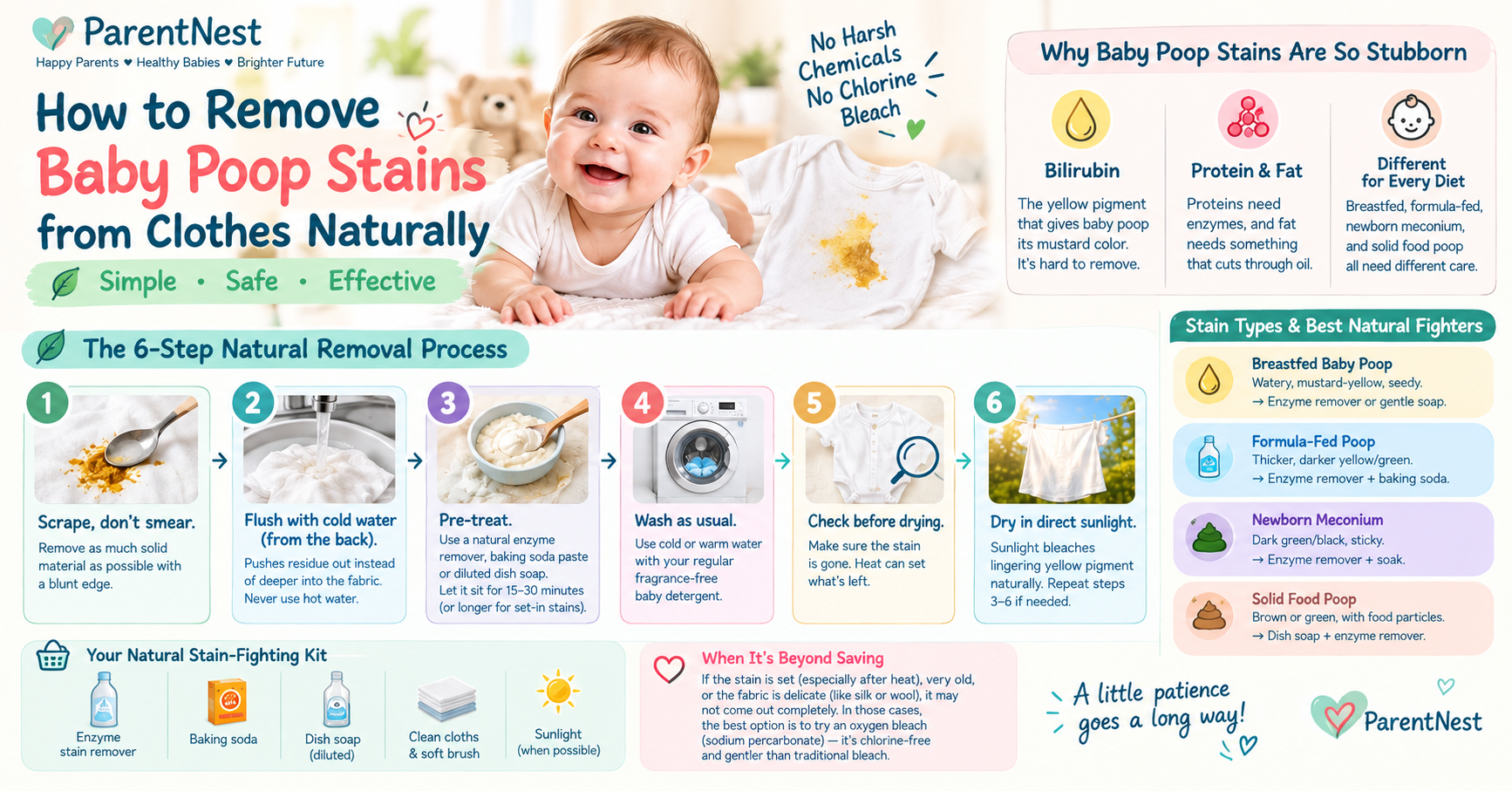
Act fast and cold — scrape off solids, flush the stain with cold water from the back of the fabric, and never use hot water or a hot dryer before the stain is fully gone, since heat sets protein-based stains permanently. Pre-treat with a natural enzyme-based stain remover, a baking soda paste, or diluted dish soap depending on the stain’s fat content, then let the item dry in direct sunlight, which naturally bleaches out lingering yellow pigment without any chlorine bleach at all. Oxygen bleach (sodium percarbonate) is a genuinely gentler, chlorine-free option for stubborn, set-in stains if you want extra power.
How To Remove Poop Stains From Baby Clothes Without Bleach Naturally
There’s a very specific kind of panic that sets in the first time a blowout climbs all the way up a newborn’s back and onto a onesie you genuinely liked, and the panic usually comes with a second layer: the stain dries a strange mustard-yellow that regular detergent barely touches, no matter how long you scrub. It isn’t your imagination, and it isn’t your detergent failing you. Baby poop is a genuinely more complicated stain, chemically, than most things that land on clothing, and the fix isn’t a stronger detergent — it’s a slightly different sequence of steps.
This article explains exactly what makes these stains so stubborn, walks through a natural, bleach-free removal process, breaks down what’s actually different between breastfed, formula-fed, newborn meconium, and solid-food poop stains, and covers a stain that almost no other guide on this topic mentions: turmeric and Indian food stains, which become a very real laundry problem the moment a baby starts eating dal and solids. Along the way, there’s also a simple kit worth keeping near the laundry area, a plan for when sunlight isn’t available, and an honest answer on when a stain is genuinely beyond saving.
Table of Contents
Why baby poop stains are unusually hard to remove
Bilirubin, the yellow pigment
The mustard-yellow color in baby poop, especially in breastfed newborns, comes largely from bilirubin, a yellow pigment that’s a normal byproduct of the body breaking down red blood cells. Bilirubin is a genuinely stubborn pigment to shift with ordinary detergent alone, which is exactly why these stains so often leave a faint yellow ghost behind even after a completely normal wash cycle.
Protein and fat
Beyond the pigment, baby poop also contains proteins and, depending on diet, a meaningful amount of fat. Regular detergent is reasonably good at general cleaning, but protein-based stains specifically respond much better to enzymes (more on this below) than to detergent surfactants alone, and fat-based residue needs something that can cut through oil rather than just lift dirt.
It’s different depending on what your baby eats
This is the detail most generic laundry advice skips entirely: a breastfed baby’s stool is chemically different from a formula-fed baby’s, which is different again from a baby who’s started solid food — and each one is, in a real sense, a different stain-removal problem, covered in detail below. Treating all three the same way, with the same single product and the same single step, is part of why a method that worked beautifully on a newborn’s milk-based stain sometimes seems to stop working entirely a few months later, once solid food enters the picture. It’s not that the method got worse — the stain itself changed.
The 6-step natural removal process
- Scrape, don’t smear. Remove as much solid material as possible with a blunt edge (a spoon, a dull knife) before it has a chance to grind further into the fabric fibers.
- Flush with cold water from the back of the fabric. Running cold water through the back of the stain pushes residue out the way it came in, rather than deeper into the weave. Never use hot water at this stage — heat denatures and sets protein-based stains almost immediately, turning a treatable stain into a permanent one.
- Pre-treat. Apply a natural enzyme-based stain remover, a baking soda paste, or a small amount of diluted dish soap directly to the stain (which one depends on the stain type — see the natural stain fighters section below), and let it sit for at least 15–30 minutes, longer for a set-in stain.
- Wash as usual in cold or warm water, with your regular fragrance-free baby detergent.
- Check before drying. Before putting the item in a dryer or letting it dry fully, check whether the stain is actually gone — heat-drying a stain that isn’t fully removed tends to set what’s left permanently, the same way hot water does.
- Dry in direct sunlight if any trace remains. Sunlight genuinely bleaches out lingering pigment, including bilirubin-based yellow staining, without any chemical bleach involved at all. Repeat steps 3–6 if a faint mark persists; most lingering stains respond to a second round rather than needing anything stronger.
Stain-by-stain: what’s actually different
Breastfed baby poop
Breastfed poop tends to be more watery, mustard-yellow, and seedy in texture, and because it’s water-based with a lower fat content than formula-fed stool, it generally responds well to the cold-water-flush-then-enzyme approach described above. The main challenge here is specifically the bilirubin pigment, which is why sunlight drying is particularly effective for breastfed poop stains.
Formula-fed baby poop
Formula-fed stool tends to be thicker, pastier, and higher in fat content than breastfed stool, with a different, often stronger odor. Because of the higher fat content, a dish soap pre-treatment (dish soap is specifically designed to break down grease) often works better here as a first pre-treat step than an enzyme spray alone, followed by the same cold-wash-and-sunlight sequence.
Meconium (the first days)
The very first stools a newborn passes, called meconium, are thick, black or dark green, and tar-like, and they behave more like an oil-based stain than a typical later poop stain, because of their high bile and mucus content. Treating meconium with a dish soap pre-treatment first (to break down the oily, sticky component) before moving to the enzyme and sunlight steps tends to work better than going straight for an enzyme spray, which is better suited to the protein-heavy stains that come later.
Solid food poop (once weaning starts)
Once a baby starts eating solid food, stool stains change again — they typically carry pigment from whatever was eaten (orange from carrots or sweet potato, deep yellow or brown from dal and turmeric-heavy foods, green from leafy vegetables) on top of the usual protein and bile components. These pigment-plus-protein combination stains are often the hardest of all to fully remove, and the turmeric-specific version of this problem gets its own section further down, since it deserves real, Indian-household-specific advice rather than a generic one-line mention.
Breast milk and formula spit-up stains
Spit-up stains are a close relative of poop stains chemically, since breast milk and formula are both protein- and fat-rich. For a fresh spit-up stain, rinse immediately in cold water from the back of the fabric, since any delay lets the protein begin to set, especially if it dries. For an already-dried stain, soak the item in cold water with a small amount of enzyme-based stain remover or a mild detergent solution for at least 30 minutes before washing, and finish with sunlight drying if any trace of yellowing remains — the same bilirubin-adjacent yellowing that shows up in poop stains can also show up in old milk stains, for similar underlying chemical reasons.
Natural stain fighters, explained
Cold water
The single most important, free tool in this entire process. Cold water loosens and flushes protein-based residue without cooking it into the fabric the way hot water does, and it should always be the first response to any fresh baby stain, regardless of what you plan to pre-treat with afterward.
Baking soda paste
A thick paste of baking soda and a small amount of water, worked gently into a stain and left for 15–30 minutes before washing, works through mild alkalinity and gentle abrasive action, lifting residue without any harsh chemicals. It’s a reasonable first-line pre-treatment, especially for lighter, fresher stains, and it’s something almost every household already has.
White vinegar
A short soak in diluted white vinegar (roughly a quarter to half a cup in a basin of cool water) can help loosen residue and reduce odor, working as a mild acid that breaks down some of the alkaline components in urine and stool stains specifically. As with laundry generally, never combine vinegar with chlorine bleach in the same step — this produces a hazardous gas.
Dish soap
Dish soap is formulated specifically to break down grease, which makes it a genuinely good choice as a first pre-treat step for fattier stains — formula-fed poop and meconium in particular — applied directly and worked gently into the fabric before the cold-water rinse and enzyme step.
Sunlight
Direct sunlight is sometimes called “nature’s bleach” for good reason: ultraviolet light breaks down many organic pigments, including the bilirubin responsible for a lot of baby poop staining, through a genuine chemical process called photobleaching. Laying a damp, stain-treated item flat or hanging it in direct sun for a few hours, ideally after washing rather than before, is one of the most effective, completely natural steps in this entire process, and it’s one that fits particularly well with the sun-drying routine many Indian households already use for baby laundry.
Enzyme-based stain removers
Enzymes — specifically protease for proteins, and often amylase and lipase in broader formulas for starches and fats — work by chemically breaking down the large molecules that make up a stain into smaller pieces that rinse away more easily. Many enzyme-based stain removers marketed as “natural” or “plant-derived” genuinely are enzyme-based without harsh synthetic solvents, though as with detergent generally, “natural” doesn’t automatically mean fragrance-free — check that label separately if your baby’s skin is sensitive.
Oxygen bleach — is it really “bleach”?
This deserves direct clarification, since the word “bleach” alone makes many parents understandably wary. Oxygen bleach (commonly sodium percarbonate) is chemically a completely different product from chlorine bleach. It works by releasing oxygen when dissolved in water, which helps break down stains, and it decomposes into soda ash, water, and oxygen — leaving no chlorine residue and generally considered significantly gentler on both fabric and skin than chlorine bleach. If you’re specifically trying to avoid chlorine bleach (likely, given this article’s focus), oxygen bleach is a reasonable middle ground to consider for a stubborn, set-in stain that doesn’t respond to the natural methods above — though if you’d prefer to stay entirely bleach-free in any form, the cold water, enzyme, dish soap, and sunlight combination above handles the large majority of baby stains without it.
Turmeric and Indian food stains — the one this topic usually skips
Almost every English-language guide on baby stain removal is written without a single mention of turmeric, which is a strange omission for an audience whose babies will, within months of starting solids, be eating dal, khichdi, and other turmeric-containing foods on a near-daily basis — and turmeric is one of the most notoriously stubborn stains in any household, baby-related or not.
Turmeric’s staining power comes from curcumin, a deeply colored pigment that binds strongly to fabric fibers and resists most standard detergents. A few things genuinely help:
- Treat it immediately. Turmeric stains become dramatically harder to remove once they’ve fully dried and set, more so than most other food stains.
- Avoid plain soap and water alone as a first response, since curcumin isn’t very water-soluble and soap alone often just smears it rather than lifting it.
- A paste of baking soda worked into the stain, left for 20–30 minutes, is a reasonable natural first step, similar to the general poop-stain approach above.
- Sunlight is especially effective on turmeric specifically. Curcumin is quite photosensitive, meaning it breaks down relatively quickly under direct UV exposure — this is part of why a turmeric-stained cloth left out in strong sun for a day often fades dramatically, sometimes more effectively than it would with a stain remover alone.
- A traditional remedy worth knowing: a brief soak in buttermilk or diluted yogurt, a method passed down in many Indian households, works because the mild lactic acid helps break down the curcumin pigment. It’s genuinely effective on fresh-to-moderate turmeric stains and costs nothing beyond what’s already in the fridge.
- Oxygen bleach is a reasonable escalation for a turmeric stain that doesn’t respond to the above, since turmeric is genuinely one of the harder stains to fully remove through natural methods alone, and a chlorine-free option is worth having in reserve for this specific stain if the gentler steps aren’t enough.
Given how often this particular combination (baby solids plus turmeric-heavy home cooking) comes up in daily Indian laundry, it’s worth treating turmeric as its own category rather than lumping it in with general “food stains” advice that doesn’t actually address curcumin’s specific chemistry.
Why skip chlorine bleach for baby clothes specifically
It’s worth being specific about why this article focuses on natural and oxygen-bleach methods rather than reaching for standard chlorine bleach, since chlorine bleach does technically remove many stains effectively.
The concern isn’t that chlorine bleach is universally dangerous — used correctly and rinsed thoroughly, many households use it safely on adult laundry. The reasons it’s generally discouraged specifically for baby clothing are more specific: chlorine bleach residue, even after rinsing, can be a skin irritant for a newborn’s more permeable skin barrier; the strong fumes released during use are more concerning in a small, enclosed laundry space when a baby may be nearby; repeated chlorine bleach use breaks down fabric fibers faster than gentler alternatives, shortening the life of clothes that are often already expensive relative to how briefly a baby wears them; and chlorine bleach can interact unpredictably with other stains (protein-based stains in particular can sometimes become harder to remove, not easier, if chlorine bleach is used on them before the protein is first broken down, since bleach can “set” certain organic stains if used out of sequence). None of this means an occasional, well-rinsed, diluted bleach use would cause obvious harm — it means the natural and oxygen-bleach alternatives above do the job just as well for the vast majority of baby stains, without needing to weigh these trade-offs at all.
Building a simple natural stain-removal kit
Most of what’s covered in this article can be handled with a small, inexpensive kit kept near the laundry area, rather than reaching for a different specialty product every time:
- Baking soda, for a general-purpose paste on fresh, lighter stains
- White vinegar, for odor and mineral/residue loosening in the rinse (never combined with chlorine bleach)
- A bar of plain dish soap or a small dish soap bottle, specifically for fattier stains like formula-fed poop and meconium
- A soft-bristled brush or an old toothbrush, for gently working a paste into a stain without aggressive scrubbing
- A natural or plant-based enzyme stain remover, for protein-heavy stains that baking soda alone doesn’t fully address
- Oxygen bleach powder, kept as an optional, occasional-use backup for stubborn, set-in, or turmeric stains, rather than a default first step
- A drying rack or line positioned to catch direct sunlight, which does more real work in this entire process than any single product on this list
Keeping these five or six items together, rather than scattered across different cabinets, makes the difference between treating a fresh stain within minutes (when it’s easiest) and discovering it already dried and set by the time you’ve found everything you need.
What if you don’t have reliable sunlight? (Monsoon and overcast alternatives)
Sun-drying isn’t always possible, particularly during the monsoon months across much of India, or in a home without good balcony or terrace access. A few workarounds help maintain most of the benefit:
- Extend the pre-treatment soak time rather than relying on sun exposure to finish the job — a longer enzyme or oxygen bleach soak (several hours rather than 15–30 minutes) compensates reasonably well for the absence of UV exposure.
- Dry near a bright, indirect light source (a well-lit window) when direct sun isn’t available — it’s less effective than direct sunlight but still offers some benefit over a dark, enclosed drying area.
- Use a fan or dehumidifier to dry items faster indoors during humid weather, since prolonged dampness itself can make a partially treated stain harder to fully remove and can encourage mildew odor on top of the original stain.
- Save genuinely stubborn stains for the next sunny day rather than giving up on the sunlight step entirely — a day or two’s delay, as long as the item has already been washed and isn’t left damp and soiled, doesn’t meaningfully worsen the outcome.
Stain removal by fabric type
Most baby clothing is a blend of cotton, cotton-synthetic mixes, or muslin, and the core process above works across all of them, with a few small adjustments worth knowing:
- 100% cotton and muslin hold up well to all the methods described, including a longer soak or a slightly more vigorous paste application, since natural fibers are generally more tolerant of baking soda and vinegar than synthetic blends.
- Synthetic blends (common in sleepsuits and outerwear) can sometimes hold onto oil-based stains (meconium, formula) more stubbornly than cotton, since synthetic fibers are often more oil-attracting; a slightly longer dish soap pre-treatment helps here specifically.
- Delicate or special-occasion fabrics (a christening outfit, an heirloom piece) are worth testing any pre-treatment on an inside seam first, since baking soda paste and vinegar are generally gentle but can behave unpredictably on unusual trims, embroidery, or dyes.
Cloth diaper stain removal
If you use cloth diapers, the same principles apply with a couple of cloth-diaper-specific notes. Always do a quick cold-water rinse or “dunk and swish” immediately after a change rather than letting soiled diapers sit, since the longer stool sits against absorbent fabric, the more it sets into the fibers. Avoid fabric softener on cloth diapers specifically — the residue it leaves reduces absorbency, which matters for a diaper’s actual function, not just its appearance (see ParentNest’s guide on fabric softener safety for more on this specific issue). Sun-drying cloth diapers does double duty here: it naturally bleaches out staining the way it does for regular clothing, and sunlight has a mild natural antimicrobial effect that’s a genuine bonus for diaper laundry specifically.
Preventing stains before they happen (realistically)
No amount of stain-removal skill beats not having the stain in the first place, though with a baby this can only ever be a partial strategy. A few habits genuinely reduce how often you’re dealing with a serious stain:
- Change diapers promptly rather than letting a soiled diaper sit, since stool that’s been in contact with fabric longer is harder to fully remove, particularly if it’s had time to dry.
- Use a larger bib during solid-food meals than feels strictly necessary, especially once turmeric-heavy foods are introduced, since a bib catching food before it reaches clothing saves considerably more laundry effort than any stain-removal method afterward.
- Keep a change of clothes and a small stain kit (even just a travel-size enzyme spray) in your diaper bag, so a stain can be rinsed or treated within minutes rather than hours after it happens, which is often the single biggest factor in whether a stain comes out easily or becomes a project.
- Size up slightly on sleepsuits with wide, easy-access necklines, since a tight neckline that a blowout has to pass through to be removed often spreads a stain further across the garment during the change itself.
None of this will prevent every stain — a baby’s digestive system runs on its own schedule — but a prompt response consistently makes the eventual stain-removal process shorter and more successful.
Rescuing old, set-in stains
A stain that’s already been through a hot wash or dryer cycle and set isn’t necessarily a lost cause, though it does need a more patient approach. Re-wet the area, apply a slightly thicker version of your chosen pre-treatment (a stronger baking soda paste, a longer dish soap application, or an oxygen bleach paste if you’ve decided to include it), and let it sit for several hours or overnight rather than the standard 15–30 minutes, before washing in cold water again. Repeat the sunlight-drying step even for a set-in stain — UV exposure over several hours on a sunny day can meaningfully fade a stain that survived an earlier wash cycle, sometimes requiring two or three rounds of sun exposure rather than a single afternoon.
Common mistakes that make stains worse
- Using hot water on a fresh stain. Heat sets protein-based stains almost immediately; always start cold.
- Drying a stained item before confirming it’s fully gone. A hot dryer does to a lingering stain exactly what hot water does — it locks it in, often permanently.
- Scrubbing hard instead of flushing from the back. Aggressive scrubbing tends to push residue deeper into the fabric weave rather than lifting it out.
- Assuming one wash cycle will fully remove a set-in or turmeric stain. Some stains genuinely need two or three rounds of pre-treat, wash, and sun exposure rather than a single pass.
- Skipping the solid-food context entirely. Once a baby starts solids, treating every stain the same way as a newborn’s milk-based stool misses the pigment component (carrot, turmeric, beetroot) that needs its own specific approach.
- Letting a soiled item sit in a closed laundry bag or hamper for days before washing. Beyond the obvious hygiene concern, a damp, enclosed environment lets bacteria continue breaking down residue in ways that can deepen a stain and its odor, making the eventual wash noticeably harder than it would have been with a quicker turnaround.
- Throwing several different unidentified stains into one wash without pre-treating any of them individually. A mixed load with several untreated stains often means every item comes out only partially clean, where separating and pre-treating each stain first, even briefly, gets meaningfully better results across the whole load.
Realistic expectations
Most fresh baby stains, treated promptly with the cold-water-plus-enzyme-or-dish-soap-plus-sunlight sequence, come out completely or close to it. Some stains — particularly turmeric, beetroot, and any stain that’s already been through a hot dryer cycle before treatment — may leave a very faint shadow even after a thorough natural process, and that’s a realistic, honest outcome rather than a sign you did something wrong. For light-colored or special-occasion clothing where a perfect result matters more, it’s reasonable to accept that a stubborn stain might need an oxygen bleach soak to fully disappear, while everyday onesies with a faint residual mark are, in practice, a completely normal part of having a baby.
It’s worth measuring success here against what actually matters rather than against a stain-free ideal that isn’t realistic for anyone with a small child. A onesie that’s clean, soft, and safe against your baby’s skin, with a faint shadow where a stain used to be, has met the actual goal. A spotless garment is a nice bonus when it happens, not the standard every piece of baby laundry needs to clear.
Real moments parents recognize
You might find yourself standing at the sink at 2 a.m., running cold water through the back of a onesie you’re fairly sure is already ruined, and feel a small, genuine satisfaction the next morning seeing the stain mostly gone after a few hours in the sun — a tiny parenting win that nobody else will ever know happened.
Or you might make dal for the first time since your baby started solids, and three days later discover an entirely new category of stain on a bib that your newborn-era stain knowledge didn’t prepare you for at all — turmeric, as it turns out, plays by different rules than milk and poop ever did.
Or you might toss a stained onesie straight into a hot dryer out of sheer exhaustion, only to find the stain permanently set the next time you look — which happens to nearly everyone at least once, and is a far more common mistake than a parenting failure.
Frequently Asked Questions
How do I remove poop stains from baby clothes without bleach? Scrape off solids, flush the stain with cold water from the back of the fabric, pre-treat with an enzyme-based stain remover, baking soda paste, or dish soap depending on the stain’s fat content, wash as usual, and finish by drying in direct sunlight, which naturally fades remaining pigment without any chlorine bleach.
Why do baby poop stains turn yellow? The yellow color, especially in breastfed babies, comes largely from bilirubin, a pigment produced as the body breaks down red blood cells. Bilirubin resists standard detergent fairly well, which is why these stains often leave a faint yellow mark even after a normal wash.
Does hot water set poop stains? Yes. Heat denatures and sets protein-based stains almost immediately, which is why cold water should always be the first response to a fresh baby stain, with hot water and the dryer avoided until the stain is confirmed fully gone.
Is oxygen bleach the same as chlorine bleach? No. Oxygen bleach (commonly sodium percarbonate) is chemically different from chlorine bleach, releasing oxygen to help lift stains and decomposing into soda ash, water, and oxygen with no chlorine residue, making it a considerably gentler option for fabric and skin.
Can you remove old, dried poop stains from baby clothes? Often, yes, though it takes more patience. Re-wet the stain, apply a stronger pre-treatment and let it sit for several hours or overnight, wash in cold water, and repeat sunlight drying, sometimes across two or three rounds, for a stain that’s already set.
Is dish soap safe to use on baby stains? Yes, in small amounts as a spot pre-treatment, particularly for fattier stains like formula-fed poop or meconium, since dish soap is specifically formulated to break down grease. Rinse thoroughly before washing with your regular baby detergent.
How is formula-fed baby poop different from breastfed poop for stain removal? Formula-fed stool tends to be thicker and higher in fat, which responds well to a dish soap pre-treatment first. Breastfed stool is more watery and bilirubin-rich, which responds particularly well to sunlight drying after the standard cold-water and enzyme steps.
How do I remove turmeric stains from baby clothes? Treat the stain as soon as possible, since dried turmeric is much harder to remove. A baking soda paste or a brief soak in buttermilk or diluted yogurt (a traditional remedy that uses mild lactic acid to break down the curcumin pigment) both help, and direct sunlight is especially effective since curcumin fades notably under UV exposure.
What’s the best way to remove meconium stains? Treat meconium, the newborn’s first tar-like stool, as an oil-based stain first — a dish soap pre-treatment to break down its sticky, bile-heavy component works better as a starting step than an enzyme spray alone, followed by the usual cold wash and sunlight drying.
Will a baby poop stain ever be impossible to fully remove? Occasionally, yes, particularly with turmeric, beetroot, or any stain that was accidentally set with heat before treatment. A faint residual mark on an everyday onesie after a thorough natural process is a realistic outcome, not a sign of doing something wrong.
Why shouldn’t I just use chlorine bleach if it works? Chlorine bleach residue can irritate a newborn’s more permeable skin even after rinsing, its fumes are a concern in a small space, it wears down fabric faster than gentler alternatives, and it can sometimes “set” certain protein-based stains if used before the protein is broken down. Natural methods and oxygen bleach achieve similar results for most baby stains without these trade-offs.
What should I keep on hand for baby stain emergencies? A simple kit of baking soda, white vinegar, plain dish soap, a soft brush, a natural enzyme-based stain remover, and optionally oxygen bleach powder covers nearly every stain type discussed here, especially if kept together near the laundry area for quick access.
What if I don’t have access to direct sunlight for drying? Extend the soak time with your chosen pre-treatment instead, dry near a bright window if direct sun isn’t available, and save particularly stubborn stains for the next sunny day rather than abandoning the sunlight step altogether.
Does the type of fabric affect how well these methods work? Mostly not significantly — cotton and muslin tolerate all the methods described well, synthetic blends can hold onto oily stains like meconium or formula slightly more stubbornly and may need a longer dish soap pre-treatment, and delicate fabrics are worth spot-testing on an inside seam first.
Can I use these same natural methods on grass, food, or other non-poop stains on baby clothes? Yes, largely. Cold water first, a baking soda or dish soap pre-treatment matched to whether the stain is more protein-, pigment-, or fat-based, and sunlight drying apply reasonably well across most organic stains a baby’s clothing picks up, not just poop and milk specifically.
Final thoughts
None of this requires a cabinet full of specialty products or a bottle of chlorine bleach. Cold water, a pinch of patience, something already in most kitchens (baking soda, vinegar, dish soap), and a bit of actual sunlight handle the overwhelming majority of what a baby’s laundry throws at you — including, eventually, the turmeric stains nobody warns you about before the dal starts. The stain that looks permanent on the counter at midnight is very often gone, or close to it, by the time it’s dried on the line the next afternoon.
And on the nights when it isn’t — when a stain genuinely won’t budge, or the sun doesn’t come out for a week, or you’re simply too tired to run through six steps for one small onesie — that’s fine too. A faint shadow on a well-loved baby garment has never been evidence of anything except a baby who actually wore it, got fed, got changed, and got on with the ordinary, slightly messy business of growing up.