Physical Address
304 North Cardinal St.
Dorchester Center, MA 02124
Physical Address
304 North Cardinal St.
Dorchester Center, MA 02124

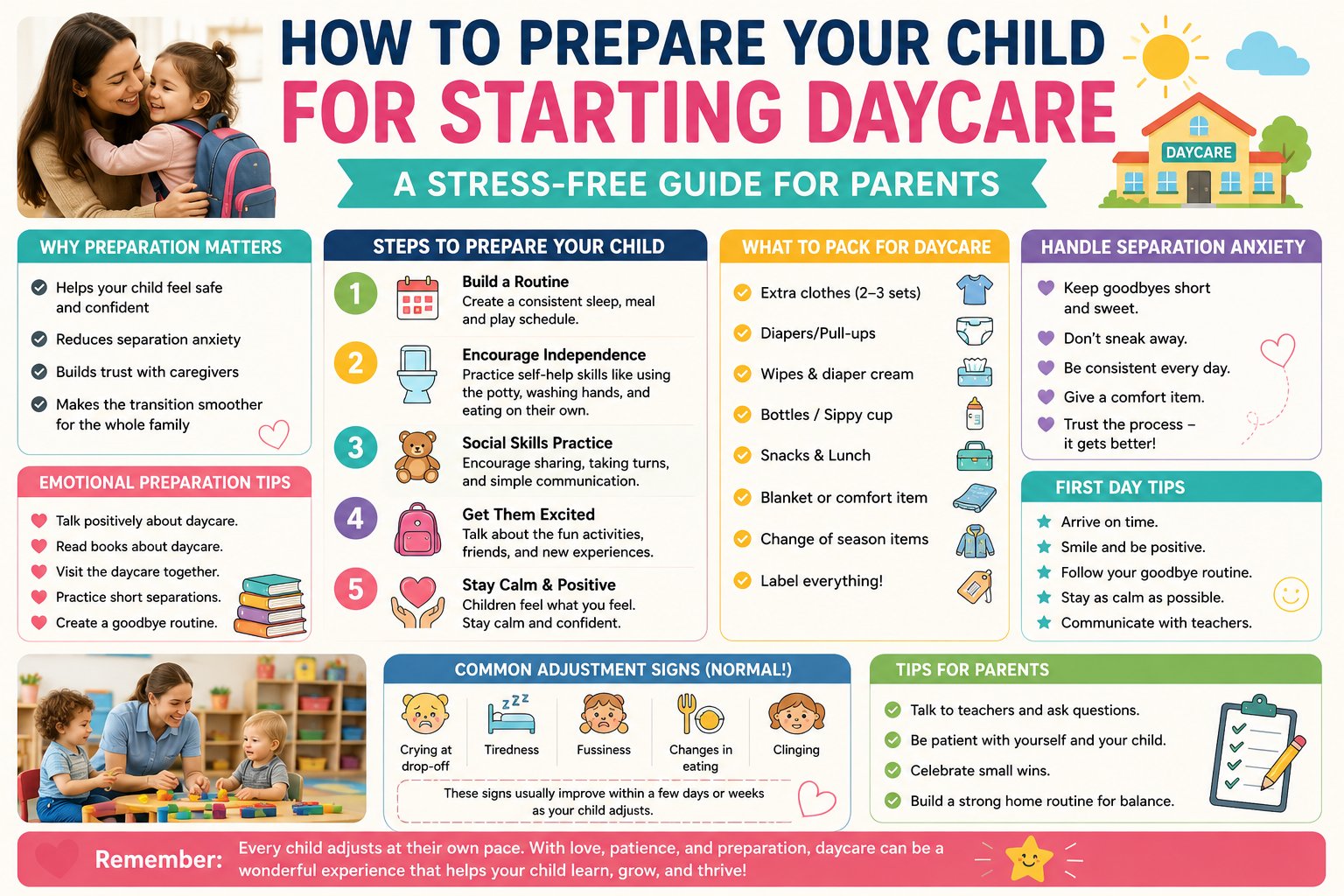
Starting daycare is one of the biggest transitions in your child’s early life. And honestly, it is one of the biggest transitions in yours too. You are not just dropping your child at a new place. You are handing them into the care of people who do not know yet that they like their toast slightly burnt or that they need ten minutes of quiet after waking before they are ready to talk to anyone. You are leaving your child in a world that is not yet familiar to them, with a routine that is not yet theirs, surrounded by children they have not yet met.
That is a genuinely big deal. And knowing how to prepare your child for starting daycare — really prepare them, not just in a ‘read one book and have a chat’ kind of way — is one of the most valuable things you can do in the weeks and months before the first day.
This guide is not about making daycare easy. It is not about pretending the transition is simple or that there is a formula that eliminates the difficult feelings. There is not. What this guide will give you is a clear, honest, practical plan for how to prepare your child for starting daycare in a way that is grounded in how young children actually develop, how attachment and separation work, and what the families on the other side of a smooth daycare start actually did in the weeks leading up to it.
Whether your child is six months old or two and a half years old, whether they are going to a large nursery or a small childminder, and whether you have six months to prepare or six weeks — this guide has something real and useful for you.
Some parents wonder whether all this preparation really changes anything. After all, children adapt. They are resilient. Plenty of children have started daycare without much preparation and turned out completely fine. So why does it matter?
The answer is that preparation does not guarantee an easy start. But it significantly improves the odds of a smoother one. And more than that, it changes the quality of the experience — for your child, for you, and for the daycare staff who are trying to build a relationship with your child from day one.
Young children — particularly babies and toddlers — experience the world primarily through their sense of what is familiar and safe versus what is unfamiliar and uncertain. The amygdala, the part of the brain that processes threat and fear, is fully developed from birth. The prefrontal cortex, which handles reasoning, planning, and emotional regulation, is not mature until the mid-twenties. This means that young children are biologically wired to respond to novelty with caution and to familiarity with calm.
When you prepare your child for starting daycare — by visiting the setting beforehand, by talking about daycare at home, by building familiarity with the key worker before the first day — you are literally building familiarity pathways in your child’s brain. You are making the daycare environment less novel, less uncertain, and therefore less threatening. That is not a small thing. That is the difference between a child who walks into daycare on day one and freezes, and one who walks in and immediately recognises something they know.
Here is something that does not get said nearly enough when people talk about how to prepare your child for starting daycare: your own confidence and emotional state on that first day matters just as much as your child’s preparation.
Young children are extraordinarily sensitive to their parents’ emotional signals. They pick up on anxiety, guilt, and ambivalence with a speed and accuracy that constantly surprises the adults who observe it. A parent who is genuinely confident — not falsely cheerful, but genuinely calm and positive about the daycare choice — gives their child implicit permission to be okay with it too.
Preparing your child for starting daycare properly, choosing the right setting carefully, doing settling-in visits, building a goodbye routine — all of these things build your confidence as well as your child’s readiness. That confidence is something your child feels on the first day. It matters.
A child who has been properly prepared for starting daycare is also a child who the daycare staff can support more effectively from day one. When the key worker already knows your child’s routine, their preferences, their comfort object, their favourite song, and the words you use for familiar things — they can provide care that feels continuous rather than alien.
That continuity does not happen by accident. It happens because parents took the time to communicate it, to write it down, to share it in detail during settling-in visits. Preparing your child for daycare is partly about what you do with your child in the weeks before. And it is also about the work you do to build the relationship between your child and their key worker before the official start date.
The answer to this question depends on how old your child is, how much time you have before the start date, and how your child typically handles new situations.
As a general guide, begin active preparation at least four to six weeks before the start date. If your child is under twelve months, two to three weeks of focused preparation alongside good settling-in visits is usually sufficient. For toddlers between twelve months and three years — the age group who typically find daycare transitions most challenging — six to eight weeks of gradual preparation is ideal.
If you have less time than that, do not panic. Do the most impactful things first: settling-in visits, the goodbye routine, and the comfort object preparation. The other elements of preparation add value but these three are the foundation.
And if you have more time — three months or more — be careful not to over-prepare. Talking about daycare every single day for three months creates more anxiety in some children, not less. Mention it regularly, but keep it light and natural rather than turning it into a prolonged build-up that gives the event outsized significance.
If you ask experienced daycare staff what makes the single biggest difference to how a child settles in, almost all of them will say the same thing: settling-in visits. Done properly. Not rushed. Not treated as a formality.
Settling-in visits are the short sessions before your child’s official start date where you and your child visit the daycare together. They serve an irreplaceable function in preparing your child for starting daycare because they allow your child to build familiarity with the environment, the key worker, and the routine — while you are still there as a safe base.
Most quality daycare centres will offer between two and five settling-in sessions of varying lengths. A typical progression looks something like this.
This progression does not need to follow a strict script. Every child is different. Some children separate easily on the second visit. Others need more time. The key is reading your child, not rushing the process for the sake of a start date.
💡 The most common mistake parents make with settling-in visits is treating them as something to get through rather than something to invest in. A parent who is physically present but mentally somewhere else during a settling-in visit gives their child almost nothing. Be present. Be calm. Let the key worker engage with your child. Watch how your child responds to the environment and share what you observe with the key worker.
Your role during settling-in visits is to be a calm, present anchor — not an entertainer, not an anxious hovercraft. Sit near your child but not constantly on top of them. Let them move away from you and come back to you. This is called the secure base exploration model and it is exactly how healthy attachment works: your child ventures out, glances back to check you are there, and then goes further when they feel safe.
When the key worker approaches your child during a settling-in visit, do not jump in and manage the interaction. Let it develop naturally. If your child comes back to you, welcome them briefly and then gently encourage them back towards the room or the key worker. ‘Look, you can show her the train set.’ This kind of bridge-building helps your child see the key worker as connected to you rather than as a replacement for you.
Use settling-in visits to share information about your child. Tell the key worker how your child takes a nap, what their favourite toy is at home, what they call their comfort object, how they prefer to be comforted when upset. This information is gold for a key worker trying to build a relationship with a new child. Share it freely and in detail.
Some daycare settings do not have a formal settling-in programme. If this is the case, ask whether you can arrange informal visits anyway. Most centres will accommodate a request to come in with your child for an hour before the official start date, even if it is not part of their standard process. If a centre is actively resistant to this request, that is worth noting as a reflection of their approach to partnerships with parents.
If visits are genuinely impossible — for logistical reasons rather than centre resistance — focus extra attention on the other preparation strategies in this guide. Build familiarity through books, through talking about daycare at home, through driving past the building, and through making the comfort object extra meaningful. You are compensating for the missing in-person familiarity-building in other ways.
How you talk to your child about starting daycare in the weeks before they start is one of the most powerful preparation tools available to you. The conversations you have, the words you use, the emotional tone you set — all of these shape your child’s expectation of what daycare is going to be like.
This is the golden rule for talking to young children about daycare. Simple means one or two sentences, not a detailed explanation. Positive means framing it as something good, not as something scary that they need to be brave for. Honest means not lying or making promises you cannot keep.
A good example for a toddler: ‘Soon you are going to a new place called daycare. There are toys there and children to play with. The kind lady called Sarah will look after you. And I will always come back and get you.’
Notice what this does. It names the place. It gives a positive preview of what is there. It names the key worker so the person becomes familiar before the first meeting. And it ends with the most important reassurance a young child can receive: I will always come back.
Repeat this kind of message regularly but lightly. You do not need to have a big sit-down conversation every day. A casual mention while you are doing something else — getting dressed, having bath time, in the car — is actually more effective because it normalises the subject rather than making it feel like a big, serious event.
⚠️ Never say things like ‘You are going to love daycare!’ as a blanket assertion, especially if your child is sensitive or anxious. If they do not immediately love it, that contradiction between your promise and their experience damages their trust in your reassurances. Instead, say ‘I think you will find some things you enjoy there’ or ‘There are lots of things to explore.’ Positive but honest.
Many parents avoid mentioning the separation directly because they do not want to introduce the idea of you leaving as something to worry about. But avoiding it does not help. Your child is going to experience the separation. Naming it gently beforehand is more reassuring than letting it come as a complete surprise.
You can say something like: ‘When we go to daycare, I am going to give you a big hug, and then I am going to leave. I will not be there all day. But Sarah will look after you and I will come back and get you when it is time to go home.’
This kind of explicit, calm description of exactly what will happen removes the element of shock from the first goodbye. Your child has heard this story before. When the goodbye arrives, it is recognisable rather than terrifying.
For older toddlers who can understand time references, give them a concrete point to anchor the reunion. ‘I will come back after your afternoon snack.’ This is more useful than ‘I will be back at four o’clock’ because toddlers do not yet understand clock time but they do understand the daily schedule of snack, sleep, play.
One of the simplest and most underused strategies for preparing your child for starting daycare is simply saying the key worker’s name out loud at home. Often. Casually. Repeatedly.
‘Sarah is the person who will read you stories at daycare.’ ‘I think Sarah will love that you know all the dinosaur names.’ ‘We are going to see Sarah at your settling-in visit tomorrow.’
By the time your child meets the key worker at the settling-in visit, Sarah is already a known name. And a known name feels safer than a stranger’s name. This tiny, free, effortless strategy genuinely reduces the strangeness of the key worker when they first meet — and the key worker relationship is the heart of how well your child settles.
Children process their experiences, their fears, and their feelings through stories. This is not a figure of speech. It is a literal description of how the young child’s brain makes sense of the world. Stories provide the narrative structure and the emotional language that young children need to understand experiences they have not yet had.
A book about starting daycare, read together in the weeks before the first day, does several things at once. It introduces the concept of daycare in a safe, low-stakes way. It shows the child that other children go through the same thing. It gives the child the emotional vocabulary to talk about how they feel about it. And it creates a shared reference point — ‘Remember in the book when the boy was sad at drop-off but then he found the painting corner? Maybe that will happen to you.’
Read these books multiple times, not just once. Toddlers process through repetition. A book read ten times has far more impact than a book read once. Let your child ask questions during reading and answer them honestly and simply. Let them look at the pictures. Let them role-play the story with their toys afterwards if they want to.
✅ After reading a daycare book, try asking your child: ‘How do you think the little bunny felt when his mummy left?’ This kind of question — about the character’s feelings rather than directly about your child’s feelings — gives your child a safe way to explore their own emotions without feeling put on the spot.
The comfort object is one of the most powerful tools you have when you are thinking about how to prepare your child for starting daycare. And yet many parents underestimate it, forget to introduce it in time, or send it to daycare only as an afterthought.
A comfort object is any item your child has formed a strong emotional attachment to — a soft toy, a particular piece of blanket, a muslin, a small teddy. These objects are not a crutch or a sign of insecurity. They are a developmentally healthy tool for self-regulation. When a child holds their comfort object, they experience a measurable reduction in cortisol — the stress hormone — and an increase in the sense of safety and calm.
If your child already has a strong comfort object, send it to daycare with them every single day. Tell the key worker what it is, what your child calls it, and how they use it. ‘Bunny goes with him for naps and when he is upset. He calls him Bun-Bun.’ This information allows the key worker to use the comfort object as a settling tool at exactly the right moments.
If possible, have two identical copies of the comfort object. This is not always possible, especially for items that have been loved since babyhood and have a specific worn-in quality that cannot be replicated. But if your child has recently formed an attachment to a toy that is still available to buy, consider getting a second one. Keep one at home and one that rotates through daycare. This way a lost or damaged comfort object does not become a crisis.
If your child has not yet developed an attachment to a particular object, you have time to help them build one — but you need to start at least four to six weeks before daycare begins.
Choose a small, soft, easy-to-carry object. Sleep with it for several nights so it carries your scent — this sounds slightly unusual but it is a completely evidence-backed strategy. Your child associates your smell with safety and comfort, and an object that smells like you provides a physiological comfort cue even in your absence.
Then introduce the object warmly and consistently. Bring it into your daily routine. ‘Here is your rabbit. He is going to keep you company at naptime.’ Include it in cuddle times and soothing moments. Over four to six weeks, most children will begin to form an attachment. It will not be the same as an organically formed attachment of two years, but it will be something real and useful.
🔖 Name the comfort object. A child who has a named comfort object — ‘Bunny’, ‘Teddy’, ‘Blue Blanket’ — has a relationship with it. That name is the first step in the object becoming a genuine companion rather than just an item. Use the name consistently so your child hears it as something with identity.
Alongside the comfort object, many families find enormous success with a simple photo card. This is exactly what it sounds like: a small laminated card with a family photo on it, and a short message: ‘I love you. I will always come back.’ The card goes in the daycare bag or directly with the comfort object.
For older toddlers who are verbal, the key worker can use the photo card during difficult moments in the day — ‘Look, there is your mummy. She loves you so much. She is going to come back when the day is done.’ For younger babies, the familiar face in a photograph carries genuine comfort even before language is developed.
The photo card costs nothing. It takes five minutes to make. And the number of parents who report that the key worker used it as a settling tool in those early weeks makes it one of the most consistently impactful preparation strategies in this entire guide.
One of the most practical and underappreciated aspects of how to prepare your child for starting daycare is building their sense of independence before the first day. Not independence from you — secure attachment to you is a strength, not a problem. Independence in the sense of being able to engage with an environment, explore, and manage short periods of adult attention being directed elsewhere.
Children who have very little experience of anything other than constant one-to-one adult attention can find the daycare environment — where one adult cares for several children simultaneously — genuinely disorienting at first. Not because anything is wrong with the daycare, but because the ratio of adult attention per child is simply different from what they are used to at home.
In the weeks before starting daycare, gently build your child’s capacity for independent play. This does not mean ignoring your child or withdrawing warmth. It means gradually increasing the periods where your child plays without you actively directing or being part of the play.
Start small. If your child currently needs you actively engaged in every play session, begin by sitting nearby but not directing — ‘I am going to sit here and drink my tea while you build your tower.’ Then progress to being in the same room but occupied with something else. Then progress to briefly leaving the room while your child continues playing.
This progression — done gradually and warmly, always returning before your child becomes distressed — builds genuine independent play capacity. And a child who can play independently for fifteen minutes at home will adapt far more readily to the group play environment of a daycare.
If your child has had limited experience of other children — if they are your first child, if they have been primarily in home care, if you live somewhere without many local children — try to build in some group experiences before daycare starts.
Toddler groups, playgrounds, soft play centres, visits to friends who have children of a similar age — any of these gives your child practice at navigating a social environment with other children. Not because daycare will be exactly like any of these, but because the experience of other children’s noise and movement and unpredictability becomes slightly more familiar. And familiar is always better than unfamiliar when it comes to how a young child copes with a new environment.
✅ Do not worry if your child is not particularly social or confident at these groups. The goal is exposure, not performance. A child who sat on your lap and watched other children for forty minutes at a toddler group has still gained something real. They have seen children their age and survived the experience. That matters.
One of the most effective ways to prepare your child for starting daycare is to practise very short separations at home before the first day. This is not about toughening your child up. It is about giving them repeated experiences of the thing they fear most about daycare — you leaving — followed immediately by the thing they need to know — you coming back.
Start tiny. Leave the room for thirty seconds to get something from another room. Come back. ‘I went to get my book. I came back. I always come back.’ Then extend gradually — two minutes, five minutes, ten minutes. Leave your child with another trusted adult for an hour or two. Each of these experiences adds to your child’s growing evidence that separation is temporary and that you always return.
This is called building a ‘reunion template’ — your child’s brain begins to expect that separations end in reunions. That expectation is one of the most protective things you can give a child heading into daycare.
The practical side of how to prepare your child for starting daycare includes aligning their sleep and daily routine with the daycare’s schedule before the first day. This is one of the most concrete and immediately impactful preparation steps you can take, and it is often overlooked entirely until the first week has already started.
During your settling-in visits or in a conversation with the key worker, ask for a copy of the daily schedule. When are meals? When are nap times? When is outdoor play? When are quieter activities? You want to know the rhythm of the day so you can begin adapting your child’s home routine to approximate it in the weeks before starting.
This does not mean completely overhauling your home schedule. It means making adjustments where you can. If the daycare has lunch at eleven-thirty and your child usually eats at one, begin moving lunch gradually earlier in the two weeks before starting. If the daycare has nap time at twelve-thirty and your child usually naps at two, begin shifting nap time earlier in small increments.
Small adjustments over two to three weeks land your child in a schedule that is already reasonably aligned with daycare before they start. This means their body clock is not having to adjust to a completely foreign schedule on top of adjusting to a completely foreign environment. You are removing one layer of difficulty from the first week.
For babies and very young toddlers, nap timing is particularly important because overtiredness dramatically increases emotional vulnerability. A baby who misses a morning nap at daycare because the timing is off from their usual sleep window will be significantly harder to settle by the afternoon — both at daycare and at home in the evening.
Share your child’s nap schedule in detail with the key worker. Write it down. ‘She usually needs to go down for her first nap about ninety minutes after waking. She needs to be in a quiet space and she settles best with gentle patting on the back and a white noise machine.’ The more specific you are, the better the key worker can support your child’s sleep in the early weeks.
If your baby has a very strong sleep association that relies on you — feeding to sleep, for example — it may be worth gently introducing alternative settling strategies in the weeks before starting daycare. Not to remove all of your baby’s sleep associations at once, which would be its own challenge, but to give them one alternative strategy that does not require you specifically — a rocking motion, a particular song, a sleep sack.
The morning of a daycare day runs better when the wake-up time and morning routine are already well established. If your child is used to a consistent wake time and a predictable morning sequence — which we cover in detail in our morning routine for toddlers guide — then the daycare morning adds a known destination to a familiar beginning. If the morning is usually unpredictable, the additional stress of the daycare drop-off can tip the morning from manageable to chaotic.
In the weeks before starting daycare, work on establishing a consistent wake time and a simple morning routine. You do not need to have the whole morning perfected before the first day. But you do need enough of a routine that your child knows what happens in the morning and how the day begins. That foundation makes the transition out of the house and into daycare significantly smoother.
The single most impactful thing you can do to prepare your child for starting daycare is to develop and practise a consistent goodbye routine before the first day. This might sound overly simple. It is one of the most evidence-backed strategies in early childhood attachment research.
Young children manage transitions best when they know what to expect. The moment of separation at daycare drop-off is inherently uncertain for a child who has never done it before. A goodbye routine removes that uncertainty. When the goodbye follows the same pattern every single time, it becomes something your child can predict, prepare for, and move through — rather than something that ambushes them.
The routine also gives the goodbye a clear ending. Without a routine, goodbyes can blur into a drawn-out period of lingering and uncertainty that is far harder for children than a brief, clear, warm separation. The routine is the signal that the goodbye is complete. What comes after the routine is the daycare day. What comes after the daycare day is you coming back. That sequence becomes the story your child tells themselves.
Your goodbye routine can involve anything that feels natural and warm. The content matters less than the consistency. Here are the elements of an effective goodbye routine for daycare drop-off.
Practise this routine at home before the first day. Play ‘daycare drop-off’ with your toddler. You be the parent, they be the child. Or they be the parent, the stuffed toys be the children. Role-play is one of the most powerful ways toddlers process anticipated experiences. A goodbye routine that has been played through many times at home is much less shocking when it happens for real.
⚠️ Never sneak out of daycare without saying goodbye, even if your child seems distracted or it seems like it would be easier. Research consistently shows that children whose parents leave without a goodbye have higher drop-off anxiety over time, not lower. They cannot trust that the goodbye will happen before the parent leaves. The goodbye routine, however hard it is, is the kindest and most effective approach every time.
Some goodbyes will be terrible. Your child will cry. They will cling. They will reach for you as you walk away. This is normal and it does not mean your preparation has failed.
Do the routine. Say goodbye. Leave. Trust the staff.
The research on daycare drop-off goodbyes is very clear: most children who cry at drop-off stop within minutes of the parent leaving. Some within seconds. The goodbye is the hardest moment. What follows is almost always much better than it looks from the doorway.
If you need to, call the centre thirty minutes after drop-off for a quick update. Most of the time, the staff will tell you your child is completely fine. Let that evidence build over the first week. Because the evidence is almost always the same: they cried at goodbye, and they were fine by the time the morning snack was on the table.
Just as important as the preparation strategies that work are the approaches that do not — and that can actually make the transition harder. Here are the most common mistakes to avoid.
Talking about daycare every single day for months, in extended anxious conversations, can build the event into something with an anxiety-inducing level of significance. Prepare steadily and consistently — not obsessively. A casual mention three times a week is more effective than a daily debriefing session.
‘You are going to love it’ is a promise you cannot keep. Some days at daycare are hard. Some days your child will not enjoy it. If you have promised them they will always love it and then they do not, they lose trust in your reassurances. Say instead: ‘There will be good things there. And if there are hard things, the kind people there will help you.’
A long, drawn-out, uncertain goodbye is harder on a toddler than a brief, warm, confident one. The longer you linger, the more your child’s anxiety builds. Do your routine. Say goodbye. Go. This sounds harsh and it is the kindest thing you can do.
Your feelings are completely valid. Your anxiety about leaving your child in daycare is normal and understandable. But manage those feelings away from your child wherever possible. Save the tears for the car, not the doorway. Your child is reading your emotional signals constantly and your anxiety, if visible, tells them this is something to be anxious about.
Settling-in visits sometimes feel logistically difficult to arrange around existing work or childcare commitments. The temptation is to skip them and just start on the official date. This almost always makes the first week harder, not easier. Find a way to do the settling-in visits. Even one or two proper visits are enormously better than none.
Start active preparation four to six weeks before the start date for most children. For toddlers between twelve and thirty months — the age group who typically find the daycare transition most challenging — six to eight weeks of gradual preparation is ideal. This gives enough time to do proper settling-in visits, to introduce or strengthen a comfort object, to practise the goodbye routine at home, and to begin aligning your child’s daily schedule with the daycare’s rhythm. If you have less time than this, focus on the three most impactful steps: settling-in visits, the comfort object, and the goodbye routine. If you have much more time, prepare steadily but do not let daycare become the only topic of conversation.
Yes, but the preparation looks different for babies than for toddlers. Babies under twelve months cannot understand verbal explanations about what daycare will be like, so book-based preparation and conversations are less relevant. What matters most for babies is settling-in visits so they begin to build familiarity with the key worker’s face, voice, and touch before the official start. Preparing a comfort object that carries your scent is particularly effective for very young babies. Sharing detailed written information about your baby’s routine with the key worker is also essential — feeding schedule, sleep cues, preferred soothing methods. The goal for babies is familiarity with the environment and the person, not intellectual understanding of the concept.
Always say a proper goodbye. Never sneak out. This is one of the most clearly supported recommendations in child development research on separation and daycare transitions. Children who are snuck away from feel ambushed by the disappearance and learn that they cannot trust that a goodbye will happen before a parent leaves. This increases drop-off anxiety over time rather than reducing it. A brief, warm, confident goodbye — even if your child cries — is always better than leaving without warning. Practise your goodbye routine at home so it is familiar and predictable before the first day.
No. A child who is securely attached to their parent and who attends a quality daycare with a warm and responsive key worker will not be traumatised by the daycare experience. Secure attachment is robust. It is not broken by hours of separation. What matters is the quality of the care your child receives when you are not there — which is why choosing the right daycare is so important — and the quality of your relationship with your child at home. The loving, consistent relationship you have built with your child is exactly what gives them the resilience to handle a daycare transition. If you have concerns about a specific child who seems particularly sensitive or who has had previous difficult separations, speak to your health visitor or GP for tailored guidance.
Most children benefit from between two and five settling-in sessions of gradually increasing length. The key indicator is not a number but your child’s response: are they beginning to show some familiarity and comfort in the daycare environment? Are they beginning to engage with the key worker, even if briefly? A child who is still completely frozen and distressed after five settling-in visits may need more time before the official start, and it is worth having an honest conversation with the centre about this. Most good daycare settings would rather extend the settling period than push a child to start before they are ready.
A clingy child is almost always a securely attached child, and secure attachment is a strength even when it makes daycare transitions harder. Prepare a very clingy child in the same ways as any other child, but give extra weight to the gradual separation practice at home and the settling-in visits. Practise very short, very predictable separations at home — starting with leaving the room for thirty seconds and returning. Build up very slowly. Use the goodbye routine consistently in practice runs at home. Make the comfort object as strong as possible. And choose a daycare with high staff ratios and a genuinely warm key worker who understands how to build trust slowly with a cautious child. A clingy child given time, consistency, and a warm key worker typically settles beautifully — sometimes to the great surprise of their parents.
Do nothing. Do not push it. Do not apologise excessively to the key worker. Do not try to engineer interaction. Simply be present and calm, let your child stay close to you, and allow the key worker to engage at whatever pace your child is comfortable with. Experienced daycare key workers know exactly how to build trust with a reluctant child and they will not take your child’s initial reticence personally. Most children who completely ignore the key worker in the first two settling-in visits are sitting on the key worker’s lap by the fourth. Trust the process and let it unfold naturally.
Daycare readiness is less about a specific developmental milestone and more about the quality of the care environment you have chosen. Babies can start daycare from a few months old and settle well with the right key worker and a good ratio. Toddlers of any age can be ready for daycare if the setting is warm, small-group, and responsive. Signs that can indicate good readiness include some ability to separate briefly from a parent without total distress, some interest in other children, some capacity for independent play for short periods, and a basic ability to communicate needs even if non-verbally. But none of these are prerequisites. Children without all of these signs settle well in quality daycare settings every day.
Your child’s daily routine sheet for the daycare should be detailed and specific. Include wake-up time, feeding schedule with amounts and timings, nap times and duration, how your child is usually settled to sleep, favourite foods and known allergies, words your child uses for key things like toilet or drink, what soothes them when upset, their comfort object’s name and how they use it, any medical information including medication, names of immediate family and how they relate to the child, and emergency contacts. Do not assume the staff will work this out over time. The more specific you are on paper, the better the care your child receives from day one. Update the sheet whenever something significant changes.
Yes, this is extremely common and it has a name: the novelty effect. During settling-in visits, the environment and the people are new and interesting enough that your child’s curiosity overrides their anxiety — especially while you are present. On day one of the official start, the novelty has worn off slightly, the reality of you leaving becomes concrete, and the emotional response arrives in full force. This does not mean the settling-in visits did not work. It means the visits built familiarity with the environment and the key worker — which is what allowed your child to get through the first day at all. Keep going. Day two is almost always easier than day one. Day five is almost always easier than day two. Trust the timeline.
Preparing your child for starting daycare is not about engineering a perfect, tearless first day. There probably will be tears — yours, theirs, possibly both at the same time. That is not failure. That is love, doing what love does when it faces a transition.
What preparation does is this: it removes the element of complete surprise from the equation. It gives your child some familiar territory in an unfamiliar place. It gives the key worker a fighting chance of knowing who your child is before they have had three weeks to figure it out. It gives you the quiet confidence that you have done everything you could, and that the people you have chosen are capable of doing the rest.
The families who navigate the daycare start most smoothly are not the ones whose children never cried at drop-off. They are the ones who chose carefully, prepared consistently, trusted their gut, and kept showing up every morning with warmth and calm — even on the mornings that were genuinely terrible.
You will get there. So will your child. And a few months from now, you will stand at that daycare door watching them run in without looking back, and you will feel something that is equal parts pride and relief and the tiniest thread of loss — because that is what it looks like when you have prepared your child well for something.
Go do it well.