Physical Address
304 North Cardinal St.
Dorchester Center, MA 02124
Physical Address
304 North Cardinal St.
Dorchester Center, MA 02124

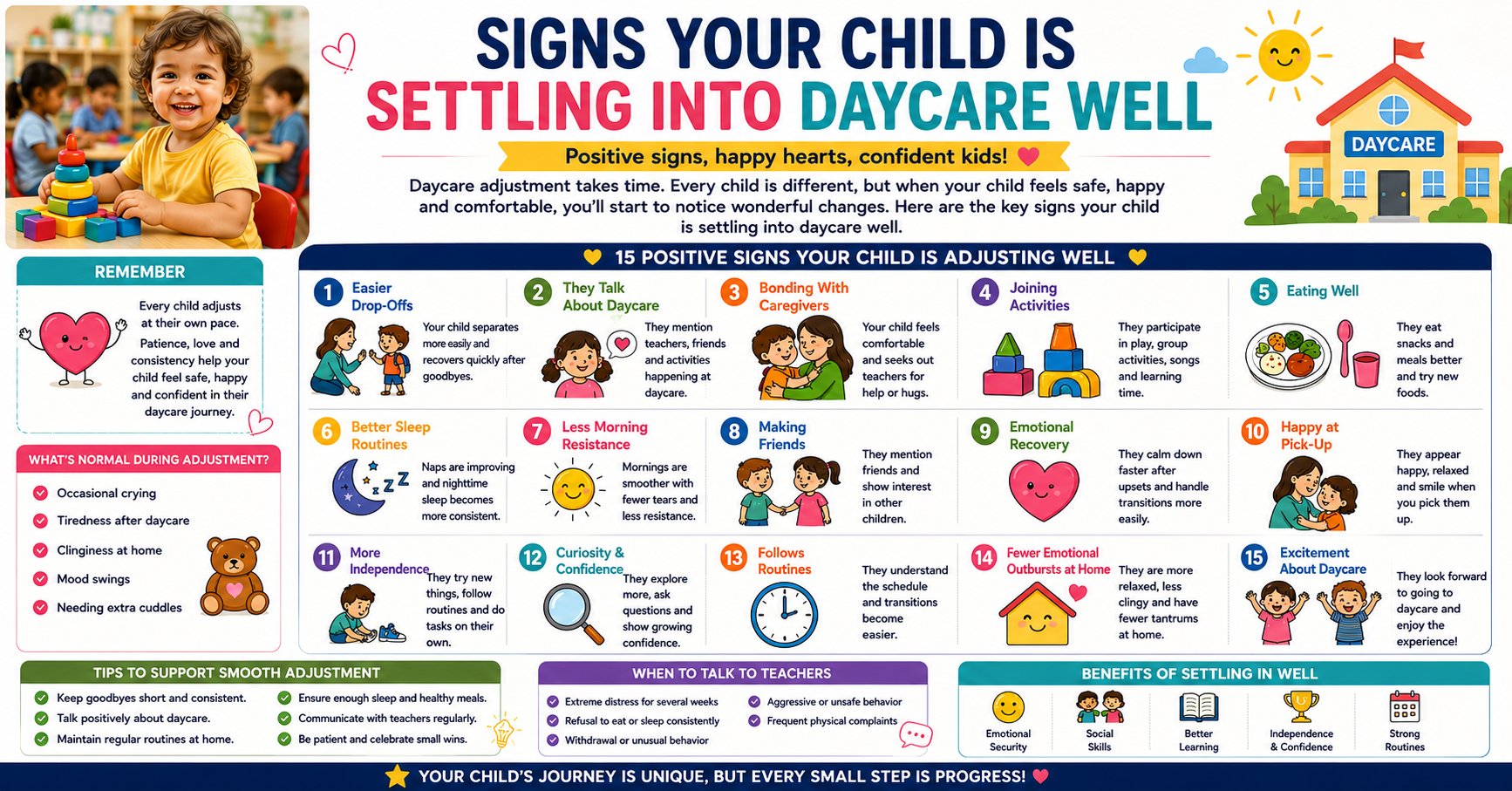
The first few weeks after your child starts daycare are some of the most emotionally exhausting weeks in early parenthood. Not because anything is necessarily wrong. But because you do not know. You leave your child at that door and then you spend the day wondering — are they okay in there? Are they eating? Are they happy? Are they sitting in the corner missing me? Have they made a friend yet? Did they sleep?
Every parent who has been through the daycare start wants the same thing: some kind of real, honest signal that tells them their child is settling into daycare well. Not a vague reassurance from a staff member who says ‘they were fine’ because that is what staff say. Actual signs. Things you can see, hear, and feel for yourself.
That is exactly what this guide gives you. A complete, honest account of the signs your child is settling into daycare — what they look like in the first week, what they look like in the first month, and what the more subtle signs are that parents often miss because they do not look like happiness on the surface.
We will also cover the signs that something might genuinely need attention, because distinguishing normal adjustment behaviour from a real concern is one of the hardest things about this period, and most parents deserve clearer guidance on where that line actually is.
And we will talk about something that most articles on this topic skip entirely: what settling into daycare looks like from your child’s emotional perspective, not just from a behavioural checklist. Because the signs your child is settling into daycare well are not always the ones you expect.
Before we get into the specific signs your child is settling into daycare, it helps to understand what settling actually involves at a developmental level. Because if you understand what is happening inside your child during this period, the signs you are watching for start to make a lot more sense.
When a child starts daycare, they are not just getting used to a new place. They are building an entirely new set of neural pathways for navigating an environment that is categorically different from anything they have experienced before. New smells. New sounds. New faces. New routines. New social dynamics. New expectations. All of this at once, in a brain that is still in the most intensive period of development it will ever experience.
Young children process novelty through their threat-detection system first. The amygdala — the brain’s alarm system — is fully developed from birth. When everything is unfamiliar, everything is flagged as potentially uncertain. Your child is not being dramatic or difficult when they cry at drop-off. Their brain is doing exactly what it is designed to do in an unfamiliar environment. Settling into daycare is the process of the familiar gradually outweighing the unfamiliar. It does not happen overnight.
The timeline for settling varies enormously between children. Some children show signs of settling into daycare within the first week. Others take six to eight weeks. A small number take longer. Temperament, attachment style, previous experience of group settings, age at starting, and the quality of the key worker relationship all influence how quickly settling happens. There is no universal timeline that applies to every child, and parents who expect their child to be settled in two weeks and are still waiting at four weeks can end up very anxious about something that is entirely within the normal range.
Most children follow a broadly similar pattern when settling into daycare, though the timing differs. Understanding this curve helps you interpret what you are seeing during the first few weeks.
Week one often looks like one of two things. Either the novelty of the environment means your child goes in relatively easily — especially if settling-in visits have been done well — or the shock of the new environment results in strong distress from the very first day. Both are normal starting points.
Weeks two and three are frequently harder than week one, even for children who started well. The novelty has worn off. Your child understands that this is a pattern, not a one-off event. They know you are going to leave. The protest often intensifies at this point and many parents mistake this escalation for evidence that their child is not settling, when in reality it is a sign that their child is processing the reality of the routine. This is actually a necessary step in settling, not a reversal of it.
Weeks four to six represent a genuine turning point for most children. This is typically when the earliest clear signs your child is settling into daycare begin to appear consistently. Drop-offs get slightly easier. The key worker is recognised and welcomed. Something from daycare starts appearing in play or conversation at home.
By weeks eight to twelve, most children who are in a quality daycare setting with a warm key worker have settled into a routine that feels normal and safe to them. The signs your child is settling into daycare at this stage are clear and observable on most days, even if there are still occasional hard mornings.
💡 The three-week low is real and it is one of the most misunderstood phases of the daycare settling period. If your child seemed to be doing well in week one and suddenly gets worse in week two or three, do not panic. This is developmentally normal and for most children it marks the beginning of the real settling process rather than the end of any progress.
These are the signs to watch for. Some will appear early. Some will only emerge after several weeks. Not all of them will appear in every child — different children show settling differently depending on their age and temperament. But across the following categories, you should start to see a gradual accumulation of positive signs as the weeks go on.
The most watched and most misunderstood sign of settling into daycare is drop-off behaviour. Parents focus intensely on this because it is the part of the daycare day they actually see. But drop-off distress is actually one of the least reliable individual indicators of how well a child is settling. What matters is not whether your child cries at drop-off — many completely settled children cry at drop-off for weeks or months. What matters is the trend over time and the speed of recovery.
A positive sign is that drop-off distress is gradually, if not consistently, reducing in intensity or duration over the weeks. Your child who cried for twenty minutes at drop-off in week one is now calming within five minutes. The crying that previously started in the car park now starts at the door. The goodbye that required three attempts in week two now completes in one.
These improvements may not be linear. There will be bad drop-off days even when overall things are improving. A child who had a disrupted night, who is coming down with a cold, or who is going through a developmental leap will often regress temporarily in their drop-off behaviour. Look at the overall trend across a week or two, not at individual days.
✅ Ask the daycare staff not just whether your child cried at drop-off but how long after you left before they settled. A child who cries through the goodbye and is building a tower with the key worker five minutes later is settling well. A child who is still distressed an hour after drop-off is a different picture. Recovery time is a more meaningful sign than whether tears happened at all.
Eating behaviour is one of the most reliable early signs your child is settling into daycare well. Children who are anxious, distressed, or in a state of sustained stress at daycare typically refuse food or eat significantly less than they would at home. A child who is eating — not necessarily with great enthusiasm at first, but eating — is a child who has enough physiological calm to engage with a basic biological need. That is a meaningful sign.
Do not expect your child to eat as well at daycare as they do at home, particularly in the first few weeks. The food is different. The environment is different. The person offering the food is different. A child who eats some of their lunch and some of their snack in the first week is doing well. A child who is eating most of their meal within the first month is showing clear signs of settling into daycare.
Ask the staff specifically about eating during the day and listen carefully to the answer. ‘They had a bit of lunch’ and ‘they ate everything and asked for more’ are very different reports. Get the specific version. The daily report sheet that most daycare centres provide should include meal information — if yours does not, ask for it.
Sleep is another deeply reliable physiological indicator when you are looking for signs your child is settling into daycare. The ability to sleep in an unfamiliar environment requires a baseline level of felt safety. A child who is fundamentally anxious or stressed in their daycare environment will struggle to sleep there, regardless of how tired they are.
In the very early weeks, sleep disruption at daycare is common and normal. Many children who nap beautifully at home take several days or weeks to nap properly at daycare because the environment, the sounds, the person who settles them, and the routine around sleep are all different. This does not mean they are not settling. It means sleep is the last thing to transfer in the settling process, not the first.
A clear sign your child is settling into daycare is when their nap at daycare begins to normalise — when they are going down without significant distress and sleeping for a reasonable duration. For babies, this may take three to four weeks. For toddlers, it often takes slightly longer because toddlers are more aware of the differences between home sleep and daycare sleep. When it happens, it is a genuinely significant milestone in the settling process.
This is one of the most beautiful and most underrated signs your child is settling into daycare well. When your child comes home and spontaneously mentions something from their daycare day — a child’s name, an activity, something funny that happened, what they had for lunch — they are doing two important things simultaneously. They are processing their daycare experience as something that belongs in their narrative. And they are sharing it with you, which means they are integrating both worlds rather than keeping them completely separate.
You might hear things like: ‘Lily was at daycare today.’ Or: ‘We did painting.’ Or: ‘The sand was too wet.’ These are small, unremarkable sentences. They are also evidence that your child experienced their daycare day as something worth talking about — which means it was something they were present for, engaged in, and processing positively enough to bring home.
For very young children who are not yet verbal, look for the behavioural equivalent. A baby who came home from daycare excited and alert rather than shut down and withdrawn. A toddler who, while playing at home, recreates something from the daycare environment. These are the non-verbal equivalent of ‘let me tell you about my day.’
Children process their experiences through play. It is not a figure of speech. It is literally how the young child’s brain digests and makes sense of the world. When your child starts using their toys to play out daycare scenarios — lining up stuffed animals for story time, pretending to be the key worker, feeding the bears their snack — they are working through their daycare experience in the medium they understand best.
This kind of play is a deeply positive sign your child is settling into daycare. It means the daycare environment is present enough in their mind to be worth exploring. It means they are associating daycare with known, safe play experiences. And it means they are developing the cognitive and emotional vocabulary to represent the daycare world, which is the precursor to being fully comfortable in it.
Some children play daycare with a slightly anxious edge — the toys cry, the bears do not want to go, the scenario involves a lot of goodbyes. This is also positive. It means your child is processing the emotional content of the experience in a healthy and appropriate way. Play is where children feel safe enough to explore feelings they cannot yet manage in real life.
🔖 If your child’s daycare play consistently involves themes of distress, abandonment, or being left and not returned to — and if this persists beyond the first month — it is worth a conversation with the key worker about how your child seems to be experiencing the day. But in the early weeks, dramatic play-processing of the daycare experience is a sign of healthy adjustment, not a cause for concern.
The key worker relationship is the single most important factor in how well a child settles into daycare. And one of the clearest signs your child is settling into daycare well is when the key worker becomes a named, known, and positively associated person in your child’s world.
When your child mentions the key worker’s name at home — ‘Sarah gave me my snack’ or simply calling out the name while playing — they are showing you that this person has moved from ‘stranger at daycare’ to ‘known person who is part of my life.’ That is a seismic shift in terms of felt safety at daycare.
Watch also for signs of the key worker relationship at drop-off. A child who, having gone through their goodbye with you, turns towards the key worker rather than continuing to reach for you — a child who allows themselves to be comforted by the key worker, who makes eye contact with them, who smiles when the key worker approaches — is showing you the beginning of a secure secondary attachment. That is one of the most positive signs your child is settling into daycare you will ever see.
A child who allows themselves to be comforted by a daycare staff member when they are upset is a child who has extended trust beyond their primary attachment figures. In attachment terms, this is called a ‘safe haven’ relationship — the experience of another person as someone who can make things better when things are hard.
This is not an instant development. In the early weeks of daycare, many children will only fully calm when their parent arrives at pick-up. This is normal. The key worker is not yet a safe haven — they are simply a less familiar person in a less familiar environment. But as the weeks progress and the relationship builds, most children begin to allow comfort from the key worker. A child who, after a fall or an upset, seeks out the key worker rather than crying alone — that is settling into daycare in one of its most meaningful forms.
Curiosity is one of the best indicators of a child’s felt safety in an environment. A child who is anxious, frightened, or deeply stressed does not explore. They freeze, cling, or withdraw. A child who is curious — who approaches new toys, who watches other children with interest, who joins in an activity, who brings something to show the key worker — is a child whose nervous system has enough calm to engage with the world around them.
Ask the daycare staff specifically whether your child engages with activities during the day. Not just whether they are okay, but whether they are curious — do they investigate things? Do they initiate play? Do they approach other children? These are the details that tell you most about your child’s actual experience of the daycare day.
The daily report is another window into this. ‘Today she went straight to the art table and spent half an hour painting’ is a specific, detailed description of a child who is genuinely engaged. Compare this to ‘he was fine today’ — which tells you almost nothing. A daycare that can describe specific moments of curiosity and engagement in your child’s day is a daycare where your child is genuinely being seen and where they are genuinely present.
How your child is when you pick them up from daycare is one of the most direct windows you have into their experience of the day. A child who is generally bright, communicative, and energetic at pick-up — even if also tired — is a child who has had a good enough day. They have enough in the tank to greet you with enthusiasm rather than with shutdown.
However — and this is important — do not mistake the emotional release that often happens at pick-up for a sign that your child has had a bad day. The opposite is frequently true. Many settled, happy daycare children fall apart the moment they see their parent at pick-up. They have held themselves together all day, managing their big feelings in a relatively unfamiliar environment, and the arrival of their safe person triggers a complete emotional release.
This phenomenon has been called ‘after-school restraint collapse’ or ‘after-care emotional release’ by child development researchers and it is extremely common. A child who cries the moment they see you, who clings, who has a meltdown in the car — this is frequently a sign of a very healthy day, not a very bad one. It means your child trusts you enough to release everything they were holding. That is good. The signs to watch for at pick-up are not whether your child cries — it is whether they also show signs of having been present and engaged in the day.
⚠️ Do not interpret emotional release at pick-up as evidence of a bad day at daycare. Ask the staff about specific moments during the day rather than asking your child how it was the moment they see you. Your child will often tell you the last emotional thing that happened — which might have been the goodbye this morning — rather than giving you an accurate account of the hours in between.
Perhaps the clearest sign your child is settling into daycare well is when the drop-off stops being a significant event and starts being just a thing that happens in the morning. The goodbye routine is done. Your child is absorbed into the daycare day. You are back in your car within ten minutes.
This shift does not happen in the first week or even the first month for most children. But it does happen. And when it does, it does not necessarily look like unbridled joy. It can look like simple acceptance — a matter-of-fact wave, a quick hug, a turn towards the room. That pragmatic normalcy is one of the most beautiful signs your child is settling into daycare. The daycare has become part of the landscape of their life. It is not scary. It is not a crisis. It is just Tuesday.
Some of the most significant signs your child is settling into daycare do not look like happiness on the surface. Parents miss these signs because they are watching for a child who is visibly thriving and missing the signals of a child who is genuinely, quietly adjusting.
A child who comes home from daycare absolutely exhausted — who falls asleep earlier than usual, who is more emotional in the evenings, who seems genuinely spent — is a child who has been fully engaged all day. Daycare is cognitively and socially demanding for young children. Managing group dynamics, following an unfamiliar routine, building new relationships, navigating a new environment — all of this uses an enormous amount of mental and emotional energy.
A child who comes home shattered has been present and engaged in their daycare day. A child who comes home with exactly the same energy they had in the morning may have been withdrawn and disengaged rather than genuinely involved. Tiredness, in the context of daycare settling, is frequently a positive sign rather than a cause for worry.
Many parents are alarmed when their child, having recently become dry, starts having accidents again after starting daycare. Or a toddler who was sleeping well starts waking at night. Or a child who had been eating well becomes picky. These regressions feel like a step backwards but they are almost always a normal response to the stress of adjustment.
The brain has limited capacity. When a significant portion of that capacity is being used to process a major environmental change, some previously automatic skills temporarily lose their smoothness. Toilet training, sleep, and appetite are all areas where this can show up. In the context of starting daycare, temporary regression in these areas is a sign of a child who is processing a big change — not a sign of a child who is fundamentally struggling.
Most regressions resolve within the first month of starting daycare as the environment becomes familiar and the brain’s capacity for previously mastered skills returns. If a regression persists beyond six weeks without improvement, it is worth raising with the key worker and possibly with your health visitor.
🔖 When temporary regression happens, respond with warmth and patience rather than frustration or correction. Your child is not deliberately going backwards. They are managing a lot. Treating a regression as a problem makes it more entrenched. Treating it as temporary — which it almost always is — and responding with calm support speeds up recovery.
Some children become noticeably more clingy with their parents at home after starting daycare. They want to be held more. They follow you from room to room. They resist bedtime or going to their own bed. Parents sometimes interpret this as evidence that daycare is damaging their child’s security. In fact, it typically means the opposite.
A child who has spent the day in a new environment, managing new relationships and new experiences, comes home with an elevated need for connection with their primary attachment figures. This clinginess is the child topping up their emotional tank — recharging their sense of safety and belonging at home before they go back out into the world tomorrow.
Respond to this clinginess by giving it, as much as you reasonably can, in the evenings after daycare. More physical contact. More one-to-one time. More presence. This is not spoiling your child. It is providing the emotional refuelling that makes returning to daycare the next day possible. Children who get this refuelling at home settle into daycare faster than children whose clinginess is managed away.
As mentioned earlier in this guide, children who play out daycare scenarios at home are processing their experience in a healthy way. But it is worth noting that this play does not always look positive on the surface. The toy animals might cry at drop-off. The stuffed bear might refuse to eat its lunch. The child might spend twenty minutes every evening being the key worker while their toys have various adventures and misadventures.
This kind of processing play is a highly positive sign. It means the child is using their most powerful developmental tool — imaginative play — to make sense of something complex and emotionally significant. The themes in the play tell you what your child is working through. The fact that they are playing through it at all tells you they have enough felt safety to explore it. Both of these things are signs your child is settling into daycare in the deepest sense.
Most of what parents worry about in the first few weeks of daycare is within the normal range of settling behaviour. But there are signs that warrant a closer look and a genuine conversation with the daycare and possibly with a healthcare professional. Knowing the difference between normal adjustment and a real concern is one of the most useful things this guide can give you.
Some drop in appetite in the first two weeks at daycare is normal. But if your child is consistently refusing food and drink at daycare beyond the first four weeks, this warrants a direct and specific conversation with the key worker. Persistent refusal to eat or drink is one of the clearest indicators that a child’s stress level at daycare is high enough to override basic physical needs. This is not something to wait out indefinitely.
Drop-off tears that are gradually improving are normal. Drop-off distress that is as intense in week eight as it was in week one, with no sign of reduction or change, is a sign that something is not working in the settling process. This might be a poor key worker match, an environment that is not meeting your child’s specific needs, or a child who needs additional support that the centre is not currently providing. Ask for a specific conversation with the manager and the key worker. Ask what strategies have been tried. Ask what the staff observe during the rest of the day, not just at drop-off.
A child who spends most of their daycare day withdrawn, not engaging with activities, not interacting with other children or staff, and not showing curiosity or enjoyment — this is a different picture from the normal adjustment process. Brief periods of watching before joining in are normal for any child. But if after several weeks the daycare staff are still describing your child as consistently withdrawn and disengaged, this needs attention.
Ask the key worker to describe specific moments in your child’s day. If they struggle to name any moments of positive engagement, curiosity, or connection, that is meaningful information. A child who is present in body but absent in spirit at daycare is a child who is not settling — they are simply surviving.
Some disruption to night sleep in the first few weeks of daycare is normal — the child is processing a lot and the nervous system stays activated. But if your child’s sleep is significantly and consistently disrupted for more than six to eight weeks without any improvement, this is worth discussing with your health visitor or GP. Chronic sleep disruption in a young child is both a sign of ongoing stress and a cause of additional vulnerability — it creates a cycle that can make settling harder rather than easier over time.
Some children develop physical symptoms — stomach aches on daycare mornings, headaches, frequent minor illnesses that seem to cluster around daycare days — that do not have a straightforward medical explanation. In young children who cannot fully articulate their emotional experience, the body sometimes expresses stress that the child cannot yet put into words. If your child consistently develops physical symptoms specifically on daycare mornings and is clear of them at weekends, this pattern is worth discussing with your GP.
Illness in the first month of daycare is extremely common due to exposure to new germs. But a pattern of vague, recurring physical complaints that correspond with daycare days and improve over weekends is a different thing and deserves attention.
⚠️ Trust your gut. You know your child better than anyone. If something feels persistently wrong — if the picture across several weeks feels like more than normal adjustment — do not allow yourself to be reassured past your instinct. Ask specific questions. Raise specific concerns. A good daycare will take your concerns seriously and will work with you to understand what your child is experiencing.
One of the biggest challenges parents face when trying to assess whether their child is settling into daycare is getting genuinely useful information from the staff. ‘They were fine today’ is not useful. It tells you nothing specific. It does not help you understand your child’s actual experience of the day.
The key is asking specific questions that require specific answers. Here are the questions that give you real information.
A key worker who can answer these questions with specific, thoughtful observations is a key worker who is genuinely paying attention to your child as an individual. A key worker who gives only vague or generic answers is one worth asking more directly — and if the vagueness persists, worth raising with the manager.
The signs your child is settling into daycare do not only depend on what happens at daycare. They also depend on what you do at home to support the process. Here are the most impactful things parents can do from their side of the daycare day.
When a child is adjusting to a major change in their daily life, stability at home is enormously important. Keep bedtimes consistent. Keep mealtimes regular. Keep the morning routine as smooth and predictable as possible. Avoid introducing other significant changes during the first month of daycare if you can help it — new siblings, house moves, and other major disruptions are all harder to manage when daycare adjustment is already using up the child’s adaptive capacity.
The predictability of home routines provides the secure base from which your child can venture out into the less predictable daycare environment each day. When both environments are unpredictable simultaneously, the child has no stable ground to return to. When home is a constant, it enables the child to tolerate the novelty of daycare without becoming overwhelmed.
After daycare pick-up, many families are rushing into the second half of the day — dinner, bath, bed — with very little time or energy for genuine connection. But the after-daycare period is exactly when your child needs connection most. They have been managing independence all day. They have been generous with their regulation and their cooperation in an environment that demands a lot.
Even fifteen minutes of genuine, uninterrupted, child-led connection after pick-up — before dinner, before bath, before the evening routine begins — fills the attachment tank that has been running on reserves all day. This is not wasted time. It is maintenance of the secure base that makes daycare possible. Children who get this connection are calmer in the evenings, sleep better at night, and return to daycare the next morning with more capacity than those who do not.
How you talk about daycare at home shapes how your child thinks about it. Keep references to daycare casual, positive, and light. ‘I wonder if you’ll do more painting today.’ ‘Did you see if the water tray was there?’ These are not loaded questions requiring a full report. They are casual references that keep daycare in the family conversation as a normal and positive part of life.
Avoid asking ‘Did you miss me today?’ or ‘Were you sad when I left?’ These questions, however kindly meant, prime your child to focus on the hard parts of the daycare day rather than the good parts. If your child has something to process, they will find their own way to bring it to you — through words, through play, or through the clinginess that shows you they need more of you right now.
When temporary regression appears — and it probably will at some point during the settling period — respond with warmth. An extra nappy at night even though you thought you were past that. A step back in independence at mealtimes. More need for your presence at bedtime. These are temporary. They are manageable. And how you respond to them affects how quickly they pass.
Frustration, even when completely understandable, tends to make regression more entrenched. Warmth, patience, and the communication that this is temporary and that you are not worried — these responses allow the child’s nervous system to relax, which is exactly the condition under which regression resolves.
Parents find it enormously helpful to have a rough framework for what settling into daycare looks like over time. Here is a realistic week-by-week picture.
Your child and the daycare are meeting for the first time in the context of you being absent. If settling-in visits were done well, there is some familiarity already. Distress at drop-off is common and normal. Eating and sleeping at daycare may be disrupted. Your child comes home tired. Both of you are adjusting.
What to look for: Any moments of engagement or calm during the day reported by staff. Any moment where your child was distracted from their distress by something in the environment. Any sign that the key worker was able to reach them, even briefly.
For many children this is the hardest phase. The novelty has gone. The reality of the daily separation is clear. Protest often intensifies. Do not mistake this for deterioration. This is processing.
What to look for: Any reduction in recovery time after drop-off. Any reported moments of positive engagement during the day. Any first mention of daycare at home, even a neutral one.
Most families notice something shift in this window. A morning where the goodbye went more smoothly than expected. A day when the staff report your child played for a long time without checking for you. A first mention of a friend’s name at home. These are the early, clear signs your child is settling into daycare.
What to look for: Unprompted mentions of daycare at home. Evidence of a developing key worker relationship at drop-off. A day where eating was noticeably better. A nap that happened without significant distress.
By this point, for most children in quality daycare, the settling signs are consistent and clear. Drop-off is a matter-of-fact routine rather than a crisis. The daycare is part of the landscape of the week. Your child knows the faces, the routine, the snacks. Daycare is not frightening. It is just where they go on Tuesdays.
What to look for: Drop-off that completes in minutes rather than being drawn out. Daycare appearing regularly in play and conversation at home. Your child showing familiarity with and warmth towards the key worker. Eating and sleeping at daycare broadly matching home patterns.
Most children take between four and twelve weeks to settle fully into daycare, though the range is wider than this for some children. The first two to three weeks are often the hardest, with the most visible signs of distress and adjustment. By weeks four to six, most children begin to show clear positive signs of settling — eating better at daycare, engaging with activities, mentioning daycare at home, accepting comfort from the key worker. By weeks eight to twelve, most children in quality daycare settings are settled into a routine that feels normal. Children who are still showing significant distress without improvement after twelve weeks may need additional support — speak to the key worker, the centre manager, and your health visitor.
Not necessarily. Crying at drop-off is one of the least reliable individual indicators of settling because many children who are genuinely settling and happy at daycare continue to protest the goodbye for weeks or months. What matters more than whether your child cries is how quickly they recover after you leave, what they are like during the rest of the day, whether they are eating and sleeping at daycare, and whether you are beginning to see any of the positive signs of settling described in this guide. Ask the daycare for a specific report on recovery time after drop-off. A child who cries at goodbye and is fine within five minutes is settling. A child who is still distressed an hour after drop-off needs a different conversation.
This is called after-care restraint collapse or after-daycare emotional release and it is one of the most commonly misunderstood aspects of the daycare settling period. It means your child has been managing their big emotions at daycare all day — which takes an enormous amount of self-regulation energy for a young child — and the moment they see you, their safe person, they release everything they have been holding. The collapse, the clinginess, the meltdowns, the tears — these are the emotional pressure valve releasing. It is actually evidence of a healthy attachment to you and of a child who was engaged enough at daycare to have something to release. Respond with warmth, not alarm.
Asking a toddler or young child whether they enjoyed daycare tends to produce unreliable information because young children answer questions about feelings based on their present emotional state, not on an accurate recollection of the day. A toddler who had a wonderful day at daycare but is currently upset because you are not letting them have a biscuit will tell you daycare was bad. Instead of direct questions, follow your child’s lead. If they want to tell you about their day, they will. Ask the daycare staff specific questions about specific moments and trust their answers more than a yes or no from a tired two-year-old at pick-up.
Trust your gut. You know your child better than anyone. Vague reassurances from staff are not the same as evidence that everything is fine. If your gut is consistently telling you something is wrong, ask more specific questions — not ‘is my child okay’ but ‘can you describe three specific moments from today’. Ask to speak to the manager if the key worker continues to give only vague answers. Ask whether there have been any incidents or difficult moments they have not mentioned. A good daycare will take a concerned parent seriously. If your concerns are consistently dismissed without specific evidence to the contrary, consider whether this is the right setting for your child.
Yes, this is very common and it is normally a sign of healthy adjustment rather than a sign that daycare is damaging your child. A child who has spent the day managing independence in a new environment comes home with an elevated need for connection and closeness with their primary carer. This clinginess is the child topping up their emotional tank. Respond generously with physical closeness, one-to-one time, and warmth in the evenings after daycare. This refuelling accelerates settling rather than slowing it. Children whose clinginess is consistently met with warmth tend to need it for a shorter period than children whose clinginess is managed away.
Not necessarily, and certainly not immediately. Toddlers process their daycare experiences at home, including the difficult parts. If your toddler talks about sad things — crying at drop-off, missing you, something that went wrong — this is healthy processing. It means they trust you with the hard parts of their experience. The question is whether the emotional content of what they share changes over time. A toddler who only ever talks about the sad parts of daycare throughout the first month and then begins to also mention the good parts — the painting, the friend, the snack they liked — is showing a healthy settling trajectory. A toddler who is still only ever talking about sad experiences at daycare after two months is worth a more specific conversation with the key worker.
A good key worker relationship is visible in several ways. Your child knows and uses the key worker’s name at home. At drop-off, your child turns towards the key worker after the goodbye rather than continuing to reach for you. The key worker can describe your child’s day in specific detail — particular moments, things they said or did, their preferences and moods. Your child accepts comfort from the key worker when they are upset. The key worker proactively shares observations about your child with you rather than waiting to be asked. And over time, your child shows at least some positive anticipation about seeing the key worker — mentioning them at home, responding warmly when they approach at drop-off.
Normal settling behaviour includes crying at drop-off that gradually improves, temporary regression in skills or behaviour, increased clinginess at home, tiredness and emotional release after daycare, and periods of reduced eating or sleeping at daycare in the first few weeks. Signs that something might genuinely not be working include consistent refusal to eat or drink at daycare beyond four to six weeks, drop-off distress that does not improve at all over eight weeks, consistent withdrawal and disengagement during the daycare day with no improvement, significant sleep disruption that persists without change, and recurring physical symptoms that correspond specifically with daycare days. If you are seeing the second group of signs persistently, it is worth a serious conversation with the setting and with your health visitor.
Yes, and it is more common than many parents realise. A child who has been settled and happy at daycare can become temporarily unsettled again in response to developmental leaps, life changes, changes in the daycare environment, loss of a key worker, or transitions between rooms or age groups. These secondary unsettlings tend to resolve faster than the initial settling period because the child has already built the neural pathways for adjusting to and finding safety in a daycare environment. They know it is possible to feel okay there, even if a change has temporarily disrupted that. Treat a secondary unsettling with the same strategies as the initial one — consistency, warmth, specific communication with the key worker — and most children settle again within a few weeks.
Looking for the signs your child is settling into daycare is, at its heart, about something much bigger than checking items off a list. It is about learning to read your child in a new context. About building a relationship with a new set of people who are now part of your child’s life. About finding the balance between watchful attention and trusting the process.
The signs your child is settling into daycare well will not all arrive at once. They will come in small pieces, on different days, in different moments. A name mentioned at dinner. A slightly shorter cry this Thursday compared to last Thursday. A morning where they walked in without looking back and you had to remind yourself to feel glad rather than bereft.
These are the moments that tell you it is working. They are quieter than you might have expected. They are more gradual than the parenting books might have implied. But they are real, and they accumulate, and one morning you will stand at that daycare door and realise you are no longer scanning for signs. You will simply know.
And that knowing — that quiet, earned confidence that your child is okay, that you chose well, that the people in there genuinely see your child — that is what the whole settling period was building towards.
You will get there. You both will.