Physical Address
304 North Cardinal St.
Dorchester Center, MA 02124
Physical Address
304 North Cardinal St.
Dorchester Center, MA 02124

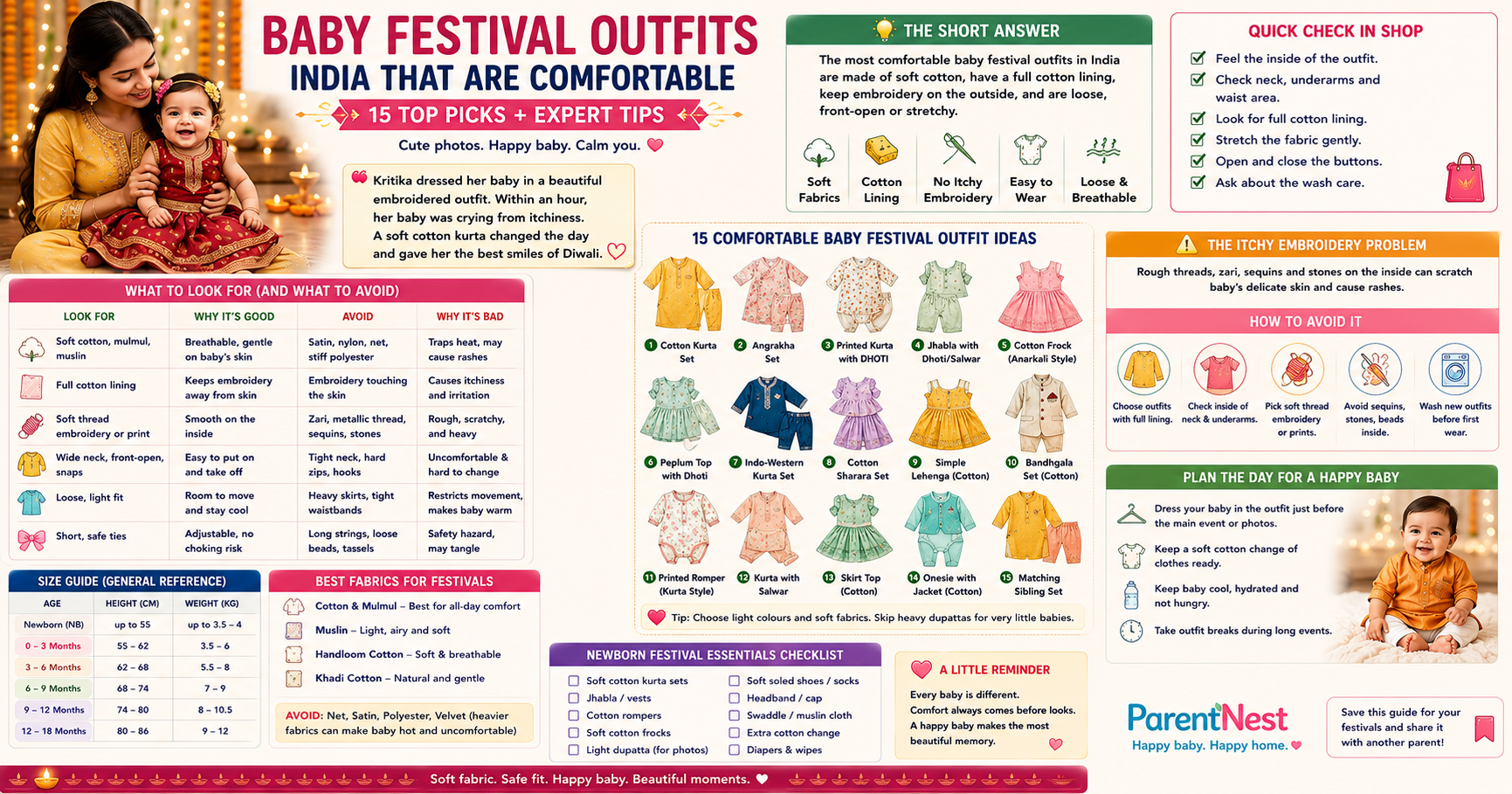
Kritika had been waiting for this Diwali for nine months.
It was her daughter’s first one. The baby was four months old, round-cheeked, and had just started to smile at everything. Kritika had bought the outfit weeks ago, from a lovely shop in a Jaipur market: a deep red lehenga-style frock with gold work all over the front, a net skirt that stood out like a small umbrella, and a tiny matching dupatta.
It looked like a doll’s dress. Her mother-in-law cried when she saw it. Her husband took forty photos before the puja even started.
And then, around the second hour, the baby began to fuss.
It was a small fuss at first. A tug at the neck. A twist of the shoulders. Then a real cry, the kind that does not stop with feeding or rocking. Kritika took her to the bedroom, turned the dress inside out, and saw it. Red lines on the neck, and a scratchy pink patch under the arms, right where the gold thread ran on the inside.
She stood there with her baby on her shoulder, and her eyes went wet. “Meri bachchi ke liye maine yeh kya pehna diya.”
Her aunt, a calm woman who had raised three children, came in and said just one thing. “Beta, isko soft cotton ka kuch pehna do. Photo baad mein bhi aa jayegi.”
So Kritika changed the baby into an old, washed cotton kurta that she had kept for the next day. Within ten minutes, the baby was calm. Within twenty, she was laughing at the diyas. And the best photos of the evening, the ones Kritika still keeps on her phone, were taken in that plain cotton kurta, with a little bit of kajal and a very big smile.
If you are searching for baby festival outfits in India that are comfortable, you probably want what Kritika wanted: a baby who looks adorable, and who is also happy. The good news is that you can have both. You just need to know what to look for.
In this article, I will share 15 festival outfit ideas, explain how to avoid itchy embroidery, give you simple tests you can do in the shop, and tell you how to plan the day so that your baby stays calm and cute from the first puja to the last photo.
Quick note: I am a parent and content writer, not a doctor. Every baby’s skin is different, and I cannot promise that any outfit will be itch-free for every baby. This article gives you a method to lower the risk. If your baby gets a rash that does not go away, or seems unwell, please see your pediatrician.
The most comfortable baby festival outfits in India are made of soft cotton or mulmul, have a full cotton lining, keep embroidery on the outside only, and are loose, front-open or stretchy. Kurta sets, jhabla, cotton frocks and soft angrakha styles are the safest choices, and a plain cotton change of clothes should always be ready.
Here is the same answer in a quick table:
| Look for | Why | Avoid |
|---|---|---|
| Soft cotton, mulmul, muslin | Breathable, gentle on skin | Satin, nylon, net, stiff polyester |
| Full cotton lining | Keeps embroidery away from skin | Embroidery that touches the skin |
| Soft thread embroidery or print | Smooth on the inside | Zari, metallic thread, sequins, stones |
| Wide neck, front-open, snaps | Easy to put on and take off | Tight neck, hard zips, hooks |
| Loose, light fit | Room to move and stay cool | Heavy skirts, tight waistbands |
| Short, safe ties | Adjustable, no choking risk | Long strings, loose beads, tassels |
Now let me explain each of these points, one by one, so you can shop with confidence.
Everyday baby clothes are made for comfort. Festival clothes are often made for looks. That is where the trouble starts.
1. Festival clothes use rougher materials. Gold thread, silver thread, sequins, stones, lace, net and stiff lining are all common in festive wear. These look wonderful, but they can feel rough and sharp against a baby’s thin skin.
2. Festival clothes are often made of synthetic fabric. Satin, polyester, nylon and tulle are cheaper, shinier and hold their shape. But they do not breathe well, and they trap heat and sweat. (If you want to understand this better, read our guide to the best breathable fabric for baby clothes in India.)
3. Festival days are long. A normal day has a few outfit changes. A festival day can mean many hours in one outfit: the puja, the family lunch, the guests, the photos, and the evening visits.
4. Festival days are crowded and warm. Many people in the house, lights and diyas, cooking, and sometimes the weather of early winter or humid autumn can raise the temperature quickly. A baby in a heavy outfit gets warm fast.
5. Festival outfits are rarely washed before wearing. Many parents buy a festive outfit and put it straight on the baby. New clothes, especially embroidered ones, can carry dust and finishing chemicals, and the baby may react.
6. Festive outfits come in the wrong shape. Many do not open at the front, and have a tight neck, small buttons or hooks at the back. They are hard to change, which makes parents keep them on longer even when the baby is fussing.
The result is a baby who looks beautiful for a short time and is uncomfortable for a long time. We can fix this, without giving up on looks.
This is the question I get most from parents: “Why does my baby scratch in festive clothes?” In many cases, the answer is the embroidery.
Babies have the most sensitive skin in these places, so check these areas first:
I use this test every time I touch a festive outfit for a baby. It takes two minutes.
1. The inside-out check. Turn the outfit inside out. What do you see and feel? Are there rough knots, thread ends, stiff patches or a hard lining? If yes, put it down.
2. The neck-and-wrist rub. Rub the inside of the garment on your neck or the inside of your wrist for ten seconds. If it feels scratchy to you, it will feel worse to a baby.
3. The lining check. Is there a full lining? Is it soft cotton, or thin synthetic? A good lining covers the whole inside of the garment, especially the body part.
4. The bend-and-stretch test. Gently fold the embroidered part. Does it crackle, stiffen or feel plasticky? Can you move the fabric easily?
5. The open-and-close test. Look at the fastenings. Are there hard hooks, big buttons, or a zip against the skin? Can you open and close the outfit in the dark, with one hand?
If an outfit passes at least four out of five, it is worth trying. If it fails the inside-out check or the lining check, I would skip it.
Sometimes you have already bought it, or it is a gift. Here are some ideas.
If your baby gets red marks, a rash, or keeps scratching, take the outfit off, let the skin rest, and talk to your pediatrician if it does not settle.
Before I give you the 15 outfit ideas, here are the rules I use. If you remember only these, you will do well.
Rule 1: Cotton against the skin, always. Whatever the outfit looks like on the outside, the inside should be soft cotton, mulmul or muslin.
Rule 2: Embroidery on the outside, softness on the inside. A beautiful design is fine, if a soft lining separates it from the skin.
Rule 3: Easy to put on, easy to take off. Front-open styles, snaps, wide necks and stretch make life simple.
Rule 4: Light and loose. Heavy skirts, tight waistbands and layers upon layers make a baby warm and cranky.
Rule 5: Plan a plain backup. Always carry a soft cotton outfit for the baby to change into. It is your emergency plan, and it takes up almost no space.
Rule 6: Wash before you wear. Wash every new outfit with a mild detergent before the festival, if the care label allows. (See our guide on washing baby clothes for tips.)
Rule 7: Keep it short. A baby does not need to wear the festive outfit all day. A few hours is enough for the best photos.
Rule 8: Safety before style. No loose beads, long strings, small mirrors or hard decorations that can come off.
Now, the part you came for. Here are 15 outfit ideas, from the simplest to the most dressed-up. I have noted who each one suits, what to look for, and what to watch out for.
Best for: babies of all ages, boys and girls. A great first festival outfit.
A kurta set for a baby, with a simple kurta and a soft pyjama or churidar, is the safest festive choice. It looks traditional, it is easy to dress, and it can be made in soft cotton or mulmul.
What to look for:
Watch out for: stiff collars, hard buttons on the neck, and heavy gold work.
Best for: warm and humid festival days, newborns and young babies.
Mulmul is a light, airy cotton that our grandmothers swore by. A mulmul kurta with a plain cotton pyjama is perfect for a baby who sweats easily, or for festivals in warm weather, like Ganesh Chaturthi, early Navratri and Onam in many parts of India.
What to look for: a double layer of mulmul for modesty and for strength, simple hand-printed or plain borders, and a loose cut.
Watch out for: very thin single-layer fabric that shows through, and long strings.
Best for: babies from about 3 months, boys especially, for pujas and photos.
A dhoti-style romper has a top with a dhoti-shaped bottom attached, usually with snaps at the bottom. It gives a traditional look without any complicated draping, so nothing slips off.
What to look for: soft cotton, snaps along the legs for diaper changes, and an elastic-free or soft-elastic waist.
Watch out for: stiff fabric, heavy borders and tight leg openings.
Best for: newborns and young babies, for all festivals.
An angrakha-style kurta wraps across the chest and ties at the side. It is front-open, like a jhabla, so you never pull it over the baby’s head. This makes it one of the most comfortable and practical festive styles.
What to look for: short ties placed at the side, soft cotton, a simple print or small embroidery on the outside only, and a cotton lining if there is embroidery.
Watch out for: long ties near the neck, and heavy embroidery at the chest.
Best for: newborns up to about 3 or 4 months, for the very first festival.
If your baby is tiny, a festive jhabla is the best choice. It is the same soft, front-open top, but in a festive colour or with a simple print. Pair it with a soft pyjama or a diaper, and a muslin wrap for warmth.
What to look for: soft cotton, bright festive colours like red, yellow, orange or green, a small print, and loose short ties.
Watch out for: anything with beads or stiff trims at the neck.
(We explained jhabla in detail in our newborn clothes checklist for India.)
Best for: baby girls from about 3 months.
A cotton frock with a full soft lining gives the “twirly skirt” look without the net and stiffness. Choose gathers or soft flare, not a stiff, wide skirt.
What to look for: soft cotton or cotton-blend fabric, a soft cotton lining inside, a wide neck or front snaps, and no heavy net.
Watch out for: layered net skirts, stiff petticoats and satin linings.
Best for: baby girls, from about 6 months, for short events.
If you must have a lehenga, choose a baby version made in soft cotton or light cotton-silk blend, with a full cotton lining and a simple border. Avoid heavy zari. Keep the dupatta light and loose, or skip it.
What to look for: soft fabric, a stretchy or tie-up blouse, a soft waistband, and a lining on both blouse and skirt.
Watch out for: heavy blouse embroidery, hooks at the back, and long dupatta ends that can wrap around the baby.
Tip: this is a “photo and puja” outfit. Plan to change into cotton afterwards.
Best for: baby girls from about 6 months and toddlers.
A soft cotton anarkali frock has a fitted top and a flowing skirt. It looks traditional and elegant, but with the right fabric it is also easy to wear. Look for a loose top, not a fitted one, so the tummy has room.
What to look for: cotton or mulmul, a lining, a wide neck or a side opening, and light prints.
Watch out for: stiff embroidery around the neck and armholes.
Best for: all babies, all festivals, especially in warm weather.
Hand block printing is a traditional craft that is common in many parts of India. Block-printed cotton is soft, breathable and full of colour, and the design is printed on the fabric, so there is no stitched embroidery to scratch the skin. This is one of my favourite ways to look festive without any itch.
What to look for: soft, well-washed cotton, vegetable or good-quality dyes from a trusted seller, and a simple cut like a kurta set, a frock or a jhabla.
Watch out for: very dark, deep colours on a brand-new fabric. Wash it before use, as extra dye can come out in the first wash. Keep it separate from other clothes.
Best for: babies from about 3 months, for short events.
If you love embroidery, look for soft cotton thread work, not metallic thread. Small flowers, simple borders and soft chikankari or kantha-style stitching can look beautiful. The key is the full cotton lining inside.
What to look for: light embroidery on the outside, a smooth inside, and a lining covering all the stitching. Check the back of the embroidery before you buy.
Watch out for: embroidery on the neckline, underarms and waist. These areas are the most sensitive.
Best for: babies from about 6 months, for short, formal photo moments.
A light cotton-silk blend can look festive and elegant. It has a nice shine, without the heavy feel of pure silk. But it can be stiffer, so a soft cotton lining and a short wear time are important.
What to look for: a soft, drapey blend with a smooth hand, a cotton lining, and a loose cut.
Watch out for: stiff or crisp fabric, scratchy zari borders, and anything that makes your baby sweat. This one is a “photo and puja” outfit, then change.
Best for: Navratri, Teej, Raksha Bandhan and many festive days, all ages.
Leheriya (wave patterns) and bandhani (tie-dye dots) on cotton give you bright festival colours with light, soft fabric. Many parents love them for babies, because they feel cheerful and traditional without any heavy trims.
What to look for: soft cotton or mulmul base, simple cuts like a frock, a kurta or a jhabla, and a comfortable finish.
Watch out for: new dyed fabric that may release colour. Wash separately for the first few washes.
Best for: older babies and toddlers, for Eid and other festivals.
A soft cotton pathani-style set, with a loose kurta and a comfortable salwar or pant, is easy to move in and looks very smart. Choose a loose cotton cut, not a stiff or heavy fabric.
What to look for: soft cotton, a wide neck or front snaps, a soft waistband, and a simple design.
Watch out for: stiff collars, buttons at the neck, and heavy fabric in warm weather.
Best for: babies from about 6 months, for cooler festival days.
A light cotton jacket over a soft kurta gives a very dressed-up look. And the best part is that the jacket is a removable layer. When the baby gets warm, take it off in a second, and you still have a comfortable kurta.
What to look for: a lightweight cotton or cotton-blend jacket, with a soft lining, and a loose fit. Skip jackets with stiff interfacing or thick lining.
Watch out for: hard buttons, stiff collars, and heavy fabric on a baby who gets warm.
Best for: babies from about 3 to 12 months, for all festivals.
A kurta romper looks like a kurta on top, but it has a bodysuit-style bottom with snaps. It means nothing rides up, the diaper area is easy to reach, and the baby can crawl and roll without a skirt or pants slipping.
What to look for: soft cotton or stretch cotton, snaps at the bottom, a wide neck, and light thread work or print.
Watch out for: tight leg openings and hard snaps that press on the skin. Check the inside of the snaps with your finger.
Each festival has its own weather, rituals and colours. Here is a quick guide to matching your baby’s outfit to the occasion.
| Festival | Weather note | Good outfit ideas | Extra tip |
|---|---|---|---|
| Diwali | Cool to mild in the north, warm and humid in the south | Kurta set, angrakha, jhabla, cotton frock | Keep the baby away from smoke and noise, and dress in light cotton |
| Navratri and Durga Puja | Warm and humid in many places | Leheriya, bandhani, block print, mulmul | Evening events can be long, so carry a change |
| Raksha Bandhan | Warm or humid | Kurta set, cotton frock, kurta romper | Short event, easy photos |
| Ganesh Chaturthi | Warm and humid | Mulmul kurta, dhoti romper, jhabla | Crowded pandals are hot, so choose light fabric |
| Eid | Varies by year and place | Pathani-style set, kurta, soft frock | Long family visits, so keep a backup |
| Onam and Pongal | Warm, humid | Cotton set mundu-style, soft cotton pavadai | Plain cream with a simple border is cool and comfortable |
| Holi | Warm, dusty, messy | Old white cotton, washed and soft | Do not use your best outfit, and keep baby away from colour powders |
| Lohri, Makar Sankranti, Christmas | Cooler in many places | Cotton kurta with a soft jacket or cardigan | Layers you can add or remove |
For Diwali in particular, you may be dressing your baby for a long evening, with a puja, lamps, relatives and photos. Plan for a comfortable day outfit and a short special outfit, and keep a soft change ready.
The first festival is a big moment for a family, and it deserves some planning. Here is a simple schedule that has worked for many parents.
A week before:
A day before:
On the day:
After the day:
Many families also plan a special outfit for the naming ceremony (naamkaran), the first rice ceremony (annaprashan) or other family rituals. The same rules apply. Soft cotton, a lining, loose fit, and a short wearing time. These events can be long, with guests, photos and rituals, so a backup outfit is even more helpful.
Festival days have extra risks, and I want to be careful here, because safety matters more than looks.
Fire and diyas. Diwali and other festivals have lamps, candles, incense and sometimes fireworks. Loose, flowing, synthetic fabrics catch fire more easily than tight cotton. Keep your baby well away from open flames, and keep long, loose dupattas and skirts away from lamps. Choose cotton over net and tulle for festival days with lamps.
Smoke, noise and crowds. Firecracker smoke and loud sounds can bother babies. Many doctors suggest keeping babies away from smoke and loud noise. If you live in a place with poor air during the festival season, ask your pediatrician what to do. Stay indoors with windows closed during peak firecracker hours, if that suits your situation.
Jewellery and accessories. Anklets, bangles, necklaces, hair clips and headbands are very popular for baby photos. But small beads, chains and tiny parts can be a choking or strangulation risk, and they can bother the skin. If you want to use any, keep them for short photo moments only, under your eyes, and remove them as soon as the photos are done. Never leave them on during sleep. Choose soft, simple, one-piece items without small beads or loose parts.
Small parts on clothes. Check for buttons, mirror work, beads, stones, tassels and bows. Tug them gently. If anything feels loose, remove it or choose another outfit. Babies put everything in their mouths.
Long ties and strings. Keep ties short and loose. Avoid anything around the neck.
Sleep. Do not let your baby sleep in a festive outfit with embroidery, jewellery, caps or loose parts. Change into soft sleepwear first. Ask your pediatrician about safe sleep for your baby’s age.
Heat. Many festival outfits are heavy. If your baby’s neck is sweaty, or the face is red, take off a layer, move to a cooler place, and offer a feed.
Holi needs a special mention. Colour powders and wet colours can irritate a baby’s skin, eyes and breathing. Many parents choose to keep babies away from the colour play, or to keep them in a safe, clean corner, with light cotton clothes that you do not mind getting messy. If you want a photo, use dry, safe, skin-friendly colours only for a short moment, with your pediatrician’s guidance, and wash the baby afterwards. Never put your baby in the middle of the colour play.
Festival outfits are worn only a few times, so I would not spend too much. Here are some ways to save.
The best festive outfit is the one your baby wears happily.
Festive clothes are delicate, and they need some care.
(For more on washing baby clothes safely, see our article on washing baby clothes separately from adult clothes.)
Many parents feel pressure to dress baby girls in lehengas and boys in sherwanis. But babies do not care. A soft cotton kurta set looks lovely on any baby. A jhabla in a bright festive colour works for all. Choose what is comfortable, what you like, and what suits your family traditions.
If you love a lehenga or a sherwani, choose a soft version, with a lining, and keep the wear time short. If you prefer simple kurtas, that is also traditional, and it is perfect.
Here are the mistakes I see most often, and I have made a few myself.
Outfit:
Bag:
Plan:
Go back to Kritika, in the bedroom, with her crying baby and a red lehenga turned inside out.
Here is what I would tell her. You did not do anything wrong. You loved your baby and wanted a beautiful first Diwali. Next time, check the inside before you buy, choose a cotton lining and a soft fabric, and keep the fancy outfit for the photos only. Keep a plain cotton kurta ready, and let the baby be comfortable for the rest of the day. The photos will still be lovely, and your baby will be happy in them.
So, if you are looking for baby festival outfits in India that are comfortable, remember the simple formula: soft cotton, a full lining, embroidery on the outside only, loose and easy to wear, short wear time and a backup outfit. Choose from the 15 ideas in this article, test with the 5-point comfort check, and enjoy the day.
Your baby does not need to be perfect in photos. Your baby needs to be calm, cool and loved. And that is the best festival outfit of all.
Soft cotton or mulmul kurta sets, jhabla, angrakha-style wraps, cotton frocks with a full cotton lining, and kurta rompers are among the most comfortable. Choose loose, front-open or stretchy styles, and keep embroidery on the outside with a soft lining inside.
A soft cotton kurta set, a festive jhabla for a newborn, a cotton frock with lining, or a kurta romper work well. Keep a plain cotton change ready, and keep the baby away from smoke, noise and open flames.
Turn the outfit inside out. Check for rough knots, stiff thread, sequins or stones, and see if there is a soft cotton lining. Rub the inside on your wrist or neck. If it feels scratchy, it will bother your baby.
Soft cotton, mulmul and muslin are the best for the skin. Light cotton-silk blends can work for short wear with a cotton lining. Avoid satin, nylon, net and stiff synthetic fabrics next to the skin.
Yes, with care. For newborns, choose soft, front-open styles like jhabla and angrakha in cotton or mulmul. Avoid heavy embroidery, hooks and tight necks, and keep the time short.
A soft cotton kurta set, a festive jhabla or a cotton frock with a lining is a good first festival outfit. It should be easy to put on, loose, and comfortable for several hours.
Yes, if the care label allows. Wash with a mild, fragrance-free detergent, preferably inside out, to remove dust and finishing chemicals. Wash dark and bright colours separately.
A few hours is usually enough, such as the puja and photos. Take it off if the baby is sweaty, fussy or has red marks. Keep a soft cotton backup ready.
Small beads, chains and tiny parts can be a choking or skin risk. If you use any, keep it for short photo moments, under supervision, and remove it right after. Never leave jewellery on during sleep. Ask your pediatrician if you are unsure.
Yes, if it is made of soft fabric with a full cotton lining and has no heavy embroidery, stiff net or hooks. Keep the wear time short, and change into cotton afterwards.
Old, soft, washed cotton clothes that you do not mind getting messy. Many parents keep babies away from colour play. Ask your pediatrician about safe options if you want a short photo.
Remove the outfit, let the skin rest in soft cotton, and avoid wearing that outfit again. If the rash does not settle, spreads, or your baby seems unwell, see your pediatrician.