
It was 3:40 in the morning, and I was standing in the bathroom with a wet muslin cloth in one hand and a white onesie in the other, staring at a stain that hadn’t been there four minutes earlier.
If you’ve fed a baby, you know this moment. The feed went well. The burp happened, or so you believed. You laid the baby down, and then came a warm, milky surprise right onto the one clean outfit you’d just put on. Now it’s soaking in, you’re half asleep, and a small voice is asking whether you should just throw it in the wash and deal with it tomorrow.
For the first few weeks, I did exactly that. Stained clothes went into the basket. Two days later I’d pull out a onesie that smelled faintly of old curd, with a pale yellow map across the shoulder that no amount of scrubbing would shift. It took me far too long to learn how to remove spit up stains from baby clothes fast, and the answer turned out to be simpler than I expected. And colder.
The secret isn’t a miracle product. It’s the order you do things in, and what happens in the first three minutes. Get that right and most stains lift with nothing fancier than cold water and a good detergent. Get it wrong, and you’ve baked milk into the fabric for good.
In this guide I’ll walk you through why these stains are so stubborn, the five-step method I now use for every spit-up, what to do with dried and old stains, how to get rid of that sour milk smell, how to deal with stains when you’re out of the house, and a few things that are very particular to Indian homes, like monsoon drying and hard water. Grab your tea. It’s a long one, but you can skim the headings if the baby is already stirring.
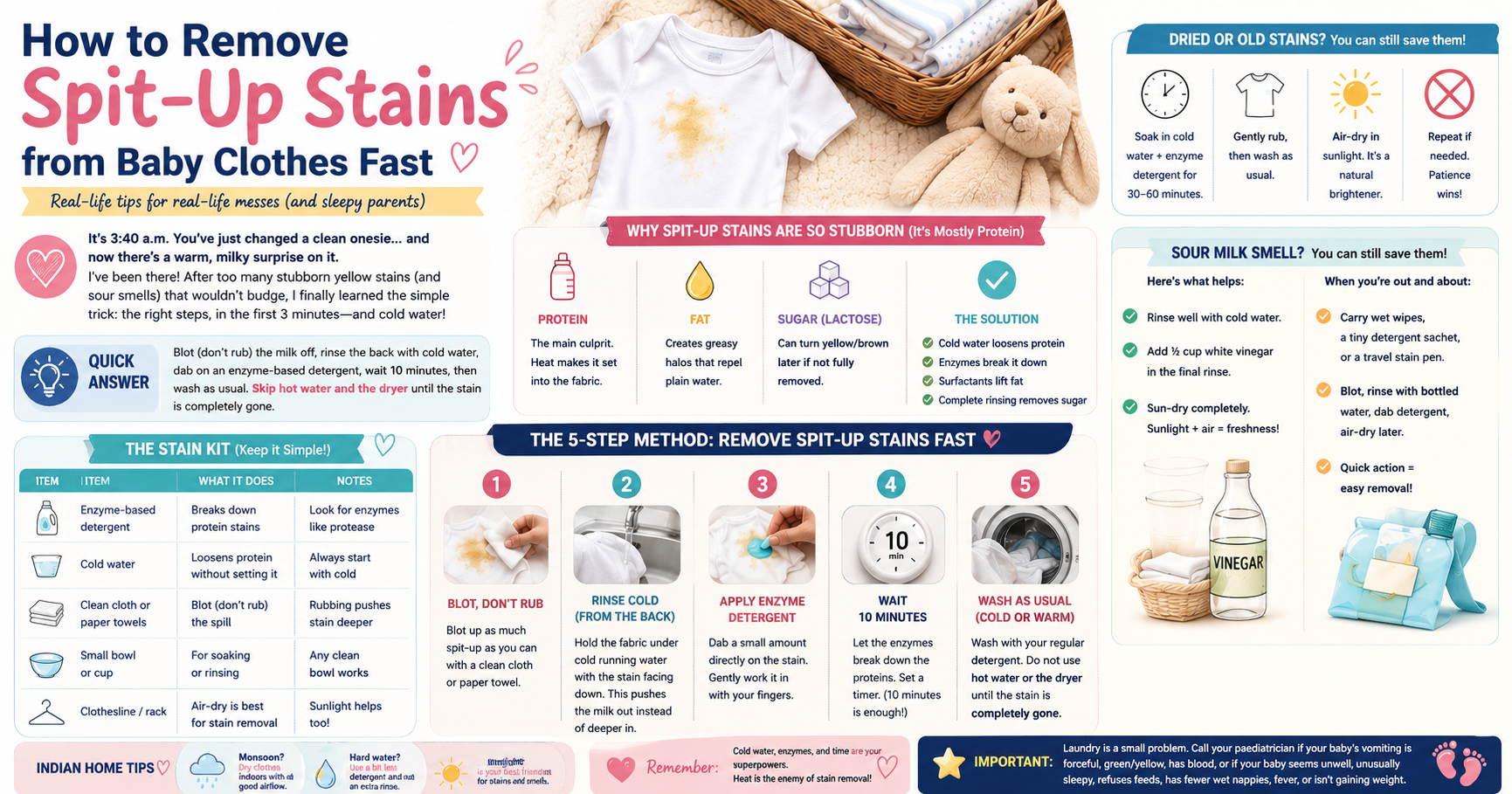
Quick answer: To remove spit-up stains from baby clothes fast, blot (don’t rub) the milk off, rinse the back of the fabric with cold water, dab on an enzyme-based detergent, wait 10 minutes, then wash as usual. Skip hot water and the dryer until the stain is completely gone, because heat bakes protein-based stains into the fibres.
Table of Contents
Why spit up stains are so stubborn (it’s mostly protein)
Spit-up looks like a simple mess, but chemically it’s a bit of a troublemaker. Breast milk and formula are both made of protein, fat and milk sugar (lactose). Mix those with a little stomach acid and you get a stain with three different personalities, and each one needs slightly different handling.
The protein is the main villain. Stain experts call milk, egg, blood and sweat protein-based stains, and they all share one nasty habit: heat makes them set. When protein meets hot water, it changes shape and grips the fibres, a bit like an egg turning solid in a pan. That’s why a stain that looked like it would rinse out can suddenly become permanent after one hot wash or one round in the dryer.
The fat gives you the greasy halo you sometimes see around a dried spot. It repels plain water, which is why rinsing alone often leaves a ghost behind.
The sugar is the sneaky one. Lactose doesn’t look like much when it’s fresh. But if it stays in the fabric and then gets heated, it can slowly turn yellow or brown. This is why a stain you “washed out” can reappear a week later on the shelf. It was never fully gone. It was just invisible.
Once you understand these three, the whole routine makes sense:
- Cold water loosens protein without setting it.
- Enzymes in detergent break protein into small pieces that rinse away.
- Surfactants (the cleaning agents in detergent) lift the fat.
- Complete rinsing removes the sugar before it can yellow.
Every step in this article comes back to those four ideas.
Spit-up vs vomit: does the stain treatment change?
Most parents use these words loosely, but the difference matters for both the baby and the laundry.
Spit-up is the gentle, effortless return of a little milk, often with a burp. It’s very common in the first months and usually harmless. Vomit is more forceful, bigger in volume, and may be sour-smelling or coloured differently, because it has spent longer in the stomach.
For stains, the method is the same. The difference is that vomit often contains more stomach acid, so it can smell stronger and sometimes affects dyed fabric faster. Rinse it off sooner, and be extra patient with the smell (I’ll get to that in the sour milk section).
A quick, important note on health. Laundry is the small problem here. Please call your paediatrician if your baby’s vomiting is forceful or projectile, if the vomit is green, yellow-green or has blood in it, if the baby seems unusually sleepy or refuses feeds, has fewer wet nappies than usual, has a fever, or isn’t gaining weight well. Normal spit-up shouldn’t make a baby miserable. If something feels off, trust that feeling and ask.
The stain kit I’d keep in every Indian home
You don’t need a shelf of products. Most of this is already in your kitchen or a quick online order away. Here’s what I keep within reach of the baby’s changing spot, because the whole point is speed.
| Item | What it does | Notes |
| Enzyme-based liquid detergent (fragrance-free if possible) | Breaks down protein and fat | The single most useful item. Check the label for “enzymes” or “protease”. |
| Soft muslin cloths or clean cotton squares | Blotting and cold rinsing | Keep a stack. They’re cheaper to ruin than a onesie. |
| Old soft toothbrush or baby-safe brush | Works detergent into the fibre | Keep it just for laundry. |
| Oxygen bleach (sodium percarbonate) | Brightens white and light cotton | Sold as “oxi” or oxygen-based stain removers. Never on wool or silk. |
| Baking soda | Gentle paste for stubborn spots, odour help | Keep it dry in a steel or glass jar. |
| White vinegar | Rinse aid that helps with sour smell | Never mix with bleach of any kind. |
| Bucket and mug | Cold-soak station | The humble bathroom bucket is a stain-fighting hero. |
| Wet bag or zip pouch | Holds stained clothes when you’re out | A clean carry-bag with a zip does the job. |
A word on what to avoid: chlorine bleach on baby clothes is harsh, it can weaken fabric, and it can leave residue on skin that is still very delicate. Strong, scented fabric softeners can coat fibres and trap odour. And rubbing the stain with a dry cloth pushes it deeper. Keep it simple.
How to remove spit up stains from baby clothes fast: the 5-step method
This is the routine I now do on autopilot, even at 3 a.m. The whole active part takes less than five minutes. I call the first three minutes of it the Rescue, and I’ll give you a pocket version for outings later.
Step 1: Remove the excess (30 seconds)
Lift off whatever is sitting on top. Use a clean muslin cloth or the edge of a soft towel, and blot. Don’t wipe or rub, because rubbing grinds the milk into the weave of the fabric. If there’s a lot of it, gently scrape with the back of a spoon or a blunt edge while the fabric is flat.
Remove the clothes straight away, if you can. Every minute the stain sits on warm skin and warm cloth is a minute it gets deeper.
Step 2: Rinse from the back, with cold water (1 minute)
Turn the garment over so the stain faces down. Hold the back of the stain under a cold tap, or pour cold water through it from a mug. The water should push the stain out the way it came in, instead of driving it further through the fabric.
Cold means cold. Not warm. Not “tap that has been sitting in a bucket in the sun”. Remember the protein rule: heat sets, cold releases. Rinse until the water coming through looks clear.
Step 3: Treat with enzyme detergent (10 minutes of waiting)
Put a few drops of enzyme-based liquid detergent directly on the stain. With your fingertips (or the soft brush), work it gently in a circular motion from the outside edge of the stain toward the middle. This stops the stain from spreading outward.
Now leave it alone for about 10 minutes. This waiting time isn’t laziness. Enzymes need a little contact time to do their job. Set a timer on your phone and go and check on the baby.
For a bigger or older stain, you can extend this into a soak. Fill a bucket with cool water, add a little detergent, and leave the garment for 30 minutes to a few hours. Check that the fabric colour is stable first (see the colour test tip below).
Step 4: Wash as normal, at a safe temperature (one wash cycle)
After treating, wash the garment as you usually would. Most cotton baby clothes do fine at 30 to 40 degrees Celsius, but always follow the care label. Don’t go hotter until you’re sure the stain has gone. If you wash by hand, rub the stained part gently against itself, then rinse in plenty of clean water. Hard water can leave detergent behind, so I always give baby clothes one extra rinse.
Step 5: Inspect before you dry (the step everyone skips)
This is the one that saves clothes. Before the garment goes into the dryer, onto a hot radiator-style heater, or even into strong midday sun, hold it up to good light and check. Look at the stain area from the front and the back.
If you can still see a shadow, repeat steps 3 and 4. Don’t dry it yet. A wet stain that’s nearly gone can still be treated. A dried stain that’s been heated is a different, much harder problem.
If it’s gone, dry as you normally would.
Pro tip, the colour test: Before treating a coloured or printed garment, dab a hidden corner with a little detergent and water, wait five minutes, and press with a white cloth. If colour transfers, skip any soaking and spot-treat only.
Fresh, dried or already washed-in: what to do for each
Not every stain gets rescued in time. Sometimes you find it at the bottom of the basket three days later. Here’s how I match the treatment to the age of the stain.
| Stain age | What it looks like | What works |
| Fresh (under 1 hour) | Wet, milky, easy to see | The 5-step method above. Usually fully gone after one wash. |
| Dried (a few hours to a day) | Stiff, crusty, faint yellow ring | Soak in cool water for 30 minutes, scrape the crust gently, then steps 3 to 5. |
| Set-in (washed once, still visible) | Pale yellow or beige shadow | Oxygen bleach soak in lukewarm water, following pack directions, then a normal wash. |
| Old and heat-dried | Deep yellow, may smell | Repeat oxygen bleach soak up to twice. Dry in shade between rounds. Some may fade but not vanish entirely. |
The oxygen bleach soak (for white and light cotton)
For a stain that has already been through a wash, an oxygen bleach soak is my second move. Mix oxygen bleach powder in lukewarm water according to the packet, submerge the garment, and leave it for the recommended time. Rinse well, then wash. Always test a hidden spot first, and don’t use it on wool, silk or anything with metal buttons that could discolour.
The gentle sun trick
For white cotton only, a few hours of sunlight can help fade the last traces of yellowing. Lay the damp garment flat or hang it, with the stain facing the sun, for a few hours. Don’t leave it all day, and keep coloured and printed pieces in the shade, turned inside out, so they don’t fade.
Sour milk smell removal that actually works
The stain is gone but the garment still smells faintly like old curd. This is probably the most common follow-up question once the stain itself is gone. The smell lingers because milk residue is still hiding deep in the fibres, and bacteria love it.
The fix is almost always a more thorough rinse, not a stronger perfume. Here’s the order I follow, from gentlest to strongest:
- Cool-water enzyme soak. Soak in cool water with enzyme detergent for 30 to 60 minutes. Enzymes break down the leftover milk proteins that cause the smell.
- White vinegar rinse. Add about half a cup of white vinegar to the final rinse of a machine load, or roughly a cup to a bucket of cool water for a hand soak of 30 minutes. Vinegar helps cut the sour smell and loosens detergent residue. The vinegar smell disappears as the garment dries.
- Baking soda soak. If vinegar isn’t enough, try a separate soak with about a quarter cup of baking soda in a bucket of water. Don’t mix vinegar and baking soda at the same time, because they cancel each other out. Use one, rinse, then the other if needed.
- Sun and air. Dry the garment in open air with good airflow. Sunlight is a natural freshener for white cotton.
Never mix vinegar with any kind of bleach. It can release harmful gases. Always rinse out one product fully before using another.
What about the smell that comes back after it dries?
If a garment smells fine wet but sour again after drying, there’s still residue in it. Do another enzyme soak and an extra rinse. If it smells musty rather than sour, that’s a different problem, usually slow drying, and I’ll cover it in the monsoon section.
Quick stain treatment on the go: the 3-Minute Spit-Up Rescue
Home is the easy case. You’ve got a tap, a bucket, a timer. The real test comes in the car, the restaurant, the wedding hall, or the crowded train compartment, where there’s a stain, a baby, and about three feet of personal space.
After more than a few of these moments, I boiled the whole thing down to a three-part routine that I call the 3-Minute Spit-Up Rescue: Blot, Cold, Contain.
Blot (30 seconds)
Press a clean cloth or soft tissue on the spot to lift the milk. Press, lift, press again. No rubbing. If you only have a paper napkin, use it flat and avoid pilling.
Cold (90 seconds)
Dampen a corner of a cloth with cold water (a sip from your water bottle will do) and dab from the outside of the stain inward. Don’t soak the whole outfit. If you can, change the baby into a spare and treat the stained one properly later.
Contain (60 seconds)
Fold the stained area inward so it doesn’t touch other clothes, and seal the garment in a zip pouch or wet bag. Don’t let it sit in a hot car boot. As soon as you get home, rinse with cold water and start the 5-step method.
That’s it. The Rescue won’t remove the stain on its own, but it stops it from setting, and that’s the entire job.
Travel stain remover for baby: what to pack
A good go-bag doesn’t need to be big. This is the one I’d pack for a day out or a long journey:
- 2 to 3 muslin cloths or soft cotton squares
- A small bottle of fragrance-free enzyme detergent (decant a little into a travel bottle)
- A stain remover stick or wipes made for babies, if you prefer something no-water
- A zip pouch or wet bag for stained clothes
- 2 spare outfits, not 1, because it always seems to happen twice
- A small cold-water bottle, kept separate from the baby’s drinking water
On the subject of stain sticks and wipes: they’re handy for the first dab, but I’d still follow up with a proper wash. Some leave a slick film that can attract dirt. Check that any product is labelled safe for baby clothes, and rinse it thoroughly.
[IMAGE: open travel pouch with muslin, mini detergent bottle and wet bag]
Bib laundry tips (the most-washed item in your house)
Bibs get the worst of it. Milk, solids, drool, curd rice, and the occasional mashed banana. They take more hits than any other item and need the most careful handling, because they sit right under a baby’s chin and cheeks.
Here’s how I handle them:
- Rinse as soon as possible. A bib that sits in the basket for two days will smell. A bib rinsed under the tap right after the meal washes clean in the machine.
- Keep a bib bucket. A small bucket of cool water and a spoonful of enzyme detergent next to the sink is my favourite trick. Drop the used bibs in, and wash them together at the end of the day.
- Wash bibs separately from adult clothes. Food residue and body oils shouldn’t travel to the baby’s other clothes, and baby skin is sensitive to residue.
- Use an extra rinse. Bibs touch the face and mouth, so rinse out all the detergent.
- Choose absorbent cotton bibs for spit-up, and wipeable silicone ones for solids. Silicone bibs just need a wash with warm soapy water. Cotton bibs soak up milk, so they need the full treatment.
- Replace them when they stiffen. If a bib stays stiff or smells even after a deep wash, the fibres are probably clogged. A fresh one is cheaper than a frustrated hour.
For the stubborn food stains on bibs (turmeric in dal is a real nemesis), a bit of sunshine works better than almost any product. Wash first, then dry in the sun for an hour or two.
Fabric by fabric: muslin, cotton, wool and fleece
Not all baby clothes behave the same way. Here’s the quick guide I use.
| Fabric | How it handles spit-up | Care notes |
| Muslin | Dries fast, rinses easily | Wash at 30 to 40 degrees. Great for burp cloths. Use enzyme soak without worry. |
| Cotton jersey (onesies) | The most common, takes stains but also cleans well | Follow the 5 steps. Oxygen bleach is fine on white cotton. |
| Terry cotton | Holds milk deep in loops | Needs a longer soak and a thorough rinse. |
| Wool and wool blends | Can felt or shrink with the wrong care | Cold water only, gentle wool detergent, no oxygen bleach. Check the label. |
| Fleece and synthetic blends | Repels water at first, holds odour | Rinse with cool water, use less detergent and rinse well. Avoid high heat. |
| Printed and coloured items | Colour may bleed | Do the colour test first. Spot-treat rather than soaking. |
What about the car seat, stroller and sofa?
Spit-up doesn’t care where it lands. For removable covers, check the label and follow the same cold-water-first logic. For things you can’t wash, blot, use a cloth dampened with cool water and a tiny amount of mild soap, and let it air dry. Always check the manufacturer’s care instructions for car seats, since some have rules about what products you can use.
Monsoon, hard water and no dryer: the Indian reality
Most laundry advice online assumes a tumble dryer and soft water. That’s not how many of us live. These are the three things I wish someone had told me earlier.
Hard water
If your water is hard, detergent doesn’t lather or rinse as well, and residue can build up in baby clothes and trap odours. Use the full recommended detergent amount (not less), add an extra rinse, and if clothes feel stiff, a vinegar rinse can help soften the feel. Hard water can also make white clothes dull over time, so oxygen bleach soaks help keep them bright.
Monsoon drying
Damp clothes in humid weather are where the musty smell begins. If spit-up residue is still in the fabric, it only gets worse. Here’s what helps:
- Rinse thoroughly, because leftover milk or detergent gives bacteria something to eat.
- Wring gently and dry in a well-ventilated spot, ideally under a fan.
- Space clothes apart on the rack so air can flow through them.
- Turn pockets and folds out so they dry fully.
- Press nearly-dry clothes with a warm iron to finish the job. The heat speeds drying and helps freshen the fabric. Only do this after the stain is fully gone.
- Never fold or store anything that feels even slightly damp.
No tumble dryer? No problem.
You really don’t need one. Cold water, enzyme detergent and open-air drying are enough for most spit-up stains. The dryer is actually a risk, because a stain that survived the wash will bake in. Sun and breeze are your friends in the dry months, and a fan and some patience handle the rest.
Breast milk, formula and solids: do the stains behave differently?
Over the months, the stain changes because the baby’s diet changes, and your method should shift a little with it.
Breast milk stains are usually pale and lift fairly easily when fresh. Because breast milk is thinner, it soaks in quickly, so the cold rinse matters more than scrubbing. Left to dry, it can leave a faint yellow ring that looks innocent and turns stubborn after a few days.
Formula stains tend to look heavier and sometimes greasier. Some parents find they show up more yellow on white cotton. The same five steps apply, but I’d give formula stains the full ten minutes of enzyme contact time, and I’d check the garment twice before it goes anywhere near heat.
Solids and purees are a different animal. Once your baby starts eating, spit-up can carry colour from carrots, beetroot, turmeric-heavy dal or spinach. These can add a dye stain on top of the protein stain. For these, treat the protein first with cold water and enzyme detergent, then use a few hours of shade or sunlight for the colour. Don’t reach for strong chemicals on a dye stain before you’ve tried gentle ones. Often the colour fades on its own after a wash and a day in the sun.
The pattern is the same every time: work out what’s in the stain, and use cold water for the protein before you do anything else.
Can I wash baby clothes with the family laundry?
This question comes up in almost every parenting group I’ve been part of, so here is the plain version.
For the first few months, I’d wash baby clothes separately from adult clothes. Not because adult laundry is dirty, but because adult clothes carry stronger detergents, fabric softeners and body oils, and newborn skin is very sensitive. A separate small load also lets you control the temperature and the rinse.
Once your baby is a few months older and doesn’t react to anything, many families gradually move to mixed washing, using the same fragrance-free detergent for everyone. If your baby has eczema or any skin sensitivity, ask your paediatrician before you change the routine.
A few small habits make a separate load easy:
- Keep a small basket for baby laundry so it never mixes with the family pile.
- Wash a small load every one or two days instead of letting it build up.
- Pre-treat stains before they go in. A machine is not a stain remover.
- Run an extra rinse if your water is hard or the baby’s skin is sensitive.
If you’re hand washing, the same logic applies: baby clothes first, while the water and your bucket are cleanest.
A simple weekly stain routine for busy parents
Stain removal becomes much easier when it’s a habit instead of an emergency. Here is the rhythm that kept me sane.
Every feed: Muslin on the shoulder. Spare outfit in reach.
After a stain: Blot and rinse in cold water straight away. Drop the garment in the cool-water bucket with a spoonful of enzyme detergent.
Every evening: Empty the bucket, check each garment for any leftover shadow, and wash the day’s baby clothes in one small load.
Once a week: Do one oxygen bleach soak for white cotton items, rinse them well and dry them in the sun for a couple of hours. Wipe down the stain kit and refill your travel bottle.
Once a month: Check your stock of muslins, replace any worn bibs, and top up detergent. That’s all.
None of this takes much time, and it means that “I found a stain three days later” becomes rare instead of normal.
Seven mistakes that make spit-up stains permanent
I’ve made all of these. Some of them more than once.
- Using hot water first. It sets protein. Always start cold.
- Rubbing instead of blotting. It spreads the stain and damages the fibres.
- Letting the stain sit in the laundry basket for days. The longer it sits, the harder it is to remove.
- Putting a damp stain in the dryer. Heat bakes whatever is left in the fabric.
- Skipping the inspection. If you don’t check before drying, you won’t know you need another round.
- Mixing products. Vinegar and bleach, or too many sprays at once, can irritate skin and damage fabric.
- Using too much detergent. More soap doesn’t mean cleaner clothes. It leaves residue that traps dirt and smells.
Fewer stains in the first place
I can’t promise you a stain-free baby, and honestly I wouldn’t believe anyone who did. But you can cut down on the number of laundry emergencies with a few small habits.
- Burp mid-feed and after. Many babies swallow air as they feed, and a pause for a burp can reduce spit-up.
- Keep the baby upright after feeding. Many paediatricians suggest holding the baby upright for 15 to 20 minutes after a feed, before laying them flat.
- Avoid overfeeding or rushing. A calmer feed often means a calmer tummy.
- Layer a muslin on your shoulder and under the chin. It catches most of it before it reaches the outfit.
- Dress for the mess. Pick stain-forgiving prints or colours on days you expect trouble, and save the pristine white for photos.
- Keep a spare outfit within arm’s reach. At home too, not only in the bag.
If the spit-up is frequent, heavy or seems to bother your baby, talk to your paediatrician. There are simple adjustments that can help, and they’re better placed to advise.
The stain I couldn’t beat, and what it taught me
There was one onesie that never came clean. It was a cream cotton one with a tiny elephant on the chest, a gift from an aunt, and I’d let it sit through a rainy weekend in the basket before I found it. By the time I treated it, the yellow had set like a watermark.
I tried everything. The oxygen soak. The sun. A second soak, then a third. It faded to a ghost of a shadow, and then it stopped fading. I was disappointed for exactly one day, and then I realised something. That onesie was the first outfit my baby had worn to meet the whole family. It had been through a hundred small, messy, wonderful moments, and it was allowed to show them.
The point isn’t that you should give up on stains. The point is that you now know how to remove spit up stains from baby clothes fast, and what to do in the first three minutes, so that most of the time the elephant onesie wins. And on the days it doesn’t, a faint shadow is just a story the fabric tells.
Here’s the whole routine in one breath: blot, rinse cold from the back, enzyme detergent for ten minutes, wash at a safe temperature, and inspect before you dry. Keep a pouch ready for outings. Keep a bucket by the sink. And go easy on yourself, because you’re already doing the hard part.
Frequently asked questions
Can I use hot water to remove spit-up stains?
No, not at first. Spit-up is a protein-based stain, and hot water makes protein bind to the fibres. Start with cold water and enzyme detergent. Once the stain is fully gone, a warm wash is fine if the care label allows it.
How do I get old yellow spit-up stains out of baby clothes?
Soak the garment in lukewarm water with oxygen bleach, following the packet directions, then wash and inspect before drying. Repeat once if needed. For white cotton, a few hours of sunlight can fade leftover yellowing. Very old, heat-set stains may fade but not disappear entirely.
Do baking soda and vinegar work on spit-up stains?
They help more with smell than with the stain itself. Vinegar in the rinse and a baking soda soak are good for sour milk smell removal. For the stain, enzyme detergent works better. Never use vinegar and baking soda in the same step, and never mix vinegar with bleach.
How do I get the sour milk smell out of baby clothes?
Soak in cool water with enzyme detergent for 30 to 60 minutes, then rinse well. Add a splash of white vinegar to the final rinse, and dry in open air or sunlight. If the smell returns after drying, residue is still in the fabric, so repeat the soak and extra rinse.
Is enzyme detergent safe for newborn clothes?
Most parents use it safely, as long as the clothes are rinsed well. Choose a fragrance-free formula, add an extra rinse cycle, and watch for any redness on your baby’s skin. If your baby has very sensitive skin or eczema, ask your paediatrician which detergent they prefer.
Can I use bleach on baby clothes?
Avoid chlorine bleach, because it’s harsh on fabric and can leave residue. Oxygen bleach is gentler and works well on white and light cotton, but follow the packet directions, rinse thoroughly, and skip it for wool, silk and delicate trims.
How often should I wash baby bibs?
After every use, or at least daily. Bibs get milk, food and drool, and damp bibs develop odours quickly. Rinse them under the tap right away, then wash with the day’s baby laundry. Rinse well, since bibs touch the baby’s face and mouth.
How do I treat a spit-up stain when I’m out and about?
Use the 3-Minute Spit-Up Rescue: blot the milk with a clean cloth, dab with cold water from the outside in, then seal the garment in a zip pouch. Don’t use hot water or leave it in a warm bag for hours. Treat it properly with cold water and enzyme detergent when you get home.
Is there a difference between breast milk and formula stains?
The treatment is the same. Some parents find formula stains look more yellow and feel greasier, while breast milk stains often lift more easily when fresh. In both cases, cold water first and enzyme detergent are the winning move.
Read Also
- How to Dry Baby Clothes Quickly During the Monsoon (Indoor Hacks That Actually Work)
- How to Wash Newborn Clothes for the First Time (8 Easy Step by Step Guide)
- Is Fabric Softener Safe For Newborn Baby Clothes Skin? 5 Facts to Know
- How To Remove Poop Stains From Baby Clothes Without Bleach: 6 Steps That Work Naturally