Physical Address
304 North Cardinal St.
Dorchester Center, MA 02124
Physical Address
304 North Cardinal St.
Dorchester Center, MA 02124

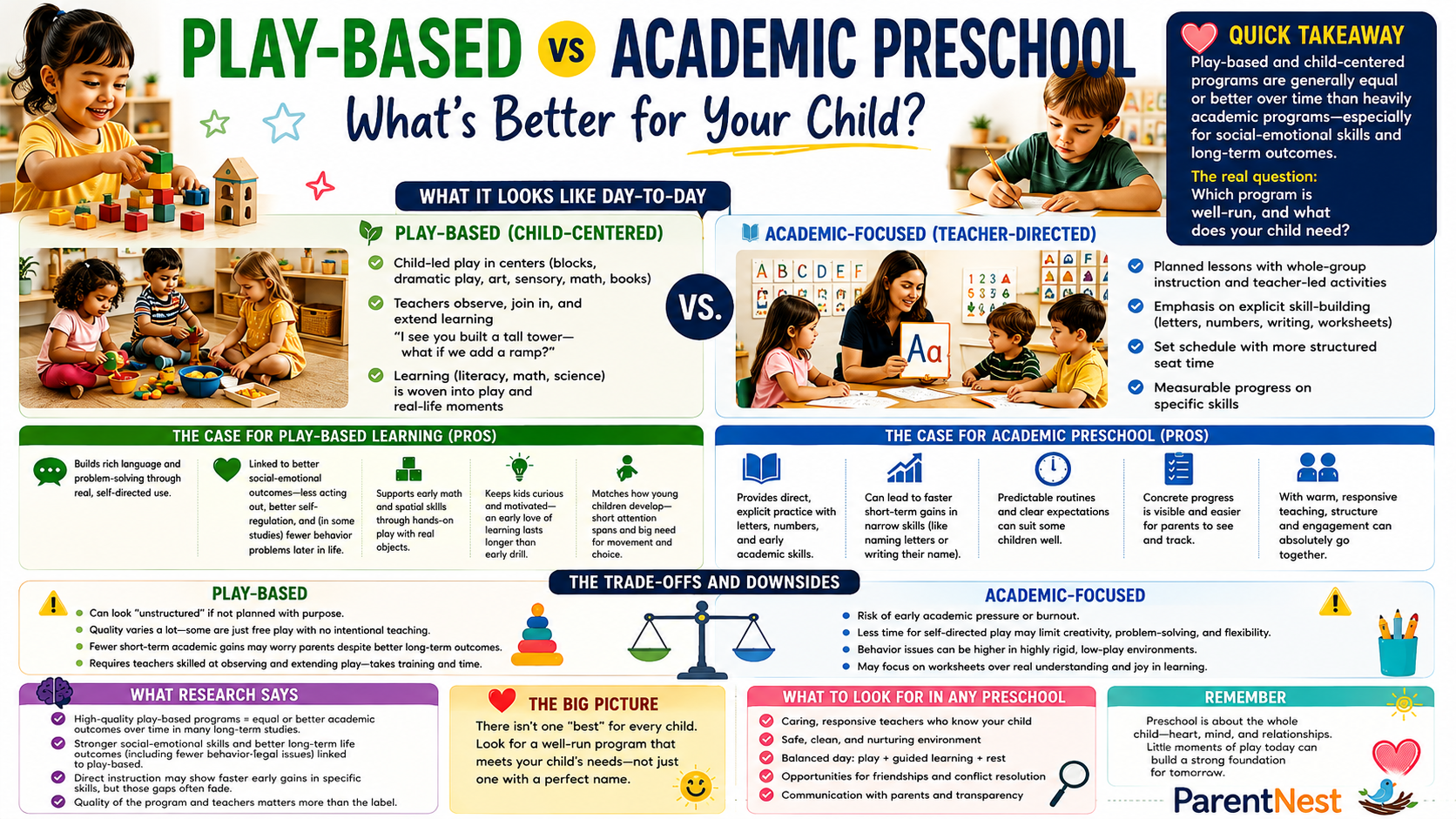
Across long-term studies, play-based and child-centered preschool programs are generally associated with equal or better academic outcomes than heavily academic, direct-instruction programs, especially over time — though the research has real limits, and a well-run academic-leaning program with responsive teachers can still serve a child well. The more useful question usually isn’t “which philosophy wins,” it’s which program is actually well-run, and what your specific child needs.
Preschool tours have a way of making parents feel like they’re being tested. Walk into one classroom and you’ll see kids building a block city, arguing about whose turtle gets to live where. Walk into another and you’ll see rows of small chairs, a whiteboard with the day’s letter, and worksheets already stacked for pickup. Both directors will tell you, confidently, that their approach is the one backed by research. It’s hard to know who’s actually right, and it’s an uncomfortable feeling to pick a preschool based on a hunch.
This guide lays out what play-based and academic-focused preschool actually look like, weighs the real pros and cons of each, and walks through what long-term research has actually found — plainly, without either side’s marketing language.
Play-based (child-centered) programs are built around child-led activity — dramatic play areas, block corners, sensory bins, art stations — with teachers observing, joining in, and gently extending what a child is already doing (“I see you’ve built a really tall tower — I wonder what would happen if you added a ramp?”). Literacy and numeracy are woven into the play rather than taught as a separate block of time.
Academic-focused (teacher-directed) programs are built around planned lessons — letter of the week, worksheet practice, whole-group instruction, and more structured seat time. The goal is usually explicit skill-building on a set schedule, with an emphasis on measurable progress (recognizing letters, counting to a target number, writing their name).
Many real preschools sit somewhere between these two poles, blending structured lesson time with open play periods — worth keeping in mind, since a lot of the research below studied fairly “pure” versions of each model that may look more extreme than what’s actually on offer at your local options.
| Model | Common downsides |
|---|---|
| Play-based | Can be harder for parents to “see” the learning happening, which sometimes triggers worry that a child isn’t being taught enough; quality varies a lot depending on whether play is genuinely guided by skilled teachers or just unsupervised free time |
| Academic-focused | Some research links heavy early direct instruction to short-term gains that fade or reverse by later elementary grades, along with higher reported stress and, in some studies, more behavior referrals in the years that follow; can undervalue social-emotional and self-regulation skills that are harder to test but matter long-term |
It’s worth being specific here, because “research shows play is better” gets repeated so often that it starts to sound like a slogan rather than a finding. Here’s what a few of the most frequently cited studies actually looked at.
The well-known High/Scope Perry Preschool Project followed children from a child-centered, play-based preschool program into adulthood and found lasting benefits — including better outcomes in areas like educational attainment, employment, and reduced involvement with the criminal justice system — compared with children who didn’t attend. It’s an influential, decades-long study, though it’s worth noting it studied a specific, small population (children from low-income families in Michigan in the 1960s), so its findings don’t automatically generalize to every family’s situation today.
A more recent randomized study of Tennessee’s state-funded, more academically structured pre-K program found that children who attended showed some early gains, but by later elementary grades were doing worse than similar children who hadn’t attended — including lower test scores and higher rates of disciplinary referrals. Researchers involved have pointed to the program’s heavy reliance on whole-group, teacher-led instruction and limited play time as a likely factor, though the exact causes remain debated among researchers.
A widely cited analysis by University of Cambridge researchers reviewed decades of studies comparing “guided play” (play-based learning shaped and gently extended by a teacher) against direct instruction, and found guided play had a generally greater positive effect on skills like math ability, shape knowledge, and mental flexibility — while also noting that pure, unguided free play didn’t show the same advantage. This is an important nuance: the research favors skillfully facilitated play, not simply unsupervised time on a playground.
None of these studies prove that any specific preschool down the street — of either type — will produce these outcomes for your specific child. Program quality, teacher warmth and skill, class size, and how consistently a philosophy is actually implemented all matter enormously, and vary widely within both “play-based” and “academic” labels. A poorly run play-based classroom with unengaged staff isn’t automatically better than a warm, responsive academic-leaning one.
Generally, yes — just not through a dedicated worksheet block. In a well-run play-based classroom, letters show up on labeled cubbies and “menus” in the pretend kitchen area, numbers show up in counting out snack cups or building block towers to match a number card, and teachers intentionally narrate this literacy and numeracy content during play rather than skipping it. If you’re touring a play-based program and want reassurance, it’s reasonable to directly ask how early literacy and numeracy are woven into the daily routine — a strong program should have a specific answer, not just “they’ll pick it up.”
Rather than choosing a label, it helps to evaluate the actual program in front of you:
You might tour a play-based classroom and feel a flicker of doubt watching kids build with blocks while your neighbor’s academic-preschooler is already writing his name — and that comparison, while understandable, isn’t actually predictive of much on its own.
Or you might choose the structured program because it’s the only one with an opening near your work schedule, and then worry you’ve made the “wrong” choice — when in reality, a caring, engaged teacher in that classroom may matter more for your child than the philosophy label ever will.
Or you’re already in a play-based program and start to wonder, watching your child “just” pretend-cook dinner for the hundredth time, whether that counts as learning anything — and often, that repeated pretend play is doing quiet, real work on language, sequencing, and social negotiation that’s easy to underestimate because it doesn’t look like a lesson.
On average, across long-term studies, play-based and child-centered programs tend to show equal or better outcomes over time, especially in social-emotional development and sustained academic progress. But program quality varies enormously within both models, so the specific program matters as much as the label.
Most early-childhood research suggests that heavy, formal academic instruction (worksheets, seat-time-based lessons) isn’t necessary before kindergarten, and that younger children generally benefit more from hands-on, play-based exposure to early literacy and numeracy concepts.
Most well-run play-based programs do, woven into daily activities and play rather than taught through worksheets — labeled materials, counting during snack, letters in dramatic play props, and similar embedded exposure.
Generally no. Learning happening through play is often less visible to parents than a completed worksheet, but a well-run play-based classroom is typically still building literacy and numeracy skills intentionally.
Not necessarily — the research raises concerns mainly about heavy, sustained direct instruction with little play, not all structure. A program with some explicit teaching balanced with substantial play time isn’t the same as an all-worksheet model.
It’s a long-running study following children from a play-based, child-centered preschool program into adulthood, which found lasting benefits in areas like education, employment, and reduced justice-system involvement compared with children who didn’t attend.
It found that children in a more academically structured, teacher-led state pre-K program showed early gains that reversed by later elementary school, with lower test scores and more disciplinary referrals than peers who hadn’t attended, though the exact causes are still debated.
Yes — many real programs blend both approaches, and the research doesn’t suggest all structure is harmful, mainly that heavy, sustained direct instruction with little play carries downsides. A thoughtful blend can work well if play periods are genuinely substantial and teacher-guided.
Observe a session if possible. Look for teachers actively engaging with and gently extending children’s play, rather than play time functioning as unsupervised free time with minimal adult involvement.
Teacher warmth, engagement, training, and class size are consistently strong predictors of preschool quality — arguably more reliable than the philosophy label alone, since both models vary widely in how well they’re actually implemented.
Neither model is automatically the right or wrong choice, and the research, read honestly, doesn’t hand parents a simple verdict — it points toward well-guided play generally outperforming heavy, sustained direct instruction over time, while also making clear that quality of implementation matters enormously either way. The most useful thing you can do on a preschool tour isn’t asking “play-based or academic,” it’s watching how the teachers actually talk to the children in front of them.