Physical Address
304 North Cardinal St.
Dorchester Center, MA 02124
Physical Address
304 North Cardinal St.
Dorchester Center, MA 02124

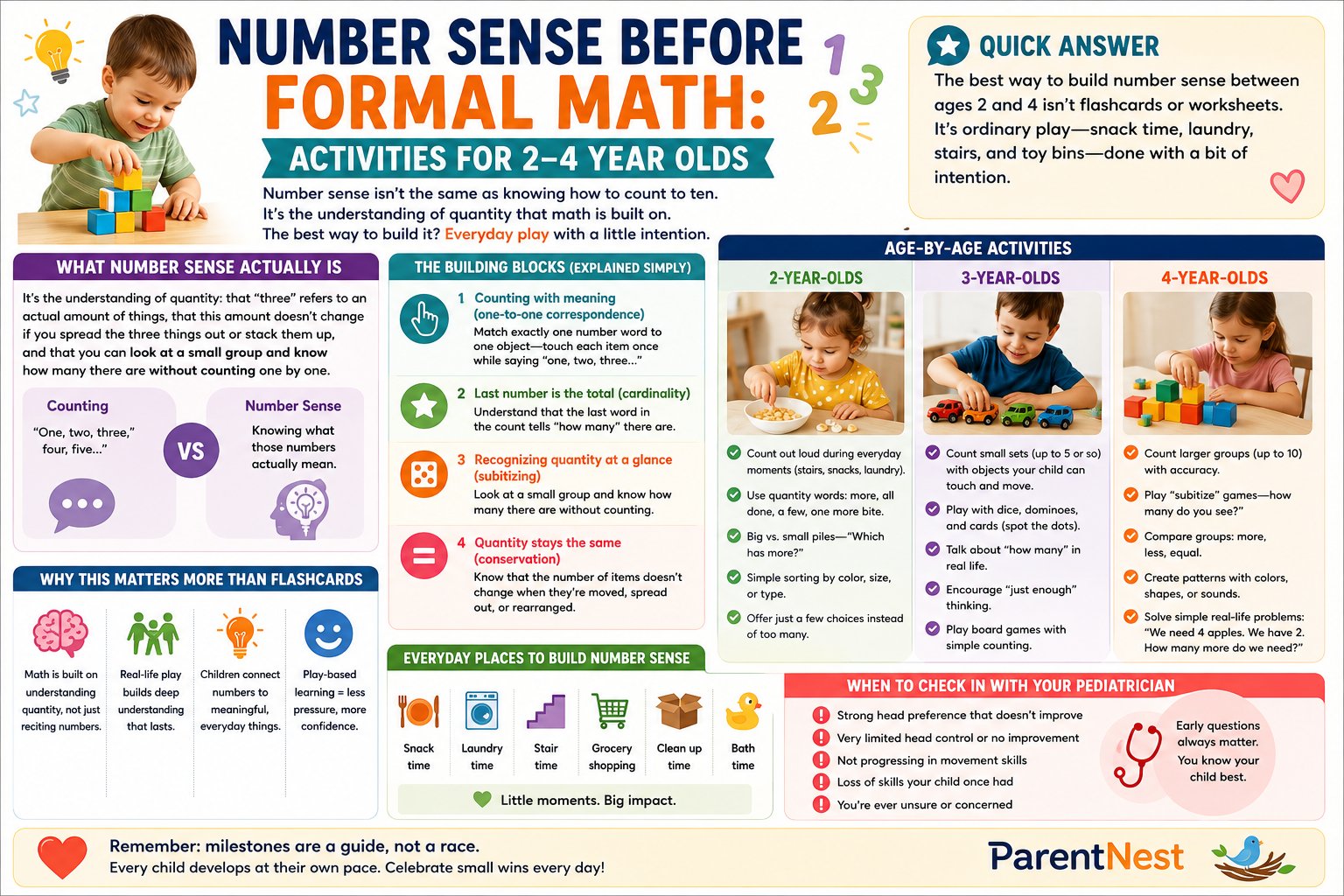
Number sense isn’t the same as knowing how to count to ten — it’s a set of underlying skills (matching one number to one object, recognizing quantity at a glance, understanding that rearranging a group doesn’t change how many are in it) that formal math later builds on. The best way to build it between ages 2 and 4 isn’t flashcards or worksheets, it’s ordinary play: snack time, laundry, stairs, and toy bins, done with a bit of intention.
Somewhere around age three, a lot of parents start noticing the ads — flashcard sets, “genius” apps, workbooks promising a head start before kindergarten. And somewhere around the same time, their toddler is very happily lining up cars by size on the living room floor, completely uninterested in sitting still for any of it. The good news is that the toddler on the floor is probably doing more for their math development than the flashcards would have. What actually matters at this age is a specific, learnable set of skills, and it turns out most of them can be built with things already lying around the house.
This guide breaks down what number sense actually means, why it matters more than early counting alone, and specific activities for 2, 3, and 4-year-olds that don’t require buying anything new.
A lot of parents assume number sense means “can count to twenty” or “knows their numbers.” Reciting numbers in order — rote counting — is part of it, but it’s the easiest part, and a child can do it fluently without actually understanding what the numbers mean.
Number sense is the underlying understanding of quantity: that “three” refers to an actual amount of things, that this amount doesn’t change if you spread the three things out or stack them up, and that you can look at a small group and know how many there are without counting one by one. It’s the difference between a child who can sing “one, two, three, four, five” and a child who can hand you exactly three crackers when asked.
Formal math — adding, subtracting, place value — is built on top of number sense, not the other way around. A child who can recite numbers but hasn’t built the underlying understanding of quantity often struggles later, not because they don’t know their numbers, but because the numbers were never connected to anything real for them.
Flashcards and worksheets tend to reinforce number recognition (this squiggle is called “5”) without necessarily building number sense (this squiggle means five actual things). At ages 2–4, hands-on, repeated, low-pressure exposure through play does more of the real work — which is good news, because it also happens to be a lot less of a fight to get a toddler to do.
This is matching exactly one number word to exactly one object — touching each block once while saying “one, two, three,” rather than saying numbers faster than the pointing finger moves. It sounds small, but it’s the piece that turns counting from a memorized song into an actual measurement of quantity.
After counting five buttons, does your child understand that “five” describes the whole group, or do they start over from one if you ask “so how many are there?” This understanding — that the last word in a count is the answer to “how many” — usually develops over the preschool years with repeated, casual practice, not all at once.
This is looking at a small group — like the dots on a die — and knowing how many there are without counting each one. It’s a skill researchers in early math education have identified as a strong predictor of later comfort with numbers, and it’s also one of the easiest to build through games, since dice, dominoes, and playing cards are already designed around it.
If you line up five toy cars close together and then spread them out along the floor, does your child think there are suddenly “more” cars because the line is longer? This understanding — that quantity doesn’t change with arrangement — tends to develop gradually and isn’t something to drill; it’s something that emerges through lots of hands-on experience moving objects around.
At this age, the goal is exposure and language, not accuracy. A 2-year-old counting “one, two, five, eight” while pointing at three toys is doing exactly what’s expected — the counting words are still being learned as a sequence.
By three, many children can count a small group somewhat accurately with a finger pointing at each item, even if the number after ten or so still gets shaky. This is the age to start layering in “how many” questions.
Four-year-olds are often ready to connect written numerals to quantity, and to start noticing number relationships — that four is one more than three, for instance.
Sorting and classifying — grouping objects by color, size, shape, or type — isn’t separate from number sense, it’s part of the same foundation. Before a child can meaningfully compare quantities (“which group has more”), they need practice recognizing that objects can belong to groups in the first place.
You might find yourself handing out crackers and realize your three-year-old touches each one and says a number, but loses track and starts over halfway through — that’s completely normal one-to-one correspondence still under construction, not something to worry about.
Or you roll a die during a board game and your four-year-old calls out the number before touching a single dot — that’s subitizing working exactly the way it’s supposed to.
Or you spread five blocks into a long line and your toddler insists there are “so many now,” more than when they were bunched together — that’s a completely typical stage on the way to understanding conservation of number, not a gap to fix.
Most children move through these skills at their own pace, and the range of “normal” here is wide. Loose signs of steady progress include: gradually more accurate one-to-one correspondence over months (not days), an emerging ability to recognize very small quantities (two or three) without counting, and increasing comfort with comparing “more” and “less” in everyday situations.
If your child is nearing kindergarten and still shows little interest in or ability to count even small groups with support, or seems to have no sense of quantity words at all (“more,” “all done”), it’s a reasonable thing to mention at a preschool conference or well-child visit — not because it signals anything serious on its own, but because an educator or pediatrician can look at the fuller picture alongside other developmental areas.
It’s the underlying understanding of quantity — knowing that numbers represent real amounts, recognizing small groups at a glance, and understanding that rearranging objects doesn’t change how many there are. It’s broader than simply reciting numbers in order.
This develops gradually and unevenly across ages 2–5. Many 2-year-olds can recite counting words; genuine understanding of quantity (cardinality, one-to-one correspondence) typically strengthens through the preschool years with practice.
Not at this age. Hands-on, repeated exposure through everyday play — counting snacks, sorting toys, comparing groups — builds the underlying skills flashcards alone tend to skip.
Awareness of quantity itself — noticing “more” and “less,” matching one object to another — tends to come before accurate counting, and both develop together rather than in a strict order.
Fold it into things you’re already doing — counting stairs, sorting laundry, dividing snacks, playing simple board games with dice. Repetition through everyday routines tends to work better than a dedicated seated activity at this age.
Generally no — the range of typical counting ability at three is wide, and understanding a small quantity well (like reliably knowing “three” means three) matters more at this stage than reciting a longer sequence.
It’s recognizing a small quantity at a glance, without counting — like knowing a die shows four dots without counting each one. It’s considered a strong building block for later comfort with numbers and mental math.
They can be a reasonable supplement in small amounts, especially for sorting and matching practice, but they don’t replace hands-on activities with real objects, which add touch, movement, and richer language.
Sorting objects by shared traits (color, size, type) builds the same foundational thinking — recognizing groups and comparing them — that later supports comparing quantities and understanding sets.
Counting out loud during routine moments — plates at the table, socks in the laundry, steps on the stairs — repeated daily, does more over time than any single structured activity.
None of this requires a curriculum or a shopping list. A toddler sorting cars by color, a preschooler rolling dice in a board game, a four-year-old handing out exactly three napkins per person at dinner — these ordinary moments are number sense being built, one repetition at a time. Formal math will have its turn soon enough; right now, the job is just noticing the numbers that are already part of the day and giving your child a reason to pay attention to them.