Physical Address
304 North Cardinal St.
Dorchester Center, MA 02124
Physical Address
304 North Cardinal St.
Dorchester Center, MA 02124

Kavya’s father-in-law said it at the dinner table, in the gentle-but-certain tone reserved for advice nobody asked for: “Beta, stop doing that hand signal thing with Aarav. Usko bolna seekhna hai, sign language nahi. You’re teaching him to be lazy — why would he bother talking if waving his hand gets him what he wants?”
Kavya had been signing “milk,” “more,” and “all done” with her ten-month-old for about six weeks at that point, mostly because a friend had sworn by it and Kavya was desperate for anything that might cut down on the nightly meltdowns over what Aarav wanted and couldn’t yet say. She didn’t have a comeback ready. She just nodded, cleared the plates, and spent that night doing exactly what most parents do when a confident relative contradicts something they’re trying — falling down a search engine rabbit hole at 11 pm, typing “does baby sign language delay speech” into her phone with the particular anxiety of someone who’s worried they might have just made a parenting mistake for six weeks running.
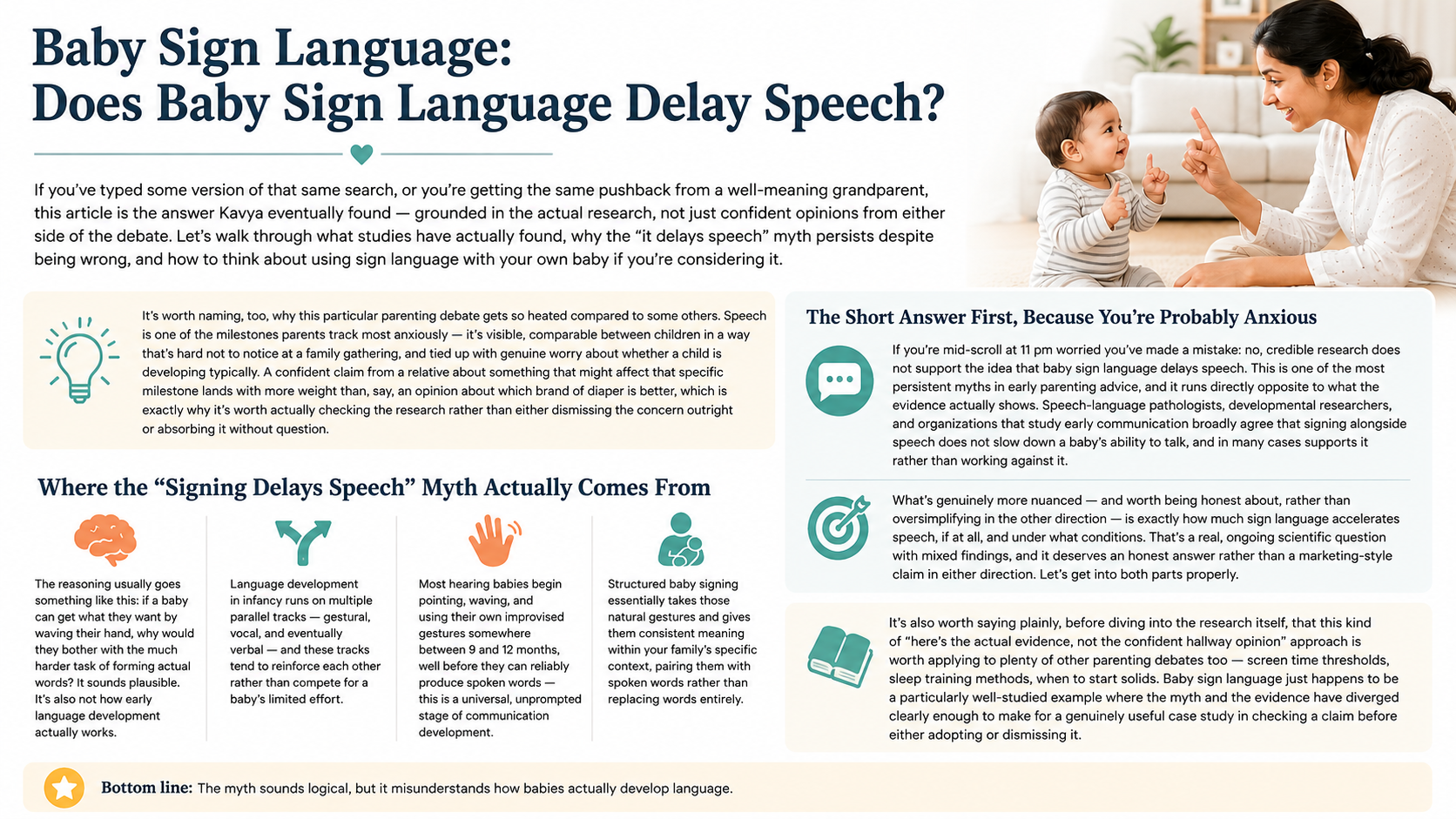
If you’ve typed some version of that same search, or you’re getting the same pushback from a well-meaning grandparent, this article is the answer Kavya eventually found — grounded in the actual research, not just confident opinions from either side of the debate. Let’s walk through what studies have actually found, why the “it delays speech” myth persists despite being wrong, and how to think about using sign language with your own baby if you’re considering it.
It’s worth naming, too, why this particular parenting debate gets so heated compared to some others. Speech is one of the milestones parents track most anxiously — it’s visible, comparable between children in a way that’s hard not to notice at a family gathering, and tied up with genuine worry about whether a child is developing typically. A confident claim from a relative about something that might affect that specific milestone lands with more weight than, say, an opinion about which brand of diaper is better, which is exactly why it’s worth actually checking the research rather than either dismissing the concern outright or absorbing it without question.
If you’re mid-scroll at 11 pm worried you’ve made a mistake: no, credible research does not support the idea that baby sign language delays speech. This is one of the most persistent myths in early parenting advice, and it runs directly opposite to what the evidence actually shows. Speech-language pathologists, developmental researchers, and organizations that study early communication broadly agree that signing alongside speech does not slow down a baby’s ability to talk, and in many cases supports it rather than working against it.
What’s genuinely more nuanced — and worth being honest about, rather than oversimplifying in the other direction — is exactly how much sign language accelerates speech, if at all, and under what conditions. That’s a real, ongoing scientific question with mixed findings, and it deserves an honest answer rather than a marketing-style claim in either direction. Let’s get into both parts properly.
It’s also worth saying plainly, before diving into the research itself, that this kind of “here’s the actual evidence, not the confident hallway opinion” approach is worth applying to plenty of other parenting debates too — screen time thresholds, sleep training methods, when to start solids. Baby sign language just happens to be a particularly well-studied example where the myth and the evidence have diverged clearly enough to make for a genuinely useful case study in checking a claim before either adopting or dismissing it.
This myth has a certain surface logic to it, which is exactly why it spreads so easily and why relatives like Kavya’s father-in-law repeat it with such confidence. The reasoning usually goes something like this: if a baby can get what they want by waving their hand, why would they bother with the much harder task of forming actual words? It sounds plausible. It’s also not how early language development actually works.
Babies don’t choose the “easier” communication method the way an adult might choose the path of least resistance at work. Language development in infancy runs on multiple parallel tracks — gestural, vocal, and eventually verbal — and these tracks tend to reinforce each other rather than compete for a baby’s limited effort. A baby who signs “milk” while you say the word “milk” back to them is receiving reinforced language input twice, through two different channels, not being handed an escape hatch from ever needing to speak.
It’s also worth noting where signing sits in typical development even without any deliberate teaching. Most hearing babies begin pointing, waving, and using their own improvised gestures somewhere between 9 and 12 months, well before they can reliably produce spoken words — this is a universal, unprompted stage of communication development, not something invented by baby sign language programs. Structured baby signing essentially takes a gestural stage that was going to happen anyway and gives it a shared, more consistent vocabulary that both parent and baby can use, rather than introducing something foreign to how babies naturally develop.
There’s also a physical, developmental reason gestures tend to show up before words at all, which helps explain why the “lazy talker” framing misunderstands what’s actually happening. The fine motor coordination needed to wave a hand or make a simple gesture develops earlier than the far more complex neuromuscular coordination needed to produce clear speech sounds — controlling lips, tongue, jaw, and breath simultaneously is a genuinely harder physical task than a hand movement. A baby signing before speaking isn’t choosing the easy path over the hard one out of laziness; their body simply becomes capable of the gestural option first, the same way babies sit before they crawl and crawl before they walk, each skill building on physical readiness rather than convenience.
This is worth walking through carefully, because the honest answer is “the evidence is mixed on how much it helps, but consistently does not show harm” — and that nuance matters more than a punchier headline claim in either direction.
Much of the popular enthusiasm for baby sign language traces back to research by Linda Acredolo and Susan Goodwyn beginning in the early 1990s. In one widely cited study, hearing infants whose parents were trained to model symbolic gestures began using those gestures on average a little under a month before their first vocal words appeared, and follow-up research from the same research group reported that children in signing groups showed advantages in verbal skills at two and three years old compared to children who received more conventional verbal-only interaction. A further, less commonly replicated follow-up reportedly found differences persisting into IQ measures years later.
This research was influential and is still cited heavily by baby-signing programs and products, but it’s worth noting for a full, honest picture that these particular studies have faced methodological critique over the years — including questions about how comparison groups were selected and the challenge of separating the effect of signing itself from the effect of parents who choose to sign generally being more responsive, engaged communicators overall. This is a common challenge across a lot of early parenting research: parents motivated enough to enroll in a signing program or follow a structured protocol may simply be more attentive, more verbally engaged, or more consistently interactive with their babies regardless of the specific intervention, which makes it genuinely difficult to isolate “the signing did this” from “the kind of parent who signs also does several other beneficial things.”
A later, more tightly controlled study — a randomized controlled trial led by researchers at the University of Hertfordshire and published in the journal Child Development — followed 40 mother-infant pairs from 8 to 20 months of age, with half the mothers trained to model a specific set of symbolic gestures with their infants. This study found that infants exposed to structured gesture training did not differ significantly from the control group on language development outcomes — in other words, no measurable acceleration in vocabulary or speech, but also, importantly, no evidence of any delay or harm either.
This is genuinely useful context: the best-controlled study on this exact question found neither a strong speech-boosting effect nor any speech-delaying effect. Baby signing, in this analysis, came out essentially neutral for raw language acceleration, while other research has more consistently found benefits in areas like reduced frustration and improved parent-child interaction quality, which are valuable outcomes in their own right even without a dramatic vocabulary boost attached.
It’s worth sitting with why a randomized controlled trial carries more weight than the earlier, more popular research, for readers who want to understand the “why” rather than just take it on faith. In a randomized trial, families are assigned to the signing or non-signing group essentially by chance, rather than parents self-selecting into a signing program because they’re already inclined toward more structured, engaged parenting. This design specifically addresses the self-selection problem mentioned above, which is exactly why researchers and clinicians tend to weight this kind of study more heavily than observational research when the two sets of findings disagree.
Separately from the question of whether signing accelerates speech, several studies have specifically investigated whether it causes any delay, given how widespread that particular worry is among parents. Research in this area, including studies on infants taught simple signs using structured prompting and reinforcement techniques, has generally found that signing infants continued to develop spoken language along typical timelines, with no evidence that time spent on gestural communication came at the expense of vocal language development. Some of this research has focused specifically on infants as young as 6 months, finding that infants can successfully learn and generalize simple signs across different settings and caregivers without any indication that this substituted for or crowded out verbal development.
One study of this kind, published in the Journal of Applied Behavior Analysis, taught a simple sign to four infants between 6 and 10 months old using structured prompting and reinforcement, and found that infants were able to generalize the signs they’d learned to new settings and new people — signing independently in a classroom or with their father, for instance, after training under more controlled conditions. This kind of finding matters for the practical question most parents actually care about: whether a sign learned in one context (say, with mom during a feeding routine) will actually transfer to being useful more broadly, and the answer this research points to is yes, with appropriate consistency.
A systematic review synthesizing the published literature on baby sign language interventions and their developmental outcomes — looking specifically at whether the practice helps promote language, social, cognitive development, or caregiver-child interaction in typically developing hearing infants — reflects the genuinely mixed state of this research area: some studies show modest benefits in specific areas like reduced frustration or richer parent-child interaction, others show no significant measurable effect on language acceleration, and none show evidence supporting the delay concern. The honest summary most speech-language professionals land on is that baby sign language is not harmful and is often mildly to moderately beneficial, particularly for communication and bonding, even where the vocabulary-acceleration claims from earlier, more popular research haven’t held up as strongly under tighter scientific scrutiny.
This kind of “genuinely mixed, but consistently not harmful” conclusion is common across a lot of early-childhood development research, and it’s worth getting comfortable with that level of nuance rather than looking for a single, definitive headline either way. Very few developmental interventions this simple and low-cost produce dramatic, universally replicated effects — the honest picture is almost always some benefit for some children under some conditions, no harm across the board, and a genuine absence of the dramatic outcomes sometimes implied by products and programs selling the idea.
There’s an important, separate conversation worth having here, distinct from the “does it help typically developing babies talk faster” question: sign language and gestural communication are actively recommended by many speech-language pathologists as a genuine tool for toddlers who are already showing signs of a speech or language delay.
The reasoning here is different from the general baby-signing case. For a toddler who’s frustrated because they understand more than they can say — a very common pattern in speech delay — having any reliable way to communicate reduces the daily frustration and tantrums that build up around not being understood, while research consistently shows this kind of augmentative communication doesn’t compete with or replace speech therapy goals; it complements them. Signs give a toddler a scaffold to build communicative confidence on while their speech skills catch up, rather than either sitting in frustrated silence or relying entirely on pointing and crying to get needs met.
This is a genuinely important distinction to sit with if you’re a parent whose toddler seems behind on talking: signing is not a substitute for a proper speech-language evaluation if you have real concerns about delay, but it is a legitimate, evidence-supported tool that a speech-language pathologist may specifically recommend alongside other interventions, not instead of them. If your toddler has very few words by 18 months, isn’t combining words by 2 years, or seems to understand far more than they can express, that’s worth raising with your pediatrician regardless of whether you’re also using signs at home — the two aren’t in competition with each other.
It’s worth adding a note here specifically for parents who feel a flash of guilt reading this section, wondering whether introducing signs earlier “caused” a delay they’re now noticing. The direction of that relationship generally runs the other way: parents often introduce or lean more heavily on signing precisely because they’ve noticed their toddler is having a harder time with spoken words, not the reverse. Signing showing up alongside a speech delay is far more often a sensible parental response to an existing communication gap than a cause of one — the same way a parent might start using more visual routines with a toddler who’s already struggling with transitions, without the routines having caused the struggle in the first place.
If the research has reassured you enough to want to try it, here’s a practical, low-pressure way to start, without needing to enroll in a formal class or buy an elaborate kit.
Rather than trying to teach dozens of signs at once, most successful approaches start with just 3 to 5 signs tied to things your baby wants or needs multiple times a day — “milk,” “more,” “all done,” “eat,” and “help” cover an enormous share of a typical baby’s daily communication needs. Choosing signs your baby will have frequent, real opportunities to use matters far more than choosing a large vocabulary upfront.
This is the single most important practice, and skipping it is the one thing that could theoretically undermine the approach’s benefits. Signing is meant to run alongside spoken language, not instead of it — every time you make the sign for “milk,” say “milk” clearly at the same time, so your baby is receiving the concept through two channels simultaneously rather than the sign becoming a silent substitute for the word.
Sign “more” while you’re actually offering more food, sign “milk” right as you’re about to feed your baby, sign “all done” as you’re clearing their tray. Babies learn signs through repeated association with real, meaningful moments, not through flashcards or isolated practice sessions — the same way they learn spoken words through hearing them used in context rather than through drilled repetition.
Especially in the early weeks, focus on showing your baby the sign yourself rather than physically moving their hands or pressuring them to sign back. Most babies go through a receptive phase — understanding what a sign means before they can physically produce it themselves — often for several weeks, and that’s a completely normal and expected part of the process, not a sign it isn’t working.
Just as toddlers approximate spoken words before pronouncing them clearly, babies often produce their own rough, simplified version of a sign rather than a textbook-perfect one — patting their chest instead of the precise official motion for “milk,” for instance. This is developmentally normal and doesn’t need correcting the way you might gently model correct pronunciation for a mispronounced word; the goal is successful communication, not signing accuracy.
Most babies who are going to pick up signing meaningfully begin showing their first recognizable signs somewhere between 8 and 12 months, though this varies widely, and plenty of babies simply aren’t interested in signing at all, preferring pointing, vocalizing, or other communication strategies instead. If your baby shows no interest after a few consistent weeks of exposure, that’s not a failure on your part or evidence that something’s wrong with your baby — some babies simply gravitate toward other communication methods, and that’s entirely fine.
Signing works best as a shared household practice rather than something only one parent does. If a grandparent, nanny, or older sibling spends significant time with your baby, showing them the two or three signs you’re actively using means your baby gets consistent exposure and reinforcement across different caregivers and settings, rather than a sign that only “works” with one specific person. This mirrors exactly how spoken vocabulary develops too — a word or sign used consistently across multiple people in a baby’s life gets reinforced far more effectively than one used by only a single caregiver.
Most baby sign language programs borrow simplified gestures loosely based on American Sign Language, though you don’t need to use official ASL signs specifically for the approach to work — what matters is consistency between you and your baby, not linguistic authenticity. Common starter signs include:
Many Indian families find it natural to layer these alongside a home language rather than English specifically — saying “doodh” while making the milk sign, or “aur” while making the “more” sign works exactly as well, since the sign is meant to pair with whatever word your baby is actually hearing at home, not with English specifically. Some families invent their own simplified gestures entirely rather than using ASL-based ones — patting a high chair tray for “eat,” for instance — and this works just as well, since the research support for baby signing isn’t specific to any particular sign system; it’s about consistent, paired gestural-and-verbal communication in general.
Many Indian families are raising children across two or more languages from birth — Hindi and English, or a regional language alongside both — and a common worry is whether adding sign language on top of an already multilingual environment is simply too much for a baby to process. The research on bilingual development generally doesn’t support this concern: babies raised in multilingual homes are capable of managing multiple language inputs without confusion or delay, and a consistent gesture layered on top of that functions similarly to how the same gesture would work in a single-language home — it’s an additional channel paired with whichever word is being spoken in that moment, not a competing language system to separately track. If your household uses Hindi with grandparents, English with one parent, and a regional language elsewhere, it’s entirely reasonable to use the same sign consistently regardless of which language accompanies it that day, since the gesture itself isn’t tied to any one language.
While signing itself doesn’t cause speech delay, there are a few situations worth being aware of, mostly to make sure signing isn’t accidentally standing in for a conversation you should be having with a professional rather than because signing itself is doing anything harmful.
If your baby relies heavily on signs well past typical early speech milestones without much spoken language emerging alongside them, it’s worth mentioning to your pediatrician — not because the signing caused a delay, but because it’s worth checking whether an underlying speech or language delay exists that would benefit from a proper evaluation, the same way you’d want to check regardless of whether signing was part of the picture.
If you notice your baby isn’t responding to sound, doesn’t turn toward voices, or seems to rely on visual cues unusually heavily, that’s worth raising with your pediatrician as a hearing-related question specifically, since hearing difficulties can affect how a child engages with both spoken and signed communication and are worth ruling in or out early.
If signing is being used as the sole communication strategy without accompanying spoken words, revisit the “always say the word out loud” practice above — this is the one scenario where the approach could genuinely fall short of its potential benefit, not because the sign itself is harmful, but because the paired verbal input is the part doing much of the developmental work.
None of these scenarios mean signing was a mistake — they simply mean it’s worth having a broader conversation about your child’s overall communication development, the same conversation worth having regardless of whether signing was ever introduced at all.
It’s worth reiterating a point made earlier because it bears repeating for anxious readers: none of these caution scenarios are evidence that signing itself caused a problem. They’re simply the same signs worth watching for in any child’s communication development, signing or not, and having a system like signing in place often makes it easier, not harder, to notice a genuine gap early — since you have a clearer sense of what your child can and can’t yet communicate compared to a household with no established communication routine at all.
Kavya did eventually find her comeback, though it took a slightly awkward second dinner conversation a few weeks later to deliver it. She’d read enough by then to explain, calmly, that the “signing delays speech” idea wasn’t supported by the research her father-in-law assumed it was — that Aarav’s daytime vocalizing had, if anything, picked up since they started, precisely because she said “doodh” every single time she made the milk sign rather than replacing the word with the gesture.
Her father-in-law wasn’t instantly convinced, but he did stop bringing it up quite so confidently, especially once Aarav started combining the “more” sign with an increasingly clear “aur” of his own around thirteen months — clumsy, half-formed, unmistakably a real word attempt happening right alongside the gesture he’d learned weeks earlier, not instead of it.
“I don’t think signing made him some kind of genius talker,” Kavya told me later. “But it gave us both something to do with the frustration before he had the words for it. That alone was worth the funny looks at the dinner table.”
Her father-in-law, for what it’s worth, eventually came around in his own way — not by acknowledging the research directly, but by starting to use the “all done” sign himself when he fed Aarav during his weekly visits, mumbling something about how “at least this way I know when he’s actually finished, instead of guessing.” Kavya didn’t push the point further. She figured a skeptic quietly adopting the practice was its own kind of concession, research citations or not.
No — credible research consistently fails to support this common concern. Multiple studies, including a rigorously controlled trial, found no evidence that signing slows down spoken language development in hearing infants.
The evidence here is genuinely mixed. Some earlier, widely cited studies found modest advantages in vocabulary and verbal skills for signing infants, while a more tightly controlled randomized trial found no significant acceleration effect. Most researchers agree the clearest, most consistent benefits are reduced frustration and improved parent-child communication, rather than a guaranteed vocabulary boost.
Most programs suggest starting around 6 to 9 months, though babies typically don’t produce recognizable signs themselves until somewhere between 8 and 12 months. Starting earlier simply means more exposure time before your baby’s fine motor skills are ready to produce the sign back.
Yes — many speech-language pathologists specifically recommend gestural communication, including simple signs, for toddlers with diagnosed or suspected speech delays, as a way to reduce frustration and build communicative confidence alongside, not instead of, speech therapy.
No — while many baby signing programs use simplified versions of American Sign Language signs, what matters most is consistency between you and your baby, not linguistic authenticity. Many families successfully use their own invented gestures instead.
That’s completely normal and not a cause for concern on its own. Some babies simply prefer other communication methods like pointing or vocalizing, and lack of interest in signing specifically doesn’t indicate anything about their broader language development.
No — research on bilingual development generally shows babies can manage multiple language inputs without confusion or delay, and a consistent gesture layered alongside whichever language is being spoken in that moment works the same way it would in a single-language home. The sign isn’t tied to a specific language; it’s tied to the concept and whichever word accompanies it.
Most children naturally phase out signing on their own once spoken words become easier and more efficient for them to produce, typically somewhere in the second year. This is a normal transition, not something that needs to be actively discouraged or “weaned off” — spoken language generally takes over communication duties once a child is capable of it, since it’s a faster and more precise tool for getting increasingly complex ideas across.
There’s no strict rule, but many successful approaches start with 3 to 5 high-frequency signs and only add new ones once the current signs are being used somewhat reliably. Introducing too many signs at once, especially early on, can dilute the repeated exposure each individual sign needs to be learned.
If you’re signing with your baby tonight and a relative raises an eyebrow, or you’re lying awake worried you’ve made things worse rather than better, the research is genuinely on your side here — signing doesn’t hold speech back. What it seems to reliably do is give a frustrated, not-yet-talking baby a way to be understood a little sooner, and give you both something to do with that gap besides tears on one side and guesswork on the other. Whether or not it makes your child talk earlier, that alone tends to be worth the funny looks at the dinner table.
And if you’re the parent who never got around to signing, or tried it and your baby simply wasn’t interested — that’s equally fine. Nothing in the research suggests signing is a required ingredient for healthy speech development; it’s one optional tool among many, and plenty of children who never signed a day in their lives go on to develop perfectly typical, on-time spoken language. The choice to sign or not sign isn’t the hinge point some marketing around it might suggest — it’s simply one option worth understanding accurately, rather than avoiding out of a myth that doesn’t hold up.
This article summarizes published research on baby sign language and early communication development, including studies referenced by sources such as the Journal of Applied Behavior Analysis and Child Development. It’s intended as general information, not a substitute for professional evaluation — if you have concerns about your child’s speech or language development, please consult your pediatrician or a licensed speech-language pathologist directly.