Physical Address
304 North Cardinal St.
Dorchester Center, MA 02124
Physical Address
304 North Cardinal St.
Dorchester Center, MA 02124

Neha noticed it on a Tuesday, standing in the shower with a clump of wet hair wrapped around her fingers, more than she was used to seeing at once. She was five months pregnant, and every article she’d read before conceiving had promised her thick, glossy, “pregnancy hair” — the kind her own mother still talked about from her own pregnancies decades ago. Nobody had mentioned this.
By the time she got out of the shower, she’d already convinced herself something was wrong. She called her mother, who said, in the calm, slightly amused tone of someone who’s seen three pregnancies and two grandchildren, “Beta, thoda hair fall toh normal hai, tension mat lo, but let’s oil your hair tonight.” Her mother-in-law, on a separate call twenty minutes later, had a different theory entirely — something about “andar se garmi,” heat in the body, and a suggestion involving amla and curd that Neha wrote down mostly to be polite.
Neither of them was entirely wrong, and neither of them had the full picture either. If you’re standing in your own shower right now, quietly panicking about a drain full of hair during a pregnancy you were told would give you your best hair ever, this article is for you. Let’s actually walk through why this happens, when it’s nothing to worry about, when it’s worth a call to your doctor, and what genuinely helps — separate from the well-meaning but sometimes contradictory advice every pregnant woman in an Indian household eventually receives from at least three different relatives.
It also helps to say plainly, before going any further, that noticing hair fall doesn’t mean you’re doing pregnancy wrong, eating wrong, or missing something obvious that other women somehow know. Most women who go through this describe the same initial spiral Neha did — a private conviction that something is uniquely off with them, followed by relief once they learn how common and explainable it usually is. You’re not the exception here. You’re closer to the norm than the glossy pregnancy-hair Instagram posts would have you believe.
For a lot of women, it does, and that’s not a myth. Rising estrogen during pregnancy slows down the natural cycle by which hair sheds, which is why many pregnant women notice their hair looking fuller and shinier than usual, especially in the second and third trimesters. For most people, without pregnancy hormones involved, this cycle happens quietly and continuously, with roughly 90 percent of hair in a growth phase and the remaining 10 percent resting at any given moment before shedding naturally every two to three months. In practical terms, most people shed somewhere between 50 and 100 hairs daily as part of this completely normal cycle — pregnancy hormones can temporarily slow that shedding down, which is where the “pregnancy glow hair” reputation comes from.
But that’s only part of the story, and it genuinely doesn’t apply to every woman the same way. Some women experience the opposite — increased shedding, thinning, or a general sense that their hair looks and feels less full than before pregnancy. This isn’t a sign that something is fundamentally wrong, and it doesn’t mean you were unlucky while everyone else got the glossy version. It usually has a specific, identifiable cause, and once you understand which one applies to you, the anxiety around it tends to drop considerably.
It’s worth adding, too, that these causes frequently overlap rather than acting alone — a woman with mild hormonal shedding who’s also running low on iron and wearing her hair in a tight bun for a job that requires it may well be dealing with all three factors compounding each other at once. Untangling which cause is contributing how much isn’t something you need to figure out on your own; it’s exactly what the blood tests and conversation with your doctor described below are for.
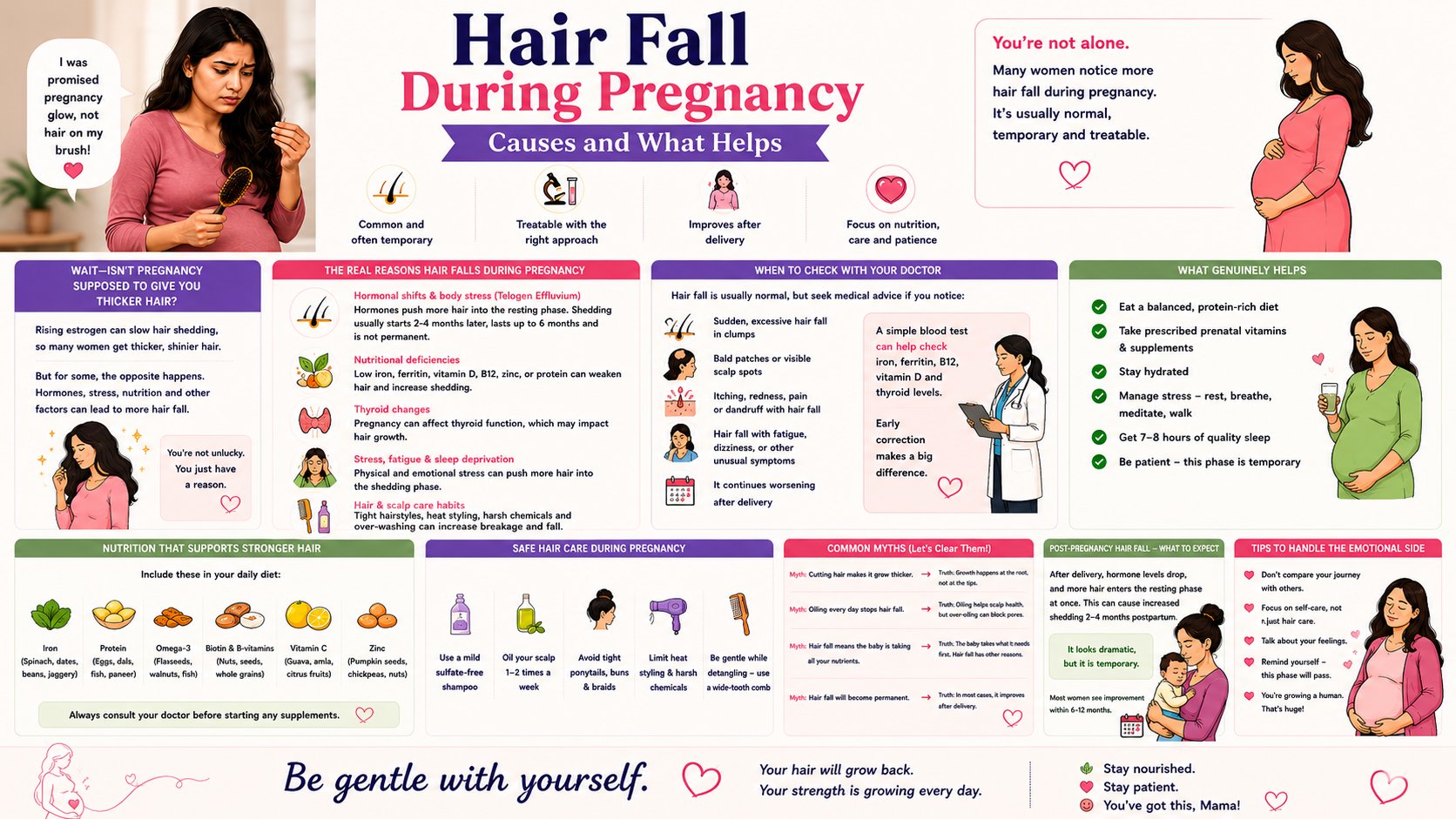
The most common medical explanation for pregnancy-related hair shedding has a name: telogen effluvium. Hair naturally cycles between a growth phase and a resting phase before it eventually sheds, and in a typical day only a small percentage of your hair is in that resting phase at any given time. The dramatic hormonal shifts of early pregnancy, combined with the general physical stress of growing another human being, can push a larger share of your hair — sometimes 30 percent or more — into that resting phase all at once.
Here’s the part that catches a lot of women off guard: this kind of hair loss doesn’t show up immediately. It often takes two to four months after the hormonal trigger for the shedding to actually become noticeable, which is exactly why so many women, like Neha, are blindsided by a sudden clump of hair in the second trimester rather than seeing a gradual buildup they could have anticipated. The reassuring news is that this type of shedding, on its own, typically doesn’t last longer than about six months and does not cause permanent hair loss or bald patches — it’s diffuse, even thinning across the scalp, not patchiness.
It also helps to understand why the delay happens at all, since the time lag is often what makes this feel so disconnected from any obvious cause. Hair that gets pushed into its resting phase during a stressful or hormonally intense stretch doesn’t fall out immediately — it sits in that resting phase for a period of months before it actually sheds and a new hair begins growing in its place. This means the hair falling out in your shower today may be responding to something that happened with your hormones two or three months ago, not anything happening in your body this week. Understanding that delay can be oddly reassuring, because it explains why the shedding sometimes seems to have no obvious trigger in the moment — the trigger already happened, and you’re simply seeing its delayed effect now.
Thyroid function shifts naturally during pregnancy, and in some women it shifts enough to cause a genuine thyroid disorder — either an underactive thyroid (hypothyroidism) or, less commonly, an overactive one (hyperthyroidism). Hypothyroidism affects roughly 2 to 3 out of every 100 pregnant women, and hair thinning is one of its recognized symptoms, often appearing alongside fatigue, constipation, or muscle cramps that get easily dismissed as “just pregnancy tiredness.”
This is one of the more important reasons not to simply assume all pregnancy hair loss is the harmless, temporary kind — thyroid issues are diagnosed with a simple blood test, and if an underlying thyroid imbalance is actually driving the hair loss, treating the thyroid condition is what allows the hair to recover, not hair oil or a change in shampoo.
Thyroid changes during pregnancy can also be easy to write off because so many of their symptoms overlap with ordinary pregnancy discomfort — everyone expects to feel tired, everyone expects some digestive changes, and it’s easy to attribute all of it to simply being pregnant rather than something separately worth checking. If hair loss is showing up alongside a cluster of these other symptoms rather than on its own, that combination is worth specifically mentioning to your doctor rather than letting each symptom get individually dismissed as normal pregnancy fatigue.
Pregnancy significantly increases your body’s iron requirements, and a genuine iron deficiency — not just mild pregnancy fatigue — can show up as hair thinning alongside other signs like unusual tiredness, shortness of breath during normal activity, headaches, or a noticeably fast heartbeat. Women carrying twins or multiples, those with pregnancies spaced close together, or those dealing with severe morning sickness that limits what they can eat are at a meaningfully higher risk of developing iron deficiency during pregnancy.
This is worth taking seriously precisely because it’s so common and so fixable — a simple blood test at your regular prenatal visit can confirm it, and correcting an iron deficiency, usually alongside dietary changes and supplementation guided by your doctor, tends to help hair recovery follow naturally once your iron levels normalize.
Many routine prenatal checkups already include hemoglobin and iron screening as a standard part of antenatal care, particularly in India where iron deficiency during pregnancy is common enough that it’s actively screened for rather than only checked when symptoms appear. If you haven’t had this checked recently, or if it’s been a few months since your last blood work, it’s a reasonable, low-effort thing to ask about at your next visit rather than waiting for your doctor to bring it up unprompted.
Sometimes the cause has nothing to do with pregnancy hormones at all. If you’ve been wearing your hair in tight braids, buns, or ponytails, or regularly using tight hair accessories, you may be dealing with something called traction alopecia — hair loss caused by sustained pulling at the follicle. This tends to show up specifically along the hairline or wherever the tension is concentrated, rather than as the more even, all-over thinning typical of hormonal shedding. Left unaddressed for a long time, traction alopecia can, in some cases, lead to more lasting damage at the follicle, which is exactly why it’s worth catching early and easing up on tight styles well before that becomes a concern.
This particular cause is worth flagging separately because it’s genuinely one of the more preventable ones on this list, and it’s also one many women don’t think to connect to their hair loss because it feels unrelated to being pregnant at all. If your thinning is concentrated specifically at the hairline, temples, or wherever a regular hair accessory or tight style sits, rather than spread evenly across your scalp, it’s worth switching to looser styles for a few weeks and seeing whether the pattern changes before assuming it’s purely hormonal.
It’s entirely possible to be pregnant and separately dealing with a hair condition that has nothing to do with the pregnancy itself — genetic pattern hair thinning, or an autoimmune condition like alopecia areata, which causes patchy hair loss rather than even thinning. The key distinguishing sign to watch for is pattern: hormonal pregnancy-related shedding is typically uniform and diffuse across the scalp, while patchy bald spots or dramatically localized thinning point toward something else worth discussing with a dermatologist alongside your obstetrician.
This is genuinely one of the more confusing parts for expecting mothers, so it’s worth being direct about it: for most women, hair loss connected to pregnancy is actually more common and more dramatic after delivery than during pregnancy itself. Estrogen levels stay elevated throughout pregnancy, which is what suppresses normal shedding and gives many women that fuller-hair experience. Once you deliver, estrogen drops back to pre-pregnancy levels fairly quickly, and all the hair that would have shed naturally over the preceding months — held back by pregnancy hormones — tends to fall out in a more concentrated window.Postpartum hair shedding, medically the same telogen effluvium process, affects a significant share of new mothers — estimates suggest somewhere between 40 and 50 percent of women notice this kind of shedding, and it typically peaks around three to four months after delivery, sometimes catching new mothers off guard precisely when they’re already exhausted and adjusting to a newborn. The genuinely good news: this is temporary too, with most women seeing hair return to its normal fullness within six to twelve months, often right around their baby’s first birthday.
If you’re currently pregnant and noticing hair loss now, it’s worth knowing this doesn’t necessarily predict a worse postpartum experience — the two processes, while related, don’t always track together, and plenty of women who had minimal shedding during pregnancy still experience the more typical postpartum shed a few months after delivery.
It’s also worth mentally preparing for the postpartum version specifically, since it tends to arrive at a particularly demanding moment — a few months into caring for a newborn, often during a stretch of disrupted sleep and general physical recovery, which is exactly the wrong time to also feel blindsided by an unrelated-seeming wave of hair loss. Knowing in advance that this is a normal, expected part of the postpartum timeline, rather than a surprise complication, tends to make it considerably easier to shrug off when it happens rather than adding it to an already long list of new-parent worries.
Let’s be honest about something upfront: for most cases of hormonal, pregnancy-related hair shedding, there isn’t a dramatic fix that reverses it faster than your body’s own timeline allows. What genuinely helps falls into a few categories — ruling out treatable underlying causes, supporting your hair gently while it recovers, and being patient with a process that resolves on its own in the vast majority of cases.
Before trying any remedy, home or otherwise, it’s worth mentioning noticeable hair loss to your obstetrician at your next visit, especially if it feels more dramatic than a bit of extra shedding in the shower. A simple blood test can rule out or confirm thyroid imbalance or iron deficiency anemia — both common, both treatable, and both far more effectively addressed with the right medical guidance than with any topical remedy. If the cause turns out to be one of these, treating it directly tends to be what actually resolves the hair loss, rather than any shampoo or oil in the meantime.
This is an important point that often gets glossed over in generic hair-loss content: several standard hair-loss treatments, including minoxidil (commonly sold as Rogaine), are not considered safe to use during pregnancy or while breastfeeding. If you were using a hair growth treatment before pregnancy, this is worth a direct conversation with your doctor rather than continuing or restarting it on your own judgment. The same caution applies to certain supplements taken in high doses — for instance, zinc is generally considered safe in normal dietary amounts but potentially unsafe at high supplemental doses during pregnancy, which is exactly the kind of thing worth running past your doctor before adding anything new to your routine, including over-the-counter hair vitamins.
A genuinely nutrient-rich diet supports hair health the same way it supports every other part of your body during pregnancy, and this is one area where common Indian dietary staples already work in your favor. Protein-rich foods like dals, eggs, paneer, and lean meats; iron-rich foods like spinach, other leafy greens, jaggery, and legumes; and foods rich in vitamin C, which helps your body absorb that iron, like citrus fruits, amla, and guava, all support the biological building blocks your hair needs. Ask your doctor whether your current prenatal vitamin adequately covers your iron and B-vitamin needs, since not all prenatal formulations are identical, and some women need additional supplementation beyond a standard prenatal multivitamin.
It’s worth pairing iron-rich foods with vitamin C sources in the same meal specifically, rather than eating them at separate times of day, since vitamin C meaningfully improves how well your body absorbs plant-based iron sources like spinach and lentils. A simple, practical example many Indian households already do without necessarily framing it this way: a dal with a squeeze of lemon, or spinach sabzi alongside a tomato-based dish, naturally combines both in one meal.
Small daily habits make a real difference during a phase when your hair is already under more stress than usual. Skip tight braids, buns, ponytails, and hair accessories that pull at the scalp — the traction alopecia risk mentioned earlier becomes more relevant, not less, during a period when hair is already shedding more than usual. Use a wide-toothed comb rather than a fine one, especially on wet hair, since hair is at its most fragile when damp. Be gentle while washing and detangling rather than vigorously scrubbing or pulling through knots. If you use heat styling tools at all, switch to the cool or lowest heat setting during this period, and give your hair a break from chemical treatments, perming, or coloring if you can, since pregnancy is generally a time dermatologists recommend minimizing harsh chemical hair treatments regardless of the shedding issue.
While you’re waiting out the natural resolution of pregnancy-related shedding, a few styling adjustments can make your hair look and feel fuller in the meantime without doing anything invasive. Volumizing shampoos and conditioners tend to work better than heavy, weighing-down formulas during this phase. When conditioning, focus the product on the ends of your hair rather than close to the scalp, since scalp-heavy conditioning can flatten hair that’s already looking thinner. Some women find that a shorter style, like a layered bob, makes thinning hair look fuller simply because shorter hair carries its own weight less and falls with more natural volume.
This is a delicate one in many Indian households, because hair remedies are often deeply tied to family tradition and genuine care, not misinformation for its own sake. Regular gentle oiling — coconut oil, almond oil, a light head massage — isn’t harmful and can feel genuinely soothing during pregnancy, so there’s no need to stop if it feels good to you. But it’s worth setting realistic expectations: oiling alone won’t resolve hair loss that’s actually caused by a thyroid imbalance or iron deficiency, and no amount of curd, amla paste, or onion juice substitutes for treating an underlying medical cause if one is present. The most respectful way to navigate well-meaning family suggestions is usually to accept the parts that are harmless and pleasant — the oiling, the diet suggestions, the general TLC — while quietly also getting the actual medical causes checked in parallel, rather than treating the two as an either-or choice.
Pregnancy is also a reasonable time to take a closer look at your existing hair care routine, separate from the shedding question specifically. Certain hair treatment ingredients — strong chemical relaxers, some permanent hair dyes with harsh ammonia content, and certain keratin treatments that release formaldehyde-related compounds when heated — are generally recommended against or approached with more caution during pregnancy, largely due to limited safety data on absorption through the scalp rather than confirmed harm. Many dermatologists suggest postponing chemical treatments until after delivery where possible, or at minimum discussing timing and ventilation with your doctor and stylist. This isn’t about panicking over your regular shampoo or conditioner — everyday hair products are generally considered fine — it’s specifically about the more intensive chemical processes some women schedule around this time for cosmetic reasons unrelated to the shedding itself.
If this isn’t your first pregnancy, it’s worth knowing that hair loss experience doesn’t necessarily repeat the same way each time. Some women notice significant shedding in one pregnancy and almost none in another, often depending on factors like how their iron levels were going into that particular pregnancy, how much nausea or appetite disruption they experienced, or simply natural variation in how their body responds to hormonal shifts each time. If you had smooth, thick hair through a previous pregnancy and are now experiencing noticeable shedding in a later one, that’s not a sign anything is more wrong this time around — it’s simply a different pregnancy with its own hormonal and nutritional starting point.
Most pregnancy-related hair shedding is uniform, gradual, and not accompanied by other symptoms — in which case, waiting it out while supporting your hair gently is entirely reasonable. But it’s worth bringing up with your doctor specifically, rather than assuming it will resolve on its own, if you notice:
It’s worth normalizing that last point specifically: you don’t need a dramatic physical symptom to justify bringing this up with your doctor. Feeling persistently upset or preoccupied about hair loss is, on its own, a legitimate reason to raise it at your next appointment, even if every physical indicator suggests it’s the ordinary, temporary kind.
None of these automatically mean something serious is wrong, but they’re worth ruling in or out with a simple conversation and, if needed, a blood test, rather than several more months of worry and home remedies that may not address the actual cause.
It’s also worth naming the emotional side of this, since it rarely gets acknowledged in medical explanations of hair loss. Pregnancy already asks a lot of your sense of control over your own body — the changes come whether you’re ready for them or not, and hair loss can feel like one more thing happening to you rather than something you’re actively part of. It’s completely reasonable to feel upset, or even a little grieved, by noticeably thinner hair during a time when you’re already adjusting to so much else about your appearance and body. That reaction doesn’t mean you’re being vain or ungrateful for a healthy pregnancy — it means you’re human, and it’s worth being gentle with yourself about it rather than feeling like you have to simply push the feeling aside because “at least the baby is healthy.”
Neha did end up mentioning it at her next prenatal appointment, mostly because her sister-in-law had insisted “just ask, no harm in asking.” Her doctor ordered a routine blood panel that was already part of her regular pregnancy checkups anyway, and it came back showing mildly low iron — common enough in pregnancy, especially given how little she’d been able to eat during a rough patch of nausea a few weeks earlier. A small adjustment to her supplements, along with deliberately adding more dal, spinach, and citrus to her meals, and a genuine, unhurried explanation from her doctor about why some hormonal shedding was simply normal regardless, took most of the anxiety out of the situation.
The shedding didn’t disappear overnight — it settled down gradually over the following couple of months, in line with exactly what her doctor had told her to expect. She kept up the oiling with her mother on weekends, mostly because it had become a nice ritual between them rather than because she expected it to fix anything on its own, and she quietly retired the amla-and-curd suggestion after one slightly messy attempt that her husband still brings up as a joke.
“I wish someone had just told me this was this common,” she told me later, well into her third trimester, hair looking noticeably fuller again. “I spent weeks convinced something was wrong with me, when really it was just… pregnancy being pregnancy.”
Her mother-in-law, for what it’s worth, still occasionally brings up the amla-and-curd theory, and Neha has learned to simply nod, thank her for the concern, and let it exist alongside the actual medical explanation rather than debating it directly. “She means well,” Neha said, “and honestly, I don’t think there’s any real harm in it. I just don’t rely on it anymore the way I might have if I hadn’t gotten the blood test done.”
Yes, for many women it is, particularly hormonally driven, uniform thinning known as telogen effluvium. It’s less commonly discussed than the “pregnancy gives you thicker hair” experience, but it’s a recognized and common variation, not a sign that something is unusually wrong.
There’s no single fixed number, but even, gradual thinning without bald patches is typically within the range of normal hormonal shedding. Sudden, dramatic hair loss, distinct bald spots, or hair loss accompanied by other symptoms like fatigue or heart palpitations are worth discussing with your doctor rather than assuming it will resolve on its own.
Yes — pregnancy increases your body’s iron needs significantly, and a genuine deficiency can contribute to hair thinning alongside symptoms like fatigue, shortness of breath, and headaches. A simple blood test can confirm this, and correcting the deficiency under your doctor’s guidance often supports hair recovery.
No — minoxidil (commonly known as Rogaine) is not considered safe during pregnancy or while breastfeeding. If you were using it before pregnancy, or are considering any hair-loss treatment, discuss it with your doctor before using it.
Postpartum hair shedding typically peaks around three to four months after delivery and resolves within six to twelve months for most women, often coinciding with their baby’s first birthday. This is a separate, though related, process from any hair loss noticed during pregnancy itself.
Regular gentle oiling isn’t harmful and can be a soothing, enjoyable ritual during pregnancy, but it doesn’t address hormonal, thyroid-related, or iron-deficiency-related hair loss on its own. It’s fine to continue as a comfort practice alongside, not instead of, checking for and addressing any underlying medical cause.
Yes, emotional or physical stress can be one of the triggers that pushes hair into its resting phase, contributing to the same telogen effluvium process caused by hormonal shifts. Since pregnancy itself is already a significant physical stressor on the body, this is one of several overlapping reasons shedding tends to increase, even without a separate diagnosable condition like thyroid imbalance or anemia.
For the majority of women, yes — hormonal, pregnancy-related shedding is temporary, and hair typically returns to its previous fullness once the underlying trigger (hormonal shift, corrected iron deficiency, treated thyroid imbalance) resolves. If hair loss continues well beyond the typical timelines discussed here, or shows a different pattern like patchiness, it’s worth a dermatologist visit to rule out something separate from ordinary pregnancy-related shedding.
Many dermatologists suggest minimizing harsh chemical treatments like relaxers, strong ammonia-based dyes, and certain keratin treatments during pregnancy, largely due to limited safety data rather than confirmed harm, and this caution applies regardless of whether you’re also experiencing hair shedding. If you’re set on a treatment, discuss timing and product choice with your doctor and stylist rather than assuming your regular pre-pregnancy routine is automatically fine to continue unchanged.
If you’re standing in your shower right now, staring at more hair than you expected to see, take a breath before you spiral into worry. This is one of the more common, least talked about parts of pregnancy — common enough that it likely happened to at least one woman in your own family, even if nobody mentioned it until you brought it up first. Get the simple checks done, be gentle with your hair and with yourself, and trust that for the vast majority of women, this resolves quietly on its own timeline, usually well before you’re holding your baby’s first birthday cake.
And if you happen to be the woman other pregnant friends and cousins come to for advice, consider being the one who actually says this out loud, the way nobody said it to Neha or to most of the women interviewed for this piece: hair fall during pregnancy happens, it’s usually explainable, and mentioning it out loud sooner rather than later — to a doctor, not just a WhatsApp family group — is almost always the more useful first step than a new home remedy.
This article offers general information about hair changes during pregnancy based on common patterns described by medical sources including Healthline and the American Pregnancy Association. It isn’t a substitute for medical advice — if you’re noticing significant, patchy, or distressing hair loss during pregnancy, or have symptoms like fatigue, heart palpitations, or shortness of breath alongside it, please consult your obstetrician or a dermatologist directly.