Physical Address
304 North Cardinal St.
Dorchester Center, MA 02124
Physical Address
304 North Cardinal St.
Dorchester Center, MA 02124

Sneha still remembers the exact moment the guilt hit her — scrolling Instagram at 1 AM, seven months pregnant with her second, looking at a birthday party some influencer had thrown for her one-year-old. A candy cart. A professional balloon artist. A custom cake stand shaped like a tiny castle. Sneha’s own son’s first birthday was three weeks away, and her actual budget, after a year of maternity leave and one income, was ₹8,000. She closed the app and sat there for a long minute feeling like a bad mother before she’d even started planning.
Here’s what Sneha eventually figured out, and what this guide exists to tell every parent scrolling at 1 AM with the same knot in their stomach: your one-year-old will not remember a single detail of this party. Not the balloon arch, not the return gifts, not whether the theme matched Pinterest. What they’ll feel — and what the room full of relatives, friends, and neighbours will remember — is warmth, love, and a celebration that felt like your family, not somebody else’s highlight reel. Some of the most talked-about, longest-remembered first birthdays in Indian families cost a fraction of the elaborate ones, because they were built on genuine care rather than a rented decor package.
This is a real, practical, India-specific guide to throwing a first birthday party that feels special without draining your savings — organised by exact budget tiers, with real numbers, real vendor negotiation tips, and honest stories from parents who’ve actually done it.
First birthdays carry particular cultural weight in Indian families — many communities treat it as a genuinely significant milestone, sometimes tied to religious rituals, often the first large family gathering since the baby’s birth, frequently the moment extended relatives who couldn’t visit earlier finally meet the child in person. That weight is real and worth honouring.
But social media has layered an entirely new kind of pressure on top of the cultural one — professionally styled parties, elaborate themed setups, and an unspoken competition among parenting circles that has very little to do with the actual milestone being celebrated. It’s worth naming this clearly: the cultural significance of a first birthday and the Instagram aesthetic of a first birthday are two completely separate things, and only one of them actually matters to your child or your family’s memory of the day.
Before diving into ideas, it helps to understand where money typically goes at an Indian first birthday party, so you can decide deliberately where to spend and where to save, rather than reacting to vendor quotes as they come in.
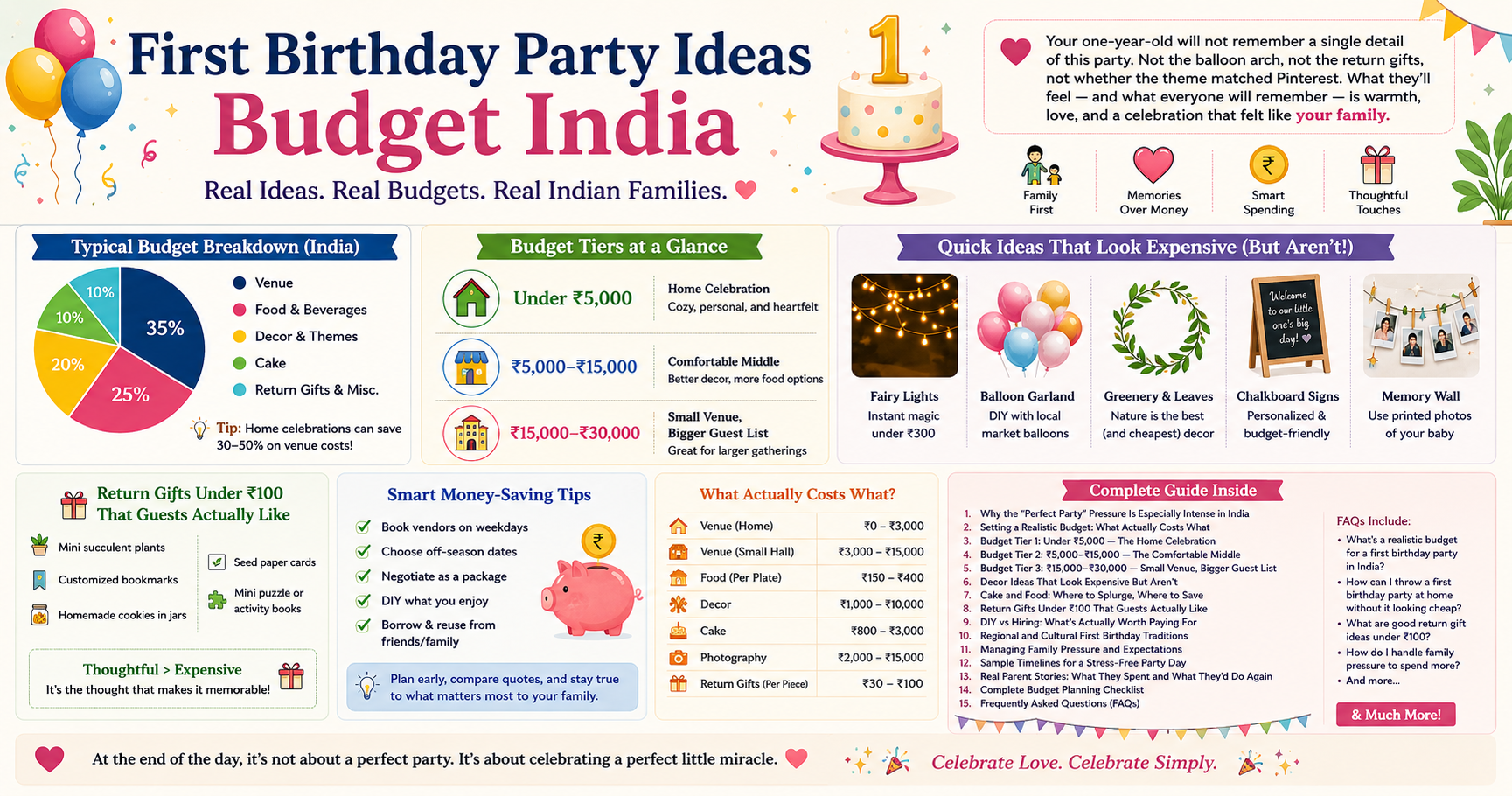
Typical cost breakdown (percentage of total budget, regardless of tier):
Understanding these proportions matters more than the absolute numbers, because it lets you make trade-offs consciously — for example, choosing to skip a hired photographer entirely in order to afford a slightly nicer venue, rather than spreading a tight budget thin across every category and ending up with a party that feels compromised everywhere instead of intentional somewhere.
This is entirely achievable for a warm, memorable celebration, particularly for an intimate gathering of close family and friends (15–25 people).
Venue: Your own home or a family member’s home — free, and genuinely often the most emotionally meaningful option since it’s the actual place the baby is being raised.
Decor (₹500–₹1,500): Balloons (bought loose and self-inflated rather than a pre-arranged balloon bouquet, which costs significantly more), simple paper streamers, a handmade banner (easily created at home with card paper and string), and fairy lights, which are reusable for future occasions and instantly elevate a simple room.
Cake (₹500–₹1,500): A home-baked cake, if anyone in the family bakes, or a simple bakery cake from a local, non-premium bakery rather than a branded cake chain — the taste difference is often minimal, but the price difference is substantial.
Food (₹1,500–₹3,000 for 20–25 people): Home-cooked food prepared by family, or a simple, well-chosen catering package from a local caterer rather than an elaborate multi-cuisine spread — a few well-made dishes (a snack item, a main course, a sweet) executed well beats an overwhelming, expensive buffet nobody finishes.
Return gifts (₹500–₹1,000 for 20–25 guests): Home-packed small treats (a few pieces of chocolate, a small handwritten thank-you note) rather than store-bought gift sets, which cost considerably more per unit for often forgettable contents.
What this tier genuinely delivers: an intimate, warm gathering where the focus stays naturally on the baby and immediate family rather than logistics — several parents specifically describe this as their favourite version of a first birthday in hindsight, even when they later hosted a bigger second-child celebration.
This range allows for a slightly larger guest list (25–50 people) and a bit more polish without moving to a paid venue.
Venue: Still home-based, but potentially extending into a building’s common area, terrace, or a small nearby community hall/society clubhouse if one’s available at a nominal or free booking cost — many residential societies in Indian cities offer this at low cost to residents.
Decor (₹2,000–₹4,000): A themed balloon arrangement (self-assembled from a kit, rather than professionally installed), a simple photo backdrop (a cloth banner with the child’s photos, printed affordably at a local print shop), and character-themed elements bought as individual pieces rather than a full “decor package.”
Cake (₹1,500–₹3,000): A well-reviewed local bakery cake with a simple custom design (a photo cake or a simple themed design) rather than an elaborate multi-tier fondant creation.
Food (₹4,000–₹8,000 for 30–40 people): A modest catering package covering 2–3 food items plus dessert, or a hybrid approach — some dishes catered, some prepared at home by family, which both saves money and often adds a more personal touch relatives specifically comment on.
Return gifts (₹1,500–₹3,000): Modest but thoughtfully chosen items — small toys, stationery sets, or edible treats in the ₹50–₹80 per-guest range, purchased in bulk from a wholesale market rather than a retail gift shop for meaningfully better pricing.
Photography: A talented friend or relative with a good phone camera or basic DSLR, briefed in advance on the shots you actually want, often produces genuinely lovely, authentic photos without the ₹15,000+ cost of a professional package.
For families wanting a slightly larger celebration (50–80 guests) or a proper rented venue, without moving into the elaborate, five-figure-plus territory some event planners push toward.
Venue (₹5,000–₹12,000): A small banquet hall, community centre, or restaurant private room — many smaller, less “premium-branded” venues in Tier 2 and Tier 3 cities, and even in specific neighbourhoods of metros, offer genuinely nice spaces at a fraction of flagship banquet hall pricing.
Decor (₹4,000–₹8,000): A themed decor package from a smaller, local decorator rather than a big-name event company — often visually comparable results at 40–60% of the cost, particularly if you’re flexible on exact colour/theme matching rather than insisting on a very specific Pinterest reference.
Cake (₹2,000–₹4,000): A proper custom-themed cake from a good local baker, which at this budget tier becomes genuinely affordable without needing a premium branded bakery.
Food (₹8,000–₹15,000 for 50–70 people): A proper catering package with a more complete menu, still from a mid-range local caterer rather than a premium event catering company, where per-plate costs are often 30–50% lower for comparable quality.
Entertainment (₹1,000–₹3,000): A simple activity corner (a small ball pit rental, a face-painting artist for older sibling guests, simple party games) rather than elaborate entertainment packages.
Return gifts (₹3,000–₹5,000): More generous per-guest gifting, still sourced from wholesale markets or online bulk-buy platforms for better per-unit pricing than retail gift shops.
Worth spending a little more on: the cake, since it’s genuinely the visual and emotional centrepiece of the day, photographed extensively, and remembered specifically; and at least one dish guests will genuinely enjoy and remember, rather than an entire menu of forgettable, budget-stretched options.
Worth saving on: an overly elaborate multi-cuisine spread that inevitably goes partially to waste; branded/premium bakery pricing when a good local baker can produce comparable quality; and excessive quantity “just in case,” which is one of the most common sources of wasted spending at Indian family functions specifically.
A genuinely useful trick many experienced Indian party planners use: ask your caterer for an honest, realistic per-head quantity recommendation based specifically on the event’s timing (a mid-afternoon party needs less food than an evening dinner-hour party) rather than defaulting to a standard “safety margin” quantity that most caterers quote by default, which often significantly overshoots actual consumption.
Return gifts are a distinctly Indian celebration tradition that can quietly consume a large chunk of the budget if not planned deliberately.
Worth DIY-ing: decor assembly (balloon kits, banners, table styling), return gift packing, invitation design (easily done on free design apps and shared digitally to save printing costs), and food preparation if family members genuinely enjoy cooking and have the bandwidth — though this last one deserves an honest gut-check, since an exhausted parent trying to cook for 40 guests the morning of the party isn’t actually saving stress, even if it saves money.
Worth hiring, even on a tight budget: at minimum a helper for the day-of logistics (serving, cleanup, guest coordination) so the parents themselves can actually be present and enjoy the celebration rather than running it like an event manager — this is one expense experienced parents consistently say was worth prioritising over decor or return gift budget, precisely because the parents’ own presence and enjoyment matters more to the day’s memory than most other line items.
Many Indian families layer specific cultural or religious elements into the first birthday, often more meaningful to relatives than any decor choice:
Choosing ceremony (a version practiced in several communities): the baby is presented with a selection of objects (money, a book, a pen, food) and the item they instinctively reach for is playfully interpreted as a sign of their future inclination — a genuinely fun, low-cost, high-engagement activity for the whole family to participate in.
A small puja or blessing, particularly common in more traditionally-inclined families, often held earlier in the day before the main celebration, requiring minimal additional cost beyond basic puja items.
First birthday specific to regional custom — for example, some South Indian families combine the child’s first birthday celebration with specific traditional rituals distinct from North Indian practice; if this matters to your family, it’s worth checking with elders on the specific version your own community follows rather than defaulting to a generic “Western-style” party format that skips these entirely.
Elders’ blessings as a structured moment, rather than an incidental part of the gathering — setting aside a specific few minutes for grandparents and elders to formally bless the child is something many families describe as the actual emotional highlight of the day, entirely free, and easily overshadowed by party logistics if not deliberately planned for.
A genuinely common, rarely discussed tension: budget-conscious parents sometimes face pushback from grandparents or extended family who want a bigger, more elaborate celebration, sometimes even offering to fund the difference themselves.
A few approaches families have found workable:
For a home celebration (Tier 1–2):
For a venue celebration (Tier 3):
Sneha, Pune — “We ended up spending ₹7,200 total — slightly over my original ₹8,000 target once return gifts were counted properly. Home celebration, twenty-two people, food from a local caterer we already trusted for family functions. My mother still talks about that party more than my sister’s much bigger, venue-hosted one for her daughter two years later. I genuinely don’t think anyone remembers or cares what we spent.”
Arjun and Divya, Bangalore — “We spent close to ₹22,000, mostly because Divya’s parents specifically wanted a proper venue since it was the first grandchild on both sides and they wanted extended family from out of town to have a comfortable space. We compromised — modest venue, but no professional decor company, we did it ourselves with a kit and it looked genuinely great in photos.”
Farah, Hyderabad, single parent — “Doing this without a partner’s income to split costs with meant I was ruthless about the budget — ₹4,500 total, entirely at home, food cooked by me and my sister the day before. It was the smallest party in my friend group by far, and also, according to every guest who came, one of the warmest. I stopped feeling guilty about the comparison pretty quickly once I saw how genuinely happy everyone actually was.”
Kavita, joint family, Lucknow — “My mother-in-law initially wanted a big function hall event. We sat down, showed her an honest budget breakdown, and she actually chose to redirect that energy into funding a proper puja and pandit visit instead, which mattered more to her than the venue itself once we actually talked about it directly instead of assuming what she wanted.”
Planning phase
Decor and cake
Food
Return gifts
Day-of logistics
Cultural elements
It genuinely ranges from under ₹5,000 for an intimate home celebration to ₹30,000+ for a larger venue-hosted event — there’s no single “right” number, and guest experience depends far more on planning and warmth than total spend.
Focus spending on one or two visual focal points (a nicely done photo backdrop, a good cake) rather than spreading a limited budget thinly across every category, and use reusable items like fairy lights and fresh flowers, which photograph beautifully at low cost.
Small potted plants, bulk-sourced chocolate or sweet boxes, simple stationery sets for guests with children, and handmade thank-you cards paired with a small treat are all well-received, budget-friendly options.
Open, early communication about the budget, combined with accepting selective help (letting relatives fund one specific element rather than the whole event) tends to work better than an all-or-nothing negotiation closer to the date.
Not essential on a tight budget — a friend or relative with a good camera, briefed in advance on the shots you want, often produces genuinely lovely results without the cost of a professional package, which can run ₹15,000 or more.
Ask your caterer for an honest, timing-specific quantity recommendation (afternoon parties need less food than evening ones) rather than defaulting to their standard “safety margin” quantity, which frequently overshoots actual consumption and drives up cost.
Yes, if they matter to your family — most cultural elements (a puja, a choosing ceremony, a structured elders’ blessing moment) cost very little and are consistently described by parents as the most meaningful part of the day, regardless of the surrounding party’s scale.
Prices referenced in this guide are approximate and vary significantly by city, vendor, and season; treat the figures as planning benchmarks rather than fixed quotes, and confirm current local pricing directly with vendors in your area.