Physical Address
304 North Cardinal St.
Dorchester Center, MA 02124
Physical Address
304 North Cardinal St.
Dorchester Center, MA 02124

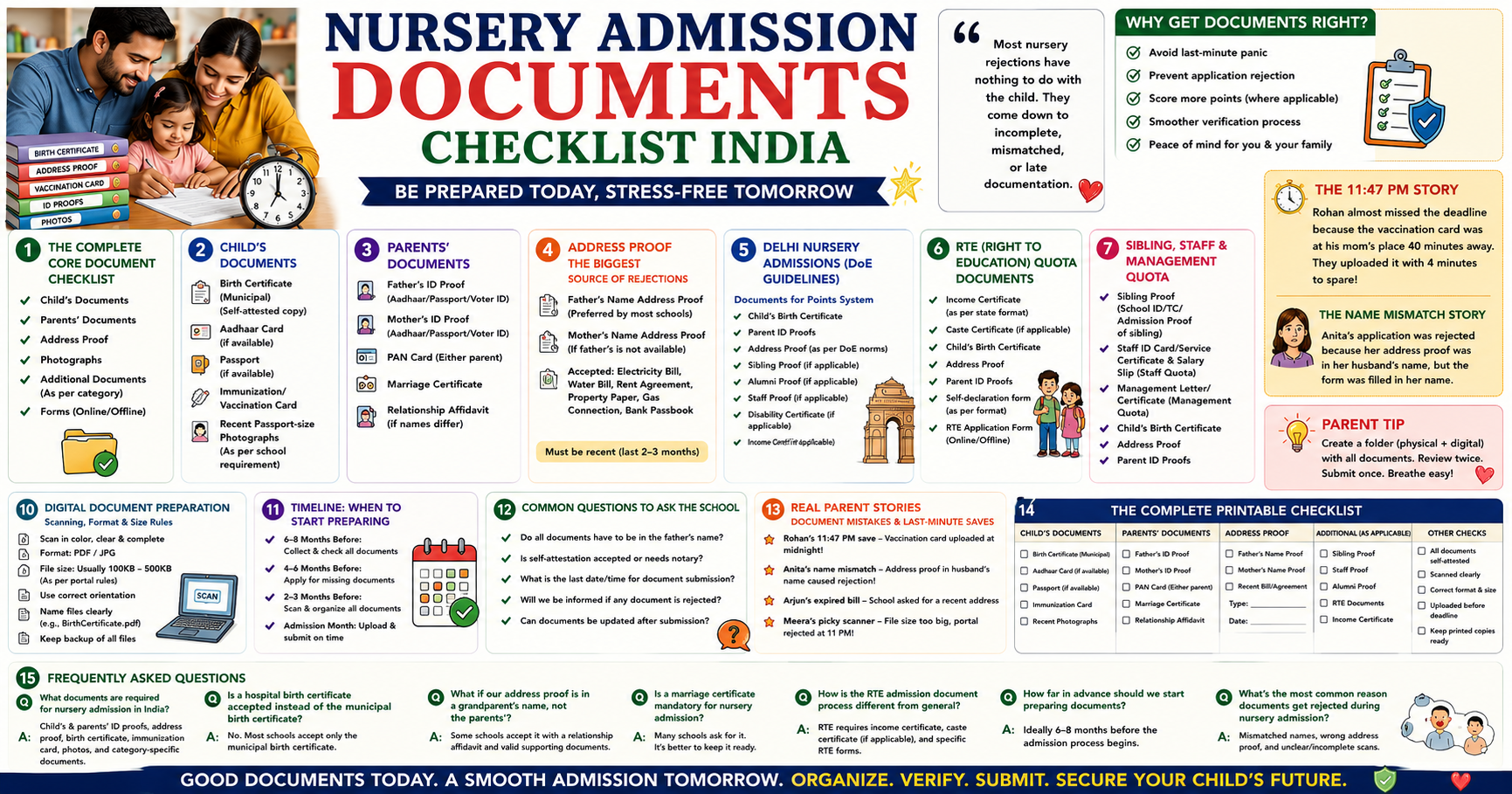
Rohan found out the hard way, at 11:47 PM, that the school portal closed admissions sharp at midnight. He had eleven of the twelve required documents scanned and uploaded. The twelfth — his daughter’s immunization card — was sitting in a drawer at his mother’s house, forty minutes away, because she’d taken the baby for a vaccination visit three weeks earlier and simply kept the card in her own file “for safekeeping.” He called her at midnight, half-laughing, half-panicking, while his wife tried to find a way to photograph the card off a video call clearly enough to upload. They made it, with four minutes to spare, and Rohan still calls it “the most stressful ten minutes of my parenting life so far” — beating out, in his words, several actual medical emergencies.
That story isn’t rare. Every admission season, thousands of Indian parents lose sleep not over whether their child is “good enough” for a school, but over paperwork — a document that’s in the wrong parent’s name, an address proof that doesn’t match the child’s birth certificate, a form that asks for something nobody warned them about until three days before the deadline. The frustrating truth is that most nursery rejections in India have nothing to do with the child at all. They come down to incomplete, mismatched, or late documentation.
This guide exists to make sure that never happens to you. It’s the complete, no-surprises checklist — what you need, why schools ask for it, how to avoid the mismatches that trip up otherwise-perfect applications, and the state and city-specific quirks that most generic checklists online completely miss.
Parents spend enormous energy worrying about whether their child will “perform well” in an interaction round, or whether their preferred school will find them impressive enough. In reality, most private schools in India — especially at the nursery level — don’t run rigorous academic evaluations at all; many have moved away from formal child interviews entirely, especially in cities where this practice has faced regulatory scrutiny.
What actually derails applications, far more often, is administrative: a document that doesn’t match across the application (a father’s name spelled differently on the birth certificate versus his own ID), a proof of address in the wrong parent’s name when the school specifically requires the father’s or mother’s proof, or simply missing a document nobody mentioned until the final submission screen. Getting the documentation exactly right, in advance, removes an entire category of stress that has nothing to do with your child’s readiness or your family’s suitability — it’s simply administrative correctness.
While requirements vary by state, city, and individual school, this is the core set that the overwhelming majority of Indian nursery admissions will ask for in some form:
Not every school asks for all fourteen. But knowing this full list before you start means you’re never caught scrambling for something you didn’t know existed.
Birth certificate. The single most important document in the entire application. It should be the official certificate issued by the municipal corporation or relevant registration authority — not a hospital-issued discharge summary, which many first-time parents mistakenly assume is sufficient. If you haven’t registered the birth yet, this should be the very first administrative task after delivery, well before admission season, since municipal processing can take time, especially if registration is delayed beyond the standard window.
Aadhaar card. Increasingly requested for children as young as 1–2 years, both as an identity document and, in some states, as part of broader digital verification systems tied to school admission portals. If your child doesn’t have an Aadhaar yet, apply well in advance — processing typically takes a few weeks.
Photographs. Requirements vary by school (white background vs any background, specific pixel dimensions for online portals), so check the specific school’s photo specification rather than assuming a generic passport photo will be accepted as-is — many online portals reject photos that don’t meet exact size/format requirements.
Immunization record. Most schools want to see the standard vaccination schedule followed up to the child’s current age, per the national immunization schedule. This is also, notably, the single most commonly forgotten document — precisely because it often lives with whoever last took the child for a vaccination, not necessarily in the primary parent’s own file.
Previous preschool documents, if applicable — a leaving certificate or transfer certificate if the child attended a playgroup or another preschool previously, along with any progress report the previous institution provided.
Identity proof for both parents. Most schools require identity proof from both parents, not just the primary applicant — Aadhaar is most commonly accepted, though PAN, passport, or voter ID typically work as alternatives or supplements.
Passport-size photographs of both parents, again with format specifications varying by school portal.
Marriage certificate. Not universally required, but increasingly requested by schools, particularly those following more formalised, portal-based application systems. Families without a formal registered marriage certificate (common in many traditional Indian marriages that weren’t formally registered) should check the specific school’s flexibility on this well in advance, since some schools accept alternate proof (a joint address proof, an affidavit) while others are stricter.
Employer ID or employment proof, occasionally requested, particularly for schools that give any weight to parent occupation in their point/preference systems, or simply as a general verification step.
Income proof, required specifically for EWS or RTE quota applications, detailed further in Section 7.
This deserves its own section because it causes more application headaches than almost anything else on this list.
Why it matters so much: many nursery admission systems, especially in cities like Delhi, use “neighbourhood” or distance-from-school criteria as a significant, sometimes decisive, factor in the admission point system. This means address proof isn’t just a formality — it can directly affect your child’s admission odds, which is exactly why schools scrutinise it closely.
Commonly accepted address proof documents:
The mismatch trap: the address proof must typically be in the name of the parent listed as the primary applicant, and must match the address used elsewhere in the form. A common, entirely avoidable rejection reason: submitting an electricity bill in the grandfather’s name when the family lives in an ancestral or joint-family home, without an additional document establishing the parent’s residency at that same address. If you’re in this situation, ask the specific school directly what supplementary document (an affidavit, a no-objection letter from the property owner) would resolve this before submission, rather than assuming it will simply be accepted.
Recently moved families: if you’ve relocated within the last few months and your address proof documents haven’t caught up yet (a common gap, since utility connections and Aadhaar updates take time), start that update process as early as possible in the admission season — this specific issue causes more last-minute panic than almost any other documentation problem.
Delhi deserves its own section because its nursery admission process is the most formally regulated and closely watched in the country, with the Directorate of Education (DoE) publishing specific guidelines each admission cycle.
Neighbourhood criteria and distance points. Delhi’s point-based system typically allocates significant weight to distance between the child’s residence and the school, meaning address proof accuracy is especially critical here — even a small discrepancy can shift a family’s point total meaningfully.
Sibling and alumni points. If an elder sibling is already enrolled at the school, or a parent is an alumnus, supporting documents (the sibling’s current enrolment proof, the parent’s own school leaving certificate) can add points under many Delhi private schools’ published criteria.
EWS/DG category (Economically Weaker Section/Disadvantaged Group). Delhi mandates a minimum percentage of seats reserved under this category in private unaided schools, requiring specific income and category certificates, detailed further in Section 7.
Single parent and other special categories. Many Delhi schools’ point systems also allocate points for specific family circumstances (single parent, girl child, twin/multiple birth siblings applying together), each typically requiring its own supporting document — a single-parent status certificate, birth certificates confirming twin status, and so on.
Because Delhi’s exact point criteria and required documents can shift slightly each admission year based on updated DoE circulars, it’s worth checking the current year’s official DoE nursery admission guidelines directly (typically published on the Directorate of Education’s website ahead of the admission season) rather than relying solely on a previous year’s requirements, even from a reliable source.
The Right to Education Act mandates 25% reservation in private unaided schools for children from economically weaker sections and disadvantaged groups. This route has its own distinct documentation requirements:
RTE application windows and documentation deadlines often run on a separate timeline from general admission, and typically go through a state government portal rather than the individual school’s own admission process — this distinction catches some families off guard, since they assume the same documents and dates apply to both routes when they frequently don’t.
Sibling quota: Requires proof that an elder sibling is currently enrolled and in good standing at the school — typically a current enrolment/bonafide certificate from the school itself, plus documents establishing the sibling relationship (birth certificates of both children, showing common parents).
Staff quota (for children of the school’s own teaching or non-teaching staff): Requires employment verification from the school’s HR/administration, typically handled internally rather than through the general document submission process.
Management/discretionary quota: Documentation requirements vary significantly and are less standardised, often handled through direct communication with school administration rather than the standard portal process.
Alumni quota: Requires proof of a parent’s own enrolment at the school — commonly the parent’s school leaving certificate or an alumni verification letter, if the school maintains formal alumni records.
<a name=”states”></a>
While Delhi has the most formalised and closely documented system, other states and cities carry their own quirks worth flagging:
Maharashtra (Mumbai, Pune) generally follows RTE guidelines closely for the reserved quota but leaves general admission criteria largely to individual school discretion, meaning document requirements can vary more school-to-school than in Delhi’s more centrally regulated system.
Karnataka (Bangalore) has its own RTE portal and process, with income and caste certificate formats specific to Karnataka’s revenue department, distinct from formats used in other states.
Tamil Nadu RTE and general admission processes often require a domicile-linked residence certificate more strictly than some other states, particularly for schools in high-demand areas of Chennai.
West Bengal (Kolkata) private school admissions tend to be less centrally standardised than Delhi’s, with individual schools setting their own document lists, though core documents (birth certificate, address proof, immunization record) remain broadly consistent with the national pattern.
General rule across states: whatever your specific city, always cross-check document requirements against both the individual school’s published list and your state’s current RTE portal guidelines if applying under that quota, since these two lists don’t always perfectly overlap.
Most Indian nursery admissions now run substantially or entirely online, which brings its own preparation checklist:
6+ months before the expected admission season: Ensure birth certificate is registered and in hand; apply for the child’s Aadhaar card if not already done; begin the address proof update process if you’ve recently moved.
3–4 months before: Gather all parent identity documents, confirm marriage certificate availability or plan for alternate documentation if needed, check the specific target schools’ published document requirements (many schools publish these ahead of their admission window opening).
1–2 months before: Prepare digital scans in the correct formats, take fresh photographs meeting each school’s specific photo requirements, apply for any category/income certificates needed for quota applications, since these government-issued certificates often take several weeks to process.
Admission window itself: Do a final cross-check of every document against the school’s published checklist before submission, keep physical originals ready for a possible verification stage, and avoid last-minute submissions given how many portals experience heavy traffic and technical issues in the final hours before a deadline closes.
Rohan, Gurgaon — “The immunization card story is basically family legend now. Four minutes to spare, my mother-in-law on a video call at midnight holding up a card in bad lighting. We laugh about it now, but I’ve told every friend with a toddler since: know exactly where every single document physically is, weeks before you need it, not the night of.”
Farah, Chennai — “Our electricity bill was in my father-in-law’s name because we live in the family home. Nobody told us this would be a problem until the school flagged it during verification, two weeks before the deadline. We had to get a notarised no-objection letter from him establishing that we reside there. Completely avoidable if I’d asked the school directly on day one instead of assuming it would be fine.”
Meera, Delhi — “Delhi’s point system genuinely rewarded precision. We double, triple-checked every document matched exactly — same spelling, same address format, same everything — because even half a point mattered given how competitive our target school was. It felt excessive at the time, honestly a little paranoid, but I don’t regret the effort at all in hindsight.”
Vikram, Bangalore, RTE applicant — “Nobody explained clearly that RTE has its own separate portal and timeline from the school’s general admission process. We assumed submitting documents to the school was enough, and almost missed the actual RTE portal deadline entirely because we didn’t realise it was a completely separate system running on its own schedule.”
Child’s documents
Parents’ documents
Address proof
Quota-specific documents (if applicable)
Digital preparation
Final cross-check
Core documents typically include the child’s birth certificate, Aadhaar card, photographs, immunization record, parents’ identity proof and photographs, and address proof — with additional documents required for RTE, EWS, sibling, or other quota applications.
No — most schools require the official municipal corporation-issued birth certificate, not a hospital discharge summary or birth confirmation letter, which many first-time parents mistakenly assume will be sufficient.
This is common in joint-family households. Most schools will accept a supplementary document — often a notarised no-objection letter or affidavit from the property owner confirming the applicant parent’s residency at that address — but it’s important to ask the specific school directly rather than assuming it will automatically be accepted.
Not universally, but increasingly requested by schools with formalised portal-based systems. Families without a registered marriage certificate should check the specific school’s accepted alternatives well before the application deadline.
RTE applications typically run through a separate state government portal with their own timeline, income/category certificate requirements, and catchment area rules — distinct from the individual school’s general admission document process, which is a common source of confusion.
Ideally 4–6 months before the expected admission season, particularly for documents that take time to obtain or update, like a child’s Aadhaar card, income/category certificates, or an updated address proof after a recent move.
Name or address mismatches across different documents — even small spelling or format inconsistencies between a birth certificate, Aadhaar card, and application form are among the most common, entirely avoidable causes of delay or rejection.
Document requirements and quota rules vary by state, city, and individual school, and official guidelines (particularly for RTE and Delhi DoE nursery admissions) are updated periodically. Always cross-check current-year requirements directly with your target school and the relevant state education portal before finalising your application.