Physical Address
304 North Cardinal St.
Dorchester Center, MA 02124
Physical Address
304 North Cardinal St.
Dorchester Center, MA 02124

Ritu had the form filled out for three weeks before she actually submitted it. Her daughter, Aanya, had just turned two, and every WhatsApp parenting group Ritu was part of seemed split into two camps: the ones triumphantly posting “admission confirmed!” for two-year-olds, and the ones insisting, with equal conviction, that sending a child to preschool before three was basically outsourcing parenting. Ritu read both camps, closed the app, and stared at Aanya, who was at that exact moment trying to feed a biscuit to the ceiling fan remote.
“Is she ready?” Ritu asked her own mother on the phone. Her mother, who’d raised three children in a Lucknow joint family with no preschool in sight until age five, laughed. “Ready ke liye koi test nahi hota, beta. Bas dekho woh khush hai ya nahi.” There’s no test for ready. Just watch whether she’s happy or not.
That conversation, more than any parenting article Ritu had read, is what finally helped her decide. This guide exists because the “best age” question doesn’t actually have one universal answer — but it does have a clear, honest framework, real developmental science, and enough India-specific context (admission cycles, costs, cultural pressure, joint-family dynamics) to help you make a confident decision for your own child, not someone else’s.
Every Indian parent searching this topic wants a single number — “just tell me, is it 2, is it 3?” — and the honest answer is that developmental readiness doesn’t arrive on a birthday. Two children born on the exact same day can be genuinely ready for structured group settings months apart, depending on temperament, prior socialisation, language development, and even something as simple as how many cousins or neighbourhood kids they already play with regularly.
That said, “there’s no fixed answer” isn’t a satisfying place to leave a parent who needs to actually submit an admission form. So this guide gives you both: the honest nuance, and a practical, India-contextualised range most educators and paediatricians actually work within.
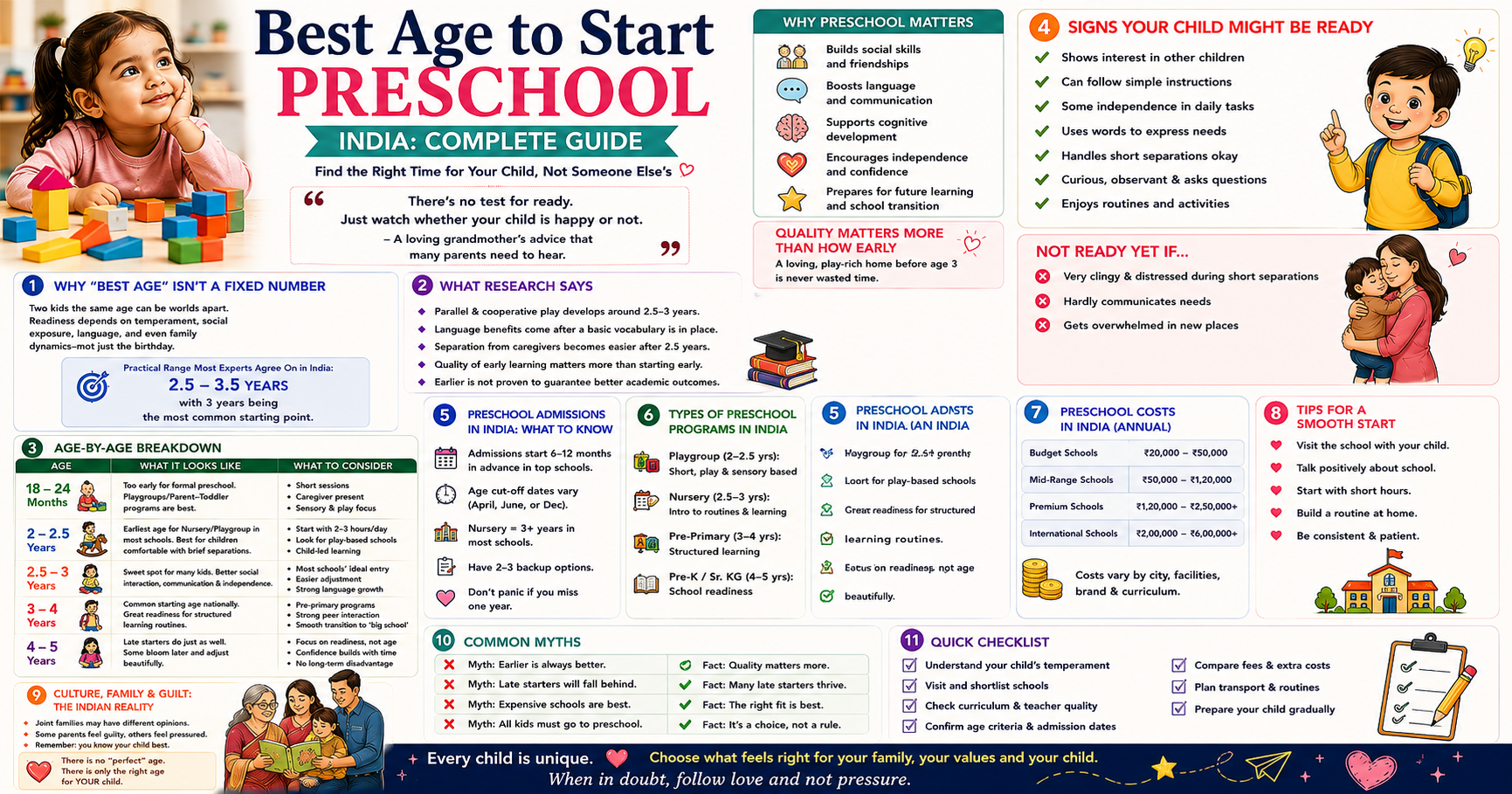
The short, practical answer most Indian preschools and early-childhood educators converge on: somewhere between 2.5 and 3.5 years, with 3 years being the most common starting point nationally. Everything after this section explains the “why,” the exceptions, and how to figure out where your own child fits.
Early childhood development research generally points to a few consistent findings that matter for this decision, regardless of country:
Structured social settings become more beneficial once children develop parallel and cooperative play skills, which typically emerge somewhere between 2.5 and 3 years. Before this window, most toddlers engage in what’s called “parallel play” — playing near other children rather than genuinely with them — which means a lot of the social benefit parents hope preschool provides simply isn’t accessible to a child’s brain yet, no matter how good the school is.
Language development benefits significantly from peer group settings, but mainly once a child already has a foundational vocabulary to build on — meaning a child who’s barely speaking often benefits more from focused one-on-one language exposure at home than from a noisy group classroom they can’t yet participate in verbally.
Separation from primary caregivers becomes developmentally easier to manage, on average, after age 2.5, as object permanence and a more secure sense of “mumma will come back” solidifies — though this varies enormously by individual temperament and attachment history, not just age.
Earlier is not consistently linked to better long-term academic outcomes. This is worth saying plainly because a lot of competitive urban Indian parenting culture implies otherwise: robust longitudinal research on early education generally shows benefits from quality of early learning environments, not from how early a child starts structured schooling. A loving, language-rich home environment before age 3 is not “wasted time” compared to an early preschool seat.
None of this means early preschool (starting at 2 or 2.5) is wrong for every child — many children genuinely thrive with earlier starts, especially only children without regular peer contact at home, or children in smaller nuclear families without extended family playmates nearby. It simply means the pressure to start as early as physically possible isn’t backed by the kind of evidence the pressure implies.
Generally considered too early for formal preschool by most Indian early-childhood educators, though some cities offer “playgroup” or “parent-toddler” programs specifically designed for this age — shorter sessions, caregiver often present, focused on sensory play rather than structured learning. If considering something at this age, a playgroup format (not a drop-off preschool) is usually the more developmentally appropriate choice.
The earliest age most standalone preschools in India will accept a child for a Nursery/Playgroup batch. Best suited to children who already show some comfort with brief separations, basic toileting progress (though full toilet training isn’t usually required at this stage), and some interest in other children, even if only watching them.
The most commonly chosen starting window nationally, and the age range most preschool curricula are actually designed around. Most children in this window can manage a 2–3 hour school day, follow simple group instructions, and handle short separations from a primary caregiver with appropriate support.
Considered by many early-childhood educators to be a genuinely comfortable, low-stress starting point — children in this range typically have stronger language skills, more developed emotional regulation, and adapt faster to classroom routines, often with fewer weeks of separation-anxiety adjustment than younger starters.
Still well within normal range for a first preschool experience, particularly for children who’ve had rich social exposure at home (siblings, joint family, regular playdates) and simply didn’t need structured schooling earlier. Some children starting at this age skip Nursery/Playgroup entirely and enter directly into a Junior KG-equivalent batch, depending on the school’s age cut-offs.
Global parenting advice often misses factors that genuinely shape this decision for Indian families specifically:
Joint family structure. A child growing up with grandparents, aunts, uncles, and cousins in daily contact often already gets significant social and language stimulation that a preschool would otherwise be the primary source of — which can reasonably support a slightly later start without any developmental disadvantage.
Working parents and childcare gaps. For many urban dual-income families, the “best age” question is inseparable from a practical childcare question — if a nanny, daycare, or grandparent isn’t consistently available, an earlier preschool start (from 2–2.5 years) may be less about “readiness” and more about a genuine logistical need, and that’s a completely valid reason on its own.
School admission cut-off pressure. Because many reputed Indian primary schools have specific age cut-offs for Nursery/KG admission (often requiring a child to be a certain age by a fixed date, commonly around 31st March or 31st July depending on the state and school board), some parents feel pushed to start preschool earlier than they’d otherwise choose, purely to stay “on track” for a preferred primary school’s admission ladder later.
Language exposure planning. In multilingual households, some parents deliberately choose an earlier preschool start specifically to introduce structured English exposure earlier, particularly if English isn’t the primary language spoken at home — a valid and common consideration in Indian urban and semi-urban families.
Cultural comparison pressure. It’s worth naming directly: a significant amount of “when should I start preschool” anxiety among Indian parents comes from social comparison — WhatsApp groups, relatives, neighbours — rather than anything specific to the individual child. This doesn’t make the anxiety less real, but recognising the source helps parents separate genuine readiness signals from comparison-driven urgency.
Age is a starting filter, not the full picture. These signs, observed together rather than individually, suggest genuine readiness regardless of exact age:
Equally worth naming honestly, since most articles only list “readiness signs” and skip this side:
None of these signs are permanent disqualifiers — they’re simply information that a few more months of preparation, or a lighter playgroup format instead of full preschool, might serve the child better than jumping straight into a formal admission.
Understanding India’s preschool admission calendar helps parents plan realistically rather than reactively:
Academic year structure. Most Indian preschools follow an April–March academic year (aligned with the broader Indian school system), meaning admissions typically open in the preceding October–January window for the following April intake.
Age cut-off dates. Common cut-off dates used by schools include 31st March, 31st May, or 31st July of the admission year, depending on the state, board affiliation, and individual school policy — meaning two children born just weeks apart can end up in different batches depending purely on which side of a school’s specific cut-off they fall.
Application timelines. Popular preschools in metro cities, particularly those affiliated with larger K-12 chains, often have applications open for as little as 2–4 weeks in a tight admission window, making early research (6+ months ahead) genuinely useful, especially for competitive schools.
Mid-year admissions. Many standalone preschools (as opposed to K-12-chain-affiliated ones) offer rolling or mid-year admissions, which is worth knowing if a family decides on preschool later than the traditional cycle — it’s rarely a strict “wait a full year” situation outside of the most competitive institutions.
These terms get used loosely and interchangeably across India, which adds to parental confusion:
Playschool/Playgroup: Typically for the youngest age band (18 months–2.5 years), shorter hours, heavy focus on sensory and social play rather than structured curriculum, sometimes allows caregiver presence for initial sessions.
Preschool/Nursery: Typically 2.5–4 years, structured half-day (2–4 hours) programs with an early curriculum focus — pre-writing, rhymes, basic concepts, structured group activities — without caregiver presence beyond initial settling-in days.
Daycare: Full-day childcare, often 8+ hours, sometimes combined with a preschool curriculum component (many daycare-preschool hybrid centres exist in Indian metros specifically for working parents), sometimes purely custodial care without a strong educational component — worth checking which model a specific centre actually follows before assuming.
Junior KG / Senior KG: The formal pre-primary stage most Indian primary schools consider the actual “start” of schooling, typically for ages 3.5–5.5, often what parents are working backward from when planning preschool timing in the first place.
Preschool costs in India vary enormously by city tier, school brand, and whether it’s a standalone local playschool or part of a larger national chain.
Metro cities (Delhi NCR, Mumbai, Bangalore, Chennai, Hyderabad): Standalone neighbourhood preschools typically range ₹25,000–₹80,000 per year; branded chain preschools often range ₹80,000–₹2,00,000+ per year, with premium international-curriculum preschools going considerably higher.
Tier-2 cities: Standalone preschools typically ₹15,000–₹40,000 per year; branded chains generally ₹40,000–₹1,00,000 per year.
Additional costs to budget for: admission/registration fees (often non-refundable, ranging ₹2,000–₹25,000 depending on school tier), uniforms and books, transport if using school buses, and activity/field trip charges that some schools bill separately from tuition.
Government and subsidised options: Anganwadi centres, run under India’s Integrated Child Development Services (ICDS) scheme, offer free early-childhood care and basic pre-school-style activities and remain an important, widely used option for many families, particularly outside major metros, though the curriculum intensity differs significantly from private preschools.
Separation anxiety at preschool start is close to universal, not a sign that a child “wasn’t ready” or that a parent chose wrong timing. What actually helps, based on common early-childhood educator guidance:
Ritu, Mumbai — “We started Aanya at 2 years 9 months, mostly because I was going back to work and my mother-in-law’s health made full-time childcare hard for her. I felt guilty about the ‘why’ for a while — it felt less pure than parents who said their child was ‘ready.’ But honestly, Aanya loved it from week two, and I’ve stopped apologising for a decision that was also about our family’s real logistics, not just her development.”
Karan and Meher, Bangalore — “Our son is an only child, no cousins nearby, both sets of grandparents in different cities. We started him at 2.5 specifically because he genuinely had almost no regular contact with other kids at home. It wasn’t about academics at all — it was purely social.”
Sunita, joint family, Lucknow — “We waited until 3.5. My daughter had four cousins in the house every single day, she was never short of social interaction, and honestly I didn’t see the rush. My mother-in-law actually pushed for later, not earlier, which surprised some of my friends who assumed grandparents always want ‘early school.’ It really depends on the family, not a generation-wide rule.”
Divya, Hyderabad — “We tried preschool at 2.5, and it was a disaster — weeks of hysterical crying that didn’t ease even after a month. We pulled her out, waited eight months, tried again at 3.2, and it was almost a completely different experience. I wish someone had told me clearly that ‘try again later’ was a completely normal, non-failure option instead of something to feel embarrassed about.”
Most Indian preschools and early-childhood educators consider 2.5 to 3.5 years the most common and developmentally comfortable starting window, with 3 years being the single most typical starting point nationally.
Not inherently — some children, particularly only children without regular peer contact at home, thrive with an earlier start. What matters more than the exact age is whether the child shows genuine readiness signs like tolerating short separations and showing interest in other children.
No. Many children, especially those with strong social exposure through joint families or siblings, start comfortably at 3.5–4 years, sometimes skipping the youngest preschool batch entirely and entering directly into a Junior KG-equivalent class.
Playschool/playgroup generally serves the youngest children (18 months–2.5 years) with a play-focused, shorter format; preschool/nursery typically serves 2.5–4 years with a half-day structured curriculum; daycare offers full-day childcare, sometimes combined with a preschool curriculum and sometimes purely custodial.
Costs vary widely — roughly ₹15,000–₹40,000 per year for standalone preschools in Tier-2 cities, and anywhere from ₹25,000 to over ₹2,00,000 per year in metro cities depending on whether it’s a local neighbourhood school or a premium branded chain.
Most early-childhood educators consider 2–4 weeks a normal adjustment period. Distress that remains severe and unchanged well beyond that window is worth discussing with the school and possibly a paediatrician.
It’s a valid practical consideration given India’s admission cut-off systems, but it’s worth separating from the readiness question — some families choose an earlier logistical start for this reason while being clear-eyed that it’s a strategic choice, not a developmental necessity.
This article reflects commonly cited early-childhood development guidance and typical Indian preschool practices; individual readiness varies significantly by child. For specific concerns about your child’s developmental readiness, a paediatrician or early-childhood specialist can offer guidance tailored to your child.