Physical Address
304 North Cardinal St.
Dorchester Center, MA 02124
Physical Address
304 North Cardinal St.
Dorchester Center, MA 02124

Let me be honest with you. Before my baby arrived, I thought bedtime would be simple. Feed the baby, put them down, and enjoy a peaceful evening. Right?
The reality hit me hard around week three. My baby would cry, arch their back, fight sleep, and I’d find myself rocking them at 11 PM, whispering “ab bas, so jao, beta!” (now please, sleep, my child!) with tears in my eyes .
If this sounds familiar, you’re not alone. According to Laura Hunter, co-founder of Moms on Call, this is a rhythm most new parents know all too well .
Here’s what I’ve learned: a consistent bedtime routine isn’t just about getting your baby to sleep. It’s about creating a gentle, predictable rhythm that signals to your baby’s body and brain that it’s time to wind down. And the best part? It doesn’t need to be complicated.
This guide shares everything you need to know about creating a calming bedtime routine for your baby—from understanding the science behind it to step-by-step routines that actually work.
You might wonder: “Why can’t I just put my baby down when they seem tired?” The answer lies in how your baby’s brain works.
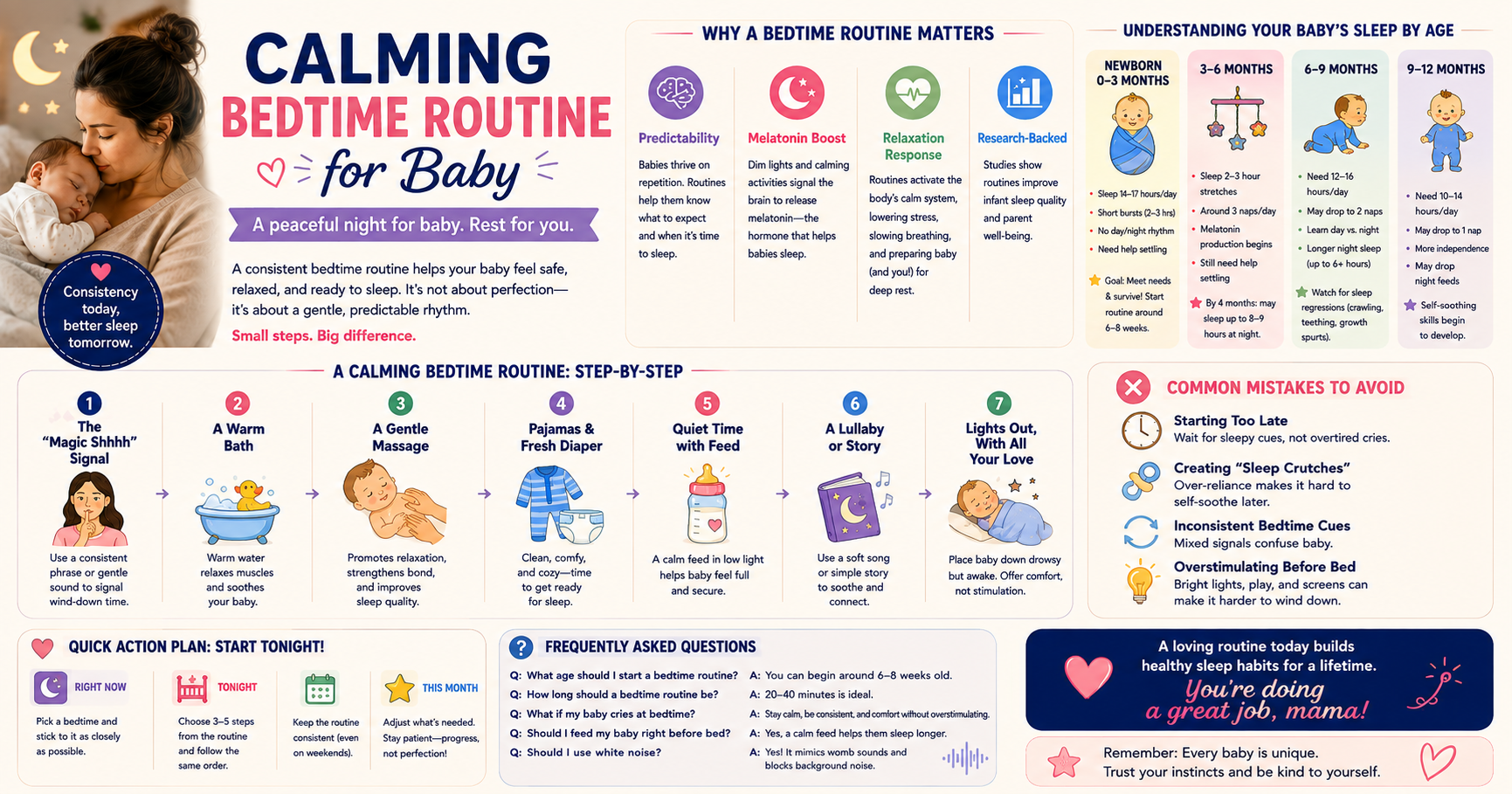
Babies can’t read clocks. They tell time through repetition. “When parents start doing the same things, in roughly the same order, around the same time each night, those patterns begin to click. Their bodies and brains learn what to expect. That’s how they start to understand when it’s time to sleep, without knowing what 7:30 p.m. means,” explains Hunter .
Here’s where it gets interesting. Simple steps like dimming the lights or turning on a white noise machine send signals to your baby’s brain to start producing melatonin—the sleep-regulating hormone that helps our bodies wind down .
Certified sleep consultant Meg O’Leary explains: “When light and activity drop, melatonin levels rise. It’s your baby’s internal clock responding to these calming signals that sleep is coming” .
But it’s not just about hormones. These routines also activate the parasympathetic nervous system—the part of your baby’s nervous system that helps them calm down and relax.
“This part of the nervous system helps your baby calm down. Following a familiar routine helps your baby’s body shift out of alert mode. Their stress levels go down, breathing slows, and they physically get ready to fall asleep” .
Studies published in Sleep Health and the Journal of Sleep Research show that predictable bedtime routines improve both infant sleep quality and parental well-being . The CDC has also found that children with a regular bedtime are less likely to feel tired during the day .
Key Takeaway: A consistent routine isn’t just about getting your baby to sleep—it’s about teaching them how to fall asleep and stay asleep.
Before we dive into the routine, it’s important to understand what’s developmentally appropriate for your baby’s age. Remember: every baby is unique and will have their own sleep habits .
What’s happening:
Your goal: Focus on meeting your baby’s needs and your own in the first few weeks . Many parents find 6 to 8 weeks of age a good time to start working on a bedtime routine .
Key signs your newborn is sleepy:
3-6 Months: Emerging Patterns
What’s happening:
Developmental milestone: By 4 months, your child might sleep for up to 8-9 hours at a time .
What’s happening:
Sleep regression alert: Developmental milestones like crawling or teething can affect sleep and lead to periods of “sleep regression” . This might include waking more during the night, shorter naps, resisting sleep, or more crying than usual .
What’s happening:
Now that you understand the “why,” let’s get to the “how.” Here’s a simple, effective routine that works for most babies.
When to start: Start your wind-down routine 30 to 45 minutes before your baby’s longest stretch of nighttime sleep . For most babies, a sweet spot is between 7:00 PM and 8:30 PM .
How long should it take? For many babies, 15 to 30 minutes is enough, though some need a shorter or longer wind-down. The goal is not to make bedtime elaborate—it’s to create a calm, repeatable pattern .
Think of this as the opening to your baby’s favourite show. Every night, at around the same time, start winding down .
What to do:
Why it works: This gentle shift tells your baby’s internal clock that sleepy time is near. It’s their first cue that the day’s adventures are ending .
There’s something truly magical about a warm bath. It’s not just about getting clean—it’s about washing away the crankiness too .
What to do:
Why it works: The feeling of warm water is very calming for babies. Research also suggests that a gentle massage after a bath may stimulate the production of melatonin, the hormone that helps regulate sleep .
Pro tip: If using products with soothing scents, they can help baby recognize it’s time to wind down for bed .
This is more than just applying oil. It’s a conversation without words. Your loving touch makes your baby feel safe, secure, and deeply loved .
What to do:
Why it works: Studies have shown that a good massage can help babies sleep better and cry less. It also helps create a strong bond between you and your baby .
Now that your baby is clean and relaxed, it’s time to get them into their comfy night clothes .
What to do:
Why it works: Comfort is key to a good night’s sleep. Pajamas help create a clear distinction between daytime and nighttime.
Important: The last step of your routine should always be the same [citation:2, citation:6].
What to do:
Why it works: A full belly helps your baby sleep longer. However, never put your baby to bed with a bottle, as it can cause baby bottle tooth decay .
Pro tip: If your baby is 6 months or older, this is a good time to introduce a soft toy or small blanket that can become their “sleeping friend” . However, for younger babies, remove all toys and comforters from the crib for safe sleep .
You don’t need to be a professional singer or storyteller. The sound of your voice is the most comforting melody your baby will ever hear .
What to do:
Why it works: It’s not about finishing the story—it’s about the closeness, the connection, and the gentle rhythm of your voice that makes the baby feel safe and secure .
Finally, it’s time to tuck your little star into their crib or bed .
What to do:
Why it works: “Putting your baby to bed when they’re sleepy, but not yet asleep, is the single most important thing you can do to teach them to fall asleep on their own” . This helps your baby learn how to self-soothe to sleep—a skill that can help them fall back asleep on their own when they naturally wake during the night .
If Your Baby Cries: Stay Calm
It’s normal for babies to cry at first when you start a new routine. They’re learning something new.
What to do:
Important: “Never leave a crying child. Stay with them so they know that they are safe and help support them to sleep” .
Newborn (0-3 Months): Keep It Short
Sample 10-15 Minute Routine:
Why it works: Newborns are still adjusting to life outside the womb, so their wind-down routines should be brief . “Babies aren’t wired for clock-based routines yet. Look for yawning, staring off, or fussiness as signs of sleepiness” .
4-6 Months: More Structure
Sample 15-20 Minute Routine:
Why it works: With longer periods of awareness, this is a great time to build in more structure . This routine can be especially comforting during transitions like the four-month sleep regression, a normal developmental phase when sleep patterns often shift .
7-9 Months: Stick With It
At this stage, you might feel tempted to overhaul the bedtime routine when your baby hits developmental milestones. But child sleep consultant Christine Brown advises: don’t change your routine .
Instead, practice new skills during the day. This stage is perfect for building in plenty of “active play” time during daytime hours to help your baby process their new physical abilities .
Quick Reference: Wake Windows by Age
This chart can help you figure out when your baby should be going to sleep based on their age :
| Age | Wake Window (Max Awake Time) | Number of Naps |
| 0–8 Weeks | 45 – 60 minutes | 4 – 6 naps |
| 2–3 Months | 1 – 1.5 hours | 3 – 4 naps |
| 4–6 Months | 1.5 – 2.5 hours | 3 naps |
| 6–9 Months | 2.5 – 3 hours | 2 naps |
| 9–12 Months | 3 – 4 hours | 2 naps |
The mistake: Letting your baby stay awake too long. “Parents might make the biggest mistake, which is to leave their babies awake for too long” . Overtired babies release cortisol, a stress hormone that works like adrenaline in their bodies, making them harder to settle .
The fix: Watch for early tired signs and act fast. For newborns, early tired signs include:
For older babies (4-8 months):
The mistake: Developing a routine that relies on you to put baby to sleep every time. For example, always feeding or rocking your baby to sleep, so they can’t fall back asleep without you when they naturally wake during the night .
The fix: Use the “drowsy but awake” method. Place your baby in the crib when they’re sleepy but still slightly awake . This helps them learn to self-soothe to sleep.
The mistake: Having bedtime happen at different times and in different ways each night, so your baby has a harder time recognizing when it is time to wind down and relax .
The fix: Aim for consistency, not perfection. “Babies don’t need a rigid schedule or perfect nights—they need a simple, repeatable wind-down routine that feels safe and predictable” .
The mistake: Engaging in active play, keeping lights bright, or having lots of noise right before bed.
The fix: Start winding down 30-45 minutes before bedtime. “A predictable baby bedtime wind-down routine with fewer bright lights, less noise, and steady soothing can help” .
Many parents find 6 to 8 weeks of age a good time to start working on a bedtime routine. Even then, progress can be slow, and infants can easily fall back into having no routine. Set your expectations accordingly .
For many babies, 15 to 30 minutes is enough, though some need a shorter or longer wind-down. The goal is not to make bedtime elaborate—it’s to create a calm, repeatable pattern .
Start by looking at timing, stimulation, and consistency. Babies often cry more at bedtime when they are overtired, overstimulated, or unsure what to expect . If crying continues, go to your baby, pat them gently, whisper comforting words, but try to keep the interaction gentle and brief .
Don’t feed just before bed. It’s a good idea to feed them an hour or so before bed, so that they aren’t trying to fall asleep on a full stomach . Never put your baby to bed with a bottle, as it can cause baby bottle tooth decay .
Stick with the same bedtime and nap routines. It can help your baby feel calm and safe, and also offers parents a sense of steadiness during a time that can otherwise feel unpredictable .
Yes, white noise can be helpful to mask household sounds . However, avoid loud noises that can startle and wake a baby .