Physical Address
304 North Cardinal St.
Dorchester Center, MA 02124
Physical Address
304 North Cardinal St.
Dorchester Center, MA 02124

Let me be completely honest with you. Before I became a parent, I thought the hardest part would be the sleepless nights. Nobody warned me about the emotional whiplash.
One moment you’re crying tears of joy watching your baby sleep. The next moment, you’re crying in the bathroom because you can’t figure out why they won’t stop crying. And then you feel guilty for crying. And then you cry some more.
If this sounds familiar, you’re not alone.
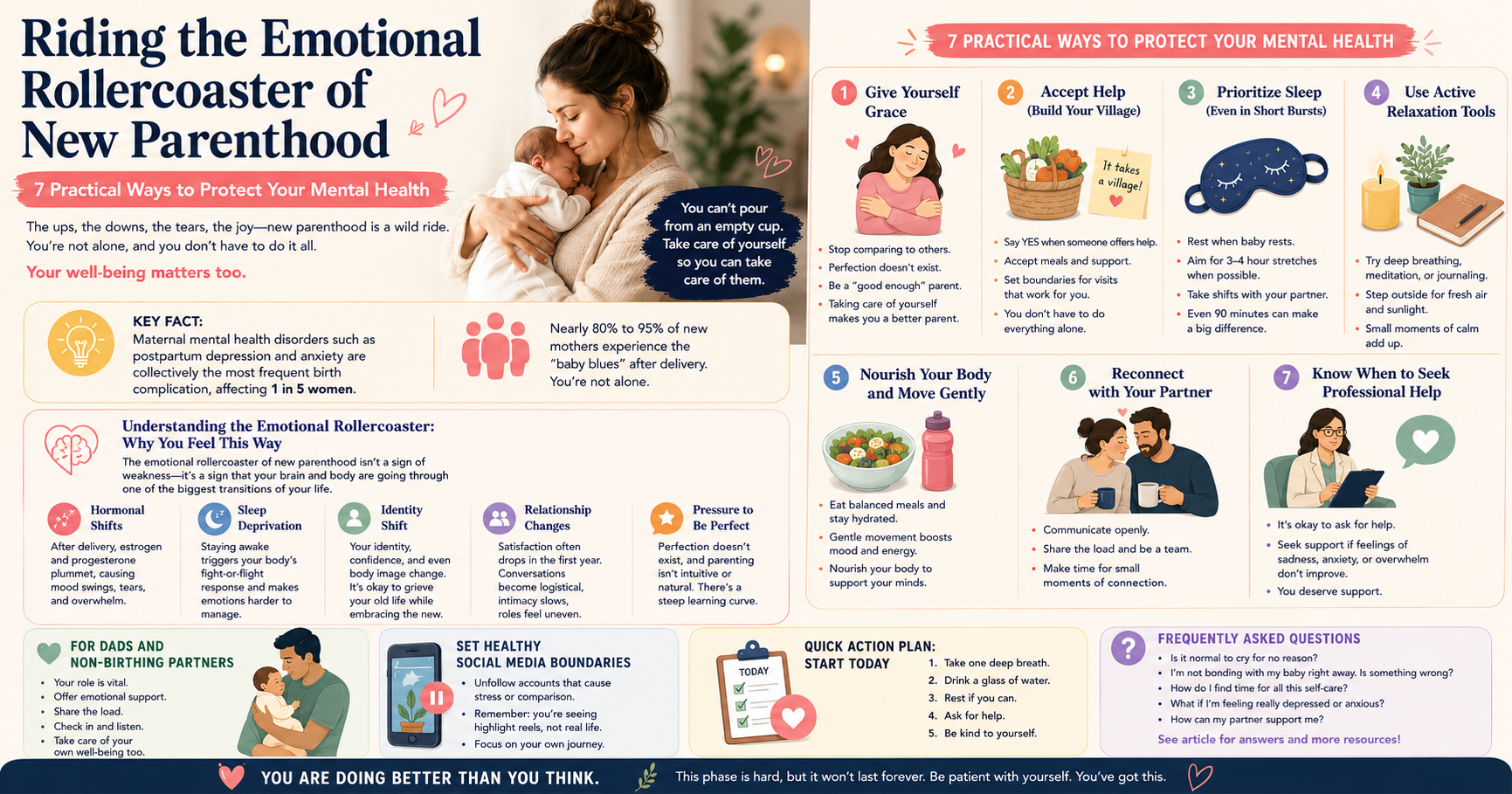
The emotional rollercoaster of new parenthood is real, intense, and completely normal. Nearly 80% to 95% of new mothers experience a short bout of grief after delivery, often called the “baby blues,” triggered by plunging estrogen and progesterone levels intensified by sleep deprivation .
But here’s what I’ve learned: riding this emotional rollercoaster doesn’t have to mean losing yourself. This guide shares practical, evidence-based strategies to help you navigate the ups and downs, protect your mental health, and actually enjoy this beautiful (but brutally hard) phase of life.
Before we dive into solutions, let’s normalize what you’re experiencing. The emotional rollercoaster of new parenthood isn’t a sign of weakness—it’s a sign that your brain and body are going through one of the biggest transitions of your life.
Hormonal Shifts
In the days after delivery, your estrogen and progesterone levels plummet dramatically. This hormonal crash, combined with sleep deprivation, creates the perfect storm for mood swings, crying spells, and overwhelming emotions .
Sleep Deprivation
Staying awake around the clock triggers your body’s fight-or-flight response, undermining your ability to emotionally regulate. Your brain literally cannot process emotions normally when you’re exhausted .
Identity Shift
Having a baby changes how you see yourself—your identity, your confidence, even your body image. It’s okay to grieve parts of your old life while celebrating the new .
Relationship Changes
New parents report a significant drop in relationship satisfaction in the first year after birth. Conversations become logistics-heavy, intimacy slows down, and roles feel uneven .
The Pressure to Be Perfect
“Perfection doesn’t exist, and parenting isn’t intuitive or natural. There’s a steep learning curve,” says Dr. Eynav Accortt, director of Cedars-Sinai’s Reproductive Psychology Program .
Key Fact: Maternal mental health disorders such as postpartum depression and anxiety are collectively the most frequent birth complication, affecting 1 in 5 women
Why it matters: The pressure to be a “perfect parent” is unrealistic and harmful. New parents often feel guilty for struggling, wrongly thinking it’s a failure on their part .
How to do it:
Pro tip: Dr. Eynav Accortt reminds us: “The stakes are really high when you’re a new parent and you think perfection is even a possible goal. Perfection doesn’t exist” .
Why it matters: You don’t have to do everything alone. Trying to is a fast track to burnout and relationship strain .
How to do it:
Pro tip: You’re allowed to say no to visits, unsolicited advice, or well-meaning but overwhelming input. Your mental health comes first .
Why it matters: Sleep deprivation is closely linked to postpartum depression and anxiety. Your body needs those hours of rest to heal from delivery or cesarean section .
How to do it:
Pro tip: Don’t aim for “perfect” sleep. Aim for “enough.” Even a 90-minute nap can dramatically improve your emotional regulation.
Why it matters: Becoming a parent is a dramatic life transition, unfolding in an easily derailed loop of newborn feeds, naps, and inconsolable cries. Active relaxation techniques can be squeezed into 5-10 minute windows .
How to do it:
The 5-Second Hand-to-Heart Reset :
The 5-4-3-2-1 Grounding Technique (for anxiety spirals) :
Body-Based Regulation: Shake It Out :
Deep Breathing :
Pro tip: Try a 10-minute meditation before each breastfeeding shift. “These techniques power down the body’s fight-or-flight instinct, lowering the stress hormone cortisol” .
Why it matters: Your body needs proper nutrition for recovery, especially if you’re breastfeeding. Poor eating affects your energy and mood. Gentle movement boosts energy and supports postpartum recovery .
How to do it:
Nutrition:
Movement:
Pro tip: “If you always put the baby’s needs first, you can’t meet them, because you’ll be too depleted” . Taking care of yourself isn’t selfish—it’s essential.
Why it matters: Many new parents spend more time together than ever, yet feel more disconnected than ever. Conversations become all baby, all the time. The parts of your relationship that once connected you get pushed to the background .
How to do it:
Start Simple: Talk About It :
Build Connection in Small Moments :
Send Little “I’m Thinking of You” Moments :
Pro tip: You don’t need to recreate the relationship you had before the baby. Instead, figure out how to build something new—a partnership that fits who you are today as two people navigating parenthood together .
Why it matters: While the baby blues typically resolve within two weeks, longer-lasting emotional distress requires professional support . Maternal mental health conditions are often mistaken for the baby blues, but they are more severe and limit your daily functioning .
When to Seek Help:
Warning Signs :
What to Do:
Pro tip: You don’t have to go through this alone. Maternal mental health conditions affect 1 in 5 birthing people and 1 in 10 non-birthing partners. Help is available, and reaching out is a sign of strength, not failure .
The emotional rollercoaster isn’t limited to birth mothers. Here’s what new dads often experience and how to cope.
Common Stressors for Dads :
Tips for Dads :
Key Fact: Postpartum mood disorders affect up to 1 in 10 non-birthing partners .
Social media can amplify the pressure to have a breezy, well-lit experience of new parenthood. Here’s how to protect your mental health :
Do This:
Don’t Do This:
Pro tip: Dr. Eynav Accortt encourages boundaries to protect your mental health during this vulnerable period .
Right now:
Today:
This week:
This month:
Yes. The baby blues happen when estrogen and progesterone plummet in the days after delivery. Parents can find themselves crying for seemingly no reason. If it lasts more than two weeks, talk to your doctor
No. The attachment isn’t always immediate for some parents. Feeling a lack of immediate bond can raise concern and even guilt, but it’s more common than people talk about
Start small. Even 5 minutes a day makes a difference. Focus on the “micro-moments” of self-care rather than waiting for a big block of time. “You can’t pour from an empty cup”
If your emotions or behaviors feel unmanageable, seek help immediately. Talk therapy (individual or group) can help you regain control. In more intense cases, consult a reproductive psychiatrist
Open communication is key. Use “I” statements instead of “You never…” statements. Divide tasks clearly but allow flexibility. Acknowledge each other’s labor—emotional, physical, and invisible