Physical Address
304 North Cardinal St.
Dorchester Center, MA 02124
Physical Address
304 North Cardinal St.
Dorchester Center, MA 02124

Last summer, we stood at the airport check-in desk with four bags, a car seat, a travel cot, a pushchair, two backpacks, and what I can only describe as the emotional weight of a family that had overpacked so badly we had to pay £60 in excess baggage fees before we’d even taken our shoes off for security.
We were going for seven nights.
Seven. Nights.
I had packed for what appeared to be a six-month expedition to somewhere with no shops, no pharmacies, no beaches selling plastic tat the children would beg for within four minutes of arrival. I had packed for contingencies that did not exist. I had packed three rain jackets for a trip to southern Spain.
We sweated through the airport. We argued about who was pulling which bag. My youngest — who was three at the time — asked to be carried, and there wasn’t a free arm between us.
It was not the relaxed start to a family holiday I had imagined while scrolling Pinterest for “best beach destinations for families” in January.
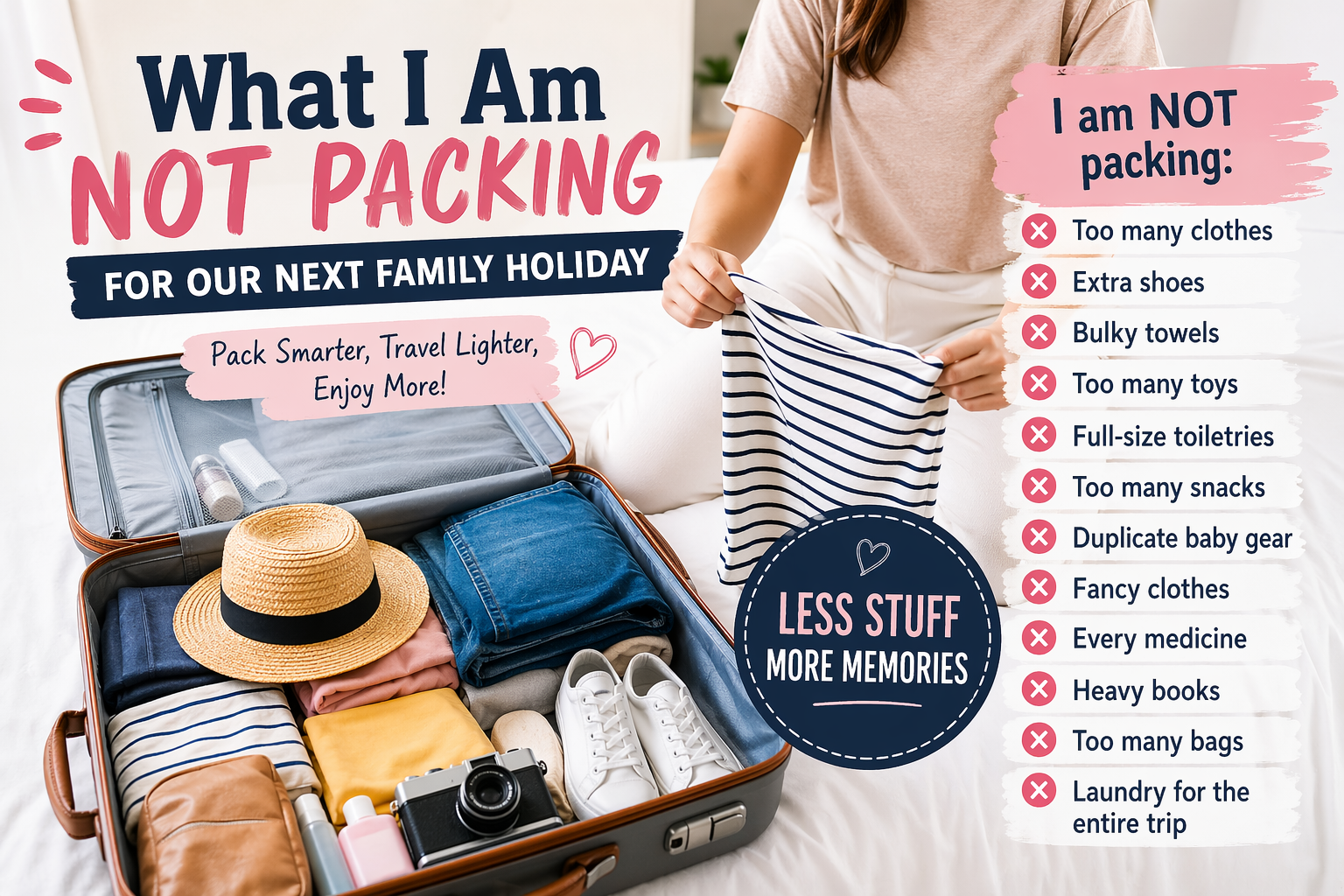
So this year, I did something radical. I sat down and wrote a list — not of what I was packing, but of what I was not packing. The things I always throw in because they seem reasonable at 10pm the night before departure. The things we drag through two airports and a taxi and a resort shuttle and never open once. The things that cost us money in excess baggage fees and cost me actual joy in the lugging.
This post is that list.
This is exactly what I am not packing for our next family holiday — and the honest, occasionally liberating reasoning behind every single decision.
Before we get into the specifics, I want to acknowledge something: overpacking with children is almost a rational response to an irrational situation.
When you’re travelling with small people who might get sick, who will definitely spill something on themselves within the first hour of the journey, who change their mind about what they want to wear three times before breakfast, who have very specific feelings about which exact soft toy is the one that helps them sleep — packing “just in case” feels like basic competence, not excess.
And then there’s the anxiety of unfamiliarity. What if the children’s paracetamol at the local pharmacy doesn’t have the same flavour? What if the sun cream isn’t the brand they’re used to? What if we need the travel kettle and we didn’t bring it?
Here’s what several holidays and sixty pounds in excess baggage fees have taught me: the pharmacy has paracetamol. The supermarket has sun cream. The apartment has a kettle. The world — even the unfamiliar bits of it — contains the things you need.
The over-packing isn’t really about the items. It’s about control. When you’re travelling with children, very little is within your control, and filling a suitcase with every conceivable contingency item is the mind’s attempt to manage that. It is completely understandable. It is also completely counterproductive.
A lighter bag means less to manage, less to lose, less to pay for, less to drag through three terminals — and, this is the part that took me a while to genuinely absorb — more space in your mind and your body for the actual experience of the holiday itself.
So. Here is what is staying home.
I used to pack one outfit per day, plus two or three “spare” outfits per child, plus one “nice” outfit for a meal out, plus a “cooler evening” layer, plus a backup of the backup in case something happened to the backup.
For a seven-night holiday, my children were each going on tour with approximately eleven outfit options.
They wore the same three things on rotation.
Every. Single. Time.
Children on holiday — particularly young children — will find their favourite shorts and their favourite t-shirt and they will wear those on repeat until you prise them off for washing. The ten other outfits return home in exactly the condition they left, slightly creased from being rolled into a suitcase corner for a week and completely unworn.
What I’m doing instead: Three to four complete outfits per child. One swimsuit each — two if we’re going somewhere particularly water-heavy, because wet swimsuits genuinely don’t dry fast enough in twenty-four hours to rewear safely. One light layer for cooler evenings. That is it. The complete wardrobe.
Children do not need a fashion rotation on a beach holiday. They need sun cream applied to the back of their necks and someone to build a sandcastle with. The clothes are, honestly, almost irrelevant.
I used to travel with a medical kit that could have sustained a small expedition through mildly hostile terrain. Calpol and Nurofen — both flavours, because obviously. Antihistamine tablets and antihistamine cream (different applications). Antiseptic wipes. Antiseptic cream. Plasters in multiple sizes, because small plasters are for small wounds and large plasters are for large wounds and who even knows in advance. Travel sickness tablets. Rehydration sachets. Digital thermometer. Eye drops. Bite relief cream. Arnica gel. Teething gel just in case. And sun cream in SPF30, SPF50, and SPF50+ in both spray and lotion form, because different situations call for different SPF apparently.
I was packing a travelling pharmacist’s dispensary into a resealable bag and then feeling righteous about it.
The truth: Almost every holiday destination in Europe — and most worldwide — has a pharmacy. A proper one. With qualified staff. Often English-speaking, often better stocked than whatever I’d crammed into my toiletry bag, and open during hours that are not 2am when you actually need something.
What I’m packing instead: One ruthlessly edited medical pouch. One age-appropriate pain and fever reliever. A travel-size antiseptic cream. A small selection of plasters. One antihistamine option. That is genuinely the whole medical kit.
If we need something else — and we rarely do — we’ll find the local pharmacy and have an authentic experience of purchasing children’s ibuprofen in a foreign language, which frankly is more memorable than anything I’d planned.
The exceptions: prescription medication, always. Anything specific to an existing medical condition. And our own sun cream, because we genuinely have sensitive-skinned children and I know what works on them. But one spray, one lotion. Not the entire SPF spectrum.
Before my revelation last year, our packing included an entire bag dedicated to the children’s entertainment. Colouring books. Activity packs. A selection of small toys, carefully curated for age-appropriateness and portability. Library books and bought books. A magnetic drawing board. Card games. A sticker activity book with over two hundred stickers and themed scenes, which I was genuinely excited about.
The children spent approximately forty minutes engaging with any of these things across a seven-day holiday.
The rest of the time they were in the pool. On the beach. Chasing pigeons in the town square. Collecting rocks. Running up and down the same flight of terracotta steps approximately forty-seven times because that, apparently, was deeply satisfying to them as a physical challenge.
The rocks they collected from the beach took up more space in their imagination than anything I packed and paid excess baggage for.
The truth about children on holiday: They are entertained by the holiday. The sea is the entertainment. The pool is the entertainment. The novelty of a different bed, a different breakfast, a different language on the signs, different food they’ve never tried — this is the entertainment. The elaborate toy bag is assembled to manage the parent’s pre-departure anxiety. It is not for the child’s actual benefit.
What I’m packing instead: One small toy each — something they chose themselves, which means there’s genuine emotional attachment and it will actually be played with. A tablet loaded with downloaded films, shows, and games for the journey and for that one rainy afternoon. A small sketchbook and a set of crayons — genuinely compact and used more than anything else we bring, because drawing the pool or the beach or the sunset is something children on holiday actually want to do without prompting.
That is the entire entertainment budget. It fits in a side pocket of a backpack.
Spare sunglasses in case the main ones break. Backup flip-flops in case the primary flip-flops give up. A second beach bag because what if the main one tears. Two phone charger cables because what if one stops working. Two beach towels per person because we might need to use both on the same day for reasons I couldn’t specifically articulate.
I have spent multiple holidays carrying backup versions of things that did not break, get lost, or show any sign of needing replacement.
The truth: Some things break on holiday. That is genuinely what holiday shopping is for. Finding a pair of replacement flip-flops in a local market for four euros is not a catastrophe — it’s an experience. A small, unplanned one. The children will remember the market. They will not remember that you had the forethought to pack a backup pair of identical footwear.
What I’m packing instead: One of everything. One charger cable per device. One beach bag that folds flat for the outbound journey. One pair of sunglasses each. If something breaks or gets lost — and it might, and it will be fine — we deal with it locally, and the dealing with it becomes briefly part of the story of the holiday.
The one genuine exception: one backup pair of comfortable walking shoes, because a shoe or sandal failing mid-sightseeing day is disruptive in a way that a broken pair of sunglasses simply isn’t. But one backup pair. Not two.
I used to pack three or four books for myself. Novels, specifically. Good ones — the kind I’d been meaning to read for months, saved specifically for the holiday with the optimistic certainty that I would spend long peaceful hours reading beside a pool while the children played quietly nearby.
I have never spent long peaceful hours reading beside a pool while the children played quietly nearby. Not once. Not even for twenty consecutive minutes.
The children play in the pool and then they want me in the pool. They build sandcastles and they want me specifically to be involved in the sandcastle project. They need snacks at fifteen-minute intervals. They need sun cream reapplied to the exact spots they missed. They need someone to arbitrate a dispute about the territorial boundaries of the sun lounger situation.
I have returned from seven separate family holidays with the same bookmark at page forty-three of the same book.
What I’m packing instead: My Kindle. One small device. Hundreds of books loaded and available. Weighs almost nothing. Takes up no meaningful space. I will still read approximately forty-three pages across the whole holiday, but at least I haven’t lugged three paperbacks onto two flights for the privilege of not opening them.
If you don’t have an e-reader, one book. Genuinely, one. The destination has bookshops. The airport has a WHSmith. The miracle of actually having time to read more will present itself if it presents itself.
My pre-revelation toiletry bag was something to behold. Full-size shampoo, conditioner, and body wash — because travel-size versions are wasteful and don’t last the whole week, which is technically true but irrelevant when you’re paying for checked baggage. A full-size hairdryer, because I’d heard horror stories about weak hotel hairdryers. My entire skincare routine, including the heavy glass bottle of toner that has absolutely no business being in a suitcase. My perfume — the actual full-size bottle, because a holiday is a special occasion and I deserved to smell nice.
This toiletry bag once weighed 3.2 kilograms. I know this because it triggered an excess baggage alert. We weighed it separately. At the airport. While the children stood next to us looking confused about why the bag was getting weighed and we were not.
The truth: Most holiday accommodations have a hairdryer. Most self-catering accommodations and all hotels have shampoo and body wash, even the basic ones. The supermarket near your holiday accommodation — wherever you’re going — has every toiletry you could possibly need, in many cases in the exact brands you use at home.
What I’m packing instead: Travel-size everything, and I mean actually travel-size — not a normal bottle I’ve decided to classify as travel-size because of optimism. Decanted into small reusable bottles where necessary. My skincare, but the stripped-back version — a cleanser, a SPF moisturiser, a night cream. No toner. No serum collection. No full-size glass bottles of anything. No perfume — I have a collection of those small sample vials from various department store visits and they have been waiting for exactly this purpose. No full-size hairdryer — if the accommodation’s is weak, my hair will air-dry in the actual sunshine, which is genuinely fine and possibly character-building.
I have packed bags of rice cakes carefully selected for low salt content. Sachets of dried fruit. Individual portions of nut butter in those small pouches. Oat bars with no added sugar. A section of my packing dedicated entirely to ensuring that airport temptation did not derail the children’s diet before we’d even arrived.
By the second day of every holiday, I’ve caved completely and we’re all eating local pastries and ice cream at 10am and nobody is pretending otherwise. The rice cakes come home largely uneaten. The healthy snack mountain was built for my pre-departure anxiety, not for any realistic version of how a family holiday actually unfolds.
The truth: Snacks served an anxiety management function for me, not a nutritional function for my children. They will eat what’s available wherever we are. Part of a family holiday is eating different things in different places. This is the point of going. It’s good. Embrace it.
What I’m packing instead: Journey snacks — enough to get through the flight or drive without a hunger-related breakdown, because being trapped in transit with hungry children is a genuine problem worth preventing. A small selection of familiar things for the first day or morning before we’ve located the nearest supermarket. After that, we shop locally, we try things, we have the ice cream, and we stop pretending we’re going to maintain our home nutrition standards at a beach resort in the Mediterranean.
Previous holiday packing has included: an inflatable lilo for the pool. Two pairs of inflatable armbands — one regular size and one slightly larger size, for redundancy. An inflatable beach ball, which seemed compact until it wasn’t. A small inflatable boat for the shallow water section that my youngest was going through a phase of loving.
We have, genuinely, paid to check an additional bag specifically because of inflatable items.
The truth: Almost every resort pool has pool inflatables available. Beach shops near actual beaches sell inflatable rings, lilos, and water toys for between three and eight pounds. And inflatable items, once deflated and rolled up — optimistically, at 11pm the night before you fly home, sitting on them in the hallway trying to squeeze out the last bit of air — always take up significantly more space than you expect and never go back to their original shape.
What I’m packing instead: Nothing inflatable. Not one item. We will buy what we need at the resort if we need it, enjoy it for the week, and either leave it for another family to discover with the joy of found treasure or bring it home in the case if there happens to be space. I am not packing inflatables outbound. This is settled.
I own a travel kettle. A neat, compact, fold-flat one that I was rather pleased about when I bought it because I considered myself extremely organised. I brought it on two separate holidays because I needed to have a proper cup of tea in the mornings, using my own teabags, brewed in my own way.
The accommodation had a kettle both times. A perfectly functional kettle, plugged in and ready. The travel kettle spent both holidays in the bottom of the suitcase and returned home without having been removed from its carrying pouch.
Similarly: the portable coffee kit I’ve seen other travel-oriented parents discuss. The specific breakfast cereal decanted into a zip-lock bag because what if the local version tastes different. The specific brand of squash the children only drink.
The truth: The kettle is there. The coffee exists and it is fine and it might actually be better than what we have at home. The cereal will be different and that will be mildly interesting rather than catastrophic. The children will drink water if the squash isn’t available.
What I’m packing instead: A small selection of my preferred teabags, because this is genuinely a comfort item that takes up no meaningful space and costs me nothing in terms of weight or luggage allowance. That is the one concession. The travel kettle stays home. The coffee apparatus stays home. We will drink the local coffee. It will be fine. We may even love it.
For a June holiday in Greece, I packed waterproof jackets for all four of us, two long-sleeved thermal tops for the children in case of unexpectedly cold evenings, and — and I say this with complete transparency about where my pre-departure anxiety was taking me — wellington boots for my youngest, because you never know.
It was 34 degrees every single day. There were no evenings requiring thermal layers. There was no situation in which wellington boots were called for or would have been welcomed by anyone involved.
Three rain jackets and a pair of wellington boots made a six-hour return journey from Greece to the UK entirely unnecessarily.
The truth: Check the historical weather averages for your specific destination in the specific month you’re travelling. Pack for that weather. Add one light layer per person for the cooler evenings that sometimes but don’t always happen. Pack for probability, not possibility.
What I’m packing instead: Clothing appropriate for the actual destination and actual season. One light cardigan or zip-up per person. If it rains unexpectedly — and occasionally it does — we will buy cheap ponchos, or shelter in a cafe and have a coffee and a local pastry and call it a cultural experience.
I used to have a system. A bag within a bag within a bag, each serving a specific purpose. A toiletry bag inside a packing cube inside the suitcase. A day bag for the beach. A separate beach bag. A small crossbody bag for evening walks. A backpack for hand luggage. An additional tote “just for bits.”
The bag situation was genuinely out of control. I was managing bags rather than enjoying a holiday.
What I’m doing instead: One suitcase per adult. One backpack per child — and they carry their own, which is non-negotiable in our family from approximately age four upward and has genuinely changed how we move through airports. One beach bag that folds flat into the suitcase for the outbound journey. One small crossbody bag for me for the evenings. That is the complete bag inventory.
The elaborate bag-within-a-bag system feels impressively organised at home when you’re packing. At the airport, at 6am, you’re juggling five small bags and nobody has a free hand. One bag, well-packed, is infinitely better than five bags that each contain one-fifth of what you need.
Since the whole premise is what I’m leaving behind, it feels right to show what’s actually making the cut.
Clothing per child:
Clothing for me:
Essentials for everyone:
Children’s extras:
That is a family of four fitting into two medium suitcases and two children’s backpacks. It is achievable. It is wonderful. The difference at the airport is immediately and physically noticeable.
The practical list is only half of what’s required. The other half is the mental work of loosening the grip on the “what if” spiral.
What if someone gets ill? There’s a pharmacy. What if the children are bored? There’s a beach and a pool and a piazza full of pigeons. What if we need something we didn’t bring? There’s a shop. There are many shops. There are shops everywhere humans go on holiday.
Every single “what if” that drives family overpacking has an answer that does not involve adding more weight to a suitcase. The answer is almost always: the destination has that. Or: we’ll manage without it, and managing without it will be fine.
Travelling lighter is fundamentally an act of trust. Trust in your destination. Trust in your own resourcefulness as a family. Trust that your children are more adaptable than your pre-departure anxiety is suggesting.
There is also something worth naming about what lighter luggage does to the experience of the holiday itself. When you arrive without having argued about bag weight at check-in, without having sweated through security, without having negotiated a taxi that may or may not fit all your luggage — you arrive differently. More available. Less frazzled. Ready for the holiday from the moment you land rather than from the moment you’ve recovered from the airport.
The holiday begins at the door of your house. Lighter bags make everything that follows easier.
I’ve adopted a simple rule that has proved more useful than any packing list:
If I haven’t actively used it on the last two holidays, it isn’t coming on the next one.
Not “might I conceivably need it.” Not “could it be useful in a specific scenario.” Did we actually use it on a real holiday that actually happened?
The travel kettle: never removed from the pouch. Not coming. The inflatable lilo: used once for twenty minutes. Not coming. The rain jackets for Spain: never worn. Not coming. The activity book collection: barely touched. Not coming. The backup sunglasses: never needed. Not coming.
It is a ruthlessly clarifying question and I recommend it completely to any parent who finds themselves at 10pm the night before departure adding things to a bag because they seem like they might be important.
I want to be honest here, because I don’t want this to read as a fantasy where everything is effortlessly perfect once you pack less.
There was one afternoon last year where my son wanted to draw something at the beach and we hadn’t brought his sketchbook down with us. He drew in the sand with a stick instead. He preferred it, genuinely — the scale was bigger and he could walk through it.
There was a morning where my daughter wanted to wear an outfit we hadn’t packed, and she had to choose from what we’d brought. She was over it within about four minutes.
There was an evening where my husband’s sunglasses broke and we didn’t have a backup pair. We found a market stall run by a man who told us approximately fifteen things about his village in enthusiastic but impenetrable Italian. My husband spent six euros on a replacement pair and has talked about them with disproportionate fondness ever since.
The things I feared about not having enough turned out to be entirely manageable, and sometimes rather good. The children were, if anything, more resourceful and more present because there wasn’t a bag full of alternatives to reach for the moment something became slightly difficult or unavailable.
That’s the thing nobody tells you when they talk about packing light: it’s not just about the luggage. It’s about the kind of family you become on holiday when you’re not managing stuff.
The things most families can safely leave behind on a family holiday include: excess clothing beyond three to four outfits per child, a full home pharmacy when pharmacies exist at the destination, large collections of toys and activity books, full-size toiletries, travel kettles and coffee equipment, inflatable pool toys available cheaply locally, multiple backup items for things that rarely break, and stacks of books you’re unlikely to read. The simplest guiding question is: did we actually use this on our last holiday? If not, leave it behind.
Three to four complete outfits per child is genuinely sufficient for most family holidays regardless of duration. Children on holiday gravitate toward one or two favourite outfits and rewear them happily. Add one or two swimsuits, one comfortable pair of shoes, one pair of sandals, and one light evening layer. Clothing can be hand-washed or put through accommodation laundry facilities if needed. Beyond this, you’re packing for a version of the holiday that won’t happen.
Packing lighter with toddlers starts with accepting that you cannot prevent every contingency — and that most contingencies are solvable locally. Cut clothing to the minimum and remember toddlers cycle through the same two outfits on rotation. Bring a compact medical pouch rather than a full pharmacy. Leave large toys behind and bring one small comfort item per child. Load a tablet with downloaded content for travel and rainy days. Use travel-size toiletries or plan to buy on arrival. Trust the destination.
Yes — particularly for holidays up to a week long. It requires disciplined packing, quick-dry clothing choices, travel-size toiletries, and comfort with buying small items locally rather than bringing everything from home. Families who travel carry-on only consistently report it transforms their airport experience and gives them significantly more freedom and ease throughout the trip. No checked baggage fees, no waiting at carousels, no risk of lost luggage.
The biggest overpacking mistakes include: packing a full rotation wardrobe far exceeding actual use, bringing full-size toiletries when travel-size or local versions are perfectly adequate, carrying a complete home pharmacy when pharmacies exist everywhere, filling a bag with toys children don’t use, packing inflatable pool toys available for a few pounds at any resort, planning for extreme weather that won’t occur, and bringing backup versions of things that almost never need replacing. Most family overpacking is driven by pre-departure anxiety rather than genuine logistical need.
For most destinations, buying basic toiletries on arrival or using what’s provided at your accommodation is practical and space-saving. Sunscreen is worth bringing from home if your family has sensitive skin and you know what works. A small medical pouch with essentials — a fever reliever, plasters, antiseptic cream — is sensible to pack. Everything else — shampoo, conditioner, body wash, toothpaste — is available at destination supermarkets, often in the exact same brands you use at home.
The genuine essentials for a beach family holiday are: three to four outfits per person appropriate for the climate, swimwear, sunscreen in spray and lotion form, sun hats, sunglasses, comfortable footwear, all travel documents and insurance, any prescription medication, a small first aid pouch, a tablet or e-reader for downtime, phone chargers, and one small toy or comfort item per child. Everything else is optional. The beach is the entertainment. The local shops and restaurants provide the rest.
Involve them in the decision rather than imposing it. Let each child choose one toy to bring — something they genuinely love — which gives them agency and means the chosen item actually gets used. Frame the holiday itself as the adventure by pointing to specific experiences ahead: the pool, the beach, the food, new places to explore. Download a selection of films, shows, and games to a tablet for the journey and quieter moments. Once the holiday begins, children who are engaged with the experience rarely think about the toys they didn’t bring.
Packing cubes are genuinely useful for family travel — one cube per person keeps everyone’s clothing separated and easy to access without unpacking the entire case. Roll clothing rather than folding to save space. Pack shoes separately in a bag or shower cap. Keep toiletries in a waterproof case. Put travel documents, journey snacks, and anything needed for the first few hours in an accessible outer pocket or carry-on bag rather than buried at the bottom of a case. Heaviest items go at the bottom of the suitcase when it’s upright.
Consistently, yes. Families who travel with less luggage arrive less stressed, move more freely during the holiday, spend less on baggage fees, avoid the anxiety and chaos of lost or overweight luggage, and have more physical and mental space for the actual experience of being on holiday. The things left behind are almost never missed once you arrive. The freedom gained from lighter bags is felt immediately — at the check-in desk, through security, in the taxi, and at every point of movement during the trip. The holiday genuinely starts better.
Last summer’s sixty-pound excess baggage fee was the best money I spent all year. Not because sixty pounds is a reasonable thing to spend at an airport — it categorically isn’t — but because it was the thing that finally made me sit down and write this list.
That fee bought me a reckoning. The reckoning bought me a completely different approach to holiday packing. And the different approach bought me a better holiday — from the moment we walked through the departure gate, each carrying a bag we could actually manage, through to the moment we walked home without the grim ritual of dragging eight bags up a flight of stairs while the children asked for snacks.
This year, we are travelling lighter. Not perfectly — I’ll probably still pack one thing I don’t need and realise mid-week that I brought four pairs of shoes and wore the same one every day.
But the three rain jackets for Spain are staying home. The travel kettle is staying home. The bag within a bag within a bag situation is staying home. The inflatable armoury is staying home. The home pharmacy is staying home.
And I genuinely cannot wait to see what a family holiday feels like when I’m not managing the logistics of a small removal operation from the moment we close the front door.
Start your own “not packing” list. It’s oddly one of the most satisfying things you can do in the week before a holiday.