Physical Address
304 North Cardinal St.
Dorchester Center, MA 02124
Physical Address
304 North Cardinal St.
Dorchester Center, MA 02124

Bringing your baby home is magical — and overwhelming at the same time. Suddenly, you are responsible for a tiny human who depends on you for everything.
Many parents quietly wonder:
If these thoughts feel familiar, you are not alone.
The truth is that newborn baby care after birth at home does not require perfection. Babies need warmth, nourishment, safety, and responsive love.
This guide will help you understand daily newborn care, build confidence, and create calm routines so you can enjoy this beautiful stage instead of fearing it.
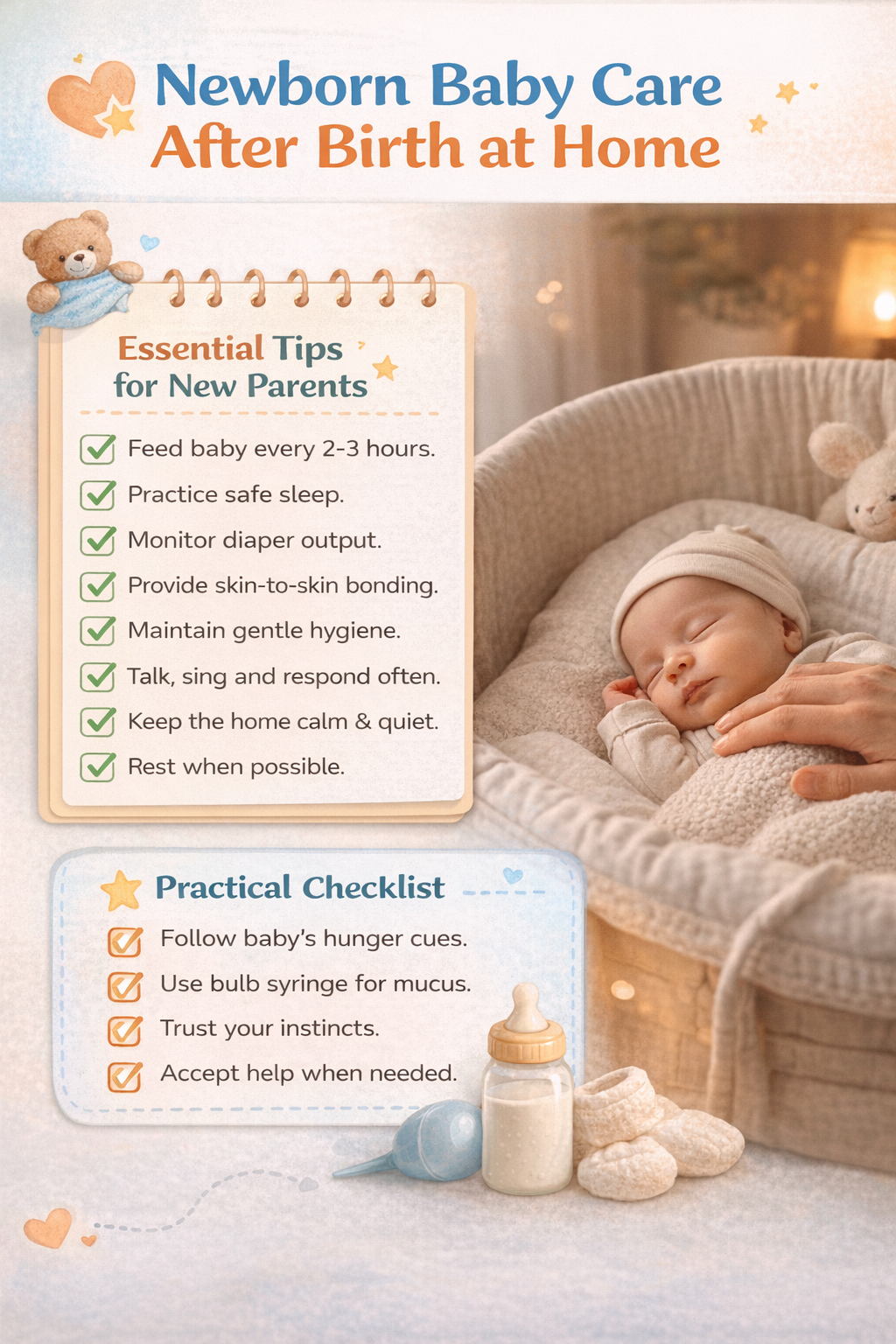
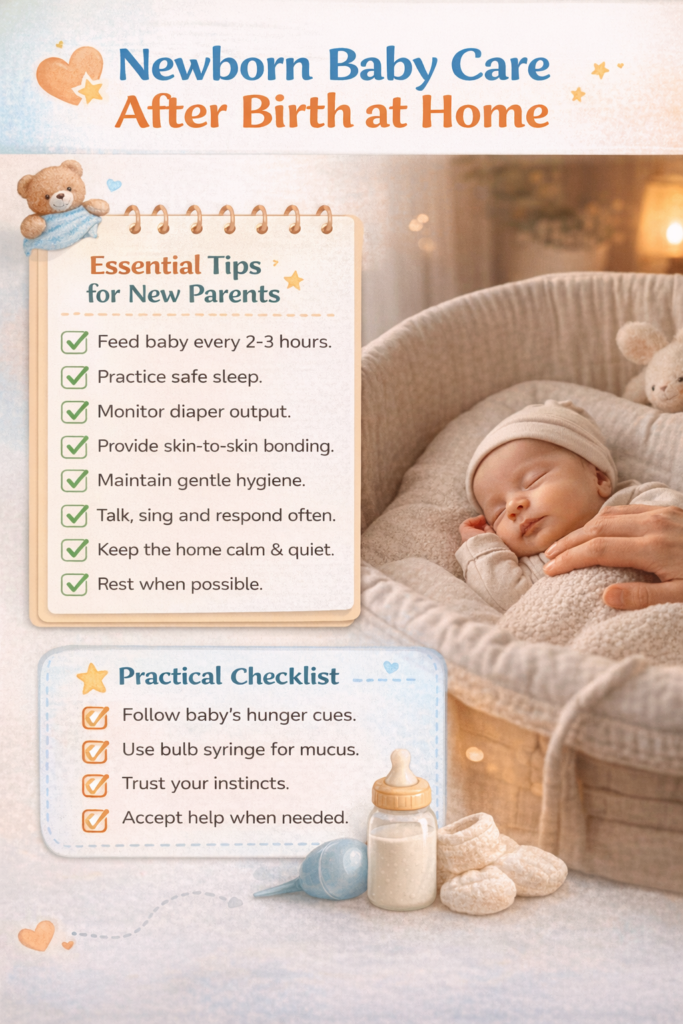
Newborn baby care after birth at home includes feeding every 2–3 hours, ensuring safe sleep, maintaining hygiene, responding to crying cues, bonding through touch and voice, and monitoring diaper output. Simple routines, calm environments, and responsive caregiving support healthy growth and parental confidence.
The first weeks after birth are called the newborn transition period. Your baby is adapting from a protected womb environment to a world full of light, sounds, and sensations.
During this stage, babies commonly:
These behaviors are normal survival responses rather than problems.
Understanding this helps parents approach newborn baby care after birth at home with patience rather than worry.
Preparation does not mean buying everything. It means creating a safe, calm, and functional space.
Parents benefit from:
A calm parent creates a calm caregiving environment.
Feeding is the center of newborn life.
Most newborns feed 8–12 times daily, regardless of feeding method.
Crying is often a late hunger sign.
Responsive feeding strengthens bonding and supports growth.
Newborn sleep can feel unpredictable.
Babies usually sleep 14–17 hours daily in short cycles.
These patterns gradually mature.
Safe sleep is one of the most important aspects of newborn care.
Consistent safe sleep habits protect babies during vulnerable months.
Newborn skin is sensitive and delicate.
Minimal handling promotes healing.
Newborn care is deeply emotional.
Babies regulate their bodies through connection.
These experiences build brain connections and attachment security.
Newborn routines are flexible patterns rather than schedules.
A simple rhythm may include:
Repeating this cycle builds predictability.
Parents often notice routines emerging naturally within weeks.
Observation is powerful.
Trusting instincts is an important parenting skill.
| Care Area | Typical Frequency | Helpful Parent Tip |
|---|---|---|
| Feeding | Every 2–3 hours | Watch cues early |
| Diaper changes | 8–12 daily | Track output |
| Sleep | 14–17 hours | Calm environment |
| Bathing | 2–3 weekly | Gentle approach |
| Bonding | Frequent | Skin-to-skin |
Use this newborn baby care after birth at home checklist daily.
Simple actions create confident caregiving.
Remember — connection matters more than perfection.
Confidence grows through experience, not instant mastery.
This section supports practical convenience.
Tools simplify caregiving but do not replace responsive parenting.
These patterns reassure parents that variability is normal.
Every 2–3 hours or based on hunger cues.
About 14–17 hours daily in short periods.
Usually within 1–3 weeks.
Yes, crying is communication.
2–3 times weekly initially.
Rooting, sucking, hand-to-mouth behavior.
For fever, feeding difficulty, breathing concerns, or unusual lethargy.
This article reflects guidance consistent with recommendations from trusted pediatric authorities including the World Health Organization, Mayo Clinic, NHS, Centers for Disease Control and Prevention, and HealthyChildren.org.
Newborn baby care after birth at home is a journey of learning, bonding, and growing together. While the early days may feel uncertain, simple responsive care builds confidence quickly.
Your baby does not need perfect parenting.
They need present parenting.
With gentle routines, safe practices, emotional connection, and patience, your home becomes the safest and most nurturing place for your newborn to thrive.
You are learning.
You are adapting.
You are doing beautifully.❤️ Encouraging Conclusion
Newborn baby care after birth at home is a journey of learning, bonding, and growing together. While the early days may feel uncertain, simple responsive care builds confidence quickly.
Your baby does not need perfect parenting.
They need present parenting.
With gentle routines, safe practices, emotional connection, and patience, your home becomes the safest and most nurturing place for your newborn to thrive.
You are learning.
You are adapting.
You are doing beautifully.