Physical Address
304 North Cardinal St.
Dorchester Center, MA 02124
Physical Address
304 North Cardinal St.
Dorchester Center, MA 02124

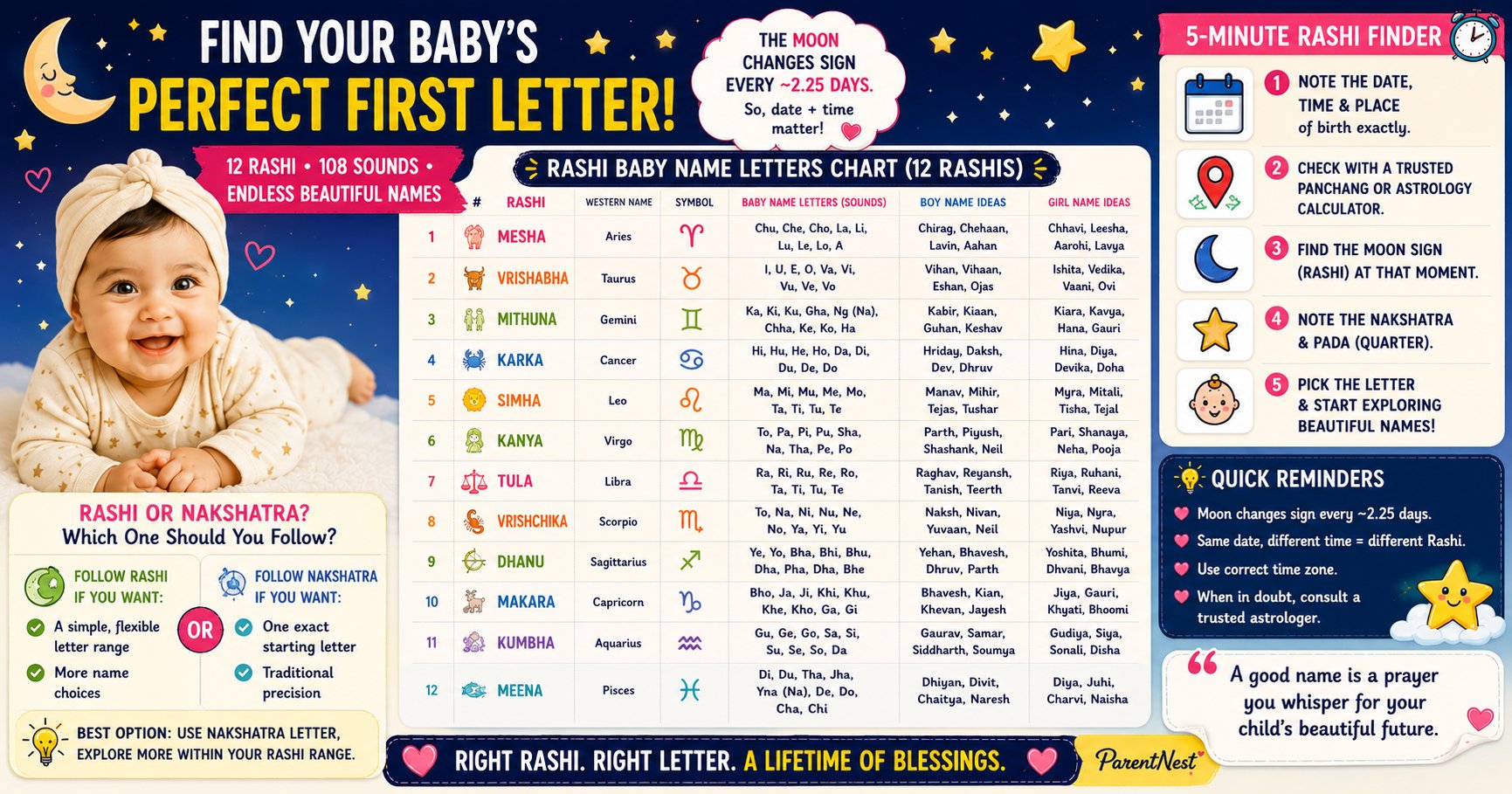
The Moon changes its sign every two and a quarter days.
That one small fact is why two families can have babies born on the same date, and still get different rashi letters. It is also why a wrong date, a wrong time, or the wrong app can quietly hand you the wrong chart.
Stay with me. In this article, you will get the full chart of all 12 rashis with their baby name letters, boy and girl name ideas for every rashi, a simple “Which system should I choose?” guide, and a 5-minute rashi finder so you can check your baby’s rashi with confidence.
Shruti was sitting on the sofa in her Lucknow home, with her five-day-old daughter asleep on her shoulder, and two completely different pieces of paper in front of her.
On the left was a printout from a mobile app, which her cousin had used for her own baby. It said her daughter’s rashi was Kanya, and the suggested letters were To, Pa, Pi, Pu, Sha, Na, Tha, Pe, Po.
On the right was a handwritten note from the family pandit ji, who had come the day before and spent forty minutes with a small notebook and a pencil. It said her daughter’s rashi was Tula, and the letters were Ra, Ri, Ru, Re, Ro, Ta, Ti, Tu, Te.
Not one letter matched.
Her mother-in-law, Dadi, was already smiling about a name starting with “Pa,” because she had a cousin called Pallavi, and she loved the sound. Her husband had a list of three names starting with “Ra.” And Shruti, who had given birth only a few days ago and was running on very little sleep, sat there with her baby and thought, “Hum kis par vishwas karein?” Whom do we trust?
The next day, pandit ji came again, and explained something that made the whole thing clear. The baby had been born at 11:52 at night, right at the edge of a date change, and the Moon was in the star called Chitra, which is a nakshatra that is split between two rashis. The first half belongs to Kanya, and the second half belongs to Tula. The app had used the wrong time zone and had put the Moon in the first half. Pandit ji’s kundli showed it was in the second half.
“Ek sitara, do rashi,” he said, gently. One star, two signs.
Shruti learned three things that week. First, that birth time matters a lot. Second, that the rashi and the nakshatra are two different ways of reaching the same naming tradition. And third, that choosing a name does not have to be a fight. It can be a calm, joyful conversation, once you understand the system.
If you are standing where Shruti stood, this article is for you. I will explain the chart of baby name letters according to rashi, for all 12 rashis, with boy and girl ideas for each, in simple English and a few Hindi words. And I will help you answer the question that confuses so many families: “Rashi or nakshatra? Which one should we follow?”
Please read this first: I am a parent and content writer, not an astrologer or a pandit. This article explains a traditional naming practice that many Indian families follow. Astrology is a matter of faith and culture, and it is not scientifically proven. Nothing here claims that a name’s first letter will change your child’s future. Many families follow the tradition, and many do not, and both choices are fine. The letter chart below is the commonly published version, and small differences exist between regions, panchangs and pandits. For your own baby, please confirm with your family pandit or a trusted astrologer.
In the traditional Hindu naming system, a baby’s name is often started with a letter linked to their janam rashi, or birth Moon sign. Each of the 12 rashis has 9 sounds, which come from the 9 nakshatra padas that fall inside it. If you know the baby’s rashi, you can pick a name from that rashi’s letters, and if you know the nakshatra pada, you can use the one exact letter for it.
Here is the quick chart. Keep this table handy, and I will explain every rashi in detail below.
| # | Rashi | Western name | Sign | Baby name letters (sounds) |
|---|---|---|---|---|
| 1 | Mesha | Aries | ♈ | Chu, Che, Cho, La, Li, Lu, Le, Lo, A |
| 2 | Vrishabha | Taurus | ♉ | I, U, E, O, Va, Vi, Vu, Ve, Vo |
| 3 | Mithuna | Gemini | ♊ | Ka, Ki, Ku, Gha, Ng (Na), Chha, Ke, Ko, Ha |
| 4 | Karka | Cancer | ♋ | Hi, Hu, He, Ho, Da, Di, Du, De, Do |
| 5 | Simha | Leo | ♌ | Ma, Mi, Mu, Me, Mo, Ta, Ti, Tu, Te |
| 6 | Kanya | Virgo | ♍ | To, Pa, Pi, Pu, Sha, Na, Tha, Pe, Po |
| 7 | Tula | Libra | ♎ | Ra, Ri, Ru, Re, Ro, Ta, Ti, Tu, Te |
| 8 | Vrishchika | Scorpio | ♏ | To, Na, Ni, Nu, Ne, No, Ya, Yi, Yu |
| 9 | Dhanu | Sagittarius | ♐ | Ye, Yo, Bha, Bhi, Bhu, Dha, Pha, Dha, Bhe |
| 10 | Makara | Capricorn | ♑ | Bho, Ja, Ji, Khi, Khu, Khe, Kho, Ga, Gi |
| 11 | Kumbha | Aquarius | ♒ | Gu, Ge, Go, Sa, Si, Su, Se, So, Da |
| 12 | Meena | Pisces | ♓ | Di, Du, Tha, Jha, Yna (Na), De, Do, Cha, Chi |
A quick note on the chart: you will see that some sounds appear in more than one rashi, like Ta, Ti, Tu, Te in both Simha and Tula, To in both Kanya and Vrishchika, and Da, Di, De, Do in more than one. This is normal, and it is why the rashi alone is not always enough, and why the nakshatra and the exact birth time matter. I will explain this in the section on overlaps.
Let me explain this in plain words, the way I would explain it to a friend.
In Vedic astrology (Jyotish), the sky is divided into 12 equal parts, called rashis. Each part is 30 degrees wide. Each rashi has a name, like Mesha or Tula, and in the West the same signs are known as Aries, Libra and so on.
Your janam rashi is the rashi where the Moon was at the moment your baby was born. This is also called the Moon sign. It is not the same as the Sun sign, which Western horoscopes in newspapers usually talk about. In India, the Moon sign is considered the more important one for daily astrology, for naming, and for matching.
The Moon moves quickly. It spends only about two and a quarter days in each rashi. So the exact date and the exact time of birth decide the rashi, and the time is very important.
Many parents say, “But my baby is a Leo, because of the date.” In Western astrology, the Sun sign is based on the birth date, and it changes about once a month. In Vedic astrology, the janam rashi is the Moon sign, and it changes every two to three days.
There is a second reason why the two can differ. Vedic astrology uses a different way of calculating the sky (called the sidereal system) than Western astrology (the tropical system). That is why your Moon sign in a Western app or a general zodiac website may not match your Vedic rashi. If you want the traditional rashi for naming, please use a Vedic (Jyotish) calculation, and confirm it with a pandit.
The Moon moves through the sky in a path made of 27 star groups, called nakshatras, like Ashwini, Rohini, Pushya or Chitra. Each nakshatra is further divided into 4 parts, called padas (or charans). So there are 27 times 4, which is 108 padas in total. Each pada has its own syllable (letter sound) for naming.
Now comes the beautiful part. There are 12 rashis, and 108 padas. So 108 divided by 12 gives 9 padas in every rashi. That is why every rashi has exactly 9 letters.
This is the main thing to understand:
The rashi letters are simply the 9 nakshatra pada letters that fall inside that rashi.
So the two systems are not rivals. They are two views of the same thing:
The pada letter of your baby always belongs to the baby’s rashi, because the pada sits inside the rashi. (This is by design.)
(If you want the full nakshatra chart, with all 27 nakshatras and their pada letters, please see our companion article on baby name letters by nakshatra. [Insert link to your Nakshatra baby name letters post])
Think of it like a postal address:
If someone only gives you the city, you know the broad area. If they give you the house number, you know exactly where to go. Both are useful, and the house number is always inside the city.
This is the question most families face, and it is the one I promised to answer. Here is a clear, calm guide.
| Approach | What you follow | Why families choose it | The trade-off |
|---|---|---|---|
| Nakshatra pada letter | The one exact letter for your baby’s pada | It is the most precise, and it is the traditional “namakarana” way in many families, especially in South and West India | You have fewer letters to choose from (often just one sound) |
| Rashi letters | Any of the 9 letters of the janam rashi | It gives you many more name choices, and it is easy to follow | It is a broader guide than the pada letter |
| Skip astrology | Choose any name you love | Freedom, and no stress | You do not follow the tradition |
Answer these four questions.
1. What does your family tradition say? Many families have a custom. Some always use the nakshatra pada letter. Some use the rashi. Some follow both. Ask your elders, and your family pandit. Respecting a family custom can make the naming ceremony smoother and happier.
2. Do you have the exact birth details? If you know the exact time and place of birth, and you have a kundli prepared by a trusted astrologer, you can use either the pada or the rashi. If you are not sure of the time, start with the rashi, and check it again with a pandit.
3. How strict do you want to be? If you want the most traditional approach, use the pada letter. If you want a bit more flexibility, use the rashi letters. If you want only a light connection to tradition, use the rashi chart as a guide, and choose a name you love.
4. How many name options do you want? The pada gives you one starting sound, so your name list will be shorter. The rashi gives you nine sounds, so your list will be much longer. Many parents enjoy having more choices, especially when two families have different tastes.
There is no single right answer. What matters is that your family is comfortable, and that the name feels right when you say it out loud.
You may hear another term: naam rashi, or the name sign. This is the rashi that comes from the first letter of the name, and not from the birth Moon. In many traditions, the janam rashi (birth Moon sign) is used for naming and for the kundli, while the naam rashi is used in daily life, for example in some newspaper horoscopes. If you start the name with a letter from the janam rashi, the naam rashi and the janam rashi usually match. This is one reason why families like this method.
Some families keep two names. The kundli naam (also called the janma naam or rashi naam) is the formal name based on the chart, used for ceremonies and religious purposes, sometimes kept quiet. The popular name (pukar naam or the daily name) is what the child is called at home and in school. These two can be the same, or different. Both are valid choices, and some families like the freedom of two names. If you decide to do this, please make sure the school and official documents use the name you want.
Here is a simple method, and it works for most parents.
Step 1: Collect the exact birth details. Write down the baby’s date of birth, time of birth (as exact as possible, in hours and minutes, with AM or PM), and place of birth (city and state). You can take the time from the hospital’s birth record.
Step 2: Check the time carefully. Many mistakes happen here. Please check:
Step 3: Get a Vedic kundli. You can ask your family pandit or a trusted astrologer to prepare a janam kundli. Or you can use a reliable Vedic astrology app or website, set to the Vedic (sidereal) system, and enter the exact details. If you use an app, compare it with your pandit’s result.
Step 4: Read the Moon sign and the nakshatra. In the kundli, look for the Chandra rashi (Moon sign) and the janma nakshatra with its pada. Write them down.
Step 5: Use the chart. Go to the rashi in this article, and see the 9 letters. If you also have the nakshatra pada, note the exact letter. Then choose your name.
A caution: if two sources give different results, do not panic. Ask your pandit to check the time, the time zone and the method used. As in Shruti’s story, the difference often comes from a wrong time or a nakshatra that sits at the edge of two rashis.
Here is the heart of the article. For each rashi, you will see the traditional ruling planet, the element it is associated with, the 9 letters (sounds), the nakshatra padas they come from, and some boy and girl name ideas. These are only ideas. Please check the meaning, the spelling and the pronunciation of any name before you choose it, and pick the one your family loves.
How to read the letters: each item like Chu or Va is a starting sound, not just a spelling. A name that begins with that sound fits the rashi. For example, Chetan starts with the sound Che, and Vihaan starts with Vi. Spellings can vary, so go by the sound.
| Rashi | Ruling planet | Element | Nakshatras that fall inside |
|---|---|---|---|
| Mesha | Mangal (Mars) | Fire | Ashwini, Bharani, Krittika (1st pada) |
| Vrishabha | Shukra (Venus) | Earth | Krittika (2nd to 4th), Rohini, Mrigashira (1st, 2nd) |
| Mithuna | Budh (Mercury) | Air | Mrigashira (3rd, 4th), Ardra, Punarvasu (1st to 3rd) |
| Karka | Chandra (Moon) | Water | Punarvasu (4th), Pushya, Ashlesha |
| Simha | Surya (Sun) | Fire | Magha, Purva Phalguni, Uttara Phalguni (1st) |
| Kanya | Budh (Mercury) | Earth | Uttara Phalguni (2nd to 4th), Hasta, Chitra (1st, 2nd) |
| Tula | Shukra (Venus) | Air | Chitra (3rd, 4th), Swati, Vishakha (1st to 3rd) |
| Vrishchika | Mangal (Mars) | Water | Vishakha (4th), Anuradha, Jyeshtha |
| Dhanu | Guru (Jupiter) | Fire | Moola, Purva Ashadha, Uttara Ashadha (1st) |
| Makara | Shani (Saturn) | Earth | Uttara Ashadha (2nd to 4th), Shravana, Dhanishtha (1st, 2nd) |
| Kumbha | Shani (Saturn) | Air | Dhanishtha (3rd, 4th), Shatabhisha, Purva Bhadrapada (1st to 3rd) |
| Meena | Guru (Jupiter) | Water | Purva Bhadrapada (4th), Uttara Bhadrapada, Revati |
Notice how the nakshatras flow in order from Mesha to Meena, like a long chain. Some nakshatras, like Krittika, Mrigashira, Punarvasu, Uttara Phalguni, Chitra, Vishakha, Uttara Ashadha, Dhanishtha and Purva Bhadrapada, stretch across two rashis. This is exactly what happened in Shruti’s story with Chitra.
If you looked closely at the chart, you may have noticed that some letters appear in two rashis. This confuses many families, so let me explain it.
| Sound | Appears in | Why |
|---|---|---|
| Ta, Ti, Tu, Te | Simha and Tula | Both rashis include padas with these sounds |
| To | Kanya and Vrishchika | Two different nakshatras give the same sound |
| Na | Kanya and Vrishchika | The sound repeats in different nakshatras |
| Da | Karka and Kumbha | The sound repeats in different nakshatras |
| Di, Du, De, Do | Karka and Meena | Ashlesha and the last nakshatras share these sounds |
| Tha | Kanya and Meena | The sound repeats in different nakshatras |
| Dha | Dhanu (appears twice) | Two different Sanskrit sounds, one Roman spelling |
If your chosen name starts with Ta, for example, it could suit either Simha or Tula. The letter alone does not tell you which rashi your baby is in. So:
The nakshatra Chitra has four padas. The first two padas (Pe, Po) fall in Kanya. The last two padas (Ra, Ri) fall in Tula. So a baby born under Chitra can have the Moon in Kanya or in Tula, and the answer depends on the exact time of birth, down to the hour and minute. A slightly wrong time, or a wrong time zone, can move a baby from one rashi to the other. This is exactly why the app and pandit ji disagreed.
The same can happen with other nakshatras that stretch across two rashis. If your baby’s Moon is near the edge, please ask your pandit to check the time carefully, and to confirm the pada.
This happens more often than you think, and it was exactly Shruti’s problem. Here is a calm way to sort it out.
Step 1: Compare the inputs, not the answers. Look at the date, the exact time (AM or PM), the place, and the time zone that each source used. One small difference in the input can change the Moon sign.
Step 2: Check whether the Moon is near the edge. If the Moon was close to the end of one rashi, a few minutes of difference can move it into the next. Ask your pandit to tell you how many degrees the Moon was from the edge.
Step 3: Check the system. Vedic (sidereal) and Western (tropical) calculations give different Moon signs for many birth times. For traditional naming, use the Vedic one.
Step 4: Check the birth time record. Hospitals record the time of birth. Many families also note the time by their own watch. If the two differ, tell your pandit, because it can matter.
Step 5: Ask your family pandit to decide. If the difference remains, a trusted pandit or astrologer can look at the kundli and settle it. Different traditions may also use slightly different methods, and that is fine.
Step 6: If you still cannot settle it, choose a name you love that fits the letters of both rashis, if possible, or use the nakshatra pada, which is often the clearest guide. Some families simply choose a name they love and treat the letter as a blessing, not a rule.
Do not let this become a source of family stress. The naming ceremony is meant to be a happy event.
If you are meeting a pandit for the first time, here is a short list of questions that will save you time and confusion.
Write the answers down. In the excitement of the moment, it is easy to forget.
The letter only gives you a starting sound. The rest of the name is up to you. Here are practical ideas, tried by many families, to help you pick a name that you will love for a lifetime.
Pick a name with a meaning you are happy with. Check it in a trusted dictionary, or ask an elder. Some names have different meanings in different languages, so it is wise to check.
Say the name with the surname, in a happy voice, in a calling-out voice, and in a stern voice. Does it sound good in all of them? Can grandparents and friends pronounce it?
Some names can be spelled in many ways, like Aarav, Arav or Aaraav. This can cause problems on school forms, passports and other documents. Decide on one spelling, and use it everywhere.
Write the full initials, and see what they spell. Think about what nickname friends may make. A name that seems lovely today can become a teasing nickname at school.
If you have other children, check that the names go well together. Some families like matching sounds, and others prefer different sounds.
If your child may study or work abroad, or if your family speaks more than one language, check that the name works in all of them.
A name that is easy to say and write will serve your child well for life. Trendy names can feel dated later. Classic names, with good meanings, rarely do.
Many Indian names work for any child, like Ishaan, Aarya, Kiran, Jiya or Noor. If you prefer a neutral name, check the letter list for options.
Some sounds mean something unflattering in another language. A quick search, or a question to a friend who speaks that language, saves embarrassment later.
In the end, a name is a gift you give your child. If it makes you smile when you say it, that is a good sign.
Some families combine the rashi letter with other systems, like numerology (ank jyotish), where the letters of the name add up to a number. This is an optional extra, and it is separate from the rashi system. If you wish to use it, please ask a qualified person, and be aware that different numerology systems give different results. Please do not feel pressure to use every system. The more rules you add, the fewer names you will have to choose from.
India has many naming traditions, and I want to respect all of them. Here are a few examples, only to show how rich and varied they are. Please follow your own family’s practice.
This article focuses on the rashi tradition used in many Hindu families. If you belong to another tradition, please follow it with confidence.
| Myth | A kinder reality check |
|---|---|
| “If we pick the wrong letter, the child will have bad luck.” | This is a fear, not a fact. The rashi tradition is a cultural and religious practice, not a scientific rule. No letter can harm a child. Choose with love and calm. |
| “The rashi is decided by the birth date, so my baby is a Leo.” | In Vedic astrology, the janam rashi is the Moon sign, which depends on the exact time of birth. The newspaper Sun sign is a different thing. |
| “Every app gives the same rashi.” | Different apps use different systems and time zones, and may give different results. Confirm with a pandit. |
| “We must use the exact nakshatra letter, or the name is wrong.” | Many families use the exact pada letter, and many use any letter from the rashi. Follow your own tradition. |
| “The letter must be the first letter of the spelling.” | It is the first sound that counts. For example, Kiara starts with the sound Ki, and Chetan with Che. |
| “A name must be traditional to fit the rashi.” | Modern names can fit any letter, if they begin with the right sound. |
| “Only one name is allowed.” | Many families keep a kundli naam and a popular name. Both are fine. |
Here are the mistakes I see most often.
If you want to start now, here is a calm plan, step by step.
You do not need to hurry. Many families take a few weeks, or longer, to settle on a name. In many traditions the naming ceremony is held on a suitable day, such as the 11th or 12th day, or later, but customs vary, so please ask your own family.
Before you start:
Finding the rashi:
Choosing the letter:
Choosing the name:
After:
Go back to Shruti, on her sofa in Lucknow, with a sleeping baby on her shoulder and two pieces of paper that did not agree.
Here is what I would tell her. You were not wrong to be confused. The app and the pandit were both trying to help, and the difference came from one small detail, the exact time, on a star that sits at the edge of two rashis. Take the kundli, ask pandit ji to confirm the Moon sign and the pada, and then look at the right chart. And once you have the letters, let the family each pick their favourites. Dadi may still win with her “Pa,” or your husband with one of his “Ra” names, but whichever it is, it will be chosen calmly and with love.
So, if you are looking for baby name letters according to the rashi chart, remember the idea in a few lines: find the janam rashi (the Moon sign) from the exact birth time, use the 9 letters of that rashi, or the one exact pada letter if your family prefers it, check the overlaps, and then choose a name with a lovely meaning that you can say with joy.
A name is a small word that your child will hear thousands of times. The tradition gives you a starting sound. Your love gives it the rest.
Each of the 12 rashis has 9 starting sounds. Mesha: Chu, Che, Cho, La, Li, Lu, Le, Lo, A. Vrishabha: I, U, E, O, Va, Vi, Vu, Ve, Vo. Mithuna: Ka, Ki, Ku, Gha, Ng, Chha, Ke, Ko, Ha. Karka: Hi, Hu, He, Ho, Da, Di, Du, De, Do. Simha: Ma, Mi, Mu, Me, Mo, Ta, Ti, Tu, Te. Kanya: To, Pa, Pi, Pu, Sha, Na, Tha, Pe, Po. Tula: Ra, Ri, Ru, Re, Ro, Ta, Ti, Tu, Te. Vrishchika: To, Na, Ni, Nu, Ne, No, Ya, Yi, Yu. Dhanu: Ye, Yo, Bha, Bhi, Bhu, Dha, Pha, Dha, Bhe. Makara: Bho, Ja, Ji, Khi, Khu, Khe, Kho, Ga, Gi. Kumbha: Gu, Ge, Go, Sa, Si, Su, Se, So, Da. Meena: Di, Du, Tha, Jha, Yna, De, Do, Cha, Chi.
You need the exact date, time and place of birth. Ask your family pandit or a trusted astrologer for a Vedic janam kundli, or use a reliable Vedic astrology app set to the sidereal system, and compare the result with your pandit. The janam rashi is the sign where the Moon was at birth.
The rashi is one of 12 zodiac signs, and gives 9 starting sounds. The nakshatra is one of 27 star groups, each with 4 padas, and each pada gives one exact sound. The 9 padas inside a rashi are the 9 letters of that rashi, so the pada letter always belongs to the baby’s rashi.
Neither is better. The nakshatra pada letter is more precise, and is the traditional choice in many families. The rashi letters give more choices. Follow your family tradition and your pandit’s advice, and choose a name you love.
No. The janam rashi is the Moon sign, which changes about every two and a quarter days. The Sun sign, used in most newspaper horoscopes, changes about once a month. Vedic and Western calculations also differ, so the same baby can have different signs in each.
Common reasons are a wrong time or time zone, a wrong date near midnight, a different calculation system (Western instead of Vedic), or a Moon that sits near the edge of two rashis. Compare the inputs, and ask your pandit to confirm.
Many families do. The 9 letters of the rashi are all traditionally accepted. Some families prefer the exact pada letter. Ask your elders and pandit which they follow.
Some sounds, like Ta, Ti, Tu, Te in Simha and Tula, appear in more than one rashi. The sound alone does not tell you the baby’s rashi, so find the rashi first, and then pick from that rashi’s letters.
The first sound matters, not the exact spelling. For example, Kiara begins with the sound Ki, and Chetan with Che. Choose one spelling, and use it on all documents.
The kundli naam (also called janma or rashi naam) is the formal name based on the chart, used for ceremonies. The popular name is the daily name used at home and in school. They can be the same or different.
No. It is a cultural and religious tradition, and many families follow it while others do not. Both choices are fine. If you do not follow it, choose a name with a good meaning that is easy to say.
Astrology is a matter of faith and culture, and it is not scientifically proven. This article presents the tradition and does not claim that a letter can change a child’s life. Choose a name with love and calm.
Customs vary. Many families hold the naamkaran on the 11th or 12th day, or on another day chosen with a pandit, and some wait longer. Please ask your own family and pandit.
See our companion article on baby name letters by nakshatra, which lists all 27 nakshatras with their pada letters.