Physical Address
304 North Cardinal St.
Dorchester Center, MA 02124
Physical Address
304 North Cardinal St.
Dorchester Center, MA 02124

Your baby changes size four times in one year. If your cupboard cannot change with them, it is not organized. It is just tidy for one week.
Stay with me. By the end of this article, you will know the one-shelf rule that makes a 2 AM clothes change take twenty seconds, and the small trick that lets your mother-in-law, your husband and your domestic help all put things back in the right place without a single argument.
Pallavi lived in a one-bedroom flat in Thane, with one steel almirah, one husband, one baby who had just turned four months, and one very strong opinion that she had a system.
The system was simple. The baby’s clothes went in the bottom two shelves of the almirah, under her sarees. Everything went in, in the order it arrived. Newborn vests, 0-3 months pyjamas, gifts from aunties, tiny socks, a woollen cap that she had never used, and a pile of muslin cloths that kept sliding to the floor every time she opened the door.
It worked, in the way a pile of laundry “works.” Pallavi knew where everything was. In her head.
But then, on a Tuesday morning, her husband had to dress the baby while she was in the shower. Ten minutes later, she heard him say, in a very small voice, “Pallavi… uska vest kahan hai?”
She came out, wet-haired, and found the almirah standing open, with clothes spread all over the bed. The baby was wearing a 6-month pyjama that went up to her chest, and a top that was meant for a newborn. The mother-in-law was in the doorway, saying, “Maine toh pehle hi kaha tha, saare kapde ek jagah rakho.”
The domestic help, who had come in to fold the laundry, had put the baby’s clean clothes back on the wrong shelf, with Pallavi’s blouses, because she could not tell the difference between a 0-3 vest and a 3-6 vest.
Pallavi stood there and had a small realization. It was not her husband’s fault. It was not the help’s fault. It was not even her mother-in-law’s fault. Her system lived only in her head, and a system that lives only in one head is not a system.
That weekend, she changed three small things. She gave the baby one shelf, and one shelf only. She stuck colour dots on the boxes. And she made a tiny “night kit” that anyone could grab in the dark. The following Tuesday, her husband dressed the baby in under two minutes. Without asking a single question.
If you are looking for how to organize a baby wardrobe by size in India, especially in a small flat, with many people in the house, this article is for you. I will share 10 practical hacks for nursery wardrobe organization, with ideas for drawer dividers, size labels, an outgrown clothes bin, small flat storage and closet organizers. You do not need to buy anything fancy. Most of it can be done with what you already have.
Quick note: I am a parent and content writer, not a professional organizer or a safety expert. This article shares practical, general ideas. For furniture safety, pest control products and anything that touches your baby’s skin, please follow the product instructions and, where needed, ask your pediatrician or a qualified professional.
To organize a baby wardrobe by size in India, edit the clothes down first, give the current size its own shelf or drawer at eye level, store the next sizes in labelled boxes higher up, keep an outgrown clothes bin always open, use dividers and colour labels so anyone in the family can follow the system, and reset it for ten minutes every week.
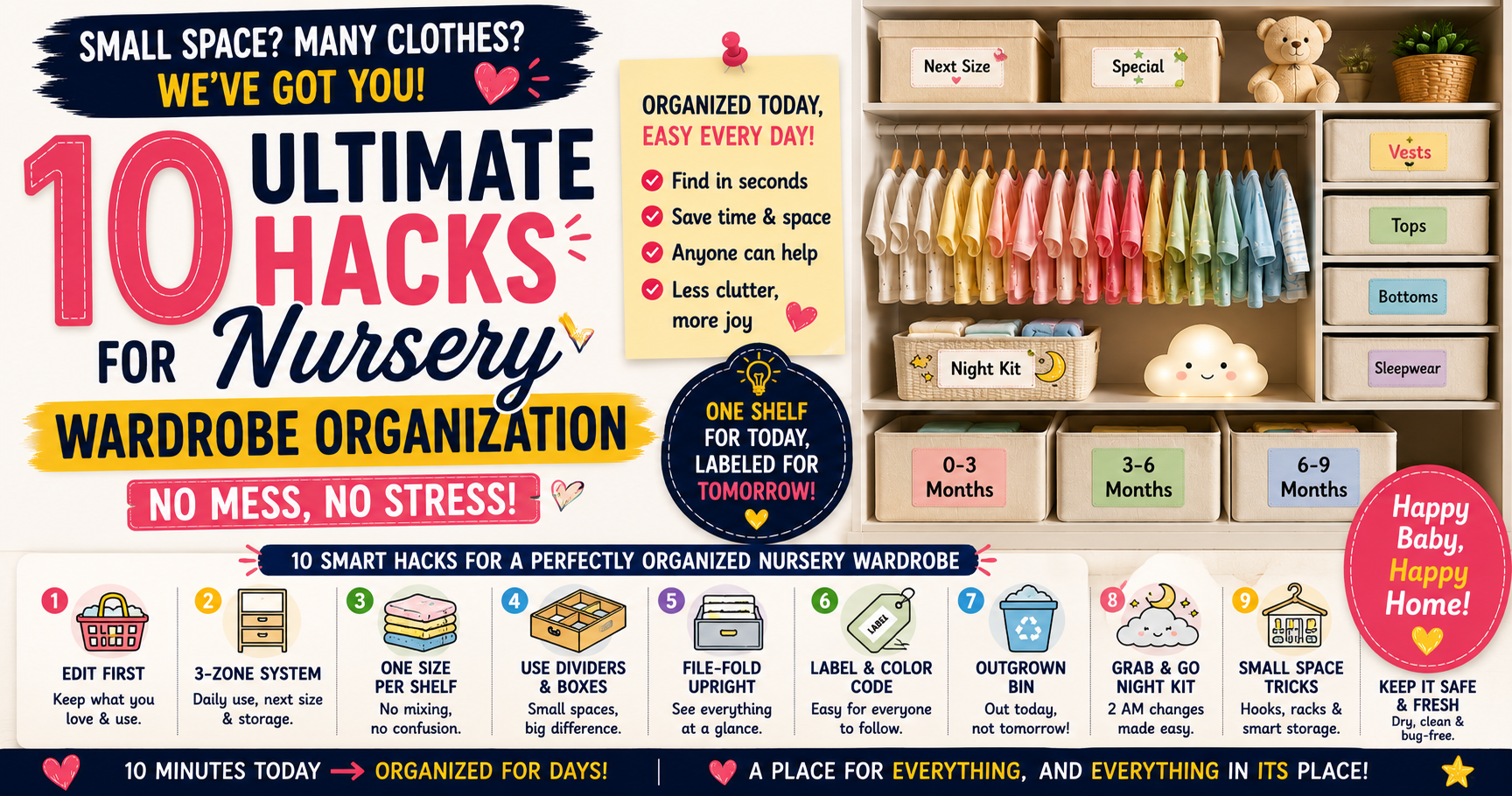
Here are the 10 hacks at a glance:
| Hack | What to do | Why it helps |
|---|---|---|
| 1 | Edit before you organize | Fewer clothes means a smaller problem |
| 2 | Divide the space into three zones | Daily, next-size and storage clothes never mix |
| 3 | One size per shelf or drawer | You always know where to look |
| 4 | Use drawer dividers and boxes | Stops piles and slides |
| 5 | File-fold clothes upright | You can see everything at once |
| 6 | Label by size and season, with colour codes | Helpers and grandparents can follow it |
| 7 | Keep an outgrown clothes bin open | Small clothes leave the cupboard the day they stop fitting |
| 8 | Make a grab-and-go night kit | A 2 AM change in twenty seconds |
| 9 | Use small flat storage tricks | Hooks, hanging organizers, under-bed boxes, trolleys |
| 10 | Keep it safe, dry and fresh | Anchored furniture, no damp, no mothballs |
Now let me take you through each hack, one by one, with simple ideas for Indian homes.
A good baby wardrobe system is useful anywhere. But in India, it matters a little more, for a few reasons.
1. Many hands touch the baby’s clothes. In many homes, the mother, father, grandparents, aunts and a domestic helper all dress the baby and put the laundry away. If the system only makes sense to one person, it breaks quickly.
2. Flats are small. A one-bedroom or two-bedroom flat has limited cupboard space. A baby’s clothes may share an almirah with adult clothes, or live in a corner of the bedroom.
3. We wash often and dry fast. Clothes come back from the terrace several times a week. They need an easy place to land.
4. Gifts arrive in waves. Relatives and friends bring clothes in many sizes. Without a plan, these pile up.
5. Monsoon damp is real. Stored clothes can get musty, and insects like silverfish like damp cupboards.
6. Babies grow fast, so sizes change quickly. The clothes in the front of the cupboard are out of date within a few weeks.
A simple, visible, shared system solves most of this. Let us build one.
You cannot organize what you have not counted. So, before the hacks, do this quick inventory. It takes fifteen minutes, and it will change how you feel about the whole thing.
Now you know your real numbers. You are ready to organize.
The biggest secret of organization is that you cannot organize clutter. You can only move it around. So the first and most powerful hack is to edit.
How to edit:
If you still have too much, do not worry. A smaller wardrobe is easier to organize, but the next nine hacks will help you manage even a bigger one.
What this saves you: space, stress and time, before you spend a rupee on boxes.
This is the idea that makes everything else work. Instead of thinking of the cupboard as one big space, divide it into three zones, based on how often you need the clothes.
This is the space you reach into many times a day. It should hold only the clothes your baby is wearing now, in the current size and the current season.
This holds the clothes your baby will wear soon, like the next size, or the clothes for the coming season.
This holds the clothes your baby is not wearing now and will not wear for a while: out-of-season pieces, much bigger sizes, hand-me-downs for later, and the clothes for a second baby.
A simple way to remember: Hot is for today. Warm is for next. Cold is for later.
What this saves you: the daily search. You only look in the hot zone, and the rest stays out of the way.
This is the rule Pallavi used, and it fixed her morning problem. One size, one place.
Many Indian homes have one steel almirah or one wooden wardrobe shared by the whole family. Here is a simple layout that works.
If the baby’s clothes are very few, a single shelf with three boxes is enough: one for the current size, one for the next size and one for extras.
What this saves you: the confusion of Pallavi’s Tuesday morning.
Dividers and boxes stop clothes from sliding into a mess. And you can make them from things you already have.
What this saves you: the daily pile-up, and a lot of money, if you use what you already have.
This is a small change that makes a big difference. Most of us stack baby clothes flat, one on top of another, like a tower. The problem is that you can only see the top piece, and every time you pull one out, the pile falls.
File-folding means folding each piece into a small rectangle and standing it upright in the drawer or box, like files in a cabinet, or books on a shelf. You can see every piece at once, pull one out without disturbing the others, and fit more in the same space.
How to file-fold baby clothes:
Tips:
What this saves you: the daily toppling of piles, and up to a third more space, in many drawers.
This is the hack that fixed Pallavi’s Tuesday morning, and it is the one I am most excited to share. A label is not just for you. It is for your husband, your mother-in-law, your domestic help, and anyone who might help with the baby.
Here is the small trick I promised. Not everyone in your house may read English labels easily, or may be in a hurry. Colours work for everyone.
A label in Hindi, Marathi, Gujarati, Tamil, Bengali or any language your helper reads is even better. Add a small picture if it helps, like a drawing of a vest for the “tops” box.
Add labels for what is inside, too:
A small safety note: keep any stickers, tags or labels away from the baby. Do not stick labels on the baby’s clothes in a way that touches the skin. Prefer labels on boxes and shelves.
What this saves you: the daily questions, the misplaced clothes, and the arguments. It makes the system independent of you.
This is one of the most useful habits in baby wardrobe organization, and one of the most forgotten. Clothes do not leave the cupboard when they stop fitting. They stay, quietly, until the cupboard is full of useless clothes.
An outgrown clothes bin fixes this. It is simply a basket, bag or box, kept open and easy to reach, where you drop any piece that no longer fits, the moment you notice.
How to set it up:
Tip: keep a second small bag in the nursery marked “Keepsakes,” for one or two outfits you want to save forever.
What this saves you: the slow creep of too-small clothes, and the monthly cupboard clear-out marathon.
This is the hack that gives you your sanity at 2 AM. Instead of searching for a vest, a top and a pair of pants in the dark, prepare ready-to-wear sets that anyone can grab.
A night kit is a small, soft bag or basket that holds two or three complete sets of baby clothes, ready to put on:
Keep the night kit within arm’s reach of the changing area, and not buried in a cupboard. Replace the used set each morning, from the hot zone.
How it works at 2 AM: the baby leaks. You open the night kit, take out one complete set, and change. No searching, no waking anyone, no waking the baby fully. Twenty seconds.
If your baby wears two or three outfits a day, you can prepare daily sets in advance, once a week:
This works well with the mix-and-match capsule idea. Because everything goes with everything, you can build sets quickly. (See our capsule wardrobe guide.)
What this saves you: the daily decision, the 2 AM search, and the time when someone else needs to dress the baby.
Most Indian flats do not have a separate nursery, or even a large cupboard. But small spaces can work very well, if you use every level of space. Here are ideas for small flat storage.
What this saves you: floor space and sanity. Even a tiny flat can hold a calm, organized baby wardrobe.
The last hack is the one most people forget, and it is the most important. A beautiful system is no use if it is unsafe or damp.
In humid Indian weather, silverfish, cockroaches, moths and other pests can get into cupboards.
What this saves you: the worry. A safe, dry, pest-free cupboard protects your baby, and your clothes.
A wardrobe is only as organized as the laundry that feeds it. Many cupboards fall apart because clean clothes have no clear place to go. Here is a simple loop that works in Indian homes.
The landing basket is a small hero. It means a helper or a grandparent can fold the clothes and leave them there, without worrying about where each piece goes. You can then put them in place in two minutes.
You may not have a separate nursery. Many families use a corner of the bedroom, and that is perfectly fine. Here is a simple layout for a baby corner.
The golden rule is: the things you use most should take the fewest steps. If you reach for something five times a day, it should be within one or two steps.
In India, the seasons change what the baby wears, and what you need to store. Here is a simple way to rotate.
Twice a year, at the start of winter and at the start of summer, take thirty minutes to rotate.
(See our newborn winter clothes guide and our best breathable fabric guide for what to keep in each season.)
In mild climates like Bengaluru or Pune, you may only need a small seasonal change. In cold regions, you may need a bigger one. In the south, the main change may be monsoon: more sets, thinner clothes, and extra care to keep things dry.
Gifts and hand-me-downs often break a good system. Set up a small “intake” routine.
This stops the cupboard from becoming a drop-off zone.
If you have two children, or plan to have a second, the wardrobe has to work for both.
A system is not a one-time event. It stays organized because of a tiny weekly habit. Pick one day, for example, Sunday evening, and do this reset in ten minutes.
That is all. Ten minutes a week keeps everything running.
Here is a simple starter list, for a family with a small flat and a baby of 0-12 months. You can do it for less, and most of it can be homemade.
| Item | How many | Notes |
|---|---|---|
| Boxes or baskets for the hot zone | 3 to 4 | Tops, bottoms, bodysuits and sleepwear, plus extras |
| Box for the warm zone (next size) | 1 to 2 | Labelled with size |
| Boxes or bags for the cold zone | 2 to 4 | By size and season |
| Drawer dividers or small cups | 2 to 4 | For socks, caps, mittens and bibs |
| Outgrown bin | 1 | Open, near the cupboard |
| Landing basket | 1 | For folded clothes waiting to be put away |
| Hamper for dirty clothes | 1 | Separate from adult laundry |
| Night kit bag or basket | 1 | Near the changing area |
| Labels and markers | A small pack | Masking tape and a thick pen are enough |
| Hooks or a hanging organizer | 1 to 2 | For jackets, bags and small items |
Most of these can be old shoe boxes, cloth bags, baskets and buckets. You do not need to buy a thing to start.
Here are the mistakes I see most often.
If you want to start today, here is an easy week. You can do each step in 20 to 30 minutes.
By the end of the week, you will have a calm cupboard, and a system the whole family can follow.
Edit:
Zones:
Tools:
Safety:
Habits:
Go back to Pallavi, standing in front of her open almirah, with clothes all over the bed and a baby in a pyjama that reached her chest.
Here is what I would tell her. You did not do anything wrong. You had a system, but it lived only in your head. Give your baby one shelf. Put the current size at eye level. Add colour dots and simple labels. Make a small night kit. Keep an outgrown bin. And ten minutes every Sunday will keep the whole thing running. Then, the next time your husband dresses the baby, he will not need to ask where anything is.
So, if you are searching for how to organize a baby wardrobe by size in India, remember the whole idea in one breath: edit first, divide into three zones, keep one size per shelf, use dividers and labels, keep an outgrown bin, make a night kit, use every inch of your small flat, and keep it safe, dry and fresh. These are small steps, but together they make a calm, shared system.
A well-organized nursery wardrobe does not make parenting easier by itself. But it takes away one small stress at a time, and when you are a tired new parent, one less stress is a gift.
Edit the clothes first, then divide the space into three zones: a hot zone at eye level for the current size, a warm zone for the next size, and a cold zone for storage. Give each size its own shelf or box, label them with size, season and colour codes, keep an outgrown clothes bin, and do a 10-minute reset every week.
Use vertical space with hanging organizers and hooks, use under-bed boxes for the cold zone, keep a small trolley or basket for daily items, and give the baby one dedicated shelf in a shared almirah. Use old shoe boxes and cloth bags as dividers.
Any small, open boxes work well. You can buy fabric or plastic dividers, or use old shoe boxes, cut-down cardboard boxes, tiffin containers and small baskets. Choose boxes slightly smaller than the shelf, so they slide in and out.
Write the size and season on every box and shelf edge, using masking tape and a thick marker. Add colour dots for each size, and a small colour key inside the cupboard door, so grandparents and helpers can follow it. Keep labels on boxes, not on baby clothes that touch the skin.
It is an open basket or box where you drop any piece that no longer fits, as soon as you notice. Empty it once a month, and decide whether to store, pass on, sell, donate or retire each piece.
Keep the current size in the hot zone, the next size in a labelled box in the warm zone, and bigger sizes and out-of-season clothes in labelled bags or boxes in the cold zone. Make sure everything is clean and dry before storing.
Use the file-fold method: fold each piece into a small rectangle and stand it upright in the drawer or box. You can see everything at once, and fit more in the same space.
Dry everything fully before storing, avoid tight packing, air the cupboard on dry sunny days, and use clean, dry cotton bags or boxes. Keep silica gel packets out of the baby’s reach. If clothes smell musty, wash them again and dry them in the sun.
It is better to avoid mothballs and strong-smelling products near baby clothes, since the fumes can be harmful and the smell is hard to wash out. Ask your pediatrician or a pest control professional about safe options.
Yes. Tall furniture can tip over when a baby pulls on drawers or climbs. Use anti-tip straps or brackets as the product instructs, keep heavy items low, and keep drawers closed.
Do a 10-minute reset every week, check the outgrown bin monthly, and do a seasonal rotation twice a year. Also check the size every few weeks as the baby grows.
Use labels with colour codes and a small colour key inside the cupboard door, in a language and style they find easy. Show them the system once, and give them a landing basket for folded clothes.