Physical Address
304 North Cardinal St.
Dorchester Center, MA 02124
Physical Address
304 North Cardinal St.
Dorchester Center, MA 02124

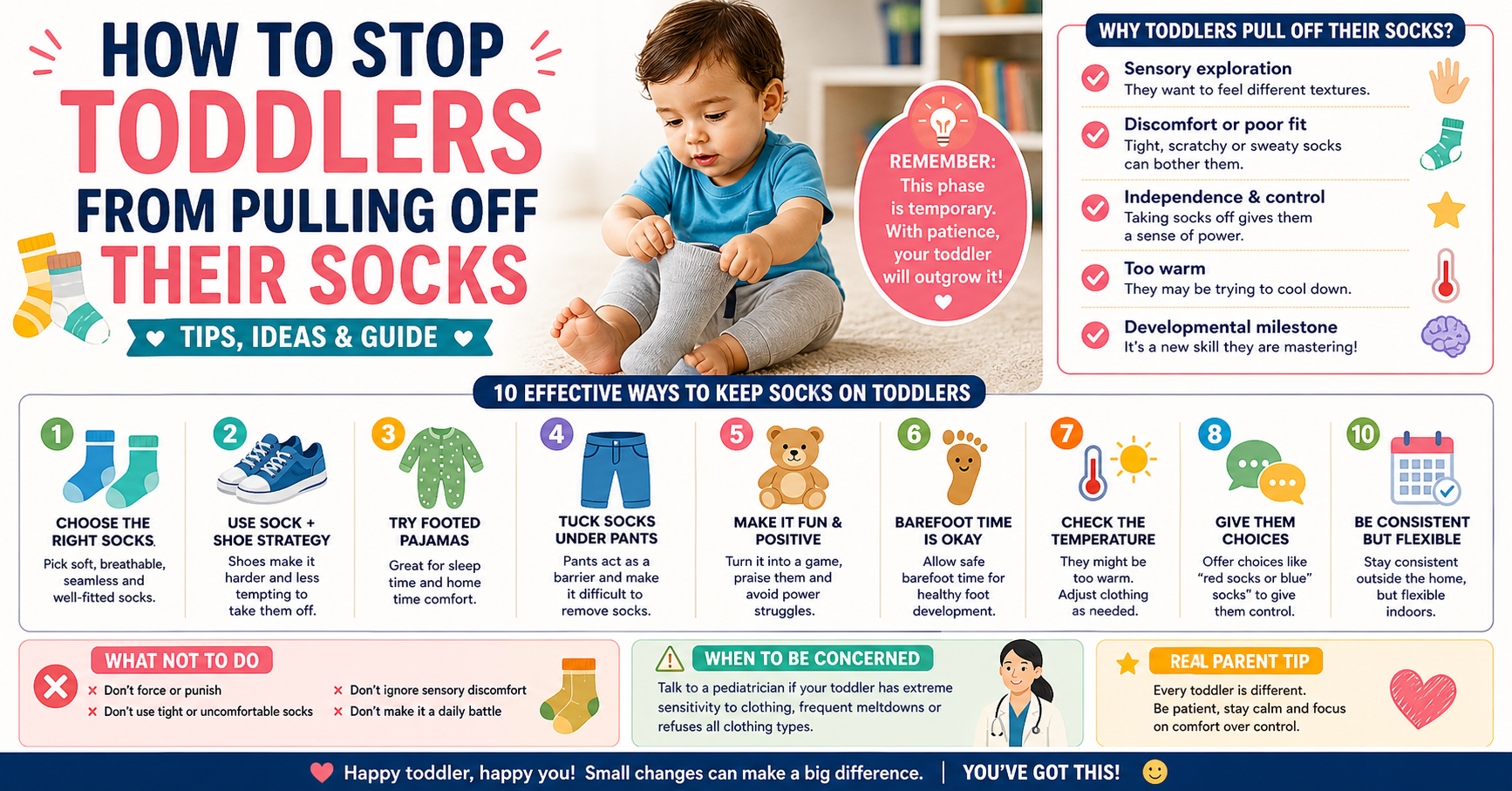
It starts innocently enough. You dress your toddler in the morning — socks on, shoes ready, you are actually running close to on time for once — and within four minutes, one sock is on the kitchen floor, the other is in the dog’s water bowl, and your toddler is sitting in the hallway with completely bare feet, looking deeply satisfied with themselves.
If you have a toddler, you know this scene intimately. The relentless, cheerful, completely unstoppable habit of toddler pulling off socks is one of the most universally shared parenting frustrations in the first three years of life. It happens at home, in the car, at nursery, in the supermarket, in the middle of winter, and most infuriatingly — immediately after you have just put the socks back on for the third time in twenty minutes.
The good news: it is entirely normal developmental behaviour, it does not mean there is anything wrong with your child, and there are genuine, parent-tested strategies that actually make a difference. The better news: understanding why your toddler keeps taking off socks makes the solutions significantly more effective, because different reasons call for completely different approaches.
This guide covers all of it. The real developmental and sensory reasons behind toddler pulling off socks, every strategy worth trying, the sock types and features that help keep them on, when sock-removal might signal something worth paying attention to, and a complete FAQ answering every question parents ask about this particular parenting puzzle.
Quick Summary: Toddler sock removal is mostly normal developmental behaviour driven by sensory curiosity, autonomy-seeking, and discomfort with specific sock features. The most effective solutions combine choosing the right socks, addressing sensory feedback, and using strategic distraction — not battles of will.
Before diving into solutions, it is worth spending real time on the “why” — because parents who understand the reason behind their toddler’s sock removal habit consistently report having more success with targeted strategies than those who try every tip at random.
There is not one single reason. There are several, and your toddler may be responding to one, two, or several of them at once depending on the situation.
Between approximately eight months and two and a half years, toddlers are in what developmental psychologists sometimes call the “cause and effect” phase of cognitive development. They pull things, throw things, push things, and remove things — not because they are naughty or deliberately difficult, but because their brain is running a constant series of experiments. “What happens when I do this? And this? And this again?”
Socks are ideal candidates for this kind of investigation. They are reachable. They respond satisfyingly to pulling. They come off completely, creating a clear and immediate result. And the adult reaction — which is usually entertaining, involves a lot of movement and vocalisations — reinforces the behaviour as especially interesting.
This type of toddler pulling off socks is not about the socks at all. It is about learning how objects and actions work. Responding with frustration or a drawn-out battle typically makes it more compelling, not less.
This is one of the most under-acknowledged drivers of toddler sock problems, and it is significant. Toddler feet contain a high density of sensory nerve endings — they are genuinely sensitive in a way that adult feet are not. The sensory feedback from floor surfaces, temperature, texture, and pressure is an active part of how toddlers navigate their environment and build proprioceptive awareness.
For many toddlers, certain socks feel genuinely uncomfortable in ways they cannot yet articulate. Common sensory complaints that toddlers cannot express verbally but respond to behaviourally include:
If your toddler seems particularly bothered by the sock removal — fussing, rubbing their feet, looking uncomfortable rather than playful when taking them off — sensory discomfort is likely a significant driver. This is the category where changing the type of sock makes the biggest difference.
This reason becomes increasingly prominent from around fifteen months onward, and is at its peak in the notorious two-year-old phase. Toddlers in this developmental window are intensely driven to assert independence and control — partly because they are becoming increasingly capable of independent action, and partly because the gap between what they want to do and what they are allowed to do is enormous and deeply frustrating.
Removing socks is one of the few acts of genuine autonomy available to a toddler. They can do it successfully, they can do it immediately, they can do it repeatedly, and it produces a visible, real result. From the toddler’s perspective, this is not misbehaviour — it is self-determination. They put the socks somewhere. They made a decision. They completed a task independently.
When toddler keeps taking off socks is driven primarily by autonomy needs, the most effective strategies involve giving the child more control in other areas — and specifically, involving them in the sock-wearing decision rather than having socks done to them.
Parents instinctively want toddler feet to be warm — bare feet on cold floors feels uncomfortable to an adult, and the assumption is that it feels the same to a child. But toddlers often run significantly warmer than adults, and their temperature regulation mechanisms are still developing and inconsistent. A toddler who has been actively playing, running, or even just sitting in a heated room may genuinely be too warm — and removing socks is a practical, effective way to cool down.
If your toddler pulling off socks is most common during active play, in warm rooms, or after energetic periods, temperature is likely a factor. Toddlers are very bad at expressing “I am too warm” verbally but very effective at doing something about it. Thick or synthetic socks in heated indoor environments are particularly likely to trigger temperature-driven removal.
This one is slightly uncomfortable to acknowledge, but important. The first time many toddlers remove a sock, the parental response is animated, immediate, and emotionally charged — all the ingredients for a toddler’s brain to flag this as a high-value activity worth repeating. If getting a sock off produces a parent who rushes over, speaks loudly, pulls a funny expression, or engages in a brief tug-of-war, that is genuinely stimulating and exciting.
Over time, toddler pulling off socks can become a reliable way to summon a parent’s full, immediate attention — especially useful when the toddler is bored, lonely, or simply wants interaction. This is not manipulation in the adult sense; it is a toddler discovering what works, which is normal and expected behaviour.
In the vast majority of cases, toddler pulling off socks is entirely normal developmental behaviour. However, there are some patterns that are worth discussing with your paediatrician or a developmental specialist:
While most toddlers have some sensory preferences, children with sensory processing differences experience sensory input with significantly higher intensity. If your child’s reaction to socks goes beyond casual removal into genuine distress — strong crying or screaming when socks are applied, physical stiffness or recoiling at the touch of fabric, extreme distress that seems disproportionate to the situation — it may be worth discussing toddler sensory issues with socks with your paediatrician.
Similarly, if sock sensitivity is part of a broader pattern of sensory responses across multiple types of clothing, textures, foods, or sounds, an occupational therapist who specialises in sensory processing can offer targeted strategies. This is not about diagnosing anything — it is about getting tools that work for your specific child’s nervous system.
Occasionally, toddler sock problems are driven not by sensory preferences but by an actual physical issue with the foot — an ingrown toenail, a blister, skin irritation, a fungal infection, or a corn. If sock removal is accompanied by the child touching, rubbing, or examining a specific part of their foot, limping, or fussing specifically when walking in shoes, it is worth checking the feet carefully. Toddlers cannot tell you “my toe hurts” but they can absolutely remove whatever is pressing against it.
With the underlying reasons clear, here are the strategies that genuinely work — explained with the reasoning behind them so you can match the right approach to your toddler’s specific motivation.
If sensory discomfort is even partly driving your toddler pulling off socks, the single most impactful change you can make is switching to seamless socks. Standard socks have a seam across the toe that sits right where the toes bend — a location that is genuinely uncomfortable for high-sensory toddlers and merely irritating for average-sensory ones.
Seamless socks are knitted in a way that eliminates this toe seam entirely, resulting in a smooth interior surface with no pressure points. Many parents who have battled toddler sock problems for months report that switching to seamless socks resolved the issue almost completely within days. They are available at various price points, and the investment is worth making before trying any other strategy — because if sensory comfort is the issue, no amount of distraction or routine-building will work as well as simply removing the cause.
Parent Tip: Turn socks inside out before putting them on — the exterior seam is usually smoother than the interior stitching. This is a free, immediate test to see if seam sensitivity is driving the removal before buying seamless socks.
Grip socks for toddlers serve two purposes simultaneously. The anti-slip rubber grip on the sole makes it harder to slide on smooth floors (which is a genuine safety benefit), and the fun, colourful designs — animals, characters, bright patterns — make the socks themselves more interesting and appealing objects to keep rather than remove.
The psychology here is simple: toddlers are less likely to remove things they find visually engaging. Pointing out the characters on the socks — “look, your dinosaur socks!” — creates a positive association that competes with the removal impulse. Grip socks for toddlers are one of the most consistently recommended solutions by parents in online communities and by early years practitioners, and the evidence in parent reports is strong.
Brands like Totes, Dotty Fish, and Blade & Rose produce toddler grip socks with particularly engaging designs that work well for this purpose.
When autonomy is the driving force behind toddler keeps taking off socks, the most effective counter-strategy is to involve the toddler in the putting-on process rather than presenting it as something that is done to them. Hand your toddler the sock. Let them attempt to put it on their foot — even partially. Make a big fuss about how well they did it. Finish what they started while maintaining the narrative that they put the sock on.
This reframes the sock from an object that was imposed on them (and can therefore be removed as an act of assertion) to an object that they chose to put on (and therefore have ownership over). It is a subtle shift in dynamics but a genuinely effective one. The toddler’s need for autonomy is met by the putting-on process rather than the taking-off process.
Sock-Ons are a specific product designed explicitly for baby pulling off socks — they are elasticated fabric wraps that go over the sock and around the ankle, making the sock significantly harder to remove without removing the Sock-On first. They have a strong following among parents of younger babies and early toddlers, though they become less effective as toddlers develop the dexterity to remove the Sock-On itself.
For the age range of roughly six to eighteen months, Sock-Ons are genuinely useful. Beyond that, they tend to be a delaying tactic rather than a solution, as older toddlers figure out the mechanism quickly. They work best combined with the other strategies in this list rather than as a standalone fix for an older toddler.
Toddlers respond well to routine and consistent language around expected behaviours. Creating a brief, consistent “sock routine” — the same words, the same sequence, the same physical cues every time — builds a predictable pattern that becomes easier to accept than a variable experience.
Something like: “Socks go on now. One foot. Two feet. Socks stay on until we get to [destination/activity].” Spoken in the same tone, at the same point in the getting-ready sequence, every time. This is not a magic formula — it takes several weeks of consistent repetition to work — but over time it creates a contextual expectation that socks are part of the going-out sequence and come off at a specific, predictable point.
The key word in that example is “until.” Giving toddlers a concrete end-point for the sock requirement — “socks on until we get home, then off” — is significantly more effective than an open-ended “socks must stay on” instruction with no visible end. Toddlers live in the immediate present; a defined time limit is comprehensible in a way that “always” is not.
This sounds counterintuitive but is grounded in solid behavioural principles: if you designate a specific time when sock removal is not only allowed but celebrated, you remove the forbidden-fruit appeal of the behaviour during all other times.
Try something like a “sock-off time” when you arrive home from an outing — make a little ritual of it, let the toddler pull them off with fanfare, toss them in the laundry basket together. The removal impulse gets a legitimate outlet. Toddler pulling off socks during outings becomes less compulsive when there is a guaranteed time coming up where it is sanctioned and enjoyed.
This works particularly well for autonomy-driven removal. The toddler’s need for control over their own body is acknowledged and met on a regular schedule, which reduces the urgency of seeking that control at inconvenient times.
Ankle socks are the easiest type to remove — they sit at the most accessible point on the foot and leg, and there is minimal fabric to interfere with the pulling motion. Switching to knee-high socks or tights makes sock removal significantly more effortful, which is sometimes enough to reduce the frequency even if it does not eliminate it entirely. It also means that if the sock is partially removed, it is less likely to fall off completely — the extra length keeps it connected to the leg while the toddler is mid-removal.
Leg warmers — which sit on the lower leg without covering the foot — are a partial solution that some parents find useful for temperature-driven removal. They keep the lower leg warm while leaving the foot free, which addresses the thermal comfort aspect without requiring the toddler to tolerate full sock coverage.
When the sock-off habit is causing issues specifically outdoors — in the car, in the pushchair, in public — shoes or booties over the socks add a physical barrier that is much harder for a toddler to bypass. Most toddlers cannot reliably take off both shoes and socks during a car journey, which buys significant time during shorter trips.
For pushchair use, footmuff covers serve a similar purpose — once the legs are inside the footmuff, sock access is significantly reduced. In colder months, all-in-one pushchair cosytoes that cover the feet entirely remove the sock question from the equation altogether during outdoor transit.
For toddlers whose toddler pulling off socks habit has been reinforced by animated parental reactions, the most effective counter is deliberate, consistent low-key responding. No frustration, no rushing over, no entertaining expressions. A calm, matter-of-fact “socks go on” followed by replacing the sock without drama removes the reward component of the behaviour.
This is genuinely harder to do than it sounds — particularly the fifteenth time in an afternoon. But toddler behaviour research consistently shows that reducing the emotional charge of a response is one of the most effective ways to reduce the frequency of attention-seeking behaviour over time. Not ignoring the behaviour entirely, but responding to it in the least interesting way possible.
Even when seams are not the issue, poorly fitting socks cause significant discomfort. Socks with elastic cuffs that are too tight leave visible marks on toddler ankles and calves and are actively uncomfortable to wear — of course the toddler removes them. Socks that are too loose bunch under the foot and create pressure points, and socks that are too small compress the toes.
When buying best toddler socks that stay on, always check: the cuff elastic should sit flat against the leg without creating a visible indentation after ten minutes of wear; the toe box should not compress the toes when the sock is on a standing foot; the heel should sit in the heel position, not migrated toward the arch. Getting the fit right eliminates comfort-driven removal and is often overlooked in favour of trying clever retention products.
Context matters enormously for toddler compliance. Socks that are associated with a transition to something exciting — “socks on, then we go to the park,” “let’s put socks on and then we’ll bake biscuits” — become part of a positive sequence rather than an end in themselves. The toddler’s attention is on the reward that follows, not on the sock itself.
This is not bribery — it is using toddler cognition as it actually works. Toddlers do not have strong future-planning ability but they do respond powerfully to immediately upcoming events. Connecting sock-wearing to a liked activity leverages this without requiring negotiation or reward.
The market for toddler socks has expanded considerably, and there are now specific products designed for toddlers with strong sock-removal habits. Here is a breakdown of the categories that work best and what to look for in each.
Seamless socks are knitted on circular looms that eliminate the toe seam entirely. The interior is completely smooth with no ridges, stitching, or pressure points. For toddlers with sensory sensitivity, these are transformative.
Grip socks with anti-slip rubber patterns on the sole serve multiple purposes. The non-slip sole is a genuine safety feature on hardwood, tile, and laminate floors. The engaging designs increase the appeal of the socks as objects. And the slightly thicker construction gives a different sensory experience that some toddlers actually prefer to standard thin socks.
Some toddler sock brands now produce designs with a small secondary strap or loop at the ankle that helps anchor the sock in the correct heel-cup position. These are different from general grip socks — the retention mechanism is structural rather than relying on friction. They tend to stay in position better than standard ankle socks during active movement.
For toddlers who run warm and remove socks primarily for temperature reasons, bamboo-blend socks are worth trying. Bamboo fibre has natural thermoregulatory properties — it stays cool when the wearer is warm — which reduces the thermal discomfort that drives temperature-related removal.
Simply by being harder to get off, knee-high socks reduce the frequency of toddler pulling off socks through a mechanical rather than behavioural route. They require two hands, significantly more coordination, and considerably more effort than ankle socks. For toddlers whose removal habit is primarily casual or habitual rather than sensory-driven, this added friction is often enough to reduce the behaviour markedly.
Quick Comparison: Best Toddler Sock Types for Common Sock-Removal Reasons
| Sock Type | Best For Reason | Key Feature | Price Range |
| Seamless socks | Sensory discomfort / seam sensitivity | No toe seam at all | Mid to Premium |
| Grip socks | Curiosity / engagement / hard floors | Non-slip sole + fun designs | Budget to Mid |
| Bamboo-blend socks | Temperature regulation / sensitive skin | Thermoregulating, breathable | Mid to Premium |
| Knee-high socks | Habitual / autonomy-driven removal | Harder to remove mechanically | Budget to Mid |
| Ankle-strap socks | Socks that migrate and bunch | Heel anchor construction | Mid |
| Sock-Ons | Babies 6–18 months | External retention wrap | Budget |
The strategies above work differently depending on the situation. Here is a quick context-by-context guide:
The car is one of the most common toddler sock problems hotspots — the child is stationary, slightly bored, and has full access to their feet. Best strategies:
Night-time sock removal is usually temperature-driven. Most toddlers simply do not need socks overnight in a properly heated room — feet are covered by bedding, body temperature drops naturally during sleep, and the sensation of socks while lying still is different from wearing them while active.
If warm feet overnight is important to you, try sleep socks with a slightly different texture to daytime socks — pure merino wool sleep socks are exceptionally soft, thermoregulating, and many toddlers tolerate them far better than standard cotton because the fibre is so soft. Alternatively, footed sleepsuits solve the problem entirely by making sock removal impossible without also removing the whole suit.
This is particularly frustrating because you lose the ability to manage it directly. Communicate with nursery staff about the strategies that work best for your child at home. If seamless socks or specific designs help, mention this. If your child has sensory sensitivities around socks, flag it as a sensory preference — nurseries with good SENCO provision will accommodate this.
Also consider: many nurseries have a relaxed attitude to bare feet indoors on clean floors during supervised play, particularly in warmer months. If your child is at nursery and socks keep coming off, it may be worth checking whether the nursery considers this a problem at all.
Pushchair sock removal often happens because the toddler can see their feet, is bored, and has nothing better to do with their hands. A footmuff that covers the feet eliminates access entirely and is the most effective solution for colder months. For warmer weather, a light blanket over the legs provides partial coverage. Hanging a small activity toy from the pushchair hood gives the hands something else to do.
This is the question every parent in the thick of constant toddler sock problems wants answered: when does it stop?
The short answer is: most children significantly reduce or stop the habitual sock-removal behaviour between the ages of two and a half and three and a half years. By this age, several of the driving factors resolve naturally:
This does not mean the battle ends entirely at age two and a half — every child is different, and some sock-resistant toddlers remain resistant well into the preschool years, particularly if sensory sensitivities are involved. But the frantic, unstoppable, twenty-times-a-day removal habit that characterises the one-to-two-year range typically does moderate significantly by the time a child is approaching three.
What usually remains is a child who still prefers to be barefoot when given the choice — which is actually a completely reasonable preference that does not require correction in appropriate settings. The goal is not to manufacture a child who loves wearing socks. It is to have a child who can keep socks on when the situation genuinely requires it.
Completely normal. Toddler pulling off socks is one of the most universally shared parenting experiences across cultures and climates. It is driven by developmentally appropriate behaviours — sensory curiosity, autonomy-seeking, cause-and-effect investigation, and temperature regulation — none of which indicate anything is wrong with the child. The behaviour peaks roughly between ten months and two years and typically reduces significantly between two and a half and three and a half.
Most baby pulling off socks begins around four to seven months, when babies develop enough hand-eye coordination and grip strength to successfully grasp and pull objects. The habit typically intensifies around eight to twelve months as the cause-and-effect learning phase peaks, and continues through toddlerhood with varying intensity depending on the individual child’s sensory profile and developmental stage.
Mild sock sensitivity is within the normal range for most toddlers. Significant distress — crying, screaming, physical stiffness, or complete refusal to wear socks as part of a broader pattern of tactile sensitivity — may indicate sensory processing differences worth discussing with a paediatrician or occupational therapist. Toddler sensory issues with socks exist on a spectrum, and most children who hate socks simply have a preference rather than a processing difference. But if the sock sensitivity is severe and part of a wider sensory picture, professional assessment can be genuinely helpful.
For toddlers whose sock removal is driven by seam or texture discomfort: yes, significantly. Parent reports in large parenting communities consistently describe seamless socks as a transformative change for sensory-sensitive children. For toddlers whose removal is primarily curiosity-driven or autonomy-driven, seamless socks improve comfort but do not address the underlying behavioural motivation. The best approach is to try seamless socks as the first intervention — they are low cost and if they work, the solution is straightforward.
The car is a perfect storm for toddler sock problems: the child is stationary, has nothing to do with their hands, can see their feet clearly, and the parent is occupied and cannot immediately respond. Cars are also often warmer than outdoor environments, which compounds temperature-driven removal. Solutions: shoes over socks for any journey, a footmuff for younger children, an engaging distraction ready from the start of the journey, and where possible keeping journeys short during peak sock-removal phases.
In most cases, not really. Toddlers often remove socks at night because they are too warm — body temperature drops naturally during sleep, and in a properly heated room with sufficient bedding, feet are usually warm enough without socks. If you want socks to stay on overnight for warmth reasons, try merino wool sleep socks (softer and more tolerated than cotton) or a footed sleepsuit which makes sock removal impossible. But a toddler keeps taking off socks at night and then sleeping soundly is not a health concern — it is a toddler who has accurately assessed their thermal needs.
For baby pulling off socks in the six to fifteen month range: yes, Sock-Ons are generally worth trying. They are inexpensive, they work well for younger babies who have not yet developed the dexterity to remove the secondary layer, and they can significantly reduce the sock-loss issue during outings and in the pushchair. For toddlers over fifteen to eighteen months: their effectiveness decreases as the child figures out the mechanism. Use them as a short-term solution while implementing the longer-term strategies in this guide.
Start with seamless socks in a soft cotton or bamboo blend with a gentle elastic cuff. These address the most common physical discomfort drivers simultaneously. Add a grip sock for toddlers design with characters or animals the child enjoys, which adds a positive association. If the toddler runs warm, prioritise bamboo for its thermoregulating properties. If you need mechanical retention during outings, go up a sock length to knee-high for the added removal friction.
Indoors on safe, clean floors: generally yes. Barefoot time is actually developmentally beneficial — it strengthens foot muscles, improves proprioception, and provides sensory feedback that contributes to balance and coordination. If your toddler is happier barefoot at home and the floors are safe and reasonably clean, this is not a battle worth having. Reserve the sock-keeping efforts for genuinely necessary situations: cold outdoor weather, public spaces, nursery if required, and situations where floor safety is a concern. Choosing your battles wisely is not parenting failure — it is parenting sensibly.
Communicate with nursery staff about what works at home — whether that is a specific sock type, a routine, or a verbal cue. If your child has sensory preferences around socks, frame it as a sensory consideration, which nurseries are generally familiar with and accommodating of. Also find out what the nursery’s actual policy on barefoot indoor play is — many nurseries are relaxed about this on clean indoor surfaces and the issue may be less critical at nursery than you think.
Yes — for some toddlers, especially those in the curiosity and engagement-driven category, character socks make a genuine difference. The key is choosing characters or animals the child is actually interested in and drawing their attention to the characters when putting the socks on. “Look, it’s a dinosaur!” creates a positive object association. The effect is not universal — sensory-driven toddlers will remove beloved character socks just as readily as plain ones — but for many children it is a useful addition to the toolkit.
Yes. Sock elastic that is too tight can leave visible red ring marks around the ankle or calf and causes genuine constriction discomfort — which is itself a strong driver of toddler pulling off socks. Check any socks you buy by stretching the cuff opening fully and checking whether it snaps back with significant force. The cuff should fit snugly around the ankle without creating visible indentation after ten to fifteen minutes of wear. Always check your toddler’s leg after removing socks — if there is a persistent red mark, the elastic is too tight.
Most toddlers can begin attempting to put socks on independently around twenty-four to thirty months, though success varies widely based on fine motor development and sock type. Loose-cuff, wide-opening socks are much easier for early independence attempts than tight ankle socks. Encouraging this process — even if the result is imperfect — directly addresses autonomy-driven toddler keeps taking off socks behaviour by giving the child genuine ownership of the putting-on process.
Asymmetric sock removal usually indicates a localised sensory or comfort issue with one foot specifically — a slightly tighter elastic on one sock, a seam that sits differently on one foot, a minor foot irritation, or simply the fact that one hand is dominant and starts with the more accessible foot. Check both feet carefully for any physical irritation. Also check whether the two socks are actually identical — slight manufacturing differences in batch production mean cuffs can have different elastic tension even in “identical” pairs.
Intense distress at sock application — screaming, significant crying, stiffening the body to avoid the sock — is worth paying attention to, especially if it is consistent and not improving with the usual strategies. This level of response may indicate genuine tactile hypersensitivity rather than behavioural preference. Start by eliminating all possible physical causes: try the softest, most seamless, most gentle-elastic socks available and see if the response changes. If distress at socks is part of a wider pattern of strong reactions to clothing textures, food textures, or sensory input generally, a conversation with your paediatrician about toddler sensory issues with socks and a referral to a paediatric occupational therapist may be the most effective next step.
The daily toddler pulling off socks struggle is one of those parenting experiences that feels enormous in the middle of it — the cold feet, the lost socks, the car journeys where both socks end up in the footwell before you hit the end of the road — and then, one day, you realise it has just quietly stopped. Your toddler is putting their own socks on, or at least tolerating them being put on without a major production, and you cannot quite pinpoint when the change happened.
That is usually how these phases end: not with a dramatic breakthrough, but with a gradual fading as the child matures past the developmental needs that were driving the behaviour.
In the meantime, the strategies in this guide work best when you match them to the specific reason your toddler is removing socks. Sensory discomfort calls for seamless, soft, well-fitted socks. Autonomy needs call for involvement and choice. Curiosity calls for engaging designs and low-key responses. Temperature needs call for better fabric choices and accepting that barefoot indoors is usually fine.
You do not need to win every sock battle. You just need enough strategies to win the ones that matter — cold winter outings, the nursery run, the formal occasion where bare feet would genuinely be a problem. For everything else, a toddler with bare feet who is warm, safe, and happily exploring their environment is doing just fine.