Physical Address
304 North Cardinal St.
Dorchester Center, MA 02124
Physical Address
304 North Cardinal St.
Dorchester Center, MA 02124

Let’s be honest for a second. Most parents do not hand their toddler a tablet or switch on the TV because they enjoy it. They do it because dinner needs cooking, because the baby is crying, because they are exhausted, or because it is 7am and nobody is ready to function yet. Screen time became part of family life for a lot of us not through a plan, but through survival.
And then one day you notice that your toddler is asking for the tablet before breakfast. Or crying when you turn the TV off. Or walking around the house saying “more YouTube” on repeat. And you think — okay, this has got out of hand.
The good news is that you are not alone, you have not broken your child, and you absolutely can reduce toddler screen time without turning your house into a war zone. This guide is going to show you exactly how to do it — in plain, simple language, with real strategies that fit into actual family life, not a perfect version of it.
No guilt. No judgment. Just practical steps that work.
Quick note: This guide is for parents of toddlers aged roughly 18 months to 4 years. If your child is older or younger, many of the strategies still apply — but the context is specifically the toddler years.
Before we talk about how to reduce toddler screen time, it helps to understand why toddlers are drawn to screens in the first place. Because it is not laziness or bad parenting — it is biology.
Screens are designed by some of the smartest engineers in the world to be as engaging as possible. Bright colours, fast movement, music, characters that respond, surprise elements that pop up — all of this hits the brain’s reward system hard. For a toddler whose brain is in rapid development mode and highly reactive to stimulation, screens are basically a dopamine delivery machine.
Add to that the fact that toddler screen time is often associated with rest, calm, snacks, and parental proximity — all good things in a toddler’s world — and you start to understand why the screen becomes such a strongly desired object. It is not the toddler being naughty. It is the toddler responding exactly as their brain is wired to respond.
Understanding this matters because it changes how you approach the problem. You are not fighting your child. You are working with their brain to find other things that feel rewarding, while gradually shifting the balance away from screens.
The research on too much screen time toddler effects is fairly consistent — and worth knowing, not to scare you, but to give you clear reasons to motivate the change.
None of this means that any screen time at all is harmful. The key word is too much. Context matters, content matters, and the relationship you build around screens matters too.
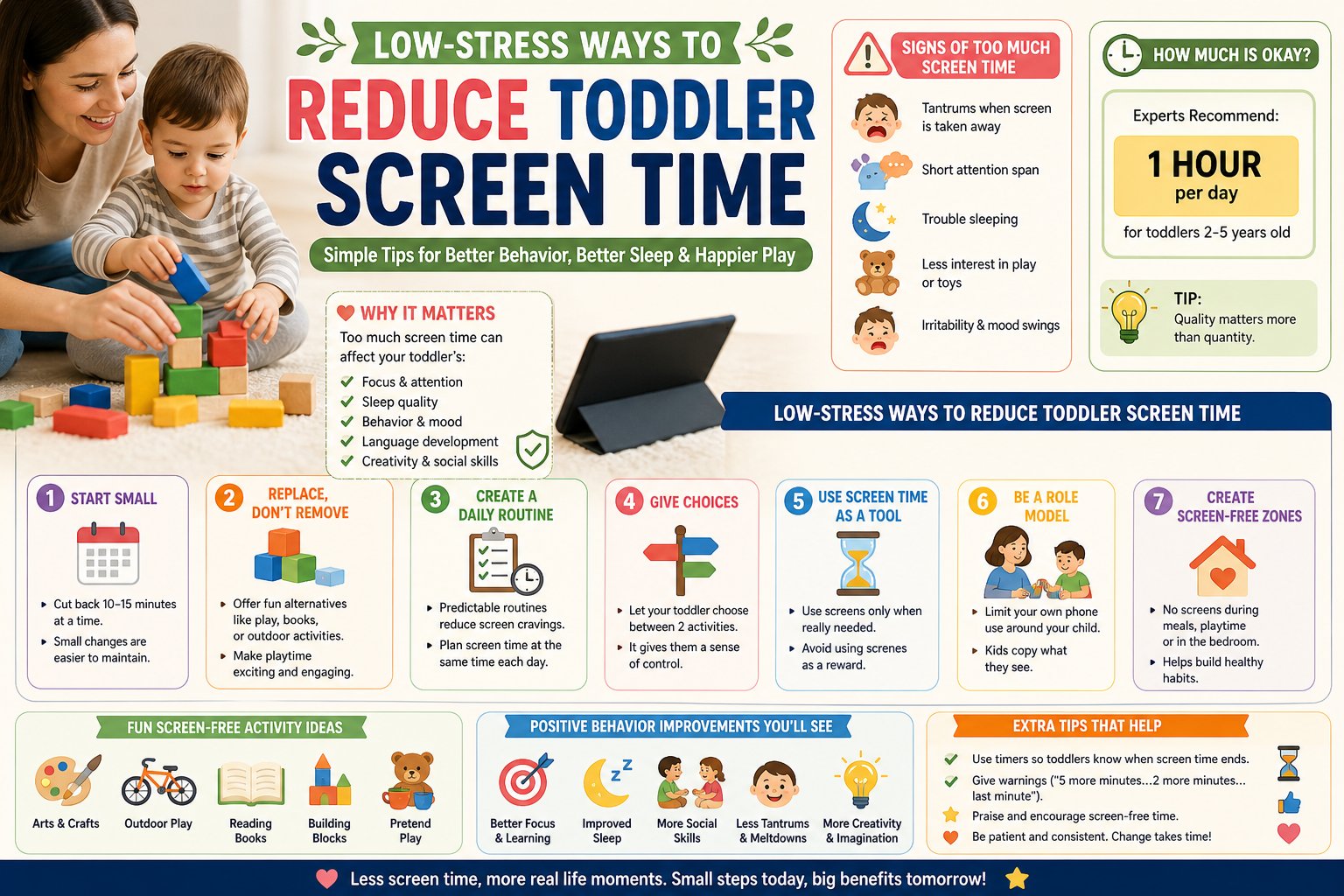
The American Academy of Pediatrics, the World Health Organisation, and the NHS all publish toddler screen time limits guidelines. Here is a simple summary:
| Age | Recommended Limit | What Counts | Exception |
| Under 18 months | None (except video calls) | All screen-based devices | Video calling family is okay |
| 18 – 24 months | Very limited, with a parent | TV, tablet, phone, computer | High-quality content only |
| 2 – 3 years | 1 hour maximum per day | All passive screen viewing | Co-viewing with parent is better |
| 3 – 5 years | 1 hour per day | TV, tablet, games, YouTube | Educational content preferred |
Important: These are guidelines, not laws. The goal is gradual, sustainable reduction — not overnight perfection. If your toddler currently watches four hours a day, getting to two hours is a meaningful win. Getting to one hour after that is another win.
A lot of parenting advice about toddler screen time starts with “just stop giving them the tablet.” And if you have ever tried that — especially without preparation or alternatives ready — you know exactly how that goes.
Sudden removal of something a toddler has become accustomed to triggers one of the most intense toddler responses there is: grief. Not manipulation, not naughtiness — genuine distress at the loss of something they loved and expected. The meltdown that follows is not a parenting failure. It is a completely predictable neurological response to unexpected loss.
The low-stress way to reduce toddler screen time works differently. It is gradual, it replaces rather than just removes, it involves the child where possible, and it sets clear expectations in advance. It takes a little longer to see results, but the results stick — and you do not spend three weeks in constant conflict to get there.
Think of it like this: you are not taking something away. You are building a life that has more interesting things in it than screens. The screen becomes less dominant not because it is forbidden, but because the alternatives are genuinely appealing.
These strategies work. They are used by early childhood educators, child psychologists, and — most importantly — by real parents in real homes with real tired days. Use the ones that fit your family. You do not need to do all twelve at once.
Do not try to overhaul everything at once. Pick one hour of the day — maybe the hour before dinner, or the first hour after nursery — and make that your screen-free zone. Do not announce it as a punishment or a screen ban. Just have something ready to fill it with.
One screen-free hour a day is a small change. But over a week, that is seven hours of toddler screen time replaced with something else. Over a month, it is 28 hours. That is not small at all. Start small, build from there.
One of the biggest causes of toddler screen time meltdowns is the abrupt switch-off. No notice, no preparation, just: screen gone. For a toddler who has no internal clock and no ability to predict the future, this is genuinely shocking and upsetting.
A simple two-step warning system works well: “Five more minutes, then TV off.” Then one minute later: “One more minute, then TV off. We are going to do [activity] after.” The warning gives the brain time to prepare for the transition. The mention of the next activity gives something to look forward to instead of just what is ending.
This sounds small but it is transformative. Parents who use consistent warnings consistently report a dramatic reduction in meltdowns when toddler screen time ends.
Script to try: “Two more minutes, then the TV goes off and we are going to do playdough. You can choose the colours!” The choice at the end hands back a small amount of control — which toddlers need.
Toddlers cannot read clocks, but they can understand visual routines. A simple daily picture schedule — drawn, printed, or made from photos — that shows when screen time for toddlers happens and when it does not, removes the negotiation from every single day.
When the screen time slot is visible and predictable, toddlers stop asking for it constantly because they can see when it is coming. “Not now, it is playtime. Screen time is after lunch — look, here it is on the chart.” The chart becomes the authority, not you — which is genuinely useful when you are tired of being the one who says no.
Keep the schedule simple: three to five picture blocks showing the main chunks of the day is enough. Breakfast block, play block, screen block, outdoor block, dinner block. Draw stick figures if needed — it does not need to be beautiful to work.
The biggest mistake parents make when trying to reduce toddler screen time is taking away the screen without having something ready to replace it. The toddler brain does not cope well with a vacuum — it will immediately go back to what it knows.
Before you turn the TV off or put the tablet away, have the alternative already set up and visible. Playdough on the table. Chalk in hand by the back door. A puzzle on the floor. A bowl of water with cups and funnels on the kitchen floor (one of the most reliably absorbing toddler activities instead of screen time). The transition from screen to activity is much smoother when there is something concrete and immediate to move toward.
Fresh air and physical movement are two of the most effective natural reduce toddler screen time tools there are. Not because they are punishments or distractions, but because genuinely active outdoor time satisfies a whole set of developmental needs — physical, sensory, social, emotional — that screens cannot. A toddler who has had a good hour outside is naturally more settled, less reactive, and more willing to engage with quiet indoor activities afterwards.
The target is ideally 60 to 90 minutes of outdoor time per day for toddlers — weather permitting. This does not need to be structured. Walking to the shops, playing in the garden, a trip to the park, kicking leaves down the pavement. It counts. And a toddler who is genuinely physically tired at the end of the day has much less need for stimulation from screens.
Build outdoor time into the daily schedule before screens, not after. A toddler who has been outdoors and active is in a much better mental state to accept toddler screen time limits than one who has been inside all morning and is climbing the walls.
When toddler screen time happens, make it better quality by sitting with your child and watching together. Ask questions about what is happening on screen. Comment on the characters. Connect it to real life: “Oh, they are baking a cake — we should bake a cake this weekend!”
Co-watching does three things simultaneously: it improves the quality of the screen time by adding language development and connection, it naturally limits how long the session goes on for (you are less likely to wander off if you are watching together), and it builds a more intentional relationship with screen content rather than a passive one.
This strategy is specifically recommended by the AAP for children under two and a half — and the reasoning applies to older toddlers too.
Two environments where too much screen time toddler issues tend to escalate quickly are bedrooms and mealtimes. Both are worth protecting consistently.
Bedroom screens — TV, tablets left in the room — affect sleep in ways that compound over time. Blue light suppresses melatonin. Exciting content raises arousal levels before sleep. A tired, dysregulated toddler is also a toddler who wants more screen time the next day to manage their tiredness. It becomes a cycle.
Mealtime screens prevent the development of conversation, delay learning to sit and engage at the table, and train the brain to need stimulation while eating — which causes problems as the child gets older. Mealtimes as screen-free zones are one of the easiest rules to establish early and one of the hardest to reverse once a habit is formed.
One of the most effective shifts you can make is moving from toddler screen time as a default (screens on whenever nothing specific is happening) to screen time as a defined daily slot (screens on at this time, for this long, then off).
Default screen time expands continuously because it fills every gap. Defined slot screen time stays contained because it has clear boundaries. The practical change is small but the impact on overall daily toddler screen time is significant. When a toddler knows screens go on at 4pm for 45 minutes, they stop asking all morning. The defined slot removes the constant negotiation and replaces it with a predictable routine.
Choose a slot that works for your family rhythm. Many parents find the late afternoon slot — roughly 4pm to 5pm, before dinner — works well because it coincides with the time of day when energy is flagging and cooking needs to happen.
Autonomy is one of the biggest drivers of toddler behaviour. When the screen goes off, a toddler who is given zero input into what happens next experiences a double loss: the screen AND control. Offering a genuine choice between two good options restores the sense of control immediately.
“Screen is off now. Do you want to play with the train set or do some painting?” Both options are things you are happy with. The child picks one. They feel they made the decision. The transition happens with significantly less resistance.
This is one of the simplest and most consistently effective strategies for managing toddler screen time transitions — and it costs nothing. Keep two or three ready-to-go activity options in mind so you can always offer a genuine choice quickly.
Every parent has high-need moments — the phone call you have to take, the meeting you need to join, the ten minutes of dinner prep where you need your toddler occupied. These are often the moments when screens get defaulted to because there is not a quick alternative ready. A busy box changes that.
A busy box is a container — a box, a bag, a shelf section — that holds activities your toddler only gets access to during these specific high-need moments. The exclusivity makes it feel special. Ideas for busy box contents:
The key is that these activities only come out during busy box time — not during regular play. Keeping them special and slightly novel means they hold attention longer than familiar toys. This directly reduces toddler screen time by giving you a reliable alternative for the moments when the screen is most tempting.
Toddlers learn by watching adults. If every time you sit down you pick up your phone, your toddler is absorbing that screens are what grown-ups choose when they have a moment. This is not a guilt trip — it is just how toddler learning works.
When you want to reduce toddler screen time, modelling non-screen choices in front of your toddler is genuinely influential. Pick up a book when you sit on the sofa. Do a puzzle at the table with your child rather than scrolling. Put music on instead of the TV when you are pottering around. These habits do not require you to be on your phone less (though that helps) — they just require you to do some visible non-screen activities where your toddler can see them.
When your toddler handles a toddler screen time transition well — accepts the switch-off, moves to the next activity, does not melt down — make a specific and warm point of noticing it. Not “good boy” or “good girl” — something specific: “You put the tablet down really well when I said it was time. That was brilliant. Well done.”
Specific praise for the behaviour you want to see more of is one of the most powerful behavioural tools available for toddlers. It names what they did well, which helps them understand and repeat it. Over time, successful screen transitions become a source of pride rather than a source of conflict.
Removing screen time for toddlers only works if there are genuinely good alternatives available. Not all activities hold toddler attention equally. Here are the ones that consistently work — and why.
Pouring, splashing, measuring, and transferring water is one of the most reliable screen-free activities for toddlers aged 18 months and up. It is deeply sensory, it is open-ended (there is no right or wrong outcome), and it develops fine motor skills, early maths concepts, and scientific thinking simultaneously. A washing-up bowl on the kitchen floor with a few cups, spoons, and small containers keeps most toddlers absorbed for 20 to 40 minutes.
Playdough is endlessly versatile and one of the most effective toddler activities instead of screen time. Rolling, cutting, pressing, poking, building, and destroying playdough satisfies multiple sensory needs simultaneously and develops fine motor strength that directly supports later writing skills. Change the colour or add scents (lavender, vanilla) occasionally to refresh the appeal.
This is one of the most underused tools for parents trying to reduce toddler screen time without losing the “background stimulation” benefit that screens provide. A good children’s podcast or audiobook on a bluetooth speaker provides language-rich, engaging content that builds listening skills and vocabulary — without any screen at all. CBeebies Radio, Storynory, and Story Pirates are all popular with toddler-age children.
Audio stories work particularly well during meals, during car journeys, and during independent play — three of the contexts where screens most often creep in.
A simple small world setup — a tray of sand with a few toy animals, a container of water with some boats, a box of duplo with a few figures — gives toddlers an imaginative world to enter and direct. Unlike structured toys that have a goal or an end state, small world play is open-ended. The toddler creates the story. This is deeply engaging and developmentally rich.
Rotate small world setups monthly to keep them fresh. Six to eight simple setups rotated regularly feel new every time they come back out.
Cornflour gloop, finger painting, foam shaving cream on a baking tray, dried pasta and lentils in a baking tin. Messy activities are universally absorbing for toddlers because they provide intense sensory input that the brain genuinely craves during this developmental stage. The mess is worth the clean-up — and using a plastic splash mat under the activity makes it significantly more manageable.
This one surprises many parents: toddlers genuinely love “helping” with real household tasks. Sorting laundry, wiping the table, emptying the dishwasher (non-sharp items), watering plants, sweeping with a child-sized broom. These activities are intrinsically motivating because toddlers want to do what the adults around them are doing. A toddler who is “helping” with dinner is occupied, developing real skills, and not watching a screen.
| Time | Activity | Why It Works |
| 3:00 pm | Outdoor play or walk | Physical activity reduces later screen craving |
| 3:45 pm | Snack + audiobook or music | Screens off, language input still present |
| 4:00 pm | Parent-child activity (playdough/puzzles/craft) | Connection time — reduces attention-seeking |
| 4:30 pm | Independent play (busy box or small world) | Parent gets a break, toddler builds focus |
| 5:00 pm | Defined screen time slot (45 mins max) | Predictable, bounded, not a default |
| 5:45 pm | Screen off + transition warning + dinner | Consistent end point with warning |
| 6:00 pm | Bath, books, bed routine | Screen-free wind-down for better sleep |
Even with the best strategies in place, toddler screen time transitions sometimes end in tears. That is normal. Toddlers are not machines, and their capacity for emotional regulation is genuinely limited by their developmental stage. Here is how to handle it without escalating and without caving.
When a toddler melts down over the TV going off, the worst thing you can do is match their energy. Raised voices, frustration, or sharp responses will escalate the meltdown every time. Take a breath, drop your body language, use a calm, warm voice. You do not have to be robotic — you can acknowledge the feeling. “You really wanted to keep watching. I know. It is hard when screen time ends.”
This is called emotional coaching, and it works. It does not mean giving in. It means acknowledging the feeling before redirecting. “It is hard. And TV is off now. Come on, let us go do playdough.” Short, calm, warm, clear. No lecture. No negotiation.
If you said screens are off and your toddler cries, and then the screen goes back on — you have just taught your toddler that crying is the correct way to extend toddler screen time. This is not blame — it is just how toddler learning works. Every parent does this sometimes. But consistency is everything here. The meltdown gets shorter each time you hold the boundary calmly. It gets longer every time the boundary shifts.
“You are really sad that the tablet is off. That makes sense. It was fun.” Naming feelings helps toddlers process them and calms the emotional brain slightly. It also models emotional vocabulary that they will use themselves over time. A toddler who can eventually say “I am sad because screen time ended” is in a much better developmental place than one who simply melts down without language.
If you want a structured starting point, here is a gentle, realistic plan for cutting back toddler screen time over two weeks without turning your home upside down.
| Period | Focus | What to Do |
| Days 1–3 | Observe and measure | Track current screen time honestly. Note when and why screens go on. No changes yet. |
| Days 4–5 | Add one screen-free hour | Pick one hour per day (same time each day) and fill it with an activity. Keep everything else the same. |
| Days 6–7 | Introduce the warning system | Start using 5-minute and 1-minute warnings before every screen-off moment. Use consistently. |
| Days 8–9 | Create the visual schedule | Make a simple picture chart showing the daily routine including the defined screen slot. Use it every day. |
| Days 10–11 | Replace default screen with busy box | Build your busy box. Use it instead of defaulting to screens during high-need moments. |
| Days 12–14 | Review and adjust | Look at where you are compared to Day 1. Celebrate progress. Adjust the schedule to keep one further screen-free hour if it feels manageable. |
According to the AAP, WHO, and NHS, toddlers aged 2 to 5 years should have no more than one hour per day of quality screen time. Children under 18 months should have none except video calls. Between 18 months and 2 years, very limited screen time with a parent present is acceptable. These are guidelines — not every family hits them, especially during transitions or difficult periods. The goal is gradual improvement, not instant perfection.
Completely normal. Toddlers have not yet developed the neurological capacity for smooth transitions, especially when something enjoyable is ending unexpectedly. This is not a sign of addiction or poor behaviour — it is a developmentally expected response. Using consistent transition warnings (“five more minutes”), offering a named next activity, and responding to the feeling calmly without reversing the decision all reduce the intensity and frequency of these reactions over time.
Yes, educational content is better than passive entertainment for toddler development — but it still counts toward toddler screen time totals. The AAP recommends that any screen time for toddlers should be high-quality content, ideally co-viewed with a parent. Apps and programmes specifically designed for early learning (Sesame Street, CBeebies programming, Khan Academy Kids) are preferable to YouTube autoplay or general entertainment. But even educational screens should be within the recommended daily limit.
True addiction in a clinical sense is rare in toddlers. What most parents are seeing is a very strong learned preference reinforced by the dopamine reward cycle and habitual use patterns. The good news is that this responds well to the strategies in this guide — gradual reduction, replacement activities, consistent boundaries. If your child is genuinely unable to function without screens for any period and shows extreme distress in all contexts, speaking with your paediatrician is worth doing. But for the vast majority of families, this is a habit that can be reshaped with patience and consistency.
This is one of the most common and most valid concerns about cutting toddler screen time. The answer is not “stop cooking” or “feel guilty” — it is to build a specific busy box or set of high-value activities that only come out during cooking time. Options that work well: kinetic sand, a contained water tray, a specific drawer of kitchen utensils and dried pasta to sort, a child-safe step stool so your toddler can “help” with washing vegetables. An audiobook or children’s podcast on a bluetooth speaker is also a genuinely good screen-free alternative for this specific window.
The earlier the better — but it is never too late to start. If your toddler has already developed strong habits around screens, a gradual reduction plan like the 2-week schedule in this guide is more effective than sudden removal. Children under 2 are easier to redirect than 3-year-olds who have had screens for a longer period, but even preschool-aged children respond well to clear, consistent routines and genuine alternatives. Start wherever you are, not where you wish you had started.
Yes — consistency between caregivers is one of the most important factors in how well toddler screen time limits stick. Toddlers are extremely adept at finding the path of least resistance. If one parent holds the limit firmly and the other gives in after five minutes of crying, the limit becomes meaningless. Having an explicit agreement between parents (and grandparents, if involved in regular care) about the daily amount, the timing, and the transition process makes the whole thing significantly easier for everyone.
Screen time at nursery or childminder settings varies by provider. Most UK nurseries follow Ofsted and EYFS guidance, which discourages passive screen use during care hours. Many settings use interactive educational technology tools purposefully and sparingly. If toddler screen time at your childcare setting is a concern, it is absolutely reasonable to raise it with the provider and ask about their screen use policy. Factor in any childcare screen time when calculating your toddler’s total daily amount.
Morning screen habits are among the most stubborn because they are linked to the morning routine — a deeply habitual sequence of events. The most effective approach is to replace the morning screen with a different morning anchor activity before the pattern begins. Put a specific morning activity out the night before — a puzzle on the table, playdough on the kitchen counter, a basket of books by the sofa. When your toddler comes downstairs, greet them warmly and move directly toward the activity: “Look what is out this morning!” The key is having the alternative already set up before anyone arrives in the room.
Tablets tend to be more problematic than TV for two specific reasons: interactivity and portability. Interactive apps and games are more intensely stimulating and harder to put down than passive TV. Portability means tablets follow the toddler everywhere, including bedrooms, mealtimes, and car journeys — contexts where TV rarely goes. That said, both count as screen time for toddlers and both should be within daily limits. Keeping tablets as shared family devices rather than personal toddler devices, and using them in designated spaces only, reduces both issues.
Rainy days are the peak test for reducing toddler screen time because outdoor options are limited. Keep a rotation of indoor activities that your toddler does not have constant access to: an art supply drawer with new materials that come out on rainy days specifically, a baking activity box (premixed dry ingredients for simple recipes), building a den with cushions and blankets, a sensory bin with dried lentils and small scoops, a simple treasure hunt set up around the house. Novelty is everything — the same activity every rainy day loses its power quickly.
This is the classic pattern of too much screen time toddler habit formation: the child is not constantly seeking screens, but the removal triggers a strong reaction. The brain has learned that screen time is a reliable pleasure, and losing it activates a real grievance response. The solution is the combination of transition warnings, predictable routines, and consistent calm responses to the reaction — without reversing. The pattern usually moderates within two to three weeks of consistent management.
This is one of the most honest questions parents ask — and it deserves an honest answer. You do not have to achieve AAP-recommended toddler screen time limits in a vacuum. If screens are a critical part of your coping toolkit as a solo parent, work within that reality. Focus on the strategies that give you the biggest return with the least effort: transition warnings, the busy box for cooking/calls, outdoor time as a built-in habit, and the morning routine anchor. Even reducing total daily screen time by 30 to 45 minutes through these changes is meaningful progress. Give yourself credit for what you are already doing.
This is a common source of friction in families. The most effective approach is a direct, non-confrontational conversation that frames your toddler screen time limits as a health and routine issue rather than a preference or a judgment. “We have been working on keeping screen time to about an hour a day because we have noticed it affects Alina’s sleep and mood. We would love your help keeping to that when they are with you.” Most grandparents respond positively when the framing is about the child’s wellbeing rather than a criticism of their parenting. Provide some specific alternatives you know work well with your child — it makes it easier for them to help.
With consistent toddler screen time management, most children’s intensity around screens reduces noticeably within four to eight weeks of establishing clear limits and strong alternatives. The initial weeks are the hardest — the brain is adjusting to a new normal. After that adjustment period, most toddlers stop asking constantly, accept transitions more easily, and engage more readily with non-screen activities. By ages four to five, children with consistent screen time management in place typically have a much healthier, more flexible relationship with screens than those who have had unlimited access during the toddler years.
If you have read this far, you are already doing something right. You are thinking carefully about what is best for your toddler, which is exactly what good parenting looks like.
The goal of reducing toddler screen time is not to raise a child who never watches TV or never uses a tablet. It is to raise a child who has a balanced, healthy relationship with technology — one where screens are one option among many, rather than the default answer to every dull moment.
You do not have to do this perfectly. You do not have to do it all at once. Pick one strategy from this guide. Try it for a week. See what happens. Then try another. Gradual, sustainable change is the only kind that sticks — and every hour of screen time you replace with something else is an hour of richer, more connected experience for your child.
That adds up faster than you think.