Physical Address
304 North Cardinal St.
Dorchester Center, MA 02124
Physical Address
304 North Cardinal St.
Dorchester Center, MA 02124

Let’s be honest about something right from the start.
When people talk about “morning routines,” they often paint a picture that looks nothing like a mum’s real life. Wake up at 5am. Meditate for twenty minutes. Journal three pages. Exercise. Make a green smoothie. Shower in peace. Arrive at your desk feeling centred and productive.
And then there’s your actual morning.
A toddler in your face before the alarm goes off. Someone has had an accident in the night. Breakfast negotiations that rival international diplomacy. One child can’t find their shoes. The baby needs feeding again. You’re still in your pyjamas at 9am wondering what happened to the last hour and a half.
The gap between the “aspirational morning routine” and the “mum morning” is real, wide, and honestly a little absurd. And most morning routine advice completely ignores it.
This guide doesn’t. Everything here is written for the actual reality of being a stay-at-home mum — with young children, unpredictable nights, limited help, and approximately zero guarantees that any plan will survive contact with an actual toddler.
What you’ll find is realistic, practical advice that genuinely helps. Not a perfect 6am routine. A better morning than the one you’re currently having — whatever that looks like for you.
Before we get into the practical stuff, it’s worth understanding why mornings matter so much — because once you understand the mechanism, you’ll be more motivated to protect them.
The morning is your most cognitively fresh time. Research consistently shows that willpower, decision-making capacity, and emotional regulation are strongest in the morning and gradually deplete throughout the day. This is why decisions made at 8am tend to be more considered and intentional than decisions made at 7pm after a full day of mum life. Your morning is when you have the most mental resource — spending it in a reactive, chaotic scramble burns through that resource before you’ve had a chance to use it for anything that matters.
How you start tends to compound. A morning that begins with calm and intention tends to roll forward that way. Conversely, a morning that begins in chaos, rushing, and stress tends to compound into a stressful day. This isn’t guaranteed — plenty of chaotic mornings end in perfectly fine days — but the pattern is real and worth being aware of. Small improvements to your morning have disproportionate effects on the rest of your day.
It’s often the only time that’s yours. For many stay-at-home mums, the early morning — before the children wake — is the closest thing to genuine personal time that exists. Evenings are often consumed by tidying, life admin, or complete exhaustion. During the day, you’re on. The morning, particularly the pre-child-waking hours, can be the only window for quiet, for yourself, for something that restores you rather than depletes you.
Understanding this doesn’t make mornings magically easier. But it does make it worth trying to protect them.
Here’s something important that most morning routine advice glosses over: there is no one-size-fits-all morning for a stay-at-home mum. Your ideal morning depends almost entirely on the ages of your children and your current season of motherhood.
Type 1 — The Early Riser Routine (For Mums Who Can Wake Before the Kids) If your children reliably sleep past 6am or 6:30am, waking up 30–60 minutes before them is genuinely transformative. This is the “miracle morning” concept applied in the most minimal, realistic way possible. You don’t need to wake at 5am. You just need to wake slightly before them — enough for a cup of tea in silence, a few minutes of movement or journalling, or simply the experience of being awake before the demands begin.
Type 2 — The Responsive Routine (For Mums of Babies, Night Feeders, or Early Wakers) If you’re feeding through the night, if your toddler is reliably up at 5:30am, or if your sleep is so broken that waking before the children is simply not survivable — this is not the season for a pre-dawn personal routine. And that is completely okay. Your routine, in this season, is about managing the morning well once it has begun, building small pockets of calm within the chaos, and setting yourself up the night before rather than the morning of.
Both types of morning are valid. Both can be improved. The key is knowing which season you’re in and working with it rather than against it.
This might be the most important section in the whole post, because the truth is that most of what makes a morning go well happens the night before.
When you’re reactive in the morning — making decisions, looking for things, figuring out the plan — you’re starting from zero. When you’ve set things up the night before, you’re starting from a running position. The difference is enormous.
Here’s what to do the night before for a significantly better morning:
1. Lay out your clothes (and theirs) We talked about this in the context of your own wardrobe, but it applies to children too. Spending two minutes the night before choosing what everyone is wearing eliminates one of the most common sources of morning friction — the “I don’t want to wear that” standoff — before it has a chance to happen.
2. Pack bags the night before School bags, nursery bags, your own bag for any errands you have planned — pack them the night before and put them by the door. The number of minutes wasted on morning bag-packing is genuinely staggering when you add it up across a year.
3. Prep breakfast as much as possible Overnight oats ready in the fridge. Cereal bowls out on the counter. A banana peeled and on the table if that’s what your toddler has every morning. Anything that reduces the morning cooking and decision load is worth doing.
4. Write tomorrow’s plan Not a long to-do list — just a simple note of the shape of tomorrow. Any appointments, any activities, any meals that need thought. When you can see the day’s shape before it starts, you feel considerably less at the mercy of it.
5. Deal with the kitchen before you sleep Waking up to a clean kitchen is disproportionately good for your mental state. A sink full of last night’s dishes is a small but real demoralising hit first thing in the morning. Ten minutes before bed clearing the kitchen pays back double in the morning.
6. Charge your phone away from the bedroom This is the step most of us don’t do and most of us know we should. When your phone is by your bed, you reach for it the moment you wake — and the first thing you do is consume rather than begin. Social media, news, emails — none of it is the right thing to start your brain on first thing. Charge your phone in another room. Use a separate alarm clock. Your morning will be quieter for it.
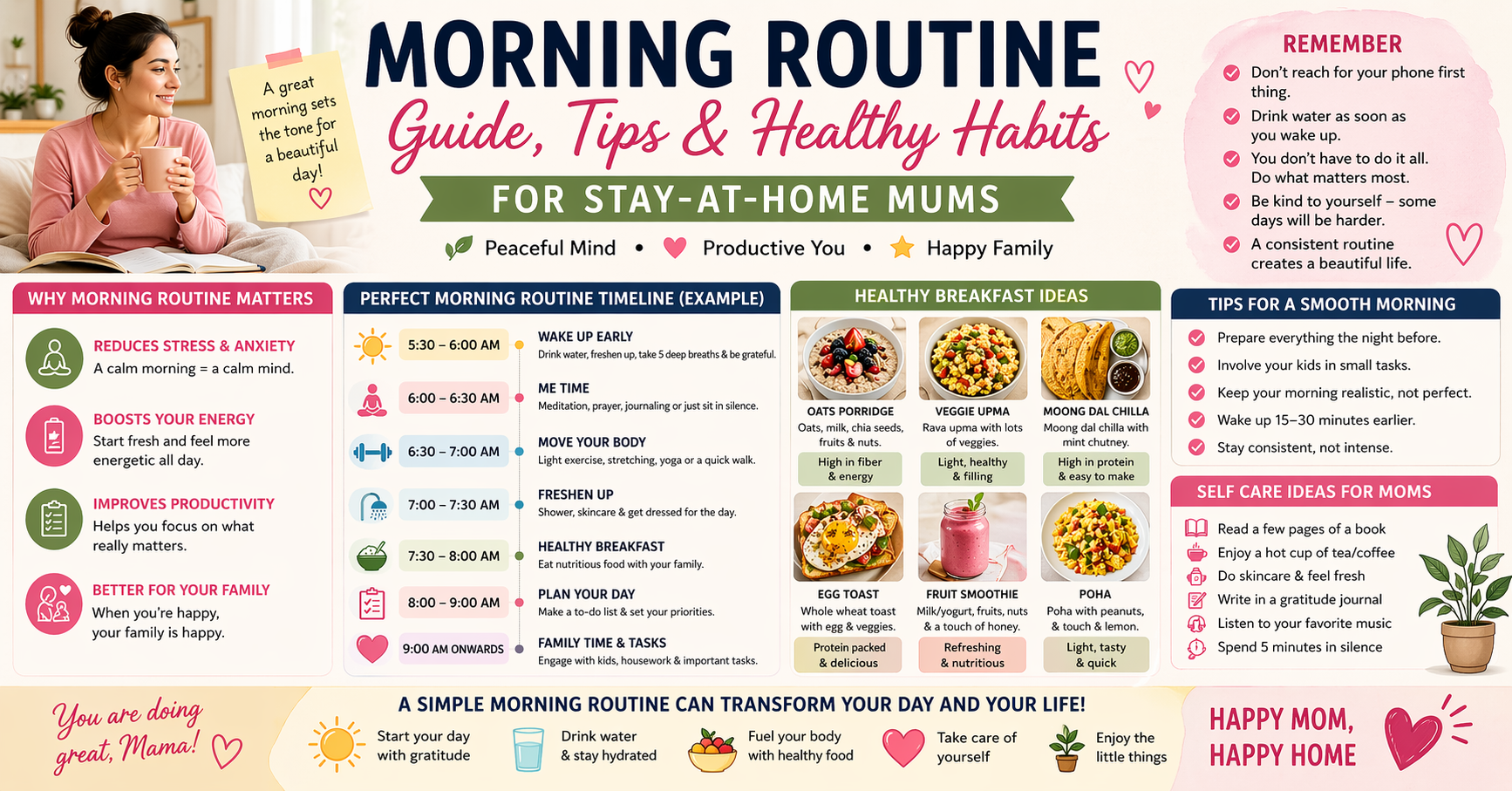
Now we get into the actual morning. Rather than a prescriptive “do this at 7:02am” type of schedule, here’s a flexible framework that you can adapt to your children’s ages, your household, and your current season of life.
Think of it in four phases:
Phase 1 — The Wake Window (Before or As the House Wakes) Phase 2 — The Launch (Getting Everyone Fed, Dressed, and Functional) Phase 3 — The Settle (Getting the Day into a Rhythm) Phase 4 — The Reset (A Small Moment for Yourself Before the Day Gets Loud)
Let’s look at each one in detail.
This is your window — however large or small — between when you wake and when the full household is in motion.
If you can carve out even fifteen minutes before the children wake, use it deliberately rather than by default. The temptation is to immediately reach for your phone or flick the kettle on and stand at the counter scrolling. Those aren’t bad things exactly, but they’re passive and reactive — you’re not choosing how to use the time, you’re filling it.
Make a hot drink and sit with it. This sounds embarrassingly simple. It is and it isn’t. Sitting — not standing, not walking around doing things — and having a hot drink in quiet is a form of deliberate rest that many mums genuinely never experience. Five minutes of this does something real for your nervous system.
Do a brief body movement. Not a workout. Not a forty-five-minute yoga class. Just five to ten minutes of gentle movement — some stretching, a short walk around the garden, a few minutes of something that gets you out of your head and into your body. This is particularly good if you’ve slept badly, which as a mum is fairly frequent.
Write three things. Not a gratitude journal if that doesn’t feel authentic to you. Just three things: what you’re thinking about today, what you need to do, what you’re looking forward to. It doesn’t need to be more than five minutes and it doesn’t need to be beautiful. Getting it out of your head and onto paper clears mental space remarkably effectively.
Read something you enjoy. Not parenting articles. Not news. Something you genuinely want to read — even just ten pages of a novel or a few pages of something that interests you. This is a reminder that you are a person with a mind and interests that extend beyond logistics.
If you have no wake window at all: This is okay and common. In this case, the goal is not a personal routine before the kids wake — it’s just to get yourself awake and mentally present before the morning demands begin. Even this: wake up five minutes before you absolutely have to. Sit on the edge of the bed. Take three slow, deliberate breaths. Don’t reach for your phone. Then start.
It sounds almost insultingly small. But that tiny buffer between sleep and the beginning of demands makes a real difference to how you feel entering the morning
This is when the children are awake and the morning’s practical work begins. Getting everyone fed, washed, and dressed — with the minimum of drama and the maximum of efficiency.
The golden rule of the launch phase: reduce decisions wherever possible.
Every decision your child makes in the morning is a decision that costs time and emotional energy. Which cereal? Which clothes? Which cup? The more of these you can pre-decide (via the night-before prep, via established routines, via rotating “this is just what we have on Mondays”), the smoother the launch goes.
Establish a consistent breakfast rotation. You don’t need to make the same thing every day, but having a regular rotation — say, porridge on Monday and Wednesday, eggs on Tuesday and Thursday, toast on Friday — eliminates the “what do you want for breakfast?” negotiation that derails many a mum morning. Children are actually less resistant to food when it’s presented as “this is what we have” rather than a choice.
Use visual cues for children who are old enough. A simple picture-based morning chart on the fridge — wake up, get dressed, brush teeth, have breakfast, wash face — gives children a visual guide for what comes next without you having to narrate every step. Even toddlers respond surprisingly well to these. It removes you as the constant instruction-giver and gives them some sense of agency and structure.
Work with your children’s natural morning rhythm. Some children wake up chatty, energetic, and ready to engage. Others need twenty minutes to fully arrive in the day. Know your child. Don’t expect high-energy interaction from a slow-waking child, and don’t try to quietly inch around an energetic one who just wants your attention. Work with who they actually are in the morning.
The dressed-before-breakfast rule (optional but effective): Getting children dressed before breakfast, rather than after, is a small but surprisingly effective strategy. It means you don’t have to interrupt eating to get dressed, there are no soggy cereal hands involved in putting on a jumper, and children who are dressed tend to feel more “in mode” for the day. Not a universal law, but worth trying
The settle happens after the immediate practical rush of breakfast and dressing — somewhere in that 8–9am window when the day is underway but not yet fully in motion.
This is where you transition from reactive (responding to the morning’s demands) to intentional (directing the day with some purpose). It might last ten minutes or thirty minutes depending on your children’s ages and your morning.
For mums with babies: The settle often aligns with a post-feed or post-breakfast settled period. Use it to do one grounding thing — even just getting dressed properly yourself, which sounds simple but makes a real psychological difference.
For mums with toddlers: Set them up with an activity — a puzzle, some colouring, a toy they haven’t seen for a while (rotation is your friend) — and use the window to do your own thing, whatever that is. Tidy the kitchen. Eat your own breakfast properly. Sit for five minutes. This window might be ten minutes, it might be twenty. Take it without guilt.
For mums with school-age children: Once the school run is done, this is your settle phase — the window between returning home and the day fully starting. Many mums describe this as feeling oddly destabilising, especially if you also have a younger child at home. Use it deliberately. Make your tea. Sit down. Write your simple list for the day. Give yourself permission to not immediately pivot to productivity.
Every morning — regardless of how it went — deserves a small reset moment. A point at which you acknowledge: the rush is over, the day is here, and now I’m choosing how I move through it.
This reset could be as simple as:
The reset isn’t about productivity. It’s about transition — moving from the reactive energy of the morning launch into a more intentional relationship with the day ahead.
Beyond the four-phase framework, here are the specific strategies that make the biggest difference in real mum mornings. These are drawn from what genuinely works — not theories, but practical adjustments that change how mornings feel.
We’ve said this before across the series and we’ll say it again because it bears repeating: getting dressed — properly, into actual clothes rather than what you slept in — is one of the simplest and most effective things you can do for your mental state in the morning.
You don’t need to dress up. You don’t need to do anything elaborate. Soft leggings and a clean sweatshirt count. What matters is the physical act of getting dressed signals to your brain that the day has begun and you are in it.
Mums who get dressed early in the morning consistently report feeling more motivated, more present, and more like themselves than those who stay in pyjamas. The psychological research behind this — the “enclothed cognition” concept from Northwestern University — backs it up. What we wear changes how we feel and behave.
The practical approach: Put getting dressed at the top of your morning routine — before or immediately after your first hot drink. Before children’s breakfast if you can manage it. Make it non-negotiable.
The number of mums who feed their children a nutritious breakfast and then eat nothing themselves, or eat while standing at the counter picking at leftovers, or eat at 11am because they’ve just remembered they haven’t yet — is genuinely high.
You need breakfast. Not because you’re following a diet plan or because some article told you breakfast is the most important meal of the day — but because you are a person who needs fuel to function, and skipping your own breakfast while ensuring everyone else eats is a small but persistent form of self-neglect that adds up.
Even something simple — a piece of toast, some yoghurt and fruit, a bowl of whatever you’re making for the children — eaten while seated, even for five minutes, is a form of care for yourself that pays dividends through the morning.
This is the advice nobody wants to hear and everyone needs to hear.
The first hour of your morning is a neurologically sensitive window. Your brain is transitioning from sleep to wakefulness, and whatever you feed it first gets a disproportionate amount of processing space. Feeding it social media, news, and notifications first thing primes it for distraction, comparison, anxiety, and reactivity — none of which are what you need entering a full day of managing children.
This doesn’t mean you can never look at your phone in the morning. It means being deliberate about when and why you do.
The practical approach: Keep your phone out of the bedroom (charge it elsewhere) and delay looking at it until after you’ve done two or three of your morning routine steps. Even thirty minutes of phone-free time at the start of your day changes the quality of the whole morning.
One of the reasons mum mornings feel so relentlessly rushed is the absence of any buffer between tasks. You finish making breakfast and immediately start clearing it up while simultaneously making sure someone has their shoes on and answering a question about what dinosaurs ate.
Building micro-buffers — just one or two minutes of deliberate transition between morning tasks — reduces the frantic energy significantly. You finish breakfast. You take sixty seconds to just stand, breathe, and orient to what’s next, before launching into it.
This sounds borderline ridiculous. Try it for a week and see what happens. The quality of your morning changes in ways that are difficult to quantify but immediately perceptible.
Habit stacking — a concept from James Clear’s book Atomic Habits — is the practice of attaching a new habit to an existing one. It works particularly well for building morning routines because it removes the friction of trying to remember when to do something new.
Examples of habit stacking for mum mornings:
The existing habit (kettle boiling, making breakfast, school drop-off) acts as a cue for the new one. You’re not adding something new to an empty slot — you’re attaching it to something that already reliably happens.
Perfectionism is the enemy of sustainable routines. If your morning routine can only be considered a success when everything goes exactly as planned — children wake at the right time, nobody cries, you have your thirty minutes of quiet, breakfast is calm — then you will have a “successful” morning approximately twice a month.
Define your “good enough morning” instead. What’s the minimum that makes a morning feel okay? For many mums it looks something like: everyone is fed, everyone is dressed, you have had something hot to drink, and you got yourself dressed before 9am. That’s it. That’s a good enough morning on the hard days.
When you meet your “good enough” standard, the morning was a success. The rest is a bonus.
Because “one routine fits all” doesn’t exist, here are three different sample morning routines adapted to different situations.
The reality: Night feeds, unpredictable wake times, exhaustion that is genuinely significant. This is survival mode, and your routine reflects that.
The goal: Nourishment and gentleness. Not productivity. Not structure beyond the basics. Just getting through well.
The reality: Early waking, high energy, constant attention needs, unpredictable moods (theirs and yours).
The reality: The school run creates a hard deadline that structures the morning, which is both helpful and stressful.
It will. Regularly. And that’s part of the deal.
Teething nights, illness, bad sleep, a child who wakes at 4:45am, a morning that is just inexplicably awful from the start — these are not failures of your routine. They are just Tuesdays.
The goal is never a perfect routine. The goal is a routine that’s easy enough to return to after the hard days. Small enough that it doesn’t feel impossible when everything is hard. Forgiving enough that a bad morning doesn’t derail the whole system.
When the routine falls apart:
And start again tomorrow.
There is a particular flavour of guilt that many stay-at-home mums experience around taking any time for themselves in the morning. The feeling that everyone else’s needs should come first, that wanting quiet or movement or a hot drink in peace is somehow indulgent.
Let’s be clear about something: taking care of yourself in the morning is not selfish. It is literally necessary for you to function at the level your family needs you to.
You cannot pour from an empty cup — and while this phrase has become a cliché, it remains true. A mum who enters the day having had no food, no quiet, no moment of her own, who has been reactive from the first second she opened her eyes — that mum is running on fumes. She is more likely to snap. More likely to feel resentful. More likely to struggle with the hard parts of the day.
A mum who has had even ten minutes of quiet, who has eaten something, who is dressed in something comfortable and clean, who has written three things on a notepad — she is more resourced. She has something in the tank. She is better equipped to be the parent she wants to be.
Protecting small pieces of your morning is not taking from your family. It is a long-term investment in your ability to show up for them.
The best morning routine for a stay-at-home mum is the one that is realistic for your current season of life and sustainable enough to actually repeat. In practical terms, this usually includes: waking slightly before your children if possible, getting dressed early in the morning, eating your own breakfast, having at least one hot drink sitting down, and identifying two or three priorities for the day. A “good enough” morning is any morning where you feel fed, dressed, and at least partially ready for the day — perfection is not the goal.
The key to a successful morning routine with a toddler is preparation the night before and managing decisions in the morning. Lay out clothes the night before, prep breakfast in advance, and use a simple visual chart to help your toddler know what comes next (getting dressed, brushing teeth, eating). Try to wake fifteen to twenty minutes before your toddler if possible to create a small buffer for yourself. Accept that some mornings will be derailed by the toddler, and define a “good enough” morning standard so you’re not holding yourself to perfection.
There’s no universal correct time — it depends entirely on your children’s sleep schedules and your own sleep needs. The most important principle is waking up slightly before your children, not alongside them. Even fifteen to twenty minutes of waking before they do creates a meaningful buffer that changes the quality of your morning. If your children wake at 6:30am, a 6:10am alarm gives you that window. Prioritise your sleep total before worrying about what time the alarm is set.
Productivity in a mum morning looks different from productivity in an office job. A productive mum morning is one where the household has launched smoothly, everyone is fed and dressed, and you have identified two or three clear priorities for the day. The habits that most reliably support productive mum mornings are evening prep (packing bags, prepping breakfast, laying out clothes), limiting phone use in the first hour, getting yourself dressed early, and using a simple daily list rather than an overwhelming to-do.
A SAHM morning at its best balances the practical needs of the household with some deliberate attention to your own wellbeing. Practically: ensure everyone is fed, dressed, and the day has a clear shape. For yourself: eat your own breakfast, get dressed, have a hot drink sitting down, and do one small thing that is just for you — whether that’s five minutes of movement, ten minutes of reading, or three minutes of writing. The ratio of “everyone else” to “you” will always be weighted towards everyone else, but the goal is for “you” not to be zero.
Motivation is unreliable — routine and habit are much more dependable. Instead of looking for motivation, focus on making your morning routine easy enough that you can do it without it. This means doing as much as possible the night before (so morning decisions are minimised), having something to look forward to in the morning (a specific tea or coffee you enjoy, a podcast you only listen to in the morning, a few pages of a book), and keeping your morning expectations small enough that a good morning is genuinely achievable on the hard days too.
Yes — with an important caveat. Waking up early is worth it if your sleep allows it. If you’re chronically sleep-deprived due to night feeds or a poor sleeper, forcing yourself to wake at 5am is likely to do more harm than good. Sleep deprivation affects every aspect of your functioning as a parent, so protecting your sleep is often more important than pursuing an early morning routine. Once your sleep is more stable, even waking fifteen to thirty minutes before your children has a genuinely significant impact on how the morning feels and how you enter the day.
Speed in the morning comes almost entirely from the night before. Lay out everyone’s clothes, prep breakfast, pack all bags, and know the plan for the day before you go to sleep. In the morning, reduce decisions: establish a consistent breakfast rotation so there’s no negotiation, use a visual routine chart for children old enough to follow one, and try the “dressed before breakfast” approach which many families find naturally speeds up the morning. Having a clear “we leave / we start the day at X time” endpoint also motivates the morning to move forward.
Start genuinely small — far smaller than you think you need to. A self-care morning routine for a mum doesn’t need to be thirty minutes of meditation and yoga. It can be: a hot drink sitting down, five minutes of movement, eating your own breakfast, getting dressed in something you feel comfortable in. Identify one thing that restores you — reading, movement, quiet, journalling, creativity — and protect five to ten minutes for it in the morning. Attach it to something that already happens (the habit stacking approach) so it happens consistently rather than just on good days.
Then you are having a normal mum experience. Routines with children are disrupted constantly — by illness, bad nights, developmental leaps, and plain old unpredictability. The goal is not a routine that never fails, but a routine that is easy to return to after it does. Keep your routine simple enough that even on a hard day, you can do at least one or two pieces of it. And define a “good enough morning” — the minimum that makes the morning feel okay — so you have a realistic bar to meet rather than an aspirational one that only lands on the perfect days.