Physical Address
304 North Cardinal St.
Dorchester Center, MA 02124
Physical Address
304 North Cardinal St.
Dorchester Center, MA 02124

You pull into the daycare parking lot. Your toddler is fine — cheerful, even. Then the moment you reach the door, it hits. The whimpering. The clinging. The wide, wet eyes staring up at you as if you are abandoning them forever.
If this sounds like your morning, you are not alone. Not even close.
Daycare drop off tears are one of the most common struggles parents face, and they are one of the least talked-about honestly. Most advice online tells you to “keep it short and sweet” and move on. But you know it is not that simple. You drive to work with your heart in your throat. You check your phone hoping the teacher will send a photo saying your child is fine. You wonder if you are damaging your child.
You are not. And this guide is going to show you exactly why — and exactly what to do instead.
These daycare drop off tips are organized by your child’s age because a six-month-old, a two-year-old, and a four-year-old are completely different human beings going through completely different developmental stages. What works for a toddler may backfire with an infant. What works for a preschooler may confuse a one-year-old. That age-specific detail is the gap no other guide fills — and it is the first thing that will make a real difference for you.
Before we get into the daycare drop off tips, let us talk about why this happens in the first place. Understanding the “why” changes everything.
Your child is not misbehaving. They are not being dramatic. What you are watching is a completely healthy, beautifully normal thing called separation anxiety — and it is actually a sign that you have done something right as a parent.
Separation anxiety develops because your baby has formed a deep attachment to you. According to Nemours KidsHealth, separation anxiety typically starts around 8 months of age and peaks between 10 and 18 months. It can continue through age three and sometimes beyond. This is not a sign that something is wrong with your child. It means their brain is developing exactly as it should.
Here is something even more important: research on early childhood bonding shows that children with strong, secure attachments to their caregivers — children who cry at drop off because they love their parents — are often better at forming social connections and handling stress later in life.
Your child cries because you matter to them. Keep that in mind every single morning.
You finally get to a point where drop off feels smooth. Then one Monday, out of nowhere, the tears are back and worse than ever. Sound familiar?
This regression is completely normal and is often triggered by:
The good news: regressions are temporary. Stick to your daycare drop off routine and they pass, usually within a week or two.
Infant drop offs are a unique experience. Your baby may not cry much at all in the first few weeks — and then suddenly start crying intensely right around eight or nine months. This is the peak of the separation anxiety window for infants, and it can feel like things got worse right when you thought they were going well.
Here are the best daycare drop off tips for infants specifically:
Infants rely heavily on smell for comfort. A small piece of fabric — even a worn t-shirt or a corner of a blanket that smells like you — can be enormously soothing for a baby. Ask your daycare provider if your baby can have a comfort scent item in their crib or during fussing moments.
Rushing creates cortisol (stress hormones) in both you and your baby. Babies cannot understand the concept of time, but they feel your anxiety in your body language, your tone, and even your heart rate when you hold them. If you are tense, they feel tense. Give yourself a buffer of 10–15 extra minutes every single morning.
The fastest way to ease infant daycare drop off anxiety is to make sure your baby genuinely likes and feels safe with their daycare caregiver. Visit the daycare together a few times before the first official drop off. Let your baby get used to the teacher’s face and voice while you are still in the room.
When your baby associates the caregiver with safety and warmth, the handoff becomes much smoother.
When it is time to go, hand your baby to the caregiver calmly and confidently. Do not linger. Do not second-guess yourself mid-handoff. Babies read your body language immediately. A calm, confident parent signals: this place is safe.
Most modern daycares use apps like HiMama, Procare, or Brightwheel to send parents photos and updates throughout the day. If your daycare offers this, use it. A photo of your baby happily playing on the mat 20 minutes after a tearful drop off is one of the most reassuring things a parent can receive.
Toddlers are the age group most parents think of when they picture daycare drop off tears. And rightly so — the toddler years (especially 18 months to 2.5 years) are the absolute peak of separation anxiety.
Toddlers cannot understand time. When you say “I’ll be back after lunch,” they have no real concept of what that means. They only know that you are leaving, and they do not know if you are coming back. That is a terrifying feeling for a small person whose entire world is you.
Understanding this will completely change how you approach daycare drop off with your toddler.
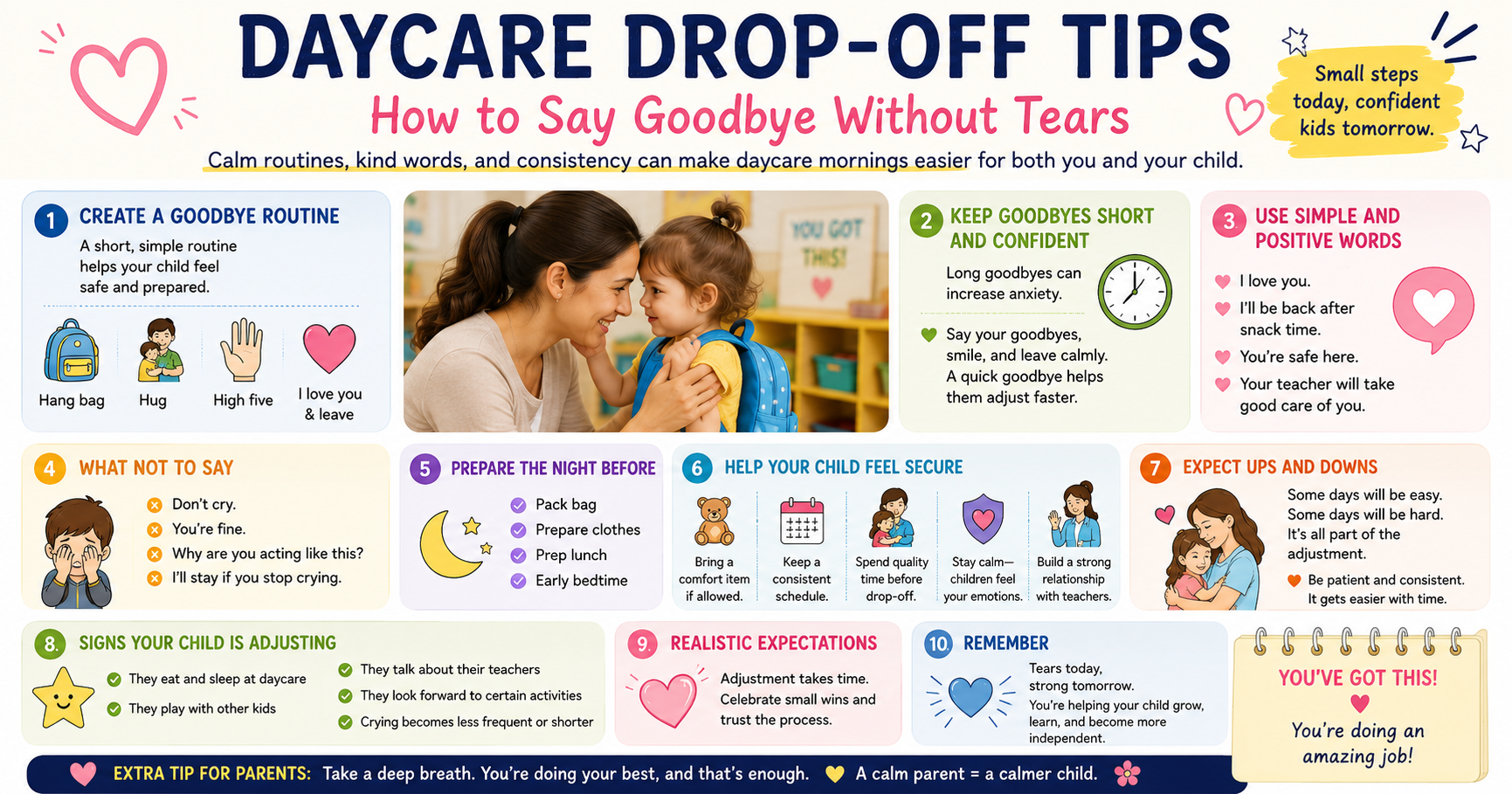
This is the single most powerful of all the daycare drop off tips for toddlers. A goodbye ritual gives your child a predictable, comforting sequence that tells them: this is what happens, then you leave, and then you come back.
A good goodbye ritual for a toddler might look like:
It does not matter what your ritual is. What matters is that it is consistent, short (under 2 minutes), and always ends with you leaving.
The ritual works because it removes uncertainty. Your toddler stops asking “what is going to happen?” and starts knowing. That knowing is where the calm comes from.
It is so tempting. Your toddler is happily building a tower of blocks. If you just slipped out quietly, maybe they would not even notice until they were already having fun. Do not do this.
Sneaking out destroys trust. When your toddler looks up and you are simply gone — no goodbye, no ritual, no warning — they do not think “oh, mum must have left.” They think “where did mum go? She disappears sometimes without warning. I need to watch her every second.”
This actually makes daycare drop off anxiety worse over time, not better. Always say goodbye, even if it produces tears.
Instead of “I’ll pick you up at 5pm,” say something your toddler can anchor to in their world:
These anchors connect time to something your toddler experiences and feels, making your return feel real and predictable.
Object permanence — the understanding that things still exist even when you cannot see them — is still developing in toddlers. You can help build this understanding through games like peek-a-boo, hide-and-seek, and hiding objects under blankets.
According to Zero to Three, these playful activities actually wire the toddler brain to understand that when you leave, you still exist. You will come back. Practicing this at home before drop off makes the concept more natural at daycare.
A transitional object is a small, meaningful item from home that your toddler carries with them at daycare. It could be a small stuffed animal, a keychain photo of your family, or even a small square of fabric from a favorite blanket.
Research shared by UNICEF Parenting shows that comfort objects reduce anxiety and help children feel connected to their primary caregiver even when apart. Ask your daycare provider if transitional objects are allowed (most encourage them).
This one is simple, slightly silly, and wildly effective. Before drop off, draw a small heart on your toddler’s hand and one on yours. Tell them: “When you miss me, press your heart and I’ll feel it.” This gives your toddler a physical action they can take when they feel anxious — and it builds a beautiful little sense of connection across the distance.
Rushing in the morning is the enemy of good daycare drop off routines. When you are scrambling to find shoes, pack the bag, and get out the door, your stress becomes their stress. Pack everything the night before. Lay out clothes. Prepare breakfast items. A calm morning creates a calm drop off.
By the preschool years, many children have moved through the worst of their separation anxiety. But not all of them. Some preschoolers still cry at drop off — and unlike toddlers, they can now tell you exactly why.
“I miss you.” “I don’t want you to go.” “What if something bad happens?”
These are real fears expressed in real language. The good news is that you can now meet them with real language back.
Preschoolers respond well to narrative. Tell them the story of drop off before it happens:
“Tomorrow morning, we’ll get in the car, drive to Miss Sarah’s class, hang up your backpack, and I’ll give you our special high-five. Then I’ll go to work, and you’ll have art time. After outdoor play and snack, I’ll be right there to pick you up.”
Run through this narrative the night before, at breakfast, and in the car. Repetition makes the unknown feel known. Known feels safe.
When your preschooler says “what if you don’t come back?”, do not brush it off. Meet it directly:
“I will always come back. My job is to keep you safe and take care of you. I have never not come back, and I never will.”
Children this age respond to certainty. Give it to them.
Preschoolers respond to specific excitement, not general reassurance. Instead of “you’ll have fun!” (vague), try:
Specific enthusiasm creates specific anticipation. It shifts focus from “I am losing you” to “I get to go do something.”
A departure cue is your signal that you are about to leave. For preschoolers, this can be verbal: “Okay, I’m going to give you our goodbye hug, say our special words, and then I’m going to walk out. You ready?”
This gives your child agency in the moment. They are not blindsided. They know it is coming. And because they have experienced it dozens of times already, they know what happens next: they feel a bit sad, they get distracted, they have a good day, and then you come back. Every time.
One of the most underused daycare drop off tips is what you do at pick-up. Instead of “how was your day?”, try asking specific questions:
When your preschooler regularly has good, specific things to report after daycare, they begin to associate daycare with good memories — and that memory bank becomes the foundation of a more confident morning next time.
One of the biggest questions parents have about daycare drop off anxiety is: how long does this last? The honest answer is that it depends on your child’s age, temperament, and how the daycare itself handles transitions. But here is a general roadmap:
Everything is new. Your child may cry intensely at drop off, or they may be too overwhelmed to cry at all. Expect inconsistency. Some days will feel manageable. Others will feel like the drop off from hell. This is normal. Stay consistent with your goodbye ritual. Trust the process.
What you can do: Keep drop offs short. Communicate closely with the teacher. Ask for updates via the daycare app. Prepare the night before to keep mornings calm.
Your child now understands the pattern. They know that you leave. They do not like it. Protests may actually get louder and more emotional in week two than week one — this is completely normal. Do not interpret escalation as a sign that things are getting worse. It often means your child’s brain is processing the transition more deeply.
What you can do: Stay calm and confident. Do not extend your goodbye. Do not linger at the door. Reinforce the goodbye ritual. Tell your child’s teacher what is happening so they can step in immediately after you leave.
By week three, many toddlers and preschoolers start trying to negotiate the goodbye. “Just one more hug.” “Come inside with me.” “Can you stay a little bit?” This is a sign their brain is getting smarter about the transition — they are looking for loopholes.
What you can do: Stick firmly to the ritual. Be warm but clear. “One hug is our ritual, and then I go. I will be back after snack.” Do not give in to one-more-hug requests — each one makes the next goodbye harder.
Most children, according to studies cited by CDC early childhood resources, begin to significantly settle into a new childcare environment within 3–4 weeks. By week four, many parents report drop offs becoming noticeably easier. There may still be occasional tears, but the intensity typically reduces.
What you can do: Keep the ritual. Celebrate wins with your child at pick-up. Notice and name what they are doing well. “You walked right in today. I could tell you were ready.”
By weeks five to eight, most children have formed real bonds with their daycare teacher and one or two friends. The daycare environment has become familiar, predictable, and — importantly — associated with good experiences. Drop offs may still have emotional moments, but they become increasingly brief.
If your child is still crying intensely every single day past week six with no improvement at all, speak with your pediatrician. Persistent, worsening separation anxiety beyond this window can occasionally signal a developmental need worth exploring.
These are real goodbye rituals parents use with real success. Pick one that feels natural to you and your child — and then do it the same way every single morning without exception.
1. The Three-Kiss Rule Three kisses in a sequence — cheek, cheek, forehead. The end. No more, no less. The specificity of “three” gives toddlers a predictable end point.
2. The Butterfly Kiss Press your eyelashes against your child’s cheek and blink. It is silly, it makes them smile, and it ends the goodbye on warmth rather than tears.
3. The Heart Press Draw matching hearts on each other’s hands. “Press it when you miss me.”
4. The Secret Handshake Develop a special shake together at home — a high-five, a fist bump, a wiggle. Practice it for fun before you ever need it at drop off.
5. The Window Wave After the indoor goodbye, walk to a window outside and wave. Your child can see you from inside. One wave, you walk away. This gives children visual confirmation of your departure and return cue.
6. The Countdown Hug “Let’s do a big five-second hug — five, four, three, two, one. Okay, I love you. See you after snack!” The countdown signals the end with warmth and certainty.
7. The Whisper Word Have a secret word only you and your child know. Whisper it at goodbye. It becomes a private bond — something that belongs only to the two of you.
8. The Family Photo Keychain A tiny laminated photo of your family on your child’s backpack zip. They can see it anytime they miss you during the day.
9. The “Talk to My Heart” Script “Whenever you miss me, put your hand on your heart and talk to me. I’ll hear you.” This gives your child an emotional coping strategy they can use independently — a huge confidence builder.
10. The Enthusiastic Teacher Handoff Coordinate with the teacher to always be ready at the door to greet your child with something specific: “Come see what we set up in the art corner!” or “I was hoping you’d come — we need your help with something.” The teacher’s enthusiasm redirects your child’s attention before tears have a chance to escalate.
The exact words you use at daycare drop off matter more than you might think. Here is a quick guide:
| Instead of… | Say this… |
|---|---|
| “Don’t cry, it’ll be fine” | “I see you’re feeling sad. I’ll be back.” |
| “You’re going to love it here!” | “Miss Sarah has the sandpit out today.” |
| “Please don’t make this hard” | “I know this feels hard. You’ve got this.” |
| “I’ll be back soon” | “I’ll be back after afternoon snack.” |
| “Why are you crying again?” | “It’s okay to miss me. I miss you too.” |
| “Just go play, you’ll be fine” | “Let’s hang your bag up together, then hug.” |
“Don’t cry.” This tells your child their emotions are wrong. It is not a strategy; it is emotional shutdown. Your child learns to suppress their feelings rather than process them — which creates bigger problems later.
“I’ll sneak back to check on you.” Never make promises you will not keep. If you say you are leaving and then you come back to “check,” your child will watch the door for the rest of the day waiting for you.
“This is just as hard for me.” Sharing your own adult distress at the drop off door adds to your child’s burden. They do not need to know you are struggling. Save that for the car, or a friend, or a good cry later. You can feel all of it — after you leave.
“If you’re good, I’ll bring you a treat.” Treats as bribes for good behavior at drop off create a transactional relationship with what should be a safe, neutral experience. It also implies that crying is “bad” behavior — which it is not.
Let us be honest about something that no other daycare drop off tips guide talks about properly: the guilt.
You walk to your car after a tearful drop off and you feel it. That heavy, acidic feeling sitting in the center of your chest. Am I doing the right thing? Am I hurting my child? Is this doing damage?
Here is what the research says — and it is good news.
The American Academy of Pediatrics has consistently found that high-quality daycare does not harm child development. In fact, children in quality daycare settings often show stronger language development, better social skills, and more confidence around unfamiliar adults compared to children who stay home exclusively.
Your child cries when you leave. Your child also laughs when you pick them up. Both of those things are true at the same time.
Here is what you can actually do with the guilt:
Use it as information, not punishment. Guilt is your brain signaling that something matters to you. Use it to stay engaged — ask your daycare teachers for regular updates, check the app, make pick-up time special.
Separate your child’s tears from your child’s wellbeing. Your child crying at drop off does not mean your child is suffering all day. These are not the same thing. Within minutes of you leaving, the vast majority of children calm down and engage fully in their day. Ask your teacher. They will tell you.
Build a relationship with the daycare staff. The more you trust the people caring for your child, the less your guilt has to do. Schedule a monthly five-minute check-in at pick-up. Ask what your child enjoys most. Watch the genuine warmth between your child and their teacher — that relationship is built by the same child you are raising.
Talk to other parents. Daycare drop off guilt is universal among working parents. You are not broken. You are not doing it wrong. You are one of millions of parents doing the same thing every morning, feeling the same thing every morning, and raising children who are fine, loved, and thriving.
Everything we have discussed so far describes normal separation anxiety — the kind that is developmentally appropriate and ultimately temporary. But there is a point where separation anxiety can cross into something that deserves professional attention.
According to Nemours KidsHealth, Separation Anxiety Disorder (SAD) is different from normal separation anxiety in both intensity and duration. It involves excessive fear that significantly interferes with daily life.
None of these signs mean something is permanently wrong with your child. They mean it is time to bring in extra support — which is a wise and loving thing to do.
Speak with your child’s pediatrician first. They can assess whether a referral to a child psychologist or therapist is appropriate. Separation anxiety disorder is highly treatable, especially when caught early.
Normal is a wider range than most parents realize. Most daycare drop off anxiety, in most children, resolves with time, consistency, and the strategies in this guide.
For most toddlers and preschoolers, the most intense drop off anxiety lasts two to four weeks. After this window, the majority of children significantly settle into their daycare routine. Some children may have occasional regression — a particularly emotional drop off after a holiday or illness — but these typically resolve within a few days. If intense separation anxiety persists beyond six to eight weeks with no improvement at all, speak with your child’s pediatrician.
Yes, daily crying at drop off is very common, especially for toddlers aged 18 months to three years. This age group is at the developmental peak of separation anxiety. Daily tears do not mean your child is unhappy at daycare — teachers consistently report that most children calm down within five to ten minutes of a parent leaving. What matters most is that you maintain a consistent, brief goodbye ritual every day.
In most cases, no. Staying longer can actually increase your child’s anxiety by prolonging the uncertainty of the goodbye. Once your goodbye ritual is complete, leave — even if your child is crying. Ask the teacher to step in immediately and redirect your child. If you feel you must stay for the very first few visits to help your child feel safe in the new environment, limit it to five to ten minutes maximum and have a clear endpoint planned.
Yes — this is actually very common and has a name: “after-school restraint collapse.” Your child holds themselves together all day, doing the emotional work of being away from you. When they see your face, they feel safe enough to finally release all that held tension. It is not a sign that they had a bad day. It is a sign of secure attachment. Pick-up tears usually reduce as your child fully adjusts to the daycare routine.
Bribing your child with treats or rewards to stop crying at drop off is not recommended. It teaches your child that their emotional reaction is a problem to be fixed with a transaction, rather than a feeling to be understood. Instead, acknowledge the emotion directly (“I see you’re sad. I get it. I’ll be back after snack.”) and follow through with your ritual. Consistency and emotional validation are far more effective — and healthier — than bribes in the long run.
A skilled daycare teacher is an essential part of smooth drop offs. If your child’s caregiver is not actively engaging your child immediately after you leave, talk to them privately about your drop off plan. Ask them to greet your child at the door, call them by name, and immediately offer an activity your child loves. If this does not improve, speak with the daycare director. A good daycare center takes drop off struggles seriously and will work with you to find a solution.
Absolutely, and it catches parents off guard. A child who has had smooth drop offs for months can suddenly develop new anxiety after a disruption — a new classroom, a teacher change, a family move, the arrival of a new sibling, or even a developmental leap. This is not regression to square one. It is a temporary recalibration. Return to your goodbye ritual, increase your communication with the teacher, and give it one to two weeks before worrying.
At three years old, some crying at daycare drop off is still completely normal — though by this age, most children are beginning to show signs of settling faster. If your three-year-old is screaming intensely every single drop off with no improvement over several months, it is worth discussing with your pediatrician. However, one or two weeks of renewed distress after a school break is normal at any age, including three.
| Age Group | Top Tip | Goodbye Ritual | Common Mistake |
|---|---|---|---|
| Infants (6–12m) | Scent object from home | Calm, confident handoff | Lingering at the door |
| Toddlers (1–3y) | Goodbye ritual — same every day | Heart on hand, window wave | Sneaking out |
| Preschoolers (3–5y) | Talk through the day narrative | Secret handshake or phrase | One more hug negotiations |
Daycare drop off is hard. Nobody is pretending otherwise. But it is also one of those parenting experiences that, looking back, most parents recognize as a turning point — the morning their child walked in confidently without looking back, and they stood at the door feeling proud and slightly heartbroken at the same time.
You are building something every morning when you follow through on that goodbye ritual. You are teaching your child that you keep your word. That you come back. That the world is safe enough to explore without you standing right beside them every moment.
That is not a small thing. That is the foundation of their confidence for the rest of their life.
The daycare drop off tips in this guide — the age-specific strategies, the goodbye rituals, the language scripts, the adjustment timeline — are not magic fixes. They are tools. Use the ones that fit your child, stay consistent, and trust the timeline.
You are doing the right thing. Keep going.